Checked 2 October 2026. CSA-XVI dates come from the IBPS 2026–27 tentative calendar; the notification may be amended. The prelims are scheduled for 10–11 October 2026 and mains for 27 December 2026. The score tool uses one mock and cannot predict a cutoff or allotment. Check the official IBPS page before acting on any date or handout.
The IBPS Clerk/Customer Service Associate (CSA-XVI) prelims are scheduled for 10–11 October 2026 and the mains for 27 December, according to IBPS’s tentative calendar. The useful question is what to do with your next mock, not which universal “90-day timetable” to copy. This guide turns three separately timed prelims results into a repair queue, then adds the fourth mains section and the changed quantitative paper. The official CSA-XVI notification is the source for the test structure and scoring conditions. The planner below is ours; it never claims to know the future cutoffs.
From the CSA-XVI detailed notification. Times are section locks, not a free pool.
The stage change in one table
| Decision point | Prelims | Mains |
|---|---|---|
| Purpose | Shortlisting for mains | Only mains marks count for final merit listing |
| Tests | English, Numerical, Reasoning | General/Financial Awareness, General English, Reasoning, Quantitative Aptitude |
| Questions / marks / time | 100 / 100 / 60 minutes | 160 / 200 / 125 minutes |
| Section timing | 20 minutes per test | 20 + 35 + 35 + 35 minutes, separately timed |
| Qualification rule | Qualify in each of three tests at IBPS-set cutoffs | Minimum score in each test and a minimum total score; state/UT and category vacancies affect allotment cutoffs |
| Wrong answer | Deduct one quarter of that question’s assigned marks | Same principle; do not assume every question has the same value |
The transition is not just “prelims but harder.” General/Financial Awareness appears only at mains, and a 20-minute window makes recall plus source freshness matter. Quantitative Aptitude has 40 questions, 50 marks and 35 minutes under CSA-XVI; the previous CSA-XV pattern had 35 questions, 50 marks and 30 minutes. The change is five more questions and five more minutes, not five more marks. The detailed notification does not give the exact one-mark/two-mark split within the new Quantitative Aptitude test; wait for the CSA-XVI mains information handout instead of carrying forward the old split as fact.
Prelims: three different 20-minute constraints
| Test | Questions | Marks | Time | What transfers | Mains bridge |
|---|---|---|---|---|---|
| English Language | 30 | 30 | 20 min | Reading speed, grammar and option elimination | Longer comprehension plus general English under 35 minutes |
| Numerical Ability | 35 | 35 | 20 min | Calculation accuracy, arithmetic and basic data reading | Quantitative Aptitude: 40 questions for 50 marks in 35 minutes |
| Reasoning Ability | 35 | 35 | 20 min | Set selection, inference and timed reasoning | Reasoning Ability: 40 questions for 60 marks in 35 minutes |
A candidate with 70 raw corrected marks could still miss a prelims test cutoff. IBPS says candidates must qualify in each of the three prelims tests at cutoffs it decides; the notification does not publish those future numbers. When you review a mock, preserve the section scores and the number attempted, not only the total. The test lock matters: finishing English early does not give extra minutes to Reasoning. In practice, one timed set per section tells you more about the bottleneck than an untimed hundred-question sheet.
Turn a prelims mock into a revision queue
Enter attempts and correct answers from one mock in each 20-minute prelims test. The tool calculates a raw corrected mark using +1 for a correct answer and −0.25 for a wrong one. It shows missed or wrong questions and sorts repair by that count. This is an editorial diagnostic, not an IBPS cutoff, normalised score, mains forecast or eligibility decision.
The prelims table above is the static fallback when scripts are unavailable. Your numbers are not sent to us by this tool.
The tool sorts by questions not answered correctly because that is a transparent first pass. It does not imply that every blank was a knowledge gap. For each row, split the unresolved questions into four causes: did not know the method or fact; read the stem or options wrongly; knew the method but made a calculation or execution error; or ran out of the section’s 20 minutes. These lead to different next sessions. A knowledge error gets one worked example and two fresh variants. A reading error gets option-by-option diagnosis. An arithmetic execution error gets calculation drills. A time failure gets a set-choice or skip rule, not another theory lecture.
Worked example: the same score can demand different repairs
Consider two mock sections with 35 questions. Candidate A attempts 30 and gets 24 correct: six wrong, five blank and a raw corrected mark of 22.50. Candidate B attempts 25 and also gets 24 correct: one wrong, ten blank and a raw corrected mark of 23.75. Their corrected marks are close, but the next session should differ. A has a high attempt rate and six mistakes; first inspect whether those were concept failures or rushed guesses. B has very high accuracy on attempts but leaves ten questions; first inspect time use and set selection. An equal daily schedule for them wastes the diagnosis. These are invented examples to explain the method, not past IBPS candidate data or predicted cutoffs.
| 35-question mock | Attempted | Correct | Wrong | Blank | Raw corrected mark | First repair |
|---|---|---|---|---|---|---|
| Candidate A | 30 | 24 | 6 | 5 | 22.50 | Classify the six wrong answers before raising speed |
| Candidate B | 25 | 24 | 1 | 10 | 23.75 | Find where the 20-minute clock was spent |
The next mock should test a specific repair, not merely produce another score. If A’s six errors were mostly misread negatives, write the negative or exception word next to every missed stem, then take a fresh 20-minute set and compare that one error class. If B spent eight minutes on one reasoning set and still left ten blank, impose an early exit from a set whose setup is not forming. Record whether the next mock recovers more questions without adding wrong answers. Keep the section scores visible because IBPS shortlisting requires each prelims test to clear its own cutoff. No single raw total removes that condition.
You can run the same kind of diagnosis after a mains mock, but do not copy the prelims calculator mechanically. The CSA-XVI notification says the wrong-answer penalty is one quarter of the marks assigned to that question. Mains sections have unequal questions-to-marks ratios: 40 Reasoning questions carry 60 marks, and 40 Awareness questions carry 50. An unverified one-mark-per-question assumption would distort your corrected mains score. Use the mock’s question-level marking where available. After IBPS releases the cycle’s mains information handout, use its instructions for the real paper. The absence of an exact Quant marks split in the detailed notification is a reason to wait, not to infer it from 50 ÷ 40.
| Mock symptom | Likely investigation | One useful repair output | What to retest |
|---|---|---|---|
| Many wrong among attempted | Check conceptual or reading errors before increasing attempts | Two-column why-right/why-wrong note for five questions | A new timed set at the same difficulty |
| Good accuracy but many blank | Check set selection and time spent per hard question | Mark two stop points and an easier-first pass | One full 20-minute section |
| Numerical loss despite known formulas | Find arithmetic or data-transcription steps | Short calculation log with intermediate steps | Five new problems without the old solution visible |
| Reasoning set consumed the clock | Compare solved marks to minutes invested | Set triage card: constraints, expected questions, abandon point | Two new sets under a fixed time box |
| English close-option errors | Locate exact line or grammar rule behind the choice | Evidence phrase plus why three options fail | Fresh passage or grammar set |
Build the mains bridge by subject, not by page count
| Mains test | Questions | Marks | Section time | First mains output |
|---|---|---|---|---|
| General/Financial Awareness | 40 | 50 | 20 min | Added at mains; build a dated source ledger |
| General English | 40 | 40 | 35 min | Transfer reading and accuracy; practise longer sets |
| Reasoning Ability | 40 | 60 | 35 min | Transfer set selection; deepen the harder question mix |
| Quantitative Aptitude | 40 | 50 | 35 min | Transfer arithmetic; use the new 40-question limit |
Official marks. This is not a recommended split of study hours; a low mock score or a sectional floor can change priorities.
Start General/Financial Awareness before prelims results. Its 40 questions are worth 50 marks, but the section is only 20 minutes. Build a dated ledger from primary sources: topic, issuing body, publication date, the exact fact, and when you last recalled it without seeing the answer. Keep banking concepts and current notices in separate columns. A generic “last six months” list has no official scope in the CSA-XVI notification, so do not treat any coaching-month boundary as an IBPS rule. Recheck live facts, figures and appointments near the exam; avoid freezing changeable data in a revision note in October.
A source ledger that survives changing facts
Make each awareness row answer four questions: What is the claim? Who issued it? On what date? What earlier fact could I confuse it with? For example, a policy rate, a banking-regulation update and a financial-inclusion programme are three different kinds of material. The rate may change; the regulation has an issuing circular or notification; the programme may have a ministry and a bank role. Put a verification date beside every numerical or appointment fact. If a fact changes, cross out the old value and write the new value with the official source. This prevents two plausible numbers from coexisting in the same notes without a date.
| Ledger field | Why it matters | Self-check |
|---|---|---|
| Claim and unit | Separates a percentage from an amount, cap or date | Could I state the claim without relying on a screenshot caption? |
| Primary issuer and link | Lets you resolve conflicting coaching summaries | Is this RBI, IBPS, a ministry or a bank announcement? |
| Publication and checked dates | Shows whether a number or office-holder may have changed | Did I verify it again in the final review window? |
| Confusable pair | Turns adjacent schemes or terms into a contrast question | Can I explain why the wrong alternative is wrong? |
Use retrieval rather than rereading. Close the ledger and write the answer from memory; then compare it to the dated source. If wrong, make one contrast card and schedule a second retrieval two days later. A hundred screenshots in a folder are not a study system because they hide the difference between a fact you recognise and a fact you can retrieve under a 20-minute section limit. If you have limited time, one accurate, source-linked card on a recurring mistake is worth more than adding another unverified page of “important updates.” The ledger is a method, not an official list of topics or a promise that a particular news period will be tested.
English transfers but gains 15 minutes and 10 questions at mains. Use the added time for inference and close-option analysis, not slower reading by default. After a passage, write the line that supports your chosen option and the word that makes each rival too broad, too narrow or unsupported. For grammar and vocabulary, group errors by rule or usage rather than memorising isolated answer letters. When a mock shows high English accuracy but poor Quant, maintain English with short spaced sets and shift the larger repair block to Quant; a fixed equal-time timetable ignores your evidence.
Reasoning has 40 mains questions for 60 marks in 35 minutes. That does not tell you how many two-mark questions the next handout will contain, so score a practice set using the marks printed by that set. Your recurring decision is whether to enter a set. Spend a brief first pass reading its constraints and question count. If the setup is still ambiguous after your chosen time box, leave it for a later pass rather than sacrificing all independent questions. Review the false start as carefully as the wrong answer: record what clue made the set look easy and what hidden condition made it expensive.
Quantitative Aptitude is the section changed in CSA-XVI. The official table names 40 questions, 50 marks, 35 minutes. Do not teach a made-up marks split. Use arithmetic, data interpretation and approximation as practice families because they train calculation and selection, but check the information handout before claiming a 2026 question-type distribution. For every wrong DI item, inspect whether the data read, operation chosen or final arithmetic failed. A candidate who merely rewatches a formula lesson may not repair a chart-reading error.
A two-gate study sequence from today to mains
| Window | Primary objective | One deliverable | Stop rule |
|---|---|---|---|
| Until scheduled prelims, 10–11 Oct | Clear three separately timed tests while starting daily awareness recall | A section-wise error ledger from two full mocks and short daily awareness cards | Do not let awareness displace a prelims section at risk |
| After prelims and before result | Keep mains work moving without pretending qualification is known | One four-test baseline plus labelled unfinished topics | Avoid a pass/fail prediction from coaching cutoffs |
| After result to 27 Dec mains | Reallocate by the newest four-section mock, respecting each test floor | Weekly error counts, two timed sections, awareness recall and a full mock | Do not trade a weak section for only a higher total |
| Final review | Verify call letter and current IBPS instructions; compress unresolved errors | One-page rule/formula/source-date sheet per weak section | No unbounded new-resource hunt |
The sequence is conditional. If IBPS changes the dates, move the calendar windows; if your prelims result is negative, treat the work as a foundation for the next cycle rather than an upcoming mains sitting. If your result is positive, the mains section floor and total floor are both relevant. IBPS converts mains marks out of 200 to a score out of 100 for provisional allotment, and only mains marks are considered for final merit listing. A raw practice score, a normalised IBPS score and a state/category allotment cutoff are different quantities. Do not call your mock total a predicted allotment score.
How to reallocate a week without hiding a weak test
Set a fixed number of study blocks you can actually finish, such as ten blocks of 45 minutes. Reserve one block for a complete timed retest of the weakest section and one for reviewing that retest. Use the remaining eight only after writing the top two repeated error causes from the last mock. If Reasoning has many blank questions because you chose a slow set, dedicate one block to two set-entry decisions and another to a fresh 35-minute Reasoning section. If Awareness is weak because recall is stale, use shorter retrieval sessions on multiple days rather than one long lecture. If Quant errors are arithmetic, keep the correction log visible during practice but close it during the retest. This is an example allocation; the notification does not prescribe weekly hours.
At the end of the week, ask whether the repair changed the same metric that triggered it. A set-choice repair should reduce time spent on abandoned sets and recover attempted questions without collapsing accuracy. A source-led awareness repair should increase correct recall of dated facts in a new set. A calculation repair should reduce a named operation error in fresh problems. If the score rises for unrelated reasons, keep the improvement but do not claim the intervention worked. If the score does not rise, inspect whether the cause label was wrong before buying another course or adding more study hours. This feedback loop is the centre of the planner; the countdown to mains is merely its calendar.
A revision board that asks for outputs
Check work only after producing it. The ticks stay in this browser.
0 of 10 done
Ticks are saved only in this browser on this device.
A compact revision layer after the free method
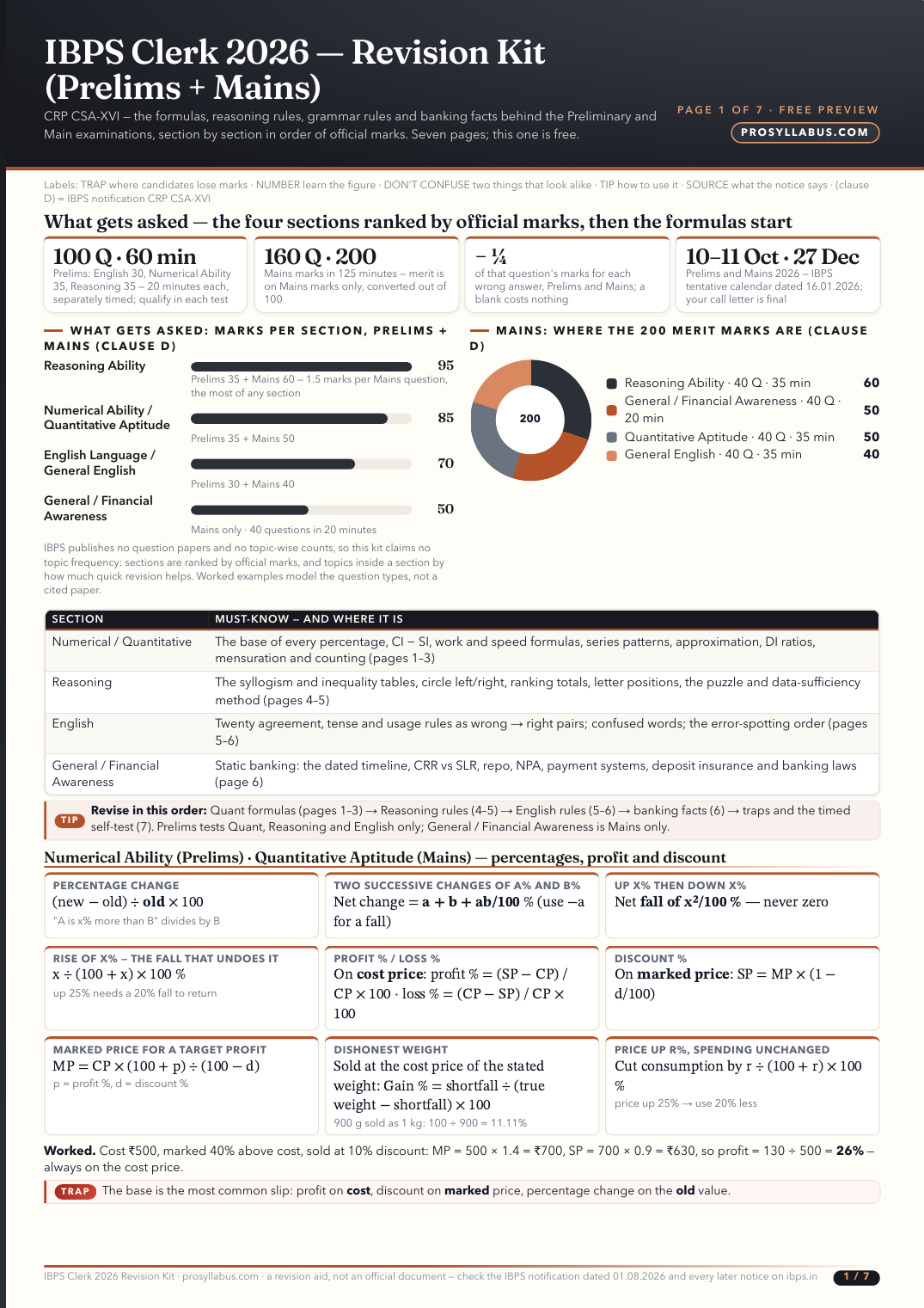
The tables, mock diagnostic and study method on this page are free. The separate IBPS Clerk revision kit is a condensed aid for rules, formulas and common traps. Check its first-page preview, exact contents and current price before deciding. ProSyllabus is independent of IBPS; a kit purchase is separate from quiz and membership access.
Preview the IBPS Clerk revision kitWhat this method cannot tell you
A mock score does not tell you the IBPS prelims cutoff, which is set after the test, nor whether you will be shortlisted. It also does not tell you a mains score out of 100 without the official conversion and normalisation process. The number of questions not answered correctly is an error inventory, not a probability of selection. Treat the tool’s suggested order as a first diagnosis, then use the cause labels and per-test qualifying rules to choose the next study block. When official information handouts or corrigenda appear, they outrank this page.
Does IBPS Clerk prelims score count for final allotment?
No. Under the CSA-XVI notification, prelims shortlists candidates for mains. Only marks obtained in the Online Main Examination are considered for final merit listing.
How many questions and minutes are in CSA-XVI mains?
The notified table has 160 questions, 200 marks and 125 minutes. The four tests are separately timed: General/Financial Awareness 20 minutes and the other three tests 35 minutes each.
What changed in IBPS Clerk mains Quantitative Aptitude?
CSA-XVI has 40 questions, 50 marks and 35 minutes. The previous CSA-XV table had 35 questions, 50 marks and 30 minutes. The exact internal marks split for XVI is not given in the detailed notification.
Can a strong total make up for a weak section?
The notification requires qualifying in each prelims test to reach mains. For mains it requires a minimum score in each test and a minimum total score before further consideration. Future cutoffs are not supplied here.
What is the penalty for a wrong answer?
The notification deducts one fourth of the marks assigned to the question. A blank has no penalty. In prelims each question is one mark, so a wrong answer costs 0.25; do not assume every mains question has one mark.
Is the diagnostic a cutoff predictor?
No. It computes raw corrected marks for a single prelims mock using your inputs and orders unresolved questions. IBPS sets its own cutoffs and normalises exam scores; the tool knows neither.
Is the revision kit included with a quiz or membership?
This guide makes no such promise. The kit has a separate offer page with a first-page preview, current contents and price; quiz and membership access are separate decisions.
Sources
- official — IBPS CRP CSA-XVI detailed notification, exam structure, penalty and merit clauses
- official — IBPS tentative calendar 2026–27, prelims and mains dates
- official — IBPS CRP CSA-XVI official updates page
official = a document published by the conducting body. reported = a news or coaching site we could not check against an original. Where sources disagree this page says so rather than picking one.
More in this series
- IBPS Clerk 2026 vacancies: 11,663 and will they grow?
- Mains scores that got an IBPS Clerk seat, by state
- IBPS Clerk Mains 2026: 160 questions, 125 minutes
- IBPS Clerk reserve list: how it works, state by state
- IBPS Clerk: choosing your state and the language rule
- IBPS Clerk vs SBI Clerk 2026
- IBPS Clerk notice board — official updates
- SBI Clerk 2026-27: two notifications