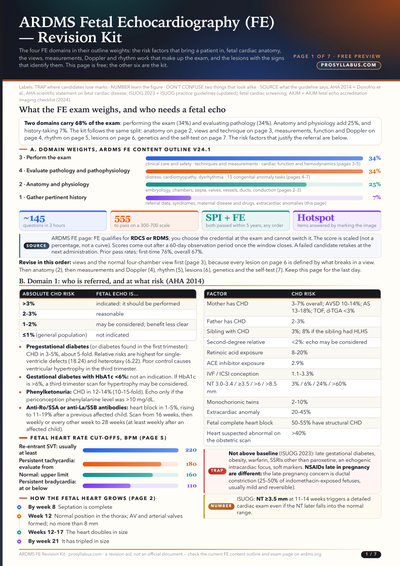

Updates as of September 22, 2026
The Fetal Echocardiography examination window is open now. Inteleos lists an application window of June 16 to August 25, 2026 and an examination administration window of September 8 to October 1, 2026, so candidates already approved have until 1 October to sit. Results are released 60 days after the examination window closes.
InteleosFE is a windowed rather than a fully on-demand exam: applications open in a defined period and testing is confined to a set administration window. The previous cycle ran with an application window of December 9, 2025 to February 17, 2026 and testing from March 3 to 26, 2026, which is the pattern published on the ARDMS FE page.
ARDMSThe examination fee is 300 US dollars, which includes a 100 US dollar non-refundable processing fee. Testing at an international test centre attracts an additional 50 US dollar non-refundable fee, and the official practice test is 45 US dollars. Scheduling is with Pearson VUE once the Examination Confirmation Letter has been issued.
ARDMSThe paper is approximately 145 questions in three hours and includes hotspot Advanced Item Type questions, where the candidate marks a location on an image rather than choosing from options. Scores are reported on a 300 to 700 scale and the pass mark is a scaled 555.
InteleosFE does not stand alone. ARDMS requires candidates to pass both the Sonography Principles and Instrumentation examination and the FE examination within five years of each other, in either order. Candidates also choose whether FE sits under the RDMS or the RDCS credential, and that choice cannot be changed once FE is passed.
ARDMSARDMS Fetal Echocardiography at a glance
| Item | Detail | Source |
|---|---|---|
| Questions and time | About 145 questions in 3 hours | Inteleos |
| Item types | Multiple choice plus hotspot Advanced Item Type questions on images | ARDMS |
| Pass mark | Scaled score of 555 on a 300 to 700 scale | ARDMS |
| Fee | 300 USD including a 100 USD non-refundable processing fee | ARDMS |
| Paired requirement | SPI and FE both passed within five years, either order | ARDMS |
| Results | Released 60 days after the examination window closes | Inteleos |
First-time applicants qualify through the ARDMS General Prerequisites, selected according to their education and clinical ultrasound experience; ARDMS provides a Prerequisite Prep tool to identify the right one, and physicians may apply under a physician-specific prerequisite through APCA. Clinical experience is evidenced on the FE Clinical Verification form. The current content is based on the FE Practice Analysis conducted in 2024. Inteleos reports first-time pass rates in the range of 65 to 82 per cent across recent administrations, with overall rates from 59 to 89 per cent.
Dates and windows
| What | When | Status |
|---|---|---|
| Application window for the current cycle | June 16 to August 25, 2026 | Closed |
| Examination administration window, current cycle | September 8 to October 1, 2026 | Confirmed |
| Booking a seat inside the open window | Through Pearson VUE, after the Examination Confirmation Letter | Rolling |
| Results for the September to October 2026 window | 60 days after the window closes, so about early December 2026 | Tentative |
| Previous cycle application window | December 9, 2025 to February 17, 2026 | Closed |
| Previous cycle examination window | March 3 to 26, 2026 | Closed |
| Next application and examination windows | Not yet listed on the ARDMS FE page reviewed here | Tentative |
The ARDMS FE page reviewed on 22 September 2026 still displayed the December to March cycle, while the Inteleos exam page carried the June to October 2026 cycle that is currently running. Where the two differ, check the Examination Confirmation Letter and the applicant's MY ARDMS account, which govern the actual eligibility period. The 60-day results estimate follows from the stated policy rather than from a published release date.
What this means for your preparation
The error that derails most FE candidates is treating it as a standalone credential. It is a specialty examination that only produces a credential when paired with SPI, and the two must be passed within five years of one another. The second error is planning around an on-demand model. FE is windowed: miss the application window and the next opportunity is a full cycle away, not a fortnight.
The five-year SPI clock runs in both directions
- Marks booster + cheatsheet: key concepts in 2 lines each, common traps
- 4 exam-outline domains, in their weights
- Biometry formulas, Doppler, the CVP score
- Exam traps collected before the test
- Standard views with settings, situs, axis
- Rhythm: rates, mechanisms, heart block, drugs
ARDMS requires the Sonography Principles and Instrumentation examination and FE to be passed within five years of each other, in either order. Candidates who passed SPI early in their career and then delayed the specialty exam can find the clock expiring before they sit FE; candidates who take FE first face the same constraint in reverse. Check the date SPI was passed before committing to an FE application window, because a lapse means retaking SPI, not merely resitting FE. Where the interval is tight, the sensible sequencing is to book the nearer exam into the current window rather than the cycle after it.
Hotspot items reward image reading, not recall
Alongside conventional multiple choice, FE uses hotspot Advanced Item Type questions in which the candidate marks a point on an image. These cannot be answered by elimination, which is the standard defence on a multiple-choice paper: either the structure is identified on the image or it is not. Preparation should therefore be weighted towards reviewing real fetal cardiac sweeps and still images and naming structures on them under time pressure, rather than towards reading descriptions of them. With roughly 145 questions in three hours, the working budget is about 75 seconds a question, which is enough to look properly at an image only if the anatomy is already fluent.
A scaled 555 is not a percentage
The pass mark is a scaled score of 555 on a 300 to 700 scale, not a raw percentage of questions answered correctly. Scaling exists so that forms of differing difficulty are equivalent, which means candidates cannot reason from a practice-test percentage straight to a pass or fail. The practical consequence is to avoid the common habit of aiming at a fixed raw target such as 75 per cent. Aim instead for consistent competence across the whole content domain, since the scaled outcome depends on performance across the full paper rather than on clearing a threshold in any one area.
Choosing RDMS or RDCS is a one-way decision
ARDMS lets candidates pursue FE under either the RDMS or the RDCS credential, and states the choice cannot be changed after the exam is passed. The decision should follow the practice setting and the employer's expectations rather than convenience at application time: a sonographer working in maternal-fetal medicine and general obstetrics is usually better served by RDMS, while a candidate whose wider work and other specialties sit in adult or paediatric cardiac imaging will find RDCS the more coherent credential. Resolve this before submitting the application, because correcting it afterwards means a further examination pathway rather than an administrative amendment.
Budget for the full cost and the 60-day wait
The headline fee is 300 US dollars including a 100 US dollar non-refundable processing component, with 50 US dollars more for an international test centre and 45 US dollars for the official practice test. Because 100 dollars of the fee is non-refundable, an application submitted before the clinical verification and prerequisite paperwork is settled risks losing that portion. Factor in the results timetable too: scores are released 60 days after the administration window closes, so a candidate testing in the September to October 2026 window should not expect an outcome until around early December, which matters where an employer has set a credentialling deadline.
Common questions
Frequently asked questions
When is the next ARDMS Fetal Echocardiography exam window?
The examination window currently running is September 8 to October 1, 2026, with the associated application window having run from June 16 to August 25, 2026. The preceding cycle applied from December 9, 2025 to February 17, 2026 and tested from March 3 to 26, 2026. The next pair of windows was not listed on the ARDMS FE page reviewed on 22 September 2026, so candidates should watch that page and their MY ARDMS account rather than assume the pattern repeats to the day.
How much does the FE exam cost?
The FE examination fee is 300 US dollars, of which 100 US dollars is a non-refundable processing fee. Candidates testing at an international test centre pay an additional 50 US dollars, also non-refundable. The official practice test is a separate 45 US dollars. Because a third of the headline fee is unrecoverable, it is worth confirming that prerequisites and clinical verification are in order before applying. Fees should be confirmed on the ARDMS page at the time of application.
What score do I need to pass the FE exam?
A scaled score of 555 or higher, on a reporting scale that runs from 300 to 700. Scaled scoring means the pass mark is not a fixed number of correct answers: forms of different difficulty are equated so that the standard is consistent between administrations. Results are released 60 days after the examination window closes. Inteleos reports first-time pass rates of roughly 65 to 82 per cent across recent administrations, with overall rates ranging from 59 to 89 per cent.
Do I have to pass SPI as well as FE?
Yes. ARDMS requires candidates to pass both the Sonography Principles and Instrumentation examination and the FE examination within five years of each other. The order does not matter, so SPI can be taken before or after FE, but the five-year interval is binding in both directions. Candidates who passed SPI some years ago should check the date before applying for an FE window, since letting the interval lapse means retaking SPI rather than simply resitting the specialty paper.
What does the FE exam look like on the day?
Approximately 145 questions across three hours. Most are multiple choice, but the paper also uses hotspot Advanced Item Type questions, where the candidate marks a location directly on an image to demonstrate practical identification rather than choosing from listed options. The content is built on the FE Practice Analysis conducted in 2024 and covers embryonic and fetal cardiac anatomy, physiology, clinical care and imaging technique. Appointments are booked through Pearson VUE once the Examination Confirmation Letter has been issued.
Who is eligible to apply for the FE exam?
First-time applicants qualify under the ARDMS General Prerequisites, chosen according to their education and clinical ultrasound experience; ARDMS publishes a Prerequisite Prep tool to help identify the correct one, and clinical experience is documented on the FE Clinical Verification form. Physicians may apply under a physician-specific prerequisite offered through APCA. Applicants must also decide whether to pursue FE under the RDMS or the RDCS credential, a choice that ARDMS states cannot be changed once the examination has been passed.