
Checked 29 September 2026. From the FE, OB/GYN, PE and SPI exam pages, their v24.1 content outlines, the RDMS and RDCS pages, the 2026 exam calendar and fee schedule, Inteleos's Global Exam Performance Summary PDFs (2013–2025) and CCI's RCCS page.
Sonographers who scan fetal hearts usually weigh three ARDMS specialties: Fetal Echocardiography (FE), Obstetrics and Gynecology (OB/GYN) and Pediatric Echocardiography (PE). They are not interchangeable. FE is the only one that counts toward both RDMS and RDCS; OB/GYN tests the fetal heart as one part of a much wider obstetric exam; PE covers children's hearts after birth and names no fetal content at all. This guide compares them on ARDMS's own figures, adds CCI's RCCS as the non-ARDMS congenital option, and gives a picker that applies the credential rules before anything else. ProSyllabus is an independent study site. We are not affiliated with, or endorsed by, ARDMS or Inteleos; every rule below is quoted or summarised from their published pages, and ARDMS decides every application.
FE, OB/GYN and PE exam pages; RDMS and RDCS pages.
FE, OB/GYN or Pediatric Echo: which fits your goal?
Three questions. The picker applies the hard rules first — which specialties count toward which credential — and only then matches your work.
Our reading of ARDMS's credential rules and content outlines; not advice from ARDMS. Every route must meet an ARDMS prerequisite pathway; the documents needed, including whether a Clinical Verification form is required, depend on the pathway and its timing.
The three ARDMS specialties and CCI's RCCS, side by side
| Feature | FE | OB/GYN | PE | CCI RCCS |
|---|---|---|---|---|
| Credential | RDMS (FE) or RDCS (FE) | RDMS (OB/GYN) | RDCS (PE) | RCCS |
| SPI also needed | Yes, 5-year rule | Yes, 5-year rule | Yes, 5-year rule | No SPI; standalone |
| Questions / time | ~145 / 3 h | ~170 / 3 h | ~145 / 3 h | 170 (150 scored, 20 unscored) / 3 h |
| Item types | Multiple choice, hotspot | Multiple choice, hotspot | Multiple choice, hotspot | Multiple choice, multiple response, hot spot, drag and place |
| When (2026) | Windows 3–26 Mar, 8 Sep – 1 Oct | Year-round | Windows 7–30 Apr, 13 Oct – 5 Nov | Year-round |
| Result | ~60 days after the window | At the test centre; portal within a week | ~60 days after the window | Unofficial report at the centre |
| If you fail | Next administration | Reapply after 3 days, retest after 60 | Next administration | Not checked |
| Fee (USD) | 300 (+50 international) | 300 (+50 international) | 300 (+50 international) | 365, including 100 non-refundable |
| Scale / pass | 300–700 / 555 | 300–700 / 555 | 300–700 / 555 | 0–900 / 650 |
| Pass rate 2025, first-time / overall | 75% / 68% | 80% / 75% | 66% / 59% | Not found |
ARDMS columns from the FE, OB/GYN and PE exam pages, the 2026 calendar and fee schedule, and the 2025 Global Exam Performance Summary; the RCCS column from CCI's own page. We did not check CCI's retake rule, and CCI's page does not mention fetal content.
What each outline weights
| Exam | Domains and weights (v24.1) |
|---|---|
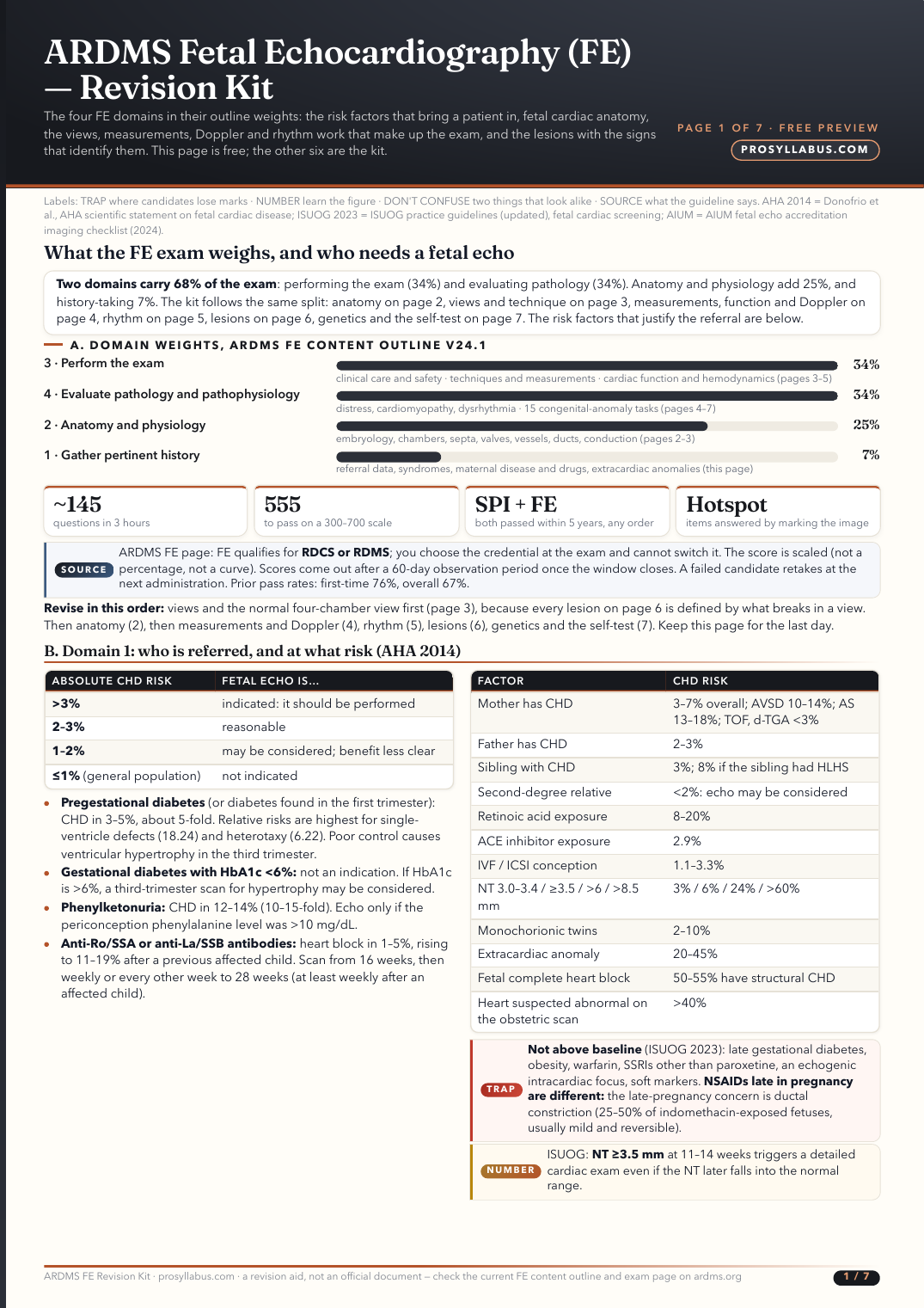
| FE | Medical history 7%, anatomy and physiology 25%, perform the exam 34%, pathology and pathophysiology 34% |
| OB/GYN | Gynecology 19%, first trimester 12%, second/third trimester 37%, protocols and procedures 24%, physics and instrumentation 8% |
| PE | Normal anatomy and physiology 15%, acquired heart disease 12%, congenital anomalies 25%, postoperative anatomy 19%, performing the exam 29% |
Official v24.1 weights, from the table above. Colours mark domain order within each exam, not the same topic across exams.
The weights show three different jobs. FE is the fetal heart from end to end: history that predicts findings, normal fetal cardiac anatomy, the views and measurements, function and Doppler, and fifteen named groups of congenital anomalies. OB/GYN is the whole pregnancy and the pelvis, of which the fetal heart is a slice. PE is the child's heart after birth, including postoperative anatomy at 19% — surgically corrected or palliated hearts — which a fetal sonographer rarely scans.
How much fetal heart is inside OB/GYN
| OB/GYN v24.1 task | What it names | FE covers it in |
|---|---|---|
| 3.A.8 Assess the fetal heart | Size, position, axis, chambers, valves, four-chamber view, LVOT, RVOT, aortic arch, ductal arch, three vessel view (3VV) and three-vessel trachea (3VT) view | 2.A.5–2.A.12, 3.B.4–3.B.6 |
| 3.B.8 Evaluate for abnormal fetal heart | Atrial and ventricular septal defects, AV canal defect, tetralogy of Fallot, transposition of the great vessels, pentalogy of Cantrell, pericardial effusion, rhabdomyoma | 4.B.4–4.B.15 |
| 3.A.4 and 5.B.1 | Fetal lie, presentation and situs; embryonic or fetal heart rate and rhythm with M-mode or cine clip | In more depth: situs by the Cordes method, M-mode, dysrhythmias |
| Not named in OB/GYN | Cordes method, mechanical PR interval, CT ratio, heterotaxy, pulmonary venous anomalies, cardiomyopathies, dysrhythmias | 3.B.3, 3.C.7, 3.B.9, 4.B.3, 4.B.9, 4.A.2–4.A.3 |
Task text from the OB/GYN and FE v24.1 outlines; the right-hand column is our mapping. Both OB/GYN tasks sit inside its 37% second/third-trimester domain, alongside the rest of fetal anatomy.
So OB/GYN does examine the fetal heart — the screening views and the headline defects — and it asks for basic situs (3.A.4) and heart rate and rhythm by M-mode or cine clip (5.B.1). The depth stops where FE starts: visceral-atrial situs by the Cordes method, the mechanical PR interval and named dysrhythmias, function and haemodynamics, and the long tail of anomalies. If your work is a general obstetric list with fetal-heart screening, OB/GYN matches it. If you are the person the screening scan gets referred to, FE is the exam that describes your job.
Pass rates for the three specialties, 2013–2025
Official figures. 2013–2021 from the exam pages, which match Inteleos's Global Exam Performance Summary PDFs (2017 appears on the exam pages only); 2022–2025 from the Performance Summary PDFs, because the exam pages print different 2022 and 2023 figures (listed below).
| Year | FE first / overall | OB/GYN first / overall | PE first / overall |
|---|---|---|---|
| 2013 | 75% / 72% | 80% / 74% | 71% / 65% |
| 2014 | 78% / 74% | 80% / 74% | 68% / 66% |
| 2015 | 75% / 69% | 79% / 72% | 63% / 55% |
| 2016 | 79% / 73% | 79% / 73% | 67% / 58% |
| 2017 | 76% / 67% | 79% / 72% | 72% / 64% |
| 2018 | 65% / 59% | 81% / 75% | 74% / 65% |
| 2019 | 77% / 70% | 81% / 76% | 72% / 68% |
| 2020 | 76% / 73% | 84% / 79% | 80% / 75% |
| 2021 | 76% / 70% | 79% / 73% | 74% / 64% |
| 2022 | 75% / 71% | 77% / 72% | 79% / 71% |
| 2023 | 81% / 76% | 78% / 74% | 88% / 80% |
| 2024 | 77% / 71% | 82% / 78% | 80% / 75% |
| 2025 | 75% / 68% | 80% / 75% | 66% / 59% |
Official rates; the ranges are our reading. Across 2013–2025 OB/GYN has been the steadiest (77–84% first-time); PE has ranged most widely (63–88%); FE ranged 65–81% first-time and 59–76% overall. The 2025 summary adds repeat-taker rates: FE 41%, OB/GYN 50%, PE 36%.
| Year | Exam | Exam page | Performance Summary PDF |
|---|---|---|---|
| 2022 | FE | 74 / 71 | 75 / 71 |
| 2022 | PE | 78 / 71 | 79 / 71 |
| 2023 | FE | 82 / 89 | 81 / 76 |
| 2023 | OB/GYN | 79 / 74 | 78 / 74 |
| 2023 | PE | 88 / 72 | 88 / 80 |
Inteleos's exam pages and its Performance Summary PDFs print different 2022 and 2023 figures for these exams; both are official, so we show both and chart the PDFs. Candidate counts appear only in older summaries — in 2018, 349 first-time FE candidates, 3,300 OB/GYN and 215 PE — so FE and PE rates move on small numbers and are not difficulty rankings.
RDMS or RDCS: the choice FE makes you take
| Credential | Specialties that count (with SPI) |
|---|---|
| RDMS | Abdomen, Breast, Fetal Echocardiography, OB/GYN, Pediatric Sonography |
| RDCS | Adult Echocardiography, Fetal Echocardiography, Pediatric Echocardiography |
| FE-certified population split (practice analysis) | RDMS 62%, RDCS 38% |
| New specialty under a certification you hold | No 5-year clock; 15 CME credits waived |
From the RDMS and RDCS certification pages. FE is the only specialty in both lists.
ARDMS: "You must choose your certification when you take the exam. It cannot be switched." In ARDMS's practice analysis, the FE-certified population was 62% RDMS and 38% RDCS, so both are common. A reasonable rule of thumb: stay in the family you already hold, because a new specialty under an existing certification carries no 5-year clock and earns a 15-credit CME waiver. If you hold nothing yet, pick the family of the next specialty you expect to add — OB/GYN points to RDMS; Adult or Pediatric Echo points to RDCS. One copy error to ignore: the RDCS page's blurb for Pediatric Echocardiography describes the Pediatric Sonography exam; the PE page itself describes cardiac anatomy, function and pathology in children.
Where CCI's RCCS fits
The Registered Congenital Cardiac Sonographer (RCCS) from Cardiovascular Credentialing International is a separate credential "for professionals working in the area of pediatric and adult congenital cardiac ultrasound". It needs no SPI, runs year-round at Pearson centres, costs USD 365, and scores on a 0–900 scale with 650 to pass. Its eligibility routes include one year of cardiac ultrasound work with 600 studies, or (RCCS6) active ultrasound credential holders with six months of full-time or full-time-equivalent adult congenital or pediatric cardiac ultrasound work and at least 100 adult congenital or pediatric studies. It is not an ARDMS credential, but an active RCCS is one of the credentials that qualifies you for ARDMS exams through Pathway 5. CCI's page does not mention fetal echo, so for a fetal-heart role FE is the credential that names the work.
| RCCS fact | Value |
|---|---|
| Exam | 170 questions (150 scored, 20 unscored), 3 hours |
| Fee | USD 365, including USD 100 non-refundable |
| Scale / pass | 0–900 / 650 |
| First renewal | USD 165, no CEU requirement; then every three years |
| Eligibility examples | One year of cardiac ultrasound with 600 studies; or (RCCS6) active ultrasound credential holders with six months full-time or FTE adult congenital or pediatric cardiac ultrasound and at least 100 adult congenital or pediatric studies |
| Link to ARDMS | An active RCCS qualifies you for ARDMS exams under Pathway 5 |
From CCI's RCCS page and ARDMS's prerequisites (Final 08-2026).
Is FE part of RDMS or RDCS?
Both. FE is the only ARDMS specialty that counts toward RDMS and RDCS; you choose one when you take the exam and cannot switch.
Does the OB/GYN exam include the fetal heart?
Yes. OB/GYN task 3.A.8 names the fetal heart views including LVOT, RVOT, 3VV and 3VT, and 3.B.8 names septal defects, AV canal, tetralogy of Fallot, transposition, pentalogy of Cantrell, pericardial effusion and rhabdomyoma.
Does Pediatric Echocardiography cover fetal echo?
No fetal content is named in the PE v24.1 outline. PE covers normal anatomy, acquired disease, congenital anomalies, postoperative anatomy and performing the exam in children.
Which is longer, FE or OB/GYN?
Both are 3 hours. OB/GYN has about 170 questions and FE about 145.
Are FE, OB/GYN and PE the same price?
Yes, USD 300 each, plus USD 50 at a centre outside the US, Canada or Mexico.
Which has the higher pass rate?
In 2025, the latest year Inteleos has published, first-time rates were FE 75%, OB/GYN 80% and PE 66% (overall 68%, 75%, 59%). Populations differ in size, so these are not difficulty rankings.
Should I choose RDMS or RDCS for FE?
ARDMS leaves it to you. Adding FE under a certification you already hold avoids the 5-year clock and earns a 15-credit CME waiver.
Is CCI RCCS the same as ARDMS FE?
No. RCCS is CCI's congenital cardiac credential, needs no SPI and scores 0-900 with 650 to pass. Its page does not mention fetal echo.
Can I take OB/GYN any time?
Yes, OB/GYN is year-round with the result at the test centre. FE and PE run in windows.
Sources
- official — Inteleos / ARDMS — Fetal Echocardiography (FE) exam page (windows, fee, format, scoring, pass rates)
- official — Inteleos / ARDMS — Obstetrics and Gynecology (OB/GYN) exam page
- official — Inteleos / ARDMS — Pediatric Echocardiography (PE) exam page
- official — ARDMS — Fetal Echocardiography Examination Content Outline v24.1 (PDF)
- official — ARDMS — OB/GYN Examination Content Outline v24.1 (PDF)
- official — ARDMS — PE Examination Content Outline v24.1 (PDF)
- official — Inteleos — Registered Diagnostic Medical Sonographer (RDMS)
- official — Inteleos — Registered Diagnostic Cardiac Sonographer (RDCS)
- official — Inteleos — Exam Calendar 2026 (PDF)
- official — Inteleos — Exam Fee Schedule (PDF)
- official — Inteleos — Retake and reapply guidelines
- official — Inteleos — Continuing Medical Education
- official — ARDMS — Fetal Echocardiography Practice Analysis Detailed Report, approved 24 April 2024 (PDF)
- official — ARDMS — SPI Requirement & Specialty Examination Prerequisites, Final 08-2026 (PDF)
- official — Inteleos — Exam Statistics page and Global Exam Performance Summary reports, 2013–2025 (PDFs)
- official — CCI — Registered Congenital Cardiac Sonographer (RCCS)
official = a document published by the conducting body. reported = a news or coaching site we could not check against an original. Where sources disagree this page says so rather than picking one.