
Checked 29 September 2026. From ARDMS's FE Content Outline v24.1 and the FE Practice Analysis approved on 24 April 2024. ARDMS re-runs a practice analysis every few years; check the outline version on the FE exam page before you plan.
The ARDMS Fetal Echocardiography (FE) exam is written to a published blueprint, the FE Content Outline v24.1. It has four domains weighted 7%, 25%, 34% and 34%, and it came out of a practice analysis that ARDMS's council approved on 24 April 2024. Several prep sites still print the weights of the outline it replaced, so the first job of this guide is to set the record straight. Then it lists every task code with the importance score practising fetal echo sonographers gave it, turns the weights into an approximate item count for a ~145-question exam, and gives you a way to split your study hours. ProSyllabus is an independent study site. We are not affiliated with, or endorsed by, ARDMS or Inteleos; every rule below is quoted or summarised from their published pages, and ARDMS decides every application.
FE exam page and FE Content Outline v24.1.
Where other pages get this wrong
The current FE weights are history 7%, anatomy and physiology 25%, perform the exam 34%, pathology 34%.
Commonly published instead: "Integrate Data 31%, Perform the Exam 30%, Evaluate Pathology 21%, Assess Anatomy 18%" (a prep site page).
Those four figures come from the pre-2024 outline (as printed on the prep site; we did not obtain the old outline document itself). ARDMS's v24.1 outline prints 7/25/34/34 under different domain names, and the 2024 redesign moved tasks between domains, so the old and new domains cannot be matched one to one. One naming detail causes the confusion: the practice-analysis survey still labelled its working Domain 1 "Integrate Data" before the panel renamed it "Gather pertinent medical history prior to the exam". That is a survey label, not evidence that the old 31% domain became today's 7% one.
| Older outline domain (prep site, reported) | Older weight (reported) | v24.1 domain (official) | v24.1 weight (official) |
|---|---|---|---|
| Integrate Data | 31% | 1. Gather pertinent medical history prior to exam | 7% |
| Perform the Exam | 30% | 2. Anatomy and Physiology | 25% |
| Evaluate Pathology | 21% | 3. Perform the exam | 34% |
| Assess Anatomy | 18% | 4. Evaluate pathology and pathophysiology | 34% |
The two lists sit side by side for reference only: a row does not mean the old domain on the left became the new domain on the right. Plan from the v24.1 column.
The four domains, their weights and roughly how many items
| Domain | Weight (official) | Task codes in v24.1 | About this many of ~145 items (ours) |
|---|---|---|---|
| 1. Gather pertinent medical history prior to exam | 7% | 4 | 10 |
| 2. Anatomy and Physiology | 25% | 15 | 36 |
| 3. Perform the exam | 34% | 19 | 49 |
| 4. Evaluate pathology and pathophysiology | 34% | 18 | 49 |
Weights and task codes are ARDMS's. The item column is our arithmetic (weight × 145, rounded down, because ARDMS itself says "approximately 145"). ARDMS publishes no per-domain item count and no weights for the subdomains inside Domains 3 and 4.
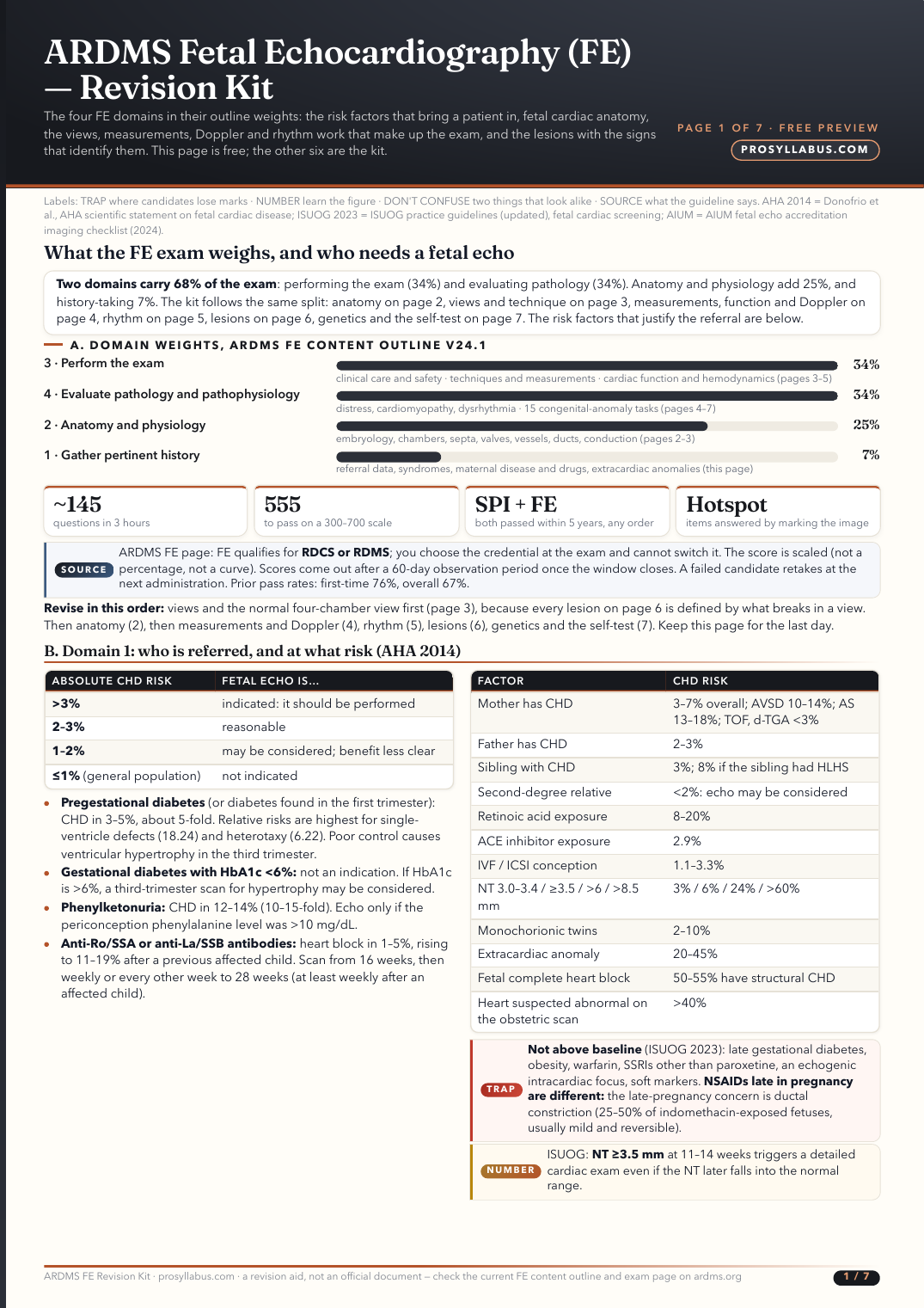
Official weights. Domains 3 and 4 together are 68% of the exam: performing the exam and evaluating pathology.
Read the weights as a statement about what the exam is for. Two thirds of it asks what you do with the probe and what you see when a heart is abnormal. Anatomy and physiology is a quarter, and medical history — referral information, genetic results, maternal disease and drugs, extracardiac anomalies — is a small but real 7%. Domain 3 splits into three subdomains: 3.A Clinical care and safety (2 tasks), 3.B Exam techniques and measurements (10) and 3.C Fetal cardiac function and haemodynamics (7). Domain 4 has 4.A Abnormal physiology and perfusion (3) and 4.B Congenital anomalies (15).
Where the outline came from: the 2023–24 practice analysis
| Step | Date |
|---|---|
| Review of the existing outline (FE Assessment Committee) | 15 June 2023 |
| Expert panel meeting, in person | 15–16 September 2023 |
| Field survey open (random sample of 1,500 FE-certified registrants; 195 completed the task inventory) | 30 October – 12 November 2023 |
| Final task and domain weighting call | 24 January 2024 |
| Approved by the ARDMS Council | 24 April 2024 |
All dates from the FE Practice Analysis Detailed Report. Survey respondents rated each task from 1 (not important at all) to 5 (absolutely essential); ARDMS summed the mean scores within each domain to get the weights. The survey's own weights were 7/25/35/33; after the panel removed one task the final figures became 7/25/34/34.
Two details from that report are worth knowing. First, the panel removed one task — "Practice universal infection control precautions", rated 4.61 — with the comment "It has been covered in SPI". Infection control is still examinable; it simply lives on the physics and instrumentation exam now. Second, 75% of 2023 respondents said FE certification was a requirement for their job, against 50% in the 2016 survey. Those are practitioners' answers, not a hiring statistic, but they show why sonographers take the exam.
| Practice analysis figure | Value |
|---|---|
| Survey weights before panel review | 7% / 25% / 35% / 33% |
| Final weights (v24.1) | 7% / 25% / 34% / 34% |
| Tasks surveyed | 56 |
| Task removed ("Practice universal infection control precautions"), importance score | 4.61 — "covered in SPI" |
| Tasks kept after the infection-control task moved to SPI | 55 |
| Task codes printed in the v24.1 outline (after "Identify outflows" was split into its own task) | 56 |
| FE-certified population (registrants, excluding physicians) | 3,433 |
| Population credential split | RDMS 62%, RDCS 38% |
| International share of the population | 3% |
| Said FE was required for their job (2023 / 2016) | 75% / 50% |
Where the counts disagree, both are printed. The report's Table 2 counts 55 tasks with 14 under Anatomy and Physiology; the outline students download lists 15 codes under Domain 2 (2.A.1–2.A.15) because the panel asked for "outflows" to become its own task. The report also calls its sample "RDCS Sonographer registrants" on one page and "RDMSs and RDCSs" on another; its own population table shows both credentials. Use the outline for task codes and the report for weights.
Every task, with the importance score practitioners gave it
| Code (v24.1) | Task (condensed) | Importance, 1–5 (practice analysis) | Note |
|---|---|---|---|
| 1.A.1 | Review referral information, genetic results, prior studies, risk factors | 4.73 | — |
| 1.A.2 | Correlate genetic syndromes and chromosomal anomalies with findings | 4.70 | — |
| 1.A.3 | Correlate maternal disease and drug exposure (maternal CHD, lupus, diabetes, indomethacin) | 4.71 | — |
| 1.A.4 | Correlate extracardiac anomalies (CHARGE, VACTERL) | 4.63 | — |
| 2.A.1 | Understand normal embryologic development | 3.94 | yellow |
| 2.A.2 | Identify abdominal/pelvic structures (IVC, ductus venosus, hepatic veins, stomach, bladder, spleen) | 4.96 | — |
| 2.A.3 | Identify chest/thorax structures (lungs, oesophagus, trachea, thymus, diaphragm) | 4.90 | — |
| 2.A.4 | Distinguish tissues of the heart (pericardium, myocardium) | 4.74 | — |
| 2.A.5 | Identify normal chamber morphology and position | 4.71 | — |
| 2.A.6 | Identify septa (atrial, ventricular, arterial) | 4.12 | — |
| 2.A.7 | Identify normal atrioventricular and semilunar valve morphology | 4.75 | — |
| 2.A.8 | Identify systemic veins and arteries | 4.71 | surveyed with outflows |
| 2.A.9 | Identify outflows | 4.71 | split out by the panel |
| 2.A.10 | Identify pulmonary veins and arteries | 4.32 | — |
| 2.A.11 | Identify aortic arch | 4.96 | — |
| 2.A.12 | Identify ductus arteriosus | 4.97 | highest |
| 2.A.13 | Identify ductus venosus | 4.85 | — |
| 2.A.14 | Identify umbilical vein and arteries | 4.95 | — |
| 2.A.15 | Understand the fetal cardiac conduction system (SA node, AV node) | 4.93 | — |
| 3.A.1 | Recognise and report fetal critical findings (sustained brady/tachycardia, demise, hydrops, anhydramnios) | 4.90 | — |
| 3.A.2 | Monitor and adjust exam for maternal symptoms (supine hypotensive disorder, severe headache, vomiting) | 4.38 | reworded |
| 3.B.1 | Select transducer and console settings | 4.67 | — |
| 3.B.2 | Evaluate multiple gestations and cardiac complications (TTTS) | 4.42 | — |
| 3.B.3 | Determine visceral-atrial situs (Cordes and other methods) | 4.77 | — |
| 3.B.4 | Evaluate and obtain standard cardiac views | 4.76 | examples removed |
| 3.B.5 | Obtain standard views of great vessels (branch PAs, systemic and pulmonary veins, aortic and ductal arches) | 4.94 | — |
| 3.B.6 | Determine orientation and relationship of the great vessels | 4.94 | — |
| 3.B.7 | Measure chamber size with 2D and M-mode | 4.95 | — |
| 3.B.8 | Measure cardiac valves and great vessels | 4.23 | — |
| 3.B.9 | Measure cardiothoracic (CT) ratio | 4.54 | — |
| 3.B.10 | Fetal biometry (BPD, HC, AC, FL) | 4.30 | — |
| 3.C.1 | Assess ventricular function | 3.90 | yellow, lowest |
| 3.C.2 | Assess AV and semilunar valve function with colour and spectral Doppler | 4.73 | — |
| 3.C.3 | Assess fetal heart rate and rhythm with Doppler and M-mode | 4.83 | — |
| 3.C.4 | Doppler of MCA, umbilical arteries, umbilical vein, ductus venosus | 4.42 | — |
| 3.C.5 | Doppler of pulmonary and systemic veins | 4.64 | — |
| 3.C.6 | Doppler of pulmonary and systemic arteries | 4.63 | — |
| 3.C.7 | Assess mechanical PR intervals | 4.11 | — |
| 4.A.1 | Recognise signs of fetal distress (fluid collections, cardiomegaly, haemodynamics) | 4.90 | — |
| 4.A.2 | Evaluate for fetal cardiomyopathies | 4.84 | — |
| 4.A.3 | Evaluate for fetal dysrhythmias | 4.85 | — |
| 4.B.1 | Abnormalities of genetic syndromes (trisomy 21, Noonan, monosomy X, 22q11 deletion) | 4.78 | — |
| 4.B.2 | Cardiac malpositioning | 4.89 | — |
| 4.B.3 | Heterotaxy syndromes | 4.78 | — |
| 4.B.4 | Cardiac septal defects | 4.61 | — |
| 4.B.5 | Left-sided cardiac anomalies | 4.83 | — |
| 4.B.6 | Right-sided cardiac anomalies | 4.75 | — |
| 4.B.7 | Conotruncal anomalies | 4.84 | — |
| 4.B.8 | Systemic venous anomalies | 4.88 | — |
| 4.B.9 | Pulmonary venous anomalies | 4.84 | — |
| 4.B.10 | Aortic arch anomalies | 4.87 | — |
| 4.B.11 | Ductus arteriosus abnormalities | 4.88 | — |
| 4.B.12 | Ductus venosus anomalies | 4.90 | — |
| 4.B.13 | Congenital cardiac masses | 4.91 | — |
| 4.B.14 | Cardiac changes with thoracic anomalies | 4.80 | — |
| 4.B.15 | Abnormal blood flow across valves and vessels | 4.82 | — |
Task wording condensed from the v24.1 outline; scores are the mean ratings in Appendix E of the practice analysis, matched to the v24.1 codes by us. The survey numbered some Domain 2 and 3 tasks differently: 2.A.8 and 2.A.9 share one score because they were surveyed as a single task, and 3.A.1–3.A.2 were 3.A.2–3.A.3 on the survey. "Yellow" is ARDMS's label for a score between 3 and 4; no task scored below 3.
From the task table above. The two amber bars are the only "yellow" tasks; ARDMS kept both.
Do not over-read the scores. A task rated 3.9 is still on the exam, and the scores measure how essential surveyed practitioners find a task, not how many questions it gets; ARDMS publishes no task-level weighting or question count. What they do show is what practising fetal echo sonographers rated most essential: structure identification (ductus arteriosus, aortic arch, umbilical vessels), standard views of the great vessels and their relationships, chamber measurements, and the congenital anomalies in 4.B. Ventricular function and embryology scored lowest, but embryology is also named in the outline's list of foundational knowledge ("Knowledge of fetal embryology"), so a candidate who skips it is gambling.
The named methods and measurements to have cold
Named in the v24.1 outline — each is fair game
- Cordes method and "other methods" for visceral-atrial situs (3.B.3).
- Cardiothoracic (CT) ratio (3.B.9) and chamber size by 2D and M-mode (3.B.7).
- Mechanical PR interval (3.C.7) and heart rate and rhythm by Doppler and M-mode (3.C.3).
- Doppler of the MCA, umbilical arteries, umbilical vein and ductus venosus (3.C.4).
- Fetal biometry — BPD, HC, AC, FL (3.B.10). It is listed in the outline, so it is examinable even if your daily work is echo only.
- Twin-to-twin transfusion syndrome and multiple gestations (3.B.2).
- Supine hypotensive disorder and other maternal symptoms that change the exam (3.A.2).
- CHARGE and VACTERL (1.A.4); trisomy 21, Noonan, monosomy X, 22q11 deletion (4.B.1); maternal lupus, diabetes, indomethacin (1.A.3).
From the FE Content Outline v24.1. The final outline dropped the survey's list of example views (bicaval, four-chamber, short axis, outflow tracts, three-vessel-trachea) from 3.B.4 and now just says "standard cardiac views".
Pacing ~145 items in three hours, including hotspots
| Pacing figure | Value |
|---|---|
| Questions | approximately 145 (official) |
| Time | 3 hours = 180 minutes = 10,800 seconds (official) |
| Average per item | about 74 seconds (ours: 10,800 ÷ 145 = 74.5) |
| Checkpoint at the half-way item (73) | about 90 minutes in (ours) |
| Item types | multiple choice; hotspot — "answer questions about individual images by marking directly on them" (official) |
| Hotspot count, unscored items | not published by ARDMS |
| Scale and passing score | 300 to 700; 555 passes; not percentage or curve-based (official) |
| Passing standard method | Modified Angoff and Bookmark, re-evaluated about every five years (official) |
A hotspot asks you to click the structure or abnormality on an image, so the skill it tests is image recognition under time pressure. Pearson VUE hosts a free Inteleos (ARDMS/APCA) tutorial of the test interface, which is the safest way to try the hotspot mechanics before exam day. It is a tutorial, not a practice exam.
Split your study hours by the official weights
Enter the total hours you can give the FE exam before your window. The tool shares them across the four domains at the v24.1 weights (7, 25, 34, 34 per cent) in whole hours that add up to your total.
Our arithmetic on ARDMS's published weights. Weighting hours by exam share is a starting point, not an ARDMS recommendation: move hours toward the domains where your own scanning is thinnest.
| Total hours | Domain 1 (7%) | Domain 2 (25%) | Domain 3 (34%) | Domain 4 (34%) |
|---|---|---|---|---|
| 60 | 4 | 15 | 21 | 20 |
| 120 | 8 | 30 | 41 | 41 |
| 200 | 14 | 50 | 68 | 68 |
Our arithmetic, the same largest-remainder split the tool uses, for readers whose browser does not run the tool.
A practical order for the syllabus
Because FE is windowed, most candidates have a fixed date months ahead. A sensible order follows the dependencies in the outline. Start with Domain 2 — normal anatomy, septa, valves, the venous and arterial connections, the ducts, the conduction system — because every abnormal finding in Domain 4 is defined against it. Move to Domain 3: situs, the standard views, great-vessel orientation and the measurements, then function and Doppler. Take Domain 4 in anatomical groups that mirror the outline (septal, left-sided, right-sided, conotruncal, venous, arch, ducts, masses), linking each lesion to the view that shows it. Finish with Domain 1, which asks you to connect history to expected findings and is easiest once the lesions are familiar. The tracker below holds every code so you can tick them off.
FE v24.1 task tracker
Tick each task once you can explain it and recognise it on an image.
0 of 56 done
Ticks are saved only in this browser on this device.
ProSyllabus has no FE practice quizzes yet, so this guide does not point you to any. The outline, the practice analysis and the Pearson VUE tutorial are the official materials; everything else, including paid question banks, is third-party.
What are the ARDMS FE exam domain weights?
In the v24.1 outline: gather pertinent medical history 7%, anatomy and physiology 25%, perform the exam 34%, evaluate pathology and pathophysiology 34%.
Why do some sites say Integrate Data is 31%?
Those are the pre-2024 weights (18/21/31/30, as printed on a prep site). The 2024 redesign moved tasks between domains, so the old Integrate Data domain does not map one to one onto any current domain. Plan from v24.1: 7/25/34/34.
How many questions are on the FE exam?
ARDMS says approximately 145 questions in 3 hours, multiple choice and hotspot. That is about 74 seconds an item on our arithmetic.
How many tasks are in the FE content outline?
The v24.1 outline prints 56 task codes. The practice analysis counts 55 because it was written before "Identify outflows" was split into its own task.
Is infection control on the FE exam?
The panel removed the infection-control task from FE because it is covered in the SPI content outline. SPI is normally the physics requirement for RDMS or RDCS; candidates who have already met it do not retake it, and ARDMS accepts a Sonography Canada Core Examination (5.1, 6.0 or 6.1) passed within the last 5 years in place of SPI for eligible Sonography Canada members.
What is a hotspot question?
ARDMS describes it as answering questions about individual images by marking directly on them. Pearson VUE's free Inteleos tutorial shows the interface.
Does ARDMS publish how many questions come from each domain?
No. It publishes percentage weights only. Our item counts (about 10, 36, 49 and 49) are arithmetic on those weights.
When was the current FE outline approved?
The practice analysis behind v24.1 was approved by the ARDMS Council on 24 April 2024, after a survey run from 30 October to 12 November 2023.
Is the FE exam graded as a percentage?
No. Scores run from 300 to 700 and 555 passes; ARDMS says scores are not percentage or curve-based.
Does ProSyllabus have FE practice questions?
Not yet. When a library goes live it will be linked from the FE exam page on ProSyllabus.
Sources
- official — ARDMS — Fetal Echocardiography Examination Content Outline v24.1 (PDF)
- official — ARDMS — Fetal Echocardiography Practice Analysis Detailed Report, approved 24 April 2024 (PDF)
- official — Inteleos / ARDMS — Fetal Echocardiography (FE) exam page (windows, fee, format, scoring, pass rates)
- official — Inteleos — Passing Standard
- official — Pearson VUE — Inteleos (ARDMS/APCA) tutorial
- official — Inteleos — Sonography Canada and ARDMS partnership (Core Examination 5.1, 6.0 or 6.1 in place of SPI for BR, FE, PS, PE, MSKS)
- reported — Prepry — Fetal Echo exam guide (reported; see corrections)
official = a document published by the conducting body. reported = a news or coaching site we could not check against an original. Where sources disagree this page says so rather than picking one.