Exam Paper Review
CBSE Class 10 Maths
Paper Analysis — Feb 17, 2026
Complete breakdown of what was asked, difficulty level, student reactions, and expert analysis of today's board exam.
📄 80 Marks · 38 Questions
⏱ 10:30 AM – 1:30 PM
🎯 Standard & Basic
📅 February 17, 2026
⚖️
Overall Difficulty
Moderate
Standard Paper
Easy
Basic Paper
Sec E
Toughest Section
Section 01
Exam Overview — What Happened
The CBSE Class 10 Mathematics board exam 2026 was conducted on February 17, 2026, from 10:30 AM to 1:30 PM at centres across India and abroad. Both Standard (041) and Basic (241) papers were held simultaneously in the morning shift. Students were given 15 minutes of reading time before the exam officially began.
This was a historic exam — the first time CBSE board exams are being held twice in the same academic year, with a Phase 2 scheduled from May 15 to June 1, 2026. The paper covered all 5 sections (A to E) with a total of 38 questions worth 80 marks.
This was a historic exam — the first time CBSE board exams are being held twice in the same academic year, with a Phase 2 scheduled from May 15 to June 1, 2026. The paper covered all 5 sections (A to E) with a total of 38 questions worth 80 marks.
😌
Basic Paper
Straightforward, balanced, NCERT-direct. Most students comfortable.
🤔
Standard Paper
Moderate. MCQs were lengthy. Section E required conceptual depth.
😰
Section E (Case Study)
Considered toughest. Required application & analytical thinking.
📌 Expert Quote: "The Standard Mathematics paper was of average difficulty, with many questions aligned with the CBSE sample papers. The paper was grounded in NCERT guidelines and adhered closely to the syllabus." — Shilpi Jain, TGT Mathematics, Silverline Prestige School, Ghaziabad
Section 02
Section-wise Difficulty Analysis
Here's how each section of yesterday's paper performed in terms of difficulty and student experience:
| Section | Type | Marks | Difficulty | Expert Verdict |
|---|---|---|---|---|
| Section A | 20 MCQs + Assertion-Reason | 20 | Moderate | Concept-based; MCQs were lengthy — took more time than expected |
| Section B | 5 Very Short Answer (2 marks) | 10 | Easy | "Easy and direct" — straightforward application of formulas |
| Section C | 6 Short Answer (3 marks) | 18 | Moderate | "Balanced tone" — required clear step-by-step working |
| Section D | 4 Long Answer (5 marks) | 20 | Easy–Mod | "Straightforward" — rewarded students who knew their concepts well |
| Section E | 3 Case-Based (4 marks each) | 12 | Toughest | Required deep application thinking; most students found it lengthy |
⏰ Time Tip: Most students who practised sample papers completed the paper within 2.5 hours, leaving 30 minutes for revision. Students who spent too long on MCQs struggled to complete Section E.
Section 03
Memory-Based Questions from Math's Paper
These are actual questions reported by students and coaching institute experts immediately after the exam. While exact wording may vary slightly by set, these represent the core questions asked:
Reason: If E and F are complementary, P(E) + P(F) = 1.
Reason: [Standard Reason given in paper]
Section A — MCQs & Assertion-Reason
Q
The system of equations 2x + 1 = 0 and 3y − 5 = 0 has:
Answer
(A) Unique Solution
Pair of Linear Equations
Q
In a right △ABC, right-angled at A, if sin B = 1/4, then the value of sec B is:
Answer
(D) 4/√15
Trigonometry
Q
√0.4 is a/an ___
Answer
(D) Irrational Number
Real Numbers
A/R
Assertion: Event E₁ (number < 3) and E₂ (number > 3) are complementary events.Reason: If E and F are complementary, P(E) + P(F) = 1.
Answer
(D) A is false, R is true
Probability
A/R
Assertion: For any two natural numbers, HCF × LCM = product of numbers.Reason: [Standard Reason given in paper]
Answer
(D) A is false, R is true
Real Numbers
Section D — Long Answer Questions (5 Marks)
Q
A solid is in the form of a cylinder with hemispherical ends. Total height = 20 cm, diameter = 7 cm. Find the total volume of the solid.
Answer
≈ 680.17 cm³ (using V = πr²h + 4/3πr³)
Surface Areas & Volumes
Q
Find the values of x and y from a frequency distribution table where total frequency = 25 and mean = 35. (Midpoints: 5, 15, 25, 35, 45, 55, 65; frequencies involve x and y)
Answer
x + y = 8, x + 3y = 18 → y = 5, x = 3
Statistics
Q
Find HCF using Euclid's Division Lemma for given numbers. (Standard lemma application)
Concept
a = bq + r, where 0 ≤ r < b
Real Numbers
Section 04
Chapters Covered in Math's Paper
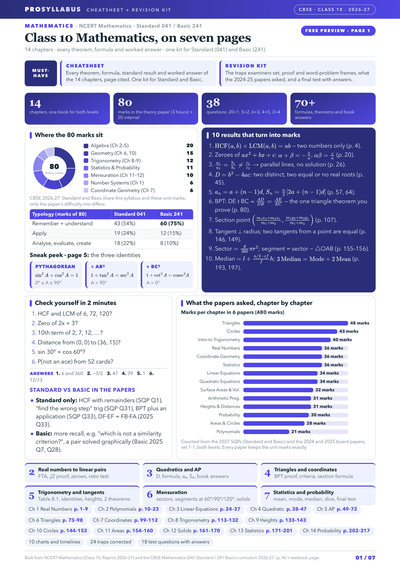
Based on student and expert reports, the following chapters had notable presence in the Feb 17 question paper. Algebra and Geometry dominated as expected, but Statistics and Circles were prominent too:
High Weightage Chapters
⭐ Real Numbers
⭐ Pair of Linear Equations
⭐ Trigonometry
⭐ Surface Areas & Volumes
⭐ Statistics
⭐ Circles
Also Appeared
Probability
Quadratic Equations
Triangles
Coordinate Geometry
Arithmetic Progressions
Polynomials
📊 Pattern Note: Circles questions were found challenging by many students — especially tangent-related theorem questions in the Standard paper. Students who had only skimmed through Circles struggled in Section C.
Section 05
Student Reactions — What They Said After the Exam
Immediately after students walked out at 1:30 PM, here's the mood outside exam centres:
"The MCQs took way more time than I expected. They were concept-heavy, not just formula-based. I barely had time to review Section E."
Standard Paper Student, Delhi
"Section B and C were absolutely fine. If you'd solved NCERT examples properly, you were sorted. The 5-mark questions were surprisingly manageable."
Standard Paper Student, Patna
"Basic maths paper was easy. Everything was straightforward — exactly like the sample paper. I think I can score above 70."
Basic Paper Student, Mumbai
"The Statistics question with two unknowns (x and y) in the frequency table was the highlight — tricky setup but solvable with simultaneous equations."
Standard Paper Student, Guwahati
🎓 Expert Overall Verdict (Tanmoy Das, PGT Maths, Modern English School, Guwahati): "The CBSE Class 10 Maths paper 2026 was moderate in difficulty and offered a fair balance between foundational concepts and critical thinking. The MCQs were concept-heavy rather than direct, which caught some students off guard."
Section 06
What Should You Do Now? — Post-Exam Guide
Calculate Your Expected Score
Use the memory-based answer keys released by Aakash, Vedantu, or Careers360. Add step-marks carefully — even partially correct answers earn marks in CBSE's marking scheme.
Don't Stress Over MCQ Mistakes
Section A carries 20 marks — but even if you got a few wrong, Sections D and E with good step-wise answers can compensate. CBSE evaluation is generous with process marks.
If You're a Phase 2 Candidate (May 2026)
Take note of today's paper pattern. Focus on: MCQ application concepts, Circles theorems, Statistics unknowns problems, and Case Study question practice from NCERT.
Download the Official Question Paper PDF
CBSE will upload all sets on cbse.gov.in. Cross-check answers section by section. PDFs are also available on Careers360, Vedantu, and SelfStudys.
You're Done — Celebrate and Rest!
Class 10 Maths is the most feared paper. You've faced it. Move on to other subjects with fresh energy. Results will come in May — until then, keep going.
Paper Done. Now Own It. 💪
Regardless of how it went today — you showed up, you attempted, you fought. CBSE's step-marking is your friend. Don't wait for results to feel proud of the effort you put in all year.
Drop your experience in the comments — how did YOUR paper go today?