Checked 3 October 2026. From CBSE’s Secondary Curriculum 2026-27, the subject curricula for 2026-27, the 2025-26 marks bifurcation circular and the SQP notification of 21.09.2026. Splits for 2026-27 are unchanged from 2025-26 per CBSE.
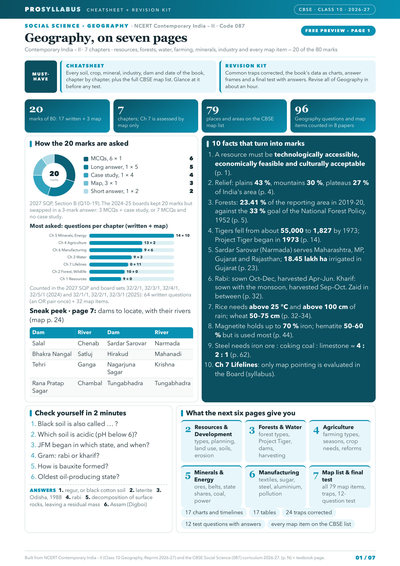
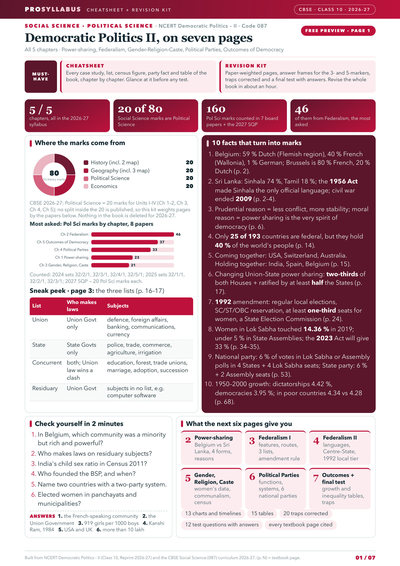
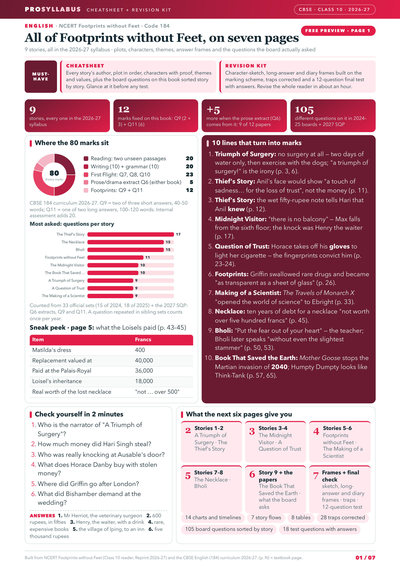
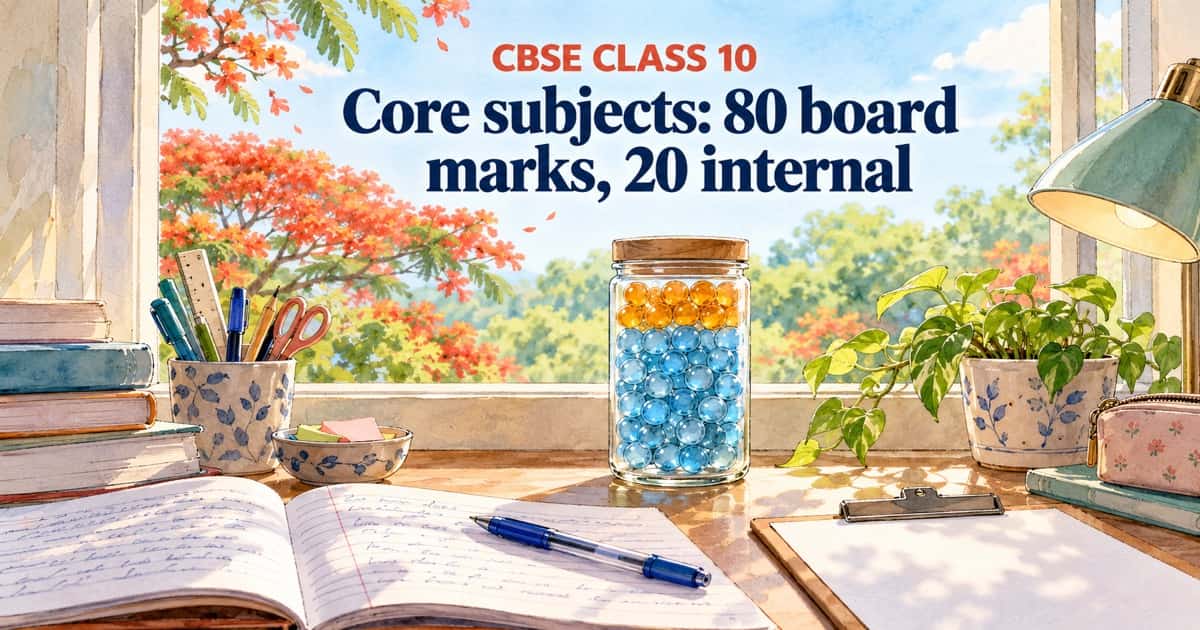
In the five main Class 10 subjects (two languages, Mathematics, Science and Social Science), every subject is out of 100: 80 marks in the board exam and 20 marks of internal assessment by the school. Optional subjects use other splits: 70+30 (Home Science, NCC, Elements of Business, Elements of Book Keeping and Accountancy), 50+50 (skill subjects and Computer Applications) and 30+70 (Painting and the music papers). CBSE’s 2026-27 curriculum says “approximately 50% of the questions are competency-focused”. This guide sets out each split, how the internal 20 marks are built, the competency weighting subject by subject, and a calculator built only from those numbers.
Secondary Curriculum 2026-27; SQP notification 21.09.2026.
Marks calculator: board marks plus internal marks
Pick the pattern of your subject, then enter marks. The calculator adds the two parts, checks the 33% pass mark, and works out the board marks you would need for a target. It uses only the splits in CBSE’s 2026-27 scheme of studies and the 2025-26 marks bifurcation.
Our arithmetic on CBSE’s published splits. Pass check: CBSE’s 2025-26 curriculum says the separate 33% condition has been relaxed, so a subject is passed on 33 out of 100 taken together; the 2026-27 text says “33% marks separately”. Both readings are shown. Marks are not saved.
The split for every Class 10 subject
CBSE lists maximum marks per subject in its scheme of studies and, in more detail, in a marks bifurcation circular it sends schools before the practical season. The 2025-26 bifurcation (circular of 17 November 2025) is the latest one; CBSE’s 2026-27 SQP notification says the assessment pattern has not changed.
| Subjects | Duration | Board theory | Practical / project | Internal assessment |
|---|---|---|---|---|
| All languages (Hindi A and B, English L&L and Communicative, Sanskrit, Urdu, regional and foreign languages) | 3 h | 80 | — | 20 |
| Mathematics Standard (041) and Basic (241) | 3 h | 80 | — | 20 |
| Science (086) | 3 h | 80 | — | 20 |
| Social Science (087) | 3 h | 80 | — | 20 |
| Home Science (064) | 3 h | 70 | 30 practical | — |
| National Cadet Corps (076) | 3 h | 70 | — | 30 |
| Elements of Business (154), Elements of Book Keeping and Accountancy (254) | 3 h | 70 | 30 project | — |
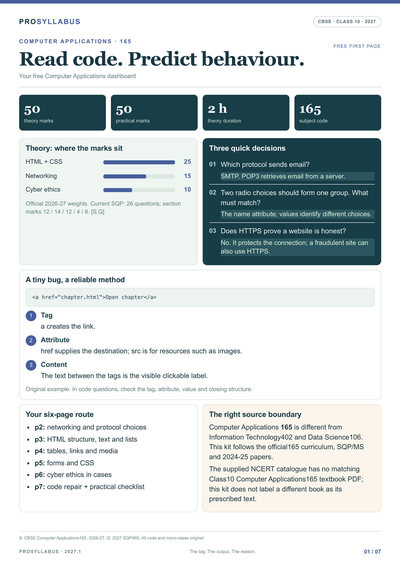
| Computer Applications (165) | 2 h | 50 | 50 practical | — |
| Skill subjects (401 to 422, including Information Technology and Artificial Intelligence) | 2 h | 50 | 50 practical | — |
| Painting (049) | 2 h | 30 | 50 practical | 20 |
| Carnatic and Hindustani music (031 to 036) | 2 h | 30 | 50 practical | 20 |
Two notes. The 2026-27 curriculum’s summary table writes some of these as “internal” marks, for example Home Science 70 + 30 and Painting 30 + 70, while the bifurcation circular names the same marks practical or project; the totals agree. And CBSE says only one of Computer Applications (165) and Information Technology (402) may be taken.
How the 20 internal marks are built
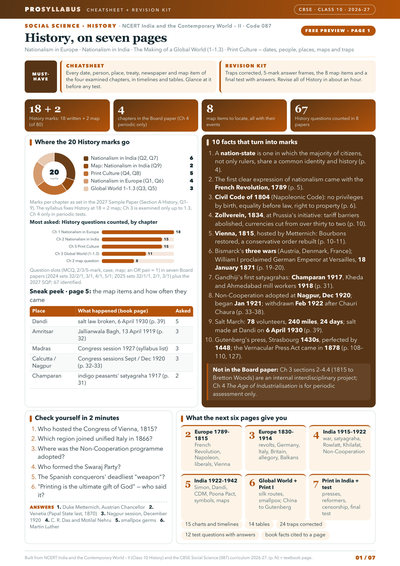
Internal assessment is done by the school across the year and is uploaded to CBSE before the board exam. Under the two-exam scheme it is done once, before the main exam, and it cannot be improved in the second exam. The 2026-27 curriculum gives the four parts equal weight, 25% each, which is 5 marks each out of 20. Each subject’s curriculum then says what fills those 5 marks.
| Part | What CBSE asks for | Mathematics | Science | Social Science |
|---|---|---|---|---|
| Periodic assessment (5) | Three periodic assessments a year; the average of the best two counts. At least one must be competency-based. | Pen-paper test and multiple assessment together 10 | Periodic assessment 5 | Pen-paper test 5 |
| Multiple assessment (5) | Varied modes: quizzes, oral work, projects, experiments, concept maps, peer and self-assessment, with rubrics shared in advance. | (included above) | Multiple assessment 5 | Quiz, debate, role play and similar through an interdisciplinary project 5 |
| Portfolio (5) | A small, chosen collection of the student’s work and reflections across the year. | Portfolio 5 | Portfolio 5 | Portfolio 5 |
| Subject enrichment (5) | Subject skills: listening and speaking in languages, investigation in Science and Mathematics, inquiry and projects in Social Science. | Lab practical 5 | Practical work 5 | Project on Consumer Rights, Social Issues or Sustainable Development 5 |
In English Language and Literature, the assessment of listening and speaking skills carries 5 marks inside subject enrichment. In Mathematics the internal marks are the same whether the student takes Standard or Basic: CBSE says the two levels apply only to the board paper.
Competency-based questions: the share by subject
CBSE’s 2026-27 curriculum says board papers are designed to assess application, analysis and evaluation, and that “presently, approximately 50% of the questions are competency-focused — such as case-based, source-based, integrated, data interpretation, situational, and application-oriented”. Each subject’s question paper design shows how that plays out. The chart uses the marks in each subject’s own design table.
Marks out of 80 from each subject’s 2026-27 question paper design. Science is published as 50%, 30% and 20%; we converted to marks (our arithmetic).
| Subject | Remember and understand | Apply | Analyse, evaluate, create | Notes |
|---|---|---|---|---|
| Science (086) | 50% (40 marks) | 30% (24 marks) | 20% (16 marks) | About 33% internal choice |
| Mathematics Standard (041) | 43 marks (54%) | 19 marks (24%) | 18 marks (22%) | Calculators not allowed |
| Mathematics Basic (241) | 60 marks (75%) | 12 marks (15%) | 8 marks (10%) | Same question count as Standard |
| Social Science (087) | 24 marks (30%) | 11 marks (see note) | 40 marks (50%) | Map skill 5 marks (6.25%) |
Where other pages get this wrong
In Social Science, 11 marks out of 80 is 13.75%, not 13.25%.
Commonly published instead: CBSE’s own 2026-27 Social Science design table prints “11 … 13.25%” for application questions, and pages copying it repeat the figure.
The marks in that table (24, 11, 40 and 5) add up to 80, but the printed percentages add up to 99.5%. 11 ÷ 80 = 13.75%. The marks are what the paper is built on; the percentage is a slip in the document (our arithmetic).
Where the marks sit inside Mathematics and Science
Each subject also fixes marks per unit. These come from the 2026-27 course structures and are the best guide to where revision time should go.
| Subject | Unit | Marks |
|---|---|---|
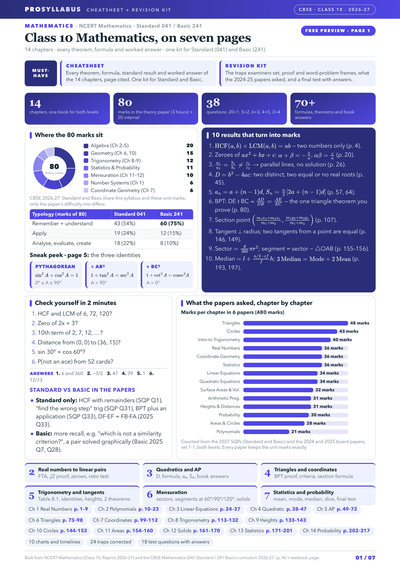
| Mathematics | Number Systems | 6 |
| Mathematics | Algebra | 20 |
| Mathematics | Coordinate Geometry | 6 |
| Mathematics | Geometry | 15 |
| Mathematics | Trigonometry | 12 |
| Mathematics | Mensuration | 10 |
| Mathematics | Statistics and Probability | 11 |
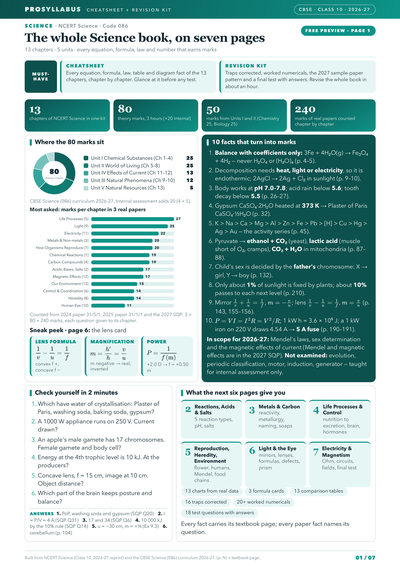
| Science | Chemical Substances: Nature and Behaviour | 25 |
| Science | World of Living | 25 |
| Science | Natural Phenomena | 12 |
| Science | Effects of Current | 13 |
| Science | Natural Resources | 5 |
| Social Science | History (with 2 map marks) | 20 |
| Social Science | Geography (with 3 map marks) | 20 |
| Social Science | Political Science | 20 |
| Social Science | Economics | 20 |
How the board paper is marked and graded
Board marks are given as numbers, and the marksheet also shows a grade in each subject. Class 10 grades are positional: CBSE ranks all students who passed a subject and gives A-1 to the top eighth, A-2 to the next eighth, and so on down to D-2, with E meaning Essential Repeat. This is used where more than 500 candidates passed the subject. The Board does not print an aggregate or percentage on the marksheet.
| Grade | Meaning |
|---|---|
| A-1 | Top one-eighth of passed candidates in the subject |
| A-2 | Next one-eighth |
| B-1 | Next one-eighth |
| B-2 | Next one-eighth |
| C-1 | Next one-eighth |
| C-2 | Next one-eighth |
| D-1 | Next one-eighth |
| D-2 | Next one-eighth |
| E | Essential Repeat |
Practical points on marking
- Step marks matter. The marking scheme for each sample paper shows how marks for long answers are split across steps.
- Science and Social Science answers must be written in the right section of the answer book. Answers in the wrong section are not evaluated.
- Verification and re-evaluation after the result cover the theory paper only, for a full question, not part of one. Marks can go down as well as up.
- Internal marks are the school’s. Ask the school early how it schedules periodic assessments and the portfolio.
CBSE guidance 09.12.2025; post-result notice 05.08.2026; Secondary Curriculum 2026-27.
Practise it, don't just read it
With about half of each paper built on application and analysis, chapter quizzes that make you apply a concept are better practice than re-reading. Our Class 10 quizzes run chapter by chapter.
The ProSyllabus CBSE Class 10 library has chapter quizzes for Mathematics, Science, Social Science (History, Geography, Political Science and Economics), English (First Flight and Footprints without Feet), Hindi and Health and Physical Education. You can start free, and a ProSyllabus school plan opens more of them each month.
Frequently asked questions
How many marks is the CBSE Class 10 board paper?
80 marks in 3 hours in the five main subjects, with 20 marks of internal assessment added by the school.
What makes up the 20 internal marks?
Four parts of 5 marks each: periodic assessment, multiple assessment, portfolio and subject enrichment. The details differ by subject.
What percentage of the Class 10 paper is competency-based?
CBSE says approximately 50% of the questions are competency-focused. Each subject’s design weights it differently.
Is Computer Applications 80 marks?
No. Computer Applications is 50 marks theory in 2 hours plus 50 marks practical.
Are skill subjects like IT and AI marked out of 100?
Yes, as 50 theory and 50 practical, with a 2-hour theory paper.
Is internal assessment different for Maths Standard and Basic?
No. CBSE says the two levels apply only to the board paper, not to internal assessment.
Does CBSE give a percentage in the Class 10 marksheet?
No. The marksheet shows marks and a grade per subject; no aggregate or division is printed.
How are Class 10 grades decided?
Positionally: passed students in each subject are ranked and split into eighths from A-1 to D-2. E means Essential Repeat.
Can I improve my internal marks in the second board exam?
No. Internal assessment is done once, before the main exam.
More in this series
- Two board exams: who sits which, which score counts
- Official sample papers and marking schemes, by subject
- Passing marks, compartment and Essential Repeat
- Date sheet and result dates, year by year
- CBSE Class 10 notice board — updates
- Class 10 Mathematics previous year question papers
- Class 10 Science previous year question papers
- Class 10 Social Science previous year question papers
- Class 10 English previous year question papers
- Class 10 Hindi Course A previous year question papers
- Class 10 Hindi Course B previous year question papers
- Class 10 Maths board paper analysis, 2026
Sources
- official — CBSE Academic — Secondary Curriculum 2026-27, Part 1 (scheme of studies and assessment)
- official — CBSE Academic — Secondary School Curriculum 2025-26
- official — CBSE — Subject-wise marks bifurcation, Class X examination 2025-26 (circular 17.11.2025)
- official — CBSE Academic — Notification: Sample Question Papers for Classes X and XII, 2026-27 (21.09.2026)
- official — CBSE Academic — Mathematics syllabus and question paper design, Class X 2026-27
- official — CBSE Academic — Science syllabus and question paper design, Class X 2026-27
- official — CBSE Academic — Social Science syllabus and question paper design, Class X 2026-27
- official — CBSE Academic — English Language and Literature syllabus, Class X 2026-27
- official — CBSE — Guidance to Class X students: answer book in sections for Science and Social Science (09.12.2025)
- official — CBSE — Post-result facilities, Class X Main and Second Board Examinations 2026 (05.08.2026)
- official — CBSE — Examination Bye-laws: scheme of examinations and pass criteria
- official — CBSE — LOC for Class X Second Board Examination 2026 (17.03.2026)
official = a document published by the conducting body. reported = a news or coaching site we could not check against an original. Where sources disagree this page says so rather than picking one.