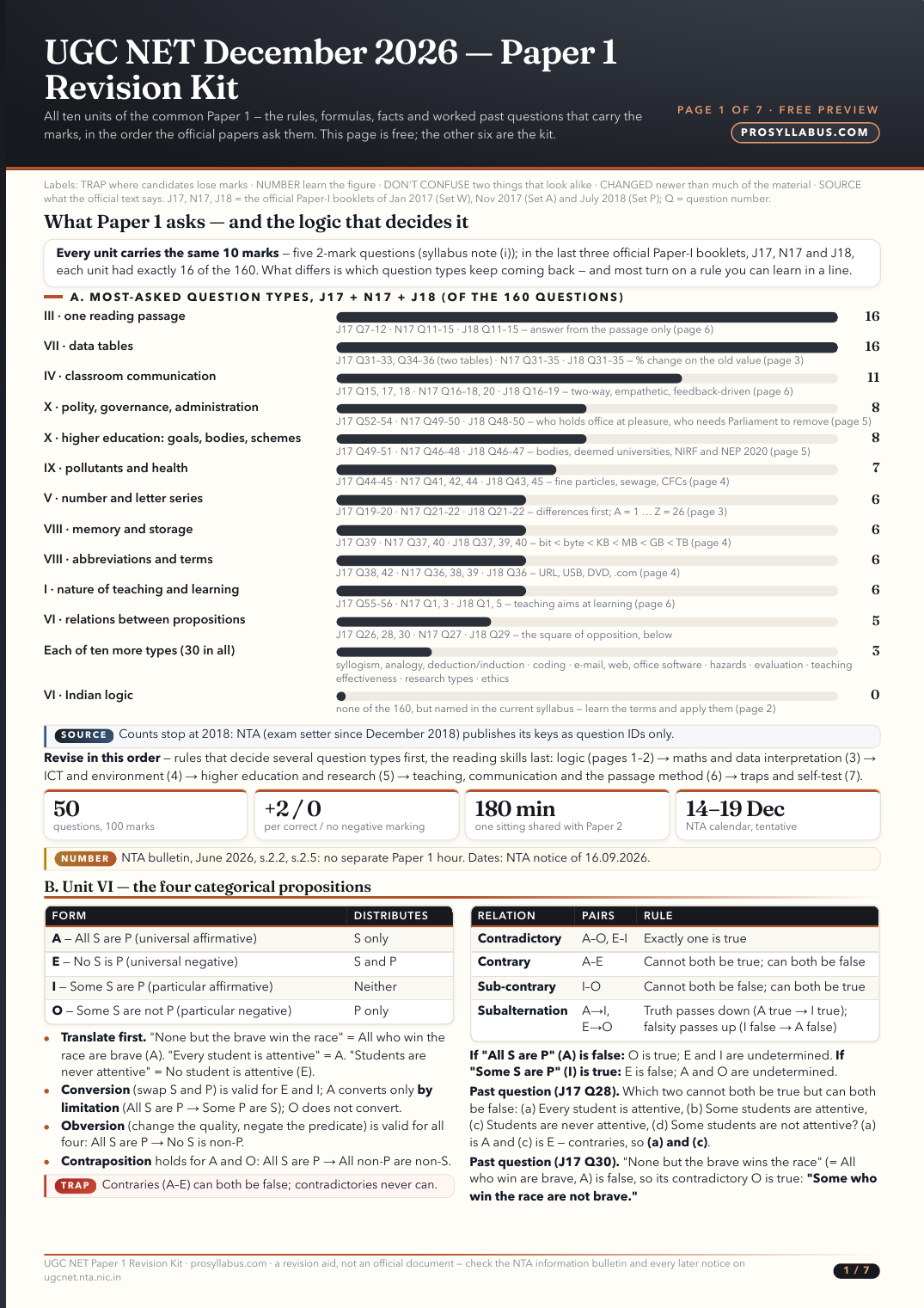

Checked 4 October 2026. The UGC Paper I syllabus and NTA June 2026 bulletin were rechecked on 4 October 2026. All cases and rules of thumb here are original teaching examples, not official NTA questions or answer explanations. Check the next bulletin for cycle-specific instructions.
The fastest way to use Teaching Aptitude notes is to make a decision, not memorise a list. In the UGC NET Bureau’s Paper I syllabus, Unit I asks about teaching levels, learners, factors, methods, support and evaluation. A question can change one fact in a classroom and turn a familiar term into a different answer. This page gives the complete official topic map, a five-step choice method and ten original cases showing how to separate close options. The last two cases bridge to Research Aptitude, Unit II, without pretending that Paper I covers your chosen Paper II subject.
 Great Indian Festival dealsSale prices live on laptops, tablets, phonesSee on Amazon
 Laptop dealsStudent laptops — see today's pricesSee on Amazon
 Tablet dealsFor notes, PDFs and online classesSee on Amazon
 Bluetooth speakersPocket-size to party-sizeSee on Amazon
 UGC-NET solved papersPrevious years, with answersSee on AmazonBooks for UGC-NETGuides and reference booksSee on Amazon
 Study lampsEye-friendly light for late nightsSee on Amazon
 Bags and backpacksRoom for books and a laptopSee on Amazon
As an Amazon Associate, ProSyllabus earns from qualifying purchases. Prices and availability are set by the seller.
UGC Paper I syllabus note and NTA UGC NET June 2026 bulletin. NTA had not published a December 2026 bulletin when this page was checked.
What the official Teaching Aptitude syllabus actually includes
| Unit I strand | Exact syllabus scope in brief | Decision to practise |
|---|---|---|
| Teaching itself | Concept, objectives, characteristics, basic requirements; memory, understanding and reflective levels | What must the learner do: recall, explain or evaluate? |
| Learners | Adolescent and adult characteristics; academic, social, emotional and cognitive aspects; individual differences | What evidence of prior knowledge or support need is available? |
| Factors | Teacher, learner, support material, instructional facilities, learning environment, institution | Which factor is actually causing the observed difficulty? |
| Methods | Teacher-centred versus learner-centred; offline versus online, including SWAYAM, SWAYAMPRABHA and MOOCs | Separate participation from delivery mode. |
| Teaching support | Traditional, modern and ICT-based systems | Which aid helps the stated learning outcome, and what remains untested? |
| Evaluation | Elements and types of evaluation; CBCS, computer-based testing and innovations | Is the evidence for diagnosis, mid-course feedback or final judgement? |
The syllabus says five two-mark questions come from each Paper I module. That is a module allocation, not a promise that one question comes from every row in the table. In the June 2026 information bulletin, Paper I has 50 questions and 100 marks, Paper II has 100 questions and 200 marks, and the combined computer-based test lasts 180 minutes without a break. There is no separate official one-hour Paper I clock or Unit I cutoff. The December 2026 cycle had only tentative calendar dates at the time of this check; use its bulletin when NTA publishes one.
The five-step choice path
First state the learning objective as something observable: “name three teaching levels,” “explain who does the reasoning in this lesson,” or “defend a method after weighing learner evidence.” Then check what the learners already know. Pick a task that produces the needed evidence, choose support that makes the task possible, and inspect the response before moving on. The UGC syllabus names the concepts; this path is our way to apply them. A glossy online tool cannot rescue a method that produces no evidence for the objective.
| If the question emphasises | Ask yourself | Likely focus | Do not jump to |
|---|---|---|---|
| Memory, understanding or reflective teaching | What kind of learner response is required? | Recall, explanation or evidence-based judgement | Calling every difficult task reflective |
| Learner differences | What did the teacher actually observe? | Prior knowledge, access or learning support | Age-based assumptions |
| Teaching method | Who does the explanation, comparison or defence? | Teacher-centred or learner-centred participation | Online/offline, which is a different axis |
| Evaluation | When is evidence collected and what will be done with it? | Diagnostic, formative or summative use in the example | Assuming every test is summative |
Memory, understanding and reflective levels in one topic
Suppose the topic is teaching methods. Asking for the names of teacher-centred and learner-centred approaches tests recall. Asking who does the intellectual work in a new lesson tests explanation. Asking learners to choose a defensible method for a mixed group, acknowledge constraints and defend the choice tests reflective judgement. The topic has not changed; the cognitive task has. There is no need to call memory work “bad”—recall can be a prerequisite for a later explanation. The clue is the outcome the teacher is asking for, not the prestige of the word on the page.
| Level named by UGC | Observable response in our example | Useful check | Typical wrong inference |
|---|---|---|---|
| Memory | Name or recognise the teaching-method labels | Can the learner retrieve the term without the list? | The learner can therefore select a method for a new class. |
| Understanding | Explain who participates in two lesson designs | Can the learner explain an unfamiliar example? | Repeating a definition demonstrates transfer. |
| Reflective | Weigh limits and defend a lesson choice for a mixed group | Can the learner state evidence, assumptions and trade-offs? | Any group discussion is reflective. |
Eight classroom decisions and two research bridges
Each scene below is a short study example, not a past-paper quotation. Read the scene, decide what the teacher or researcher should do, then read the reasoning. The examples intentionally use different topics so that the operation survives a change in surface wording.
1. Levels of teaching
A teacher wants learners to recall the names of the three teaching levels before a later comparison.
Best reading: Memory level. A retrieval prompt checks whether the names can be recalled. It does not yet show whether learners can choose a level for a new teaching objective.
Tempting error: Calling recall reflective merely because the topic is teaching theory.
2. Levels of teaching
Learners can name teacher-centred and learner-centred methods but cannot explain how participation differs in a new classroom scene.
Best reading: Understanding level. Ask them to explain who does the reasoning in two unfamiliar lesson designs.
Tempting error: Repeating the two labels as if recognition proves understanding.
3. Levels of teaching
Two lesson designs could serve a mixed-ability group. Learners must inspect evidence, identify constraints and defend a tentative choice.
Best reading: Reflective level. The task asks for a reasoned judgement where the evidence and assumptions matter.
Tempting error: Treating every discussion as reflective even when learners only repeat what the teacher said.
4. Learner characteristics
A mixed group has entrants with prior field experience and entrants who have never handled the instrument. Both must reach the same learning goal.
Best reading: Check prior knowledge first, then offer a common goal with a supported route for beginners and an extension for experienced learners.
Tempting error: Assuming age or course year alone tells you each person’s skill.
5. Factors affecting teaching
Many learners can describe the procedure but the laboratory has no working instrument for the scheduled practical.
Best reading: The immediate constraint is an instructional facility. Plan a safe demonstration or reschedule access; a lecture alone cannot establish practical competence.
Tempting error: Blaming motivation without checking whether the required facility exists.
6. Method and mode
A teacher posts a recorded lecture online. Another teacher runs a face-to-face discussion in which learners defend answers.
Best reading: The first is online and largely teacher-centred; the second is offline and learner-centred. Delivery mode and participation are separate axes.
Tempting error: Equating every online lesson with learner-centred learning.
7. Teaching support
A class must recognise the parts of a microscope, but a full instrument is not available for every learner.
Best reading: Use labelled images or a model for initial identification, then arrange real-equipment practice before claiming hands-on skill.
Tempting error: Calling a digital image a substitute for the practical outcome.
8. Evaluation
Halfway through a unit, quick responses show that most learners have confused correlation with causation. The final graded test is next week.
Best reading: Use the responses formatively now: give a counterexample and recheck the concept. The later graded test is summative evidence.
Tempting error: Waiting for the final grade when a reversible misunderstanding is already visible.
9. Research bridge
A lecturer wants to know whether a new classroom activity caused a change, but only compares one volunteer group after the activity.
Best reading: The claim of cause is too strong for that evidence. First name the comparison and selection limitations; then choose a design fit for the question.
Tempting error: Using the word “experimental” for any activity with numbers.
10. Research bridge
A candidate finds an attractive diagram in a published article and wants to place it in a dissertation without attribution.
Best reading: Record the source, cite it, and check whether reuse permission is required. Research ethics is not satisfied by changing colours.
Tempting error: Treating an uncredited figure as safe because the accompanying words are original.
Two axes candidates often collapse into one
| Delivery | Teacher-centred version | Learner-centred version |
|---|---|---|
| Offline | Face-to-face explanation followed by the teacher’s worked solution | In-room peer explanation, investigation or defended comparison |
| Online | Recorded or live lecture with little learner contribution | Online seminar, peer critique or project with learners defending choices |
This is a conceptual two-by-two matrix, not an NTA classification table. “Online” says where or how the interaction is delivered; it does not tell you who does the reasoning. Likewise a discussion is not automatically learner-centred if the teacher supplies every conclusion. SWAYAM, SWAYAMPRABHA and MOOCs appear by name in the official syllabus, but a question may be about teaching method rather than the brand of platform. Identify the requested axis before selecting an option.
Online initiatives and evaluation terms without a memorised blur
| Term | Official meaning or service | Question distinction |
|---|---|---|
| SWAYAM | A Ministry of Education course platform with video, downloadable reading, self-assessment and discussion components | An online course platform is not itself a teaching level. |
| SWAYAM PRABHA | Educational DTH television channels with programme schedules and archive access | A channel broadcast is not the same delivery arrangement as an interactive course. |
| MOOC | A general category of massive open online course | The word names a course format, not a guarantee of learner-centred activity. |
| CBT | Computer-based testing under evaluation systems | It names a test delivery mode, not whether results are used formatively or summatively. |
| CBCS | Choice Based Credit System in higher-education evaluation | Credits and course choices are a framework; grading details depend on the applicable institution rules. |
The official SWAYAM description identifies its four course components, while the Ministry’s SWAYAM PRABHA page describes the DTH channel network. The UGC syllabus names CBCS and CBT but gives no universal grade conversion or platform-based teaching level. For evaluation, ask how the evidence will be used: an initial check to locate a gap is diagnostic; evidence used during instruction to revise the next lesson is formative; a final judgement after the unit is summative. These examples clarify terms, not a claim that UGC prescribed this exact answer wording.
Test the decision rule, then repair a weak strand
| Self-check case | Best answer | Why |
|---|---|---|
| Definition recalled; new example fails | Explanation and transfer | The next task needs evidence of understanding. |
| Live online defended solutions | Online and learner-centred | Delivery and participation are separate. |
| No instrument for microscope practical | Instructional facilities | The necessary facility is missing. |
| Midway exit ticket shows misconception | Formative feedback and retest | The evidence can change teaching before the final assessment. |
If you miss one answer, write the exact distinction, not just the question number: “method versus mode,” “memory versus understanding,” “facility versus learner,” or “formative use versus final grade.” Then create a new scenario by changing one fact. A correct response to the same memorised question is weak evidence that the misconception is repaired.
A seven-day Unit I repair loop
| Day | Small task | Evidence to keep |
|---|---|---|
| 1 | Read the six official Unit I strands and classify these ten cases. | One line explaining each choice. |
| 2 | Write three tasks on one topic: recall, explain, defend. | The requested learner output changes each time. |
| 3 | Take one teaching-factor scene and change the missing resource. | The causal diagnosis changes when the fact changes. |
| 4 | Make one offline/online by teacher/learner-centred matrix from your course. | Four examples, not four platform names. |
| 5 | Review traditional, modern and ICT support against one learning objective. | Say what each aid can and cannot demonstrate. |
| 6 | Write a diagnostic, mid-unit and final evaluation use for one topic. | The timing and purpose are clear. |
| 7 | Take a fresh Paper I set or audited quiz; classify every missed Unit I item. | An error label and a new counterexample for each miss. |
Where Teaching Aptitude meets Research Aptitude
Unit II of the same official syllabus separately lists the meaning and types of research; positivist and post-positivist approaches; experimental, descriptive, historical, qualitative and quantitative methods; research steps; thesis and article writing with referencing styles; ICT in research; and research ethics. The last two scenes above are a bridge: a classroom observation can suggest a research question, but a before-and-after impression is not proof of causation, and an attractive uncredited figure is still an ethics issue. Keep Unit I and II in separate error logs because their distinctions differ. Both modules have five two-mark questions under the syllabus note.
| Unit | What to revise after a miss | Kit connection |
|---|---|---|
| I Teaching Aptitude | Level, learner evidence, factor, method, support or evaluation | Page 6 condenses teaching and communication. |
| II Research Aptitude | Question/design fit, steps, referencing or ethics | Page 5 condenses research alongside higher education. |
Keep the distinction you just repaired close
This workshop and its answers are free. The separate seven-page UGC NET Paper I revision kit condenses Teaching Aptitude and communication on page 6, research on page 5, plus the other eight units and a timed self-test. Preview the actual first page and check the current contents and price before deciding. It does not cover your Paper II subject or include quiz or membership access.
Preview page 1 of the Paper I revision kitExam-use notes that prevent wrong inferences
The UGC syllabus is not an answer key or a detailed textbook. It names what may be assessed; our case answers illustrate a reasoned interpretation of those names. Where two classroom choices could both work in life, the best exam answer depends on the objective and evidence stated in that question. Do not turn “learner-centred” into a magic answer for every situation. Do not infer current question frequency from the old Bureau papers. NTA’s June 2026 bulletin has no negative marking, but a future cycle’s bulletin is the controlling document for its own marking and schedule.
How many Teaching Aptitude questions are in UGC NET Paper I?
The UGC Paper I syllabus note says five questions of two marks are set from each module, including Unit I Teaching Aptitude. The NTA June 2026 bulletin gives 50 Paper I questions and 100 marks overall.
Is there a separate one-hour Paper I timer?
No. The June 2026 NTA bulletin gives Paper I and Paper II a shared 180-minute sitting without a break. Plan your own pacing within that total.
What are the three levels of teaching in Unit I?
The official syllabus names memory, understanding and reflective teaching. Our examples distinguish recall, explanation/transfer and reasoned judgement respectively; they are study examples, not official answer explanations.
Is online teaching automatically learner-centred?
No. Online versus offline is delivery mode; teacher-centred versus learner-centred concerns who does the learning work. A recorded lecture may be online and teacher-centred.
Are these ten cases official previous-year questions?
No. They are original ProSyllabus examples built from the official Unit I and II syllabus headings. Use official past booklets and the current bulletin for primary exam material.
Do I need to memorise every platform named in the syllabus?
Know why SWAYAM, SWAYAMPRABHA and MOOCs appear under online teaching. A method question may ask about participation rather than the platform name.
Does the kit cover Paper II?
No. The offer is a Paper I revision kit for all ten common units. Your subject-specific Paper II needs separate preparation.
Is December 2026 UGC NET fully notified?
As checked on 4 October 2026, NTA had issued a tentative calendar, not a December 2026 information bulletin. Verify current notices before relying on cycle dates or fees.
Sources
- official — UGC NET Bureau — current Paper I syllabus index (code 00; applicable since June 2019)
- official — UGC NET Bureau — General Paper on Teaching and Research Aptitude syllabus (English PDF through official download)
- official — NTA — UGC NET June 2026 information bulletin: Paper I and II pattern, marking and duration
- official — Ministry of Education — SWAYAM course-platform overview and its four components
- official — Ministry of Education — SWAYAM PRABHA educational DTH channels
- official — NTA — 16 September 2026 examination calendar (December UGC NET dates tentative, not a notification)
official = a document published by the conducting body. reported = a news or coaching site we could not check against an original. Where sources disagree this page says so rather than picking one.
More in this series
- UGC NET cut-offs by subject and category, every cycle since 2023
- UGC NET JRF vs Assistant Professor vs PhD only
- UGC NET pattern, marking, percentile and normalised marks
- UGC NET previous papers and official answer keys
- UGC NET December 2026 dates and every past cycle's timeline
- UGC NET notice board — alerts and updates
- UGC NET exam day: time management and CBT
- UGC NET syllabus and a study plan
- CSIR NET: JRF vs Assistant Professor