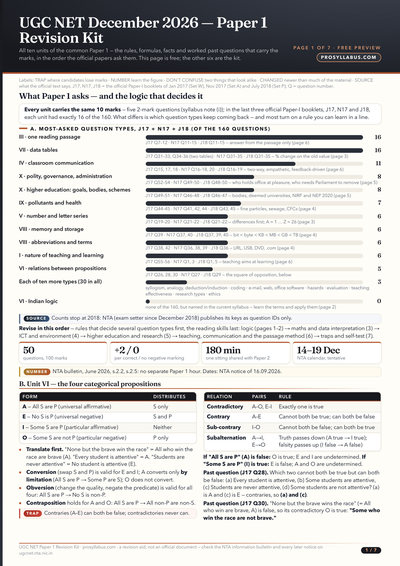

Checked 6 October 2026. The syllabus note and the NTA bulletin of June 2026 were rechecked on 6 October 2026. NTA publishes no Paper 1 question papers, so any change in how its computer-based papers spread questions across units cannot be seen from outside; the count below is of the six pen-and-paper booklets of June 2015 to July 2018.
Every UGC NET Paper 1 unit carries the same weight: five questions of two marks each, 10 marks of 100. That is printed in note (i) of the UGC Paper 1 syllabus and the six official booklets we counted agree with it: of 340 questions, each of the ten units has 33 to 35 (9.7% to 10.3%). So a "unit-wise weightage" chart that shows one unit with a larger share is not describing this paper. NTA has never published a Paper 1 question paper in any cycle since it took over in December 2018, and its public keys list question IDs without text, so there is no NTA count to quote; the only official questions you can count are the UGC NET Bureau booklets up to July 2018, and that is what this page does.
The first two are official. 340 is our count of the Bureau booklets; 0 is from the NTA bulletin and key pages (checked 6 October 2026).
The ten units, and what the official syllabus names in each
The syllabus is a UGC NET Bureau document, referred to by the NTA bulletin (section 2.3). Each unit is a "module"; the table condenses its official scope. The wording of the note is: "Five questions each carrying 2 marks are to be set from each Module." A second note says that when graphical or pictorial questions are set for sighted candidates, a passage with an equal number of questions and weightage is set for visually impaired candidates.
| Unit | Official scope in brief (UGC syllabus) | Questions and marks (syllabus note i) |
|---|---|---|
| I. Teaching Aptitude | Teaching: concept, objectives, levels (memory, understanding, reflective), characteristics. Learner characteristics and individual differences. Factors affecting teaching. Methods in higher education (teacher-centred vs learner-centred; offline vs online incl. SWAYAM, SWAYAMPRABHA, MOOCs). Teaching support systems. Evaluation systems (elements, types, CBCS, computer-based testing). | 5 questions x 2 marks = 10 of 100 |
| II. Research Aptitude | Research: meaning, types, characteristics; positivism and post-positivism. Methods: experimental, descriptive, historical, qualitative, quantitative. Steps of research. Thesis and article writing, referencing. Application of ICT in research. Research ethics. | 5 questions x 2 marks = 10 of 100 |
| III. Comprehension | A passage of text is given; questions are asked from the passage. | 5 questions x 2 marks = 10 of 100 |
| IV. Communication | Communication: meaning, types, characteristics. Effective communication: verbal and non-verbal, inter-cultural, group, classroom. Barriers. Mass media and society. | 5 questions x 2 marks = 10 of 100 |
| V. Mathematical Reasoning and Aptitude | Types of reasoning. Number series, letter series, codes and relationships. Mathematical aptitude (fraction, time and distance, ratio, proportion, percentage, profit and loss, interest and discounting, averages). | 5 questions x 2 marks = 10 of 100 |
| VI. Logical Reasoning | Structure of arguments (argument forms, categorical propositions, mood and figure, fallacies, uses of language, square of opposition). Deductive and inductive reasoning. Analogies. Venn diagrams. Indian logic: pramanas, anumana, vyapti, hetvabhasas. | 5 questions x 2 marks = 10 of 100 |
| VII. Data Interpretation | Sources, acquisition and classification of data. Quantitative and qualitative data. Graphical representation (bar chart, histogram, pie chart, table chart, line chart). Data interpretation. Data and governance. | 5 questions x 2 marks = 10 of 100 |
| VIII. Information and Communication Technology (ICT) | ICT: abbreviations and terminology. Internet, intranet, e-mail, audio and video conferencing. Digital initiatives in higher education. ICT and governance. | 5 questions x 2 marks = 10 of 100 |
| IX. People, Development and Environment | Millennium and Sustainable Development Goals. Human and environment interaction. Air, water, soil and noise pollution, waste, climate change. Impact of pollutants on health. Natural and energy resources. Hazards and disasters. Environmental Protection Act 1986, National Action Plan on Climate Change, international agreements. | 5 questions x 2 marks = 10 of 100 |
| X. Higher Education System | Institutions of higher learning in ancient India. Evolution of higher learning and research after Independence. Oriental, conventional and non-conventional programmes. Professional, technical and skill-based education. Value and environmental education. Policies, governance and administration. | 5 questions x 2 marks = 10 of 100 |
Paper 1 in the NTA era, in the bulletin's words
- Part I carries 100 marks and 50 multiple-choice questions, all compulsory, to assess teaching and research aptitude: "reasoning ability, reading comprehension, divergent thinking and general awareness".
- Each question carries 2 marks; "there is no negative marking for incorrect response" (section 2.5).
- Paper 1 and Paper 2 are taken together in 180 minutes without a break.
Source: NTA Information Bulletin, UGC-NET June 2026, sections 2.2 and 2.5. 50 questions at 2 marks each, split over ten units at 5 each, is the arithmetic the syllabus note describes.
What exists to count, cycle by cycle
Weightage can only come from question papers or from keys that say which question tests what. Here is what each era publishes.
| Cycles | Paper 1 question paper | Public final key | Can a unit count be made? |
|---|---|---|---|
| June 2026 and its September re-examination | Shown to each candidate behind the login for two or three days; no public copy | Behind the candidate login only | No |
| December 2025, June 2025, December 2024 | Login only | One PDF per subject; question IDs and correct option, no question text | No: IDs carry no unit |
| June 2024 and the earlier NTA cycles back to December 2018 | Login only | Whole-cycle or per-subject PDFs, IDs only (December 2018: login only) | No |
| June 2009 to July 2018 (UGC NET Bureau, pen and paper): 19 archive entries, counting the September 2013 re-exam of June 2013 | Public: every booklet, in the Bureau archive | Keys only for June 2012 to June 2014 | Yes: we counted six sessions, June 2015 to July 2018 |
| June 2014 and December 2014 | Public | Official keys for June 2014 only | Read, not counted: the unit blocks are in a different order and mix topics |
We read the June 2014 and December 2014 booklets and left them out of the count: their unit blocks come in a different order from the later booklets (a communication block opens the December 2014 paper, for example) and several questions straddle two units, so a count would rest on judgement calls we cannot defend. Sessions before June 2014 were not counted; extending the table to them is a later job.
Our count: 340 questions in six official booklets
We counted one set of each Paper I booklet from June 2015 to July 2018 (June 2015, December 2015, July 2016, January 2017, November 2017, July 2018). The four sets of a session carry the same questions in a different order; we spot-checked two sessions (July 2018 sets P and Q, November 2017 sets A and B) and 44 and 45 of 50 question openings matched on their first 40 characters (we did not trace the remaining few). Each question was assigned to the unit whose syllabus text it tests. That is the unit of the block it sits in in all but one case, described below. June 2015 to July 2016 and January 2017 had 60 questions with "answer any 50"; November 2017 and July 2018 had 50 compulsory questions, as the NTA paper does. The question-by-question file is saved with this page's research.
| Unit | June 2015 | December 2015 | July 2016 | January 2017 | November 2017 | July 2018 | Total of 340 | Share |
|---|---|---|---|---|---|---|---|---|
| I. Teaching Aptitude | 6 | 7 | 6 | 6 | 5 | 5 | 35 | 10.3% |
| II. Research Aptitude | 6 | 6 | 6 | 6 | 5 | 5 | 34 | 10.0% |
| III. Comprehension | 6 | 5 | 6 | 6 | 5 | 5 | 33 | 9.7% |
| IV. Communication | 6 | 6 | 6 | 6 | 5 | 5 | 34 | 10.0% |
| V. Mathematical Reasoning and Aptitude | 6 | 6 | 6 | 6 | 5 | 5 | 34 | 10.0% |
| VI. Logical Reasoning | 6 | 6 | 6 | 6 | 5 | 5 | 34 | 10.0% |
| VII. Data Interpretation | 6 | 6 | 6 | 6 | 5 | 5 | 34 | 10.0% |
| VIII. Information and Communication Technology (ICT) | 6 | 6 | 6 | 6 | 5 | 5 | 34 | 10.0% |
| IX. People, Development and Environment | 6 | 6 | 6 | 6 | 5 | 5 | 34 | 10.0% |
| X. Higher Education System | 6 | 6 | 6 | 6 | 5 | 5 | 34 | 10.0% |
| All units | 60 | 60 | 60 | 60 | 50 | 50 | 340 | 100.0% |
The bars start at zero, so the near-identical lengths are the finding. Source: our count of the UGC NET Bureau Paper I booklets; one set per session.
The only deviation is December 2015. Question 18, on the objectives of student evaluation of teachers, sits between the comprehension passage (questions 13 to 17) and the communication block (19 to 24), but it tests Unit I (evaluation systems), so we count Unit I as 7 and Unit III as 5 for that booklet. If you count by position instead, every unit has exactly 6 in every 60-question booklet and 5 in every 50-question booklet. By position the spread is zero; by topic it is two questions across the 340 (33 to 35).
In January 2017, the Teaching Aptitude block comes last (questions 55 to 60), and in July 2016 two Unit I questions (59 and 60) are placed at the end. Unit order inside a booklet is not fixed, which matters if you practise with one paper from one year only.
What does vary: the kinds of question inside a unit
Equal marks per unit does not mean equal difficulty or equal predictability. Unit by unit, these are the regularities we found in the six booklets, with the question numbers so that you can check each against the PDFs. They are our grouping of official questions, not an NTA statement, and they describe pen-and-paper papers that ended in 2018.
| Unit | What recurs | Evidence |
|---|---|---|
| III Comprehension | Exactly one passage, with 5 or 6 questions on it | All six booklets: June 2015 Q13-18, December 2015 Q13-17, July 2016 Q11-16, January 2017 Q7-12, November 2017 Q11-15, July 2018 Q11-15 |
| V Mathematical reasoning | A number series in every booklet; coding-decoding in five; blood relations in five; direction sense in four | Number series: June 2015 Q25, Dec 2015 Q25, July 2016 Q24, Jan 2017 Q19, Nov 2017 Q21, July 2018 Q21. Coding: all except December 2015. Blood relations: all except January 2017. Direction: June 2015 Q27, December 2015 Q27, July 2016 Q26, November 2017 Q25 |
| VI Logical reasoning | Relations between propositions (square of opposition) in every booklet, 10 questions in all; Indian logic in none | Square of opposition: June 2015 Q34; Dec 2015 Q32, Q36; July 2016 Q29, Q30; Jan 2017 Q26, Q28, Q30; Nov 2017 Q27; July 2018 Q29. Indian logic (pramanas, anumana, hetvabhasa): 0 of the 340 |
| VII Data interpretation | The whole unit is built from one or two data sets (tables or charts), never from stand-alone items | One set of 6: June 2015 Q37-42. One set of 5: Nov 2017 Q31-35, July 2018 Q31-35. Two sets of 3: Dec 2015 Q37-42, July 2016 Q35-40, Jan 2017 Q31-36 |
| VIII ICT | Memory and storage in every booklet; binary conversion in three; open-source software in two | Memory and storage: June 2015 Q45, Dec 2015 Q45, July 2016 Q45, Jan 2017 Q39, Nov 2017 Q37, July 2018 Q39. Binary: June 2015 Q47, July 2016 Q42, Jan 2017 Q37. Open source: June 2015 Q46, Dec 2015 Q47 |
| IX People, development and environment | One air or water pollution question, one energy or renewable-resources question and one natural-hazard question in every booklet | Pollution: June 2015 Q53, Dec 2015 Q49, July 2016 Q47, Jan 2017 Q44, Nov 2017 Q41, July 2018 Q43. Energy: June 2015 Q52, Dec 2015 Q53, July 2016 Q50, Jan 2017 Q46, Nov 2017 Q45, July 2018 Q44. Hazards: June 2015 Q51, Dec 2015 Q52, July 2016 Q52, Jan 2017 Q48, Nov 2017 Q43, July 2018 Q42 |
| X Higher education system | Roughly half the unit is polity and governance, half is higher-education institutions and schemes (19 against 15 of the 34, by our grouping) | Polity and governance: Dec 2015 has 5 of 6 (Lok Sabha, Public Order, Advocate General); June 2015 has 2 of 6. Institutions and schemes: June 2015 Q57-60 (South Asia University, UGC aims, GER, central universities) |
| II Research aptitude | Research ethics in five booklets; thesis format, referencing or seminar-type questions in all six | Ethics: Dec 2015 Q12, July 2016 Q9, Jan 2017 Q5, Nov 2017 Q10, July 2018 Q9 (none in June 2015). Thesis or referencing or seminars: June 2015 Q8, Dec 2015 Q9-10, July 2016 Q7, Jan 2017 Q6, Nov 2017 Q8-9, July 2018 Q10 |
| I Teaching aptitude | Evaluation questions in every booklet (the 8 listed here) | June 2015 Q5; Dec 2015 Q2, Q4, Q18; July 2016 Q4; Jan 2017 Q60; Nov 2017 Q4; July 2018 Q4 |
| IV Communication | Classroom communication frames the unit in five booklets | Dec 2015, July 2016, Jan 2017, Nov 2017 and July 2018; the June 2015 unit is on communication in general (effectiveness, formal and informal, the grapevine) |
Three of these are structural and the most useful for planning. Comprehension is always one passage, so it rewards reading speed, not a syllabus list. Data interpretation is always built from whole data sets, so five or six marks hang on reading one table well. Indian logic is named in the syllabus but was not asked in any of the 340 questions, while square-of-opposition questions came up in every booklet: study what has been asked first and the named-but-unasked strands once the rest is secure.
How to use equal weights
Ten equal units means the cheapest marks are in the units where a day of work changes your accuracy most. Units V, VI and VII are formula and method units that reward drilling; Units VIII, IX and X are fact units that reward revision; Units III and IV reward reading and reasoning habits that no syllabus list can give you. All are worth the same 10 marks. The tracker below uses only the official strands of each unit, so a tick means that strand of the official text has been covered.
For Unit I in depth, see the Teaching Aptitude workshop; for the paper itself, the pattern and normalisation guide; for the official questions you can download, the previous papers and keys guide. The UGC NET Paper 1 revision kit ranks question types inside each unit from the last three booklets; the free first page is on the kit page.
Practise it, don't just read it
Equal marks per unit means no unit is safe to skip. Practise each unit a little every week and use the official booklets for a timed run.
Nine UGC NET quizzes are live on ProSyllabus, all on Paper 1: Teaching Aptitude Objectives (Unit I), Research Types and Methods and Research Aptitude (Unit II), Reading Comprehension Inference Skills (Unit III), Mathematical Reasoning and Aptitude (Unit V), Syllogism and Logical Fallacies and Logical Reasoning (Unit VI), Information and Communication Technology (Unit VIII) and Higher Education System (Unit X): nine quizzes in all. There is no quiz yet for communication, data interpretation or people, development and environment.
Questions
How many questions come from each unit in UGC NET Paper 1?
The syllabus note says five questions of two marks each from every unit, so 10 marks of 100 per unit. In the six official booklets we counted, each unit had 33 to 35 of 340 questions.
Which unit has the highest weightage in Paper 1?
None. All ten units carry equal weight under the syllabus note. Our count has Teaching Aptitude at 35 of 340 (because one December 2015 question tests teaching evaluation) and Comprehension at 33; the other eight units have 34.
Does NTA publish UGC NET Paper 1 question papers?
No. Candidates can see their own paper and responses during the answer-key challenge window. NTA's public final keys list question IDs and correct options, with no question text and no unit label.
Where did the weightage figures come from, then?
From counting the UGC NET Bureau's Paper I booklets of June 2015, December 2015, July 2016, January 2017, November 2017 and July 2018, which are public. We label the counts "our count". No NTA cycle can be counted.
Is Indian logic asked in Paper 1?
It is named in the syllabus (Unit VI) but none of the 340 questions we counted tested it. Relations between propositions (the square of opposition) appeared in every booklet, 10 times in all.
Is there negative marking in Paper 1?
No. The June 2026 bulletin says each correct response earns 2 marks and there is no negative marking for incorrect responses.
Can I rely on the old booklets for the new pattern?
For the content and style of questions, yes; they are the only official questions available. For the exact spread across units in NTA's computer-based papers, no evidence is public. The syllabus note is the only official statement, and it says five questions per unit.
ProSyllabus is an independent study site. It is not part of the National Testing Agency (NTA), which conducts UGC-NET, or of the University Grants Commission (UGC). Always confirm on ugcnet.nta.nic.in and the UGC NET Bureau site.
More in this series
- UGC NET cut-offs by subject and category, every cycle since 2023
- UGC NET JRF vs Assistant Professor vs PhD only
- UGC NET pattern, marking, percentile and normalised marks
- UGC NET previous papers and official answer keys
- UGC NET December 2026 dates and every past cycle's timeline
- Teaching Aptitude: worked classroom decisions
- UGC NET notice board — alerts and updates
- UGC NET exam day: time management and CBT
- UGC NET syllabus and a study plan
- CSIR NET: JRF vs Assistant Professor
Sources
- official — UGC NET Bureau: syllabus, General Paper on Teaching and Research Aptitude, Paper-I (code 00): ten units; note (i) "Five questions each carrying 2 marks are to be set from each Module"
- official — UGC NET Bureau: syllabus index page (ugcnetonline.in/syllabus-new.php)
- official — NTA: Information Bulletin, UGC-NET June 2026: pattern (s.2.2), syllabus pointer (s.2.3), marking (s.2.5), Appendix II
- official — UGC NET Bureau: archive of previous question papers, June 2009 to July 2018 (19 archive entries)
- official — UGC NET Bureau: Paper I booklet, June 2015, Set A (60 questions, answer any 50)
- official — UGC NET Bureau: Paper I booklet, December 2015, Set P (60 questions, answer any 50)
- official — UGC NET Bureau: Paper I booklet, July 2016, Set A (60 questions, answer any 50)
- official — UGC NET Bureau: Paper I booklet, January 2017 (the December 2016 cycle), Set W (60 questions, answer any 50)
- official — UGC NET Bureau: Paper I booklet, November 2017, Set A (50 questions, all compulsory)
- official — UGC NET Bureau: Paper I booklet, July 2018, Set P (50 questions, all compulsory)
- official — NTA: example of a public final answer key (June 2025, subject 003): question IDs and correct option numbers, no question text
official = a document published by the conducting body. reported = a news or coaching site we could not check against an original. Where sources disagree this page says so rather than picking one.


