
Checked 3 October 2026. Low. The pattern and marking have been the same in every bulletin from June 2024 to June 2026. The normalisation method changed once, in the December 2024 bulletin. Re-check the December 2026 bulletin when NTA issues it.
UGC NET is one computer-based sitting of 180 minutes with no break: Paper 1 has 50 questions for 100 marks and Paper 2 (your subject) has 100 questions for 200 marks. Every question carries 2 marks and there is no negative marking. NTA declares the result as a percentile together with your marks, and for a subject held in more than one shift, with normalised marks worked out by an equi-percentile method. Qualification is decided on the total of both papers, never on Paper 1 alone. All of this is in the June 2026 information bulletin, and nothing in it has changed since the December 2024 bulletin.
 Great Indian Festival dealsSale prices live on laptops, tablets, phonesSee on Amazon
 Laptop dealsStudent laptops — see today's pricesSee on Amazon
 Tablet dealsFor notes, PDFs and online classesSee on Amazon
 Bluetooth speakersPocket-size to party-sizeSee on Amazon
 UGC-NET solved papersPrevious years, with answersSee on AmazonBooks for UGC-NETGuides and reference booksSee on Amazon
 Study lampsEye-friendly light for late nightsSee on Amazon
 Bags and backpacksRoom for books and a laptopSee on Amazon
As an Amazon Associate, ProSyllabus earns from qualifying purchases. Prices and availability are set by the seller.
Source: NTA Information Bulletin, UGC-NET June 2026, sections 2.2 and 2.5.
The pattern, as the bulletin prints it
| Part | Questions | Marks | What it tests (bulletin wording) | Time |
|---|---|---|---|---|
| Paper 1 (Part I) | 50 | 100 | Teaching and research aptitude: "reasoning ability, reading comprehension, divergent thinking and general awareness" | Shared 180 minutes, no break |
| Paper 2 (Part II) | 100 | 200 | "based on the subject selected by the candidate and will assess domain knowledge" | Shared 180 minutes, no break |
| Total | 150 | 300 | All questions are compulsory and multiple choice | 180 minutes (3 hours) |
The medium is English and Hindi, except in the language papers, and you fix it in the application form; it cannot be changed later. If a translation is ambiguous, the English version is final (bulletin section 2.4).
Where other pages get this wrong
Paper 1 has no one-hour clock of its own. Both papers share one 180-minute timer with no break.
Commonly published instead: Several popular preparation pages print "1 hour" for Paper 1 and "2 hours" for Paper 2, and some add a separate Paper 1 pass mark of 40%.
The bulletin prints a single duration, "03 hours (180 minutes) without any break", across both parts, and qualification is on "at least 40% aggregate marks in both the papers taken together" (35% for reserved categories). You can spend 40 minutes or 90 minutes on Paper 1; the clock does not split them.
Marking, including dropped and disputed questions
| Situation | Marks |
|---|---|
| Correct answer | +2 |
| Wrong answer | 0 (no negative marking) |
| Unanswered, or only marked for review | 0 |
| More than one option found correct | +2 to anyone who marked any of the correct options |
| All options found correct | +2 to everyone who attempted the question |
| No option correct, question wrong, or question dropped | +2 only to those who attempted the question |
The last row matters more than it looks. When NTA drops a question, the 2 marks go only to candidates who attempted it. With no negative marking, there is no reason to leave any question blank: a guess costs nothing and can only add marks. The bulletin says so itself: "Since there is no negative marking, candidate needs to choose one most appropriate option as correct answer."
Paper 1: ten units, five questions each
The Paper 1 syllabus (code 00) is the UGC NET Bureau syllabus that the bulletin points to. Its own note fixes the spread: "Five questions each carrying 2 marks are to be set from each Module." Ten units of five questions is the 50-question paper, so each unit is worth exactly 10 of Paper 1's 100 marks.
| Unit | Name | Questions | Marks |
|---|---|---|---|
| I | Teaching Aptitude | 5 | 10 |
| II | Research Aptitude | 5 | 10 |
| III | Comprehension (one passage) | 5 | 10 |
| IV | Communication | 5 | 10 |
| V | Mathematical Reasoning and Aptitude | 5 | 10 |
| VI | Logical Reasoning (including Indian logic) | 5 | 10 |
| VII | Data Interpretation | 5 | 10 |
| VIII | Information and Communication Technology (ICT) | 5 | 10 |
| IX | People, Development and Environment | 5 | 10 |
| X | Higher Education System | 5 | 10 |
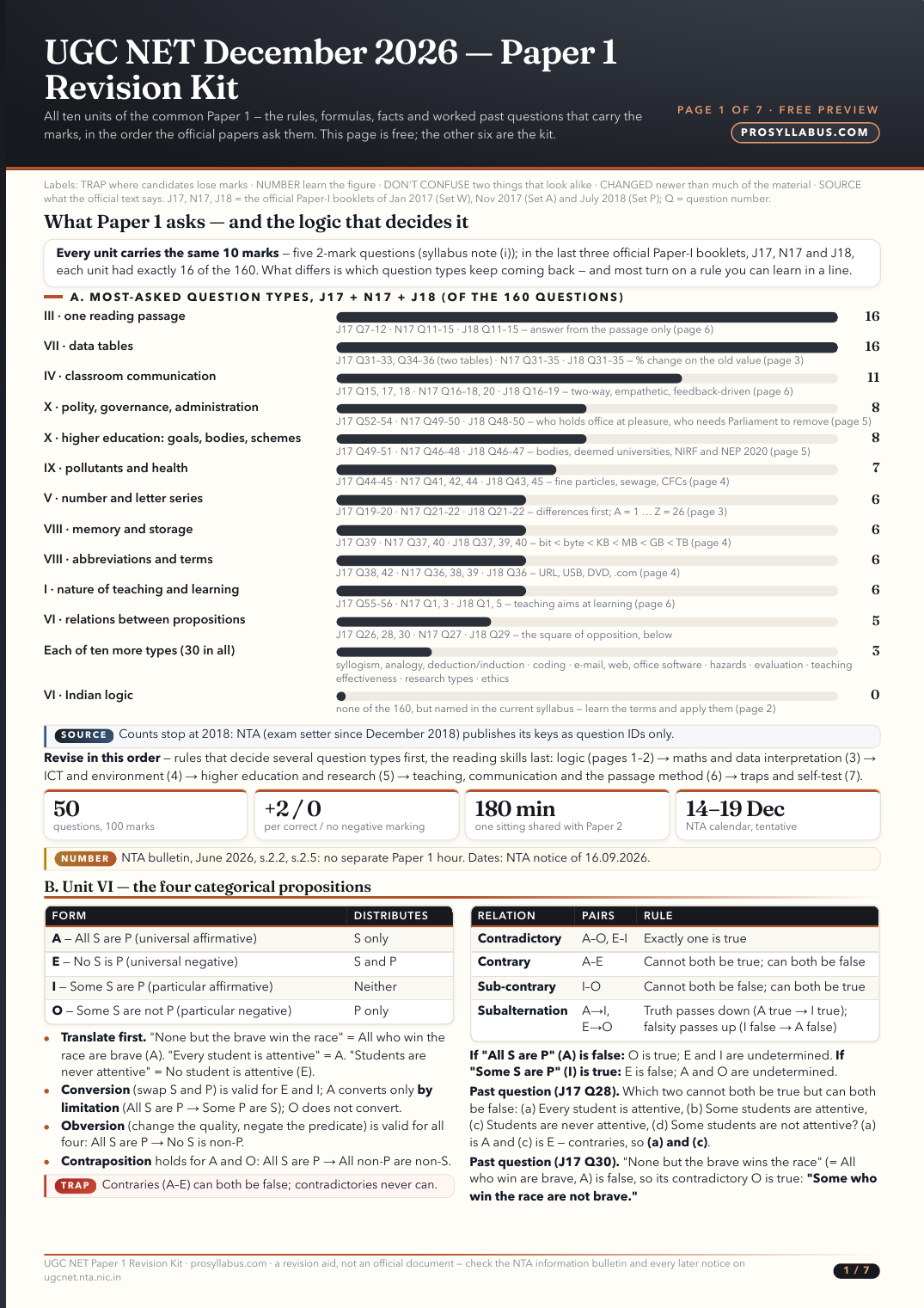
The last three Paper 1 booklets published with their questions (January 2017, November 2017 and July 2018, before NTA took over) follow the same rule: when we counted them, each unit had 16 of the 160 questions. NTA has run the exam since December 2018 and publishes its answer keys as question and option numbers only, so later papers cannot be counted this way.
What a percentile on your score card means
The bulletin defines it in Appendix VIII: the percentile is calculated inside your own shift as 100 × (the number of candidates in that shift with a raw score equal to or less than yours) ÷ (the number who appeared in that shift). The topper of every shift gets exactly 100. It is calculated to seven decimal places "to avoid bunching effect and reduce ties", and it is not a percentage of marks.
Normalised marks: how NTA puts different shifts on one scale
A subject held in two or more shifts gets different question papers in each. From the December 2024 bulletin onwards, NTA converts raw marks with the equi-percentile method in Appendix IX, designed by a committee of professors from the Indian Statistical Institute Delhi, IIT Delhi and the University of Delhi. In three steps:
The three steps (bulletin Appendix IX)
- Step 1. Inside each shift, convert every raw score to a percentile with the formula above.
- Step 2. Line all shifts up by percentile. For every percentile that occurs, find the raw score that corresponds to it in each shift, filling gaps by linear interpolation between the nearest scores above and below.
- Step 3. The normalised mark for that percentile is the average of those raw scores across the shifts.
The June 2024 bulletin had only the percentile-score method (Appendix VI there), and that cycle's cut-offs for five multi-shift subjects were printed as percentiles. Since December 2024 every cut-off has been printed in marks.
| Percentile | Shift 1 raw | Shift 2 raw | Shift 3 raw | Shift 4 raw | Normalised mark (average) |
|---|---|---|---|---|---|
| 100 | 200 | 194 | 188 | 200 | 195.5 |
| 99.9691438 | 192 | 171.96504 | 186 | 171.96504 | 180.4825 |
| 99.4320538 | 180 | 155.09028 | 172 | 155.09028 | 165.5451 |
Three rows of the bulletin's own four-shift illustration. Read the first: the toppers of the four shifts scored 200, 194, 188 and 200, so a topper's normalised mark is 195.5 whichever shift they sat. The decimals in shifts 2 and 4 are the interpolated scores from step 2. The illustration elsewhere shows negative raw scores, which cannot happen in UGC NET without negative marking, so treat it as NTA's generic example of the method rather than UGC NET data.
From the NTA bulletin, Appendix IX, Step 3 table.
Marks to percentile: what the official method lets you know
No official table converts UGC NET marks to a percentile. The percentile depends on how everyone in your shift scored, and NTA does not publish shift-wise score distributions. Any "marks vs percentile" chart for UGC NET is somebody's estimate, and this page does not print one. What the official documents do let you work out is the useful part:
What you can compute from official numbers
- Your total out of 300 is 2 × your correct answers, because every question is worth 2 and nothing is deducted.
- The minimum to be considered at all is 40% of 300, which is 120 marks or 60 correct answers (General and EWS), or 35%, which is 105 marks or 53 correct answers (reserved categories). Our arithmetic on bulletin section 6.3.
- The cut-off you are measured against is printed in marks for every subject since December 2024, so the honest target is "marks above past cut-offs", not a percentile.
| Cut-off (out of 300) | Correct answers needed (of 150) | Example from June 2026 |
|---|---|---|
| 120 | 60 | the 40% minimum for General and EWS |
| 150 | 75 | Hindi PhD only, General |
| 170 | 85 | Political Science PhD only, General |
| 196 | 98 | Political Science Assistant Professor, General |
| 222 | 111 | Political Science JRF, General |
| 250 | 125 | Geography JRF, General |
Correct answers needed is the cut-off divided by 2, rounded up (our arithmetic); the examples are from the NTA June 2026 cut-off PDF. Seen this way, the gap between Assistant Professor and JRF in Political Science in June 2026 was 13 more correct answers out of 150.
Questions
Is there negative marking in UGC NET?
No. Each correct answer earns 2 marks and a wrong or unanswered question earns 0, in both papers (bulletin section 2.5).
How long is Paper 1?
There is no separate duration. Paper 1 and Paper 2 are taken together in one 180-minute sitting without a break, and you divide the time yourself.
Is there a qualifying mark for Paper 1?
No. You need at least 40% of the aggregate of both papers (35% for reserved categories) and then the subject and category cut-off, which is also a total of both papers.
How many questions come from each Paper 1 unit?
Five, each carrying 2 marks, from each of the ten units. That is the rule printed in the official Paper 1 syllabus.
Is the percentile the same as the percentage of marks?
No. The percentile is the share of candidates in your shift who scored equal to or less than you. Someone with 60% of the marks can be in the 99th percentile if most of the shift scored less.
What are normalised marks?
For a subject held in several shifts, NTA puts every shift on one scale: it matches candidates across shifts by percentile and takes the average of the raw scores at that percentile. The cut-off is then applied to normalised marks.
Can I convert my expected marks into a percentile before the result?
Not from any official source. NTA does not publish shift-wise distributions. Compare your expected total with past cut-offs in marks instead.
Practise it, don't just read it
Ten units, five questions each, 10 marks each: Paper 1 rewards covering every unit rather than going deep in two. A timed five-question set per unit is the fastest way to find the unit that is costing you marks.
Nine UGC NET quizzes are live on ProSyllabus today, all on Paper 1: teaching aptitude, research types and methods, research aptitude, reading comprehension, syllogisms and fallacies, logical reasoning, mathematical reasoning, ICT, and the higher education system. There is no Paper 2 subject quiz yet.
ProSyllabus is an independent study site. It is not part of the National Testing Agency (NTA), which conducts UGC-NET, or of the University Grants Commission (UGC). Always confirm on ugcnet.nta.nic.in and nta.ac.in.
More in this series
- UGC NET cut-offs by subject and category, every cycle since 2023
- UGC NET JRF vs Assistant Professor vs PhD only
- UGC NET previous papers and official answer keys
- UGC NET December 2026 dates and every past cycle's timeline
- UGC NET notice board — alerts and updates
- UGC NET exam day: time management and CBT
- UGC NET syllabus and a study plan
- CSIR NET: JRF vs Assistant Professor
Sources
- official — NTA — Information Bulletin, UGC-NET June 2026 (as on 30.04.2026): pattern (s.2.2), marking (s.2.5), eligibility and age (ch.3), result procedure (s.6.3), normalisation (Appendices VIII and IX), subject codes (Appendix II)
- official — NTA — Information Bulletin, UGC-NET December 2024 (first bulletin with the equi-percentile normalised-marks appendix)
- official — NTA — Information Bulletin, UGC-NET June 2024 (percentile-score normalisation only)
- official — UGC NET Bureau — syllabus, General Paper on Teaching and Research Aptitude, Paper-I (code 00): ten units, "Five questions each carrying 2 marks are to be set from each Module"
- official — NTA — UGC-NET June 2026, (84) subjects, subject/category-wise cut-off marks (published with the result, 28.08.2026)
- official — NTA — UGC-NET June 2026 re-examination of 9 and 10 September 2026 (English, Commerce, Sociology), subject/category-wise cut-off marks (17.09.2026)
- official — UGC-NET portal (ugcnet.nta.nic.in) — notices, answer keys, results
official = a document published by the conducting body. reported = a news or coaching site we could not check against an original. Where sources disagree this page says so rather than picking one.