
Checked 13 October 2026. Criteria from SIRI’s assessment guide for Studieprøven written production, October 2022 (Wayback capture of 12 September 2025; no longer on danskogproever.dk, and a newer edition may exist on SIRI’s assessor-training site). Task format from SIRI’s Studieprøven page and sample task. The task, both texts and every grade estimate are ours; only an examiner and an appointed censor together give a grade (BEK 1687/2025 §33).
- Cheatsheet + revision sheet: key concepts in 2 lines each
- All 7 parts: time, aids, marking
- 400-word text: plan for 4 points
- 1 model text of about 414 words
- 5-minute presentation frame
- 20 connectors, 14 grammar points
Studieprøven skriftlig fremstilling eksempel: what you can and cannot get from a model text
SIRI publishes one passed answer to its sample task “Forbrug”, and nothing on the candidate page says what grade it received. Its assessment guide for censors does: the same answer is printed there as the “besvarelse til karakteren 7”, with a page of reasons [official: assessment guide, October 2022]. So the one official model you can download is a 7 — a good answer, not a perfect one, with tense errors and an argument the censors call imprecise in places.
That guide contains six graded answers in all, to three different tasks, but it was written as an internal tool for censors and teachers and is no longer on danskogproever.dk. We do not reprint its answers. Instead this page does what a teacher would do: it sets one task of our own, gives two answers of our own — one that would struggle and one that would do well — and reads both against the criteria SIRI gave its censors. The format and the three hours of the test are in the written exam guide; this page is about quality.
Where other pages get this wrong
The grades on this page are our estimates, not SIRI’s.
Commonly published instead: Model answers labelled “a 12 answer” or “guaranteed pass”, with no source for the grade.
A Studieprøven written answer is graded by an examiner and an appointed censor together (BEK 1687/2025 §33, §34) against SIRI’s criteria, and SIRI describes only three grades in full: 12, 7 and 02. We place each text between those descriptions and say why. Nobody outside the assessors can promise a grade.
The criteria in three rows
SIRI’s censors are asked to make an overall judgement first and then check it against a sheet with six lines: one for each of the four points (conveying facts, explanation, perspective and assessment, position and argument), one for organisation and coherence, and one for vocabulary, syntax, morphology and spelling. Each line is ticked as top, middle, bottom or below level [official: assessor sheet]. The descriptions behind the ticks, shortened and translated by us:
| Grade | SIRI’s words for it | The four points | Coherence | Language |
|---|---|---|---|---|
| 12 | Den fremragende præstation: særdeles god opfyldelse af de faglige mål | The most important facts are conveyed suitably and precisely, and the issues they reflect are clear. Explanations and perspectives are developed, clear and well reasoned. A clear position is taken, reasoned and nuanced in a consistent and very developed argument | The text hangs together very well and is very well organised, with many precise and varied linking words that support the message | Very good syntactic complexity and variation: many varied sentences with several subordinate clauses. Nuanced word choice. Only few spelling or grammar errors, and they do not disturb the reading |
| 7 | Den gode præstation: god opfyldelse af de faglige mål | The facts are conveyed mostly suitably. Explanations and perspectives are presented clearly and suitably, but in a few places without reasons. A position is taken and reasoned with a coherent, mostly clear argument | Hangs together well and is mostly well organised. Linking words are mostly suitable but somewhat stereotyped; faults can disturb the reading slightly but do not hinder understanding | Good syntactic complexity and some variation. Word choice allows precise writing about complex topics, with some stereotypy. Spelling and grammar errors bother the reading slightly but do not hinder understanding |
| 02 | Den tilstrækkelige præstation: en netop acceptabel grad af opfyldelse | Only the very broad main features of the facts are conveyed; several significant points are not mentioned or specified. Explanations and perspectives are both there, but only to a lesser degree supported with reasons or examples, so they can seem unclear. A position is taken and supported by arguments, but the argument as a whole is unclear and incoherent in several places | Only to a lesser degree coherent, with little organisation and little suitable use of linking words. Faults can hinder understanding to some degree, but the meaning can always be worked out from the context | Typically only little syntactic complexity and variation. Word choice just makes it possible to write about complex topics. Errors can hinder understanding, but the meaning can always be worked out from the context |
The grades 10 and 4 have no description of their own; on the 7-point scale they stand for “fortrinlig” and “jævn”, between the three that are described. Two things in the guide decide most borderline cases [official]. First, the four points weigh most: language is judged by how far it supports them and “kan ikke i sig selv begrunde en karakter” — cannot justify a grade on its own. Second, in points 2 to 4 one matter developed and nuanced counts for more than several that are only listed.
The task (ours, with invented figures)
Opgave: Unge og læsning (our own task; the figures are invented for practice)
Opgave
• Beskriv kort de vigtigste træk i udviklingen i de unges læsning og medieforbrug fra 2010 til 2022.
• Hvilke årsager kan der være til udviklingen?
• Hvilke konsekvenser vurderer du, at udviklingen kan få for de unge og for samfundet?
• Tag stilling til udsagnet: ”Man lærer lige så meget af at se film og serier som af at læse bøger.” (Besvarelsen af dette punkt skal udgøre mindst 25 % af den samlede besvarelse.)
Du skal skrive mindst 400 ord.
English: It is often discussed whether young people read fewer books than before while spending more time on films, series and social media. Some think this weakens their language and concentration; others stress that you also learn a lot from other media. Task: describe briefly the main features of the development in young people’s reading and media use from 2010 to 2022 · what causes can there be · what consequences do you judge the development can have for the young and for society · take a position on the statement “You learn just as much from watching films and series as from reading books” (at least 25% of the answer). At least 400 words.
| 2010 | 2016 | 2022 | Tabel 1 (invented) |
|---|---|---|---|
| 46 % | 39 % | 31 % | Andel af 16-24-årige, der læser i en bog mindst én gang om ugen |
| 2010 | 2022 | Tabel 2 (invented): minutter om dagen blandt 16-24-årige |
|---|---|---|
| 35 | 110 | Streaming af film og serier |
| 40 | 95 | Sociale medier |
| 27 | 14 | Bøger |
Write your own answer before reading on, by hand if you can, with the dictionary you will bring to the test. Then paste it into the checker further down and compare it with the two texts.
- Cheatsheet + revision sheet: key concepts in 2 lines each
- All 7 parts: time, aids, marking
- 400-word text: plan for 4 points
- 1 model text of about 414 words
- 5-minute presentation frame
- 20 connectors, 14 grammar points
Text A: the weaker answer
Text A contains errors on purpose. They are the errors a C1 candidate under time pressure typically makes, and every one is listed in the table after the text. Do not learn from its sentences.
Tekst A (our own text, written with deliberate errors)
Der er mange årsager til det. Den første årsag er, at alle unge har en mobiltelefon i dag. Den anden årsag er, at der er mange serier på nettet, og de er spændende. Den tredje årsag er, at bøger er dyre. Den fjerde årsag er, at de unge har ikke tid, fordi de har meget travlt med skole og arbejde. Forældrene læser heller ikke så meget mere, så børnene lærer det ikke hjemmefra.
Jeg synes, at det er en dårlig udvikling for samfundet. Når de unge læser ikke bøger, de bliver dårligere til at skrive, og det er et stor problem i uddannelsen. Det kan også være et problem for demokratiet. Men det er også godt, at de unge kan finde informationer hurtigt på nettet. På den måde kan man sige, at udviklingen har både fordele og ulemper, og det er svært at sige, hvad der sker i fremtiden.
Jeg er ikke enig i udsagnet. Man lærer mere af bøger end af film. Når man læser en bog, man skal tænke selv, men når man ser en film, man bare kigger. Jeg har selv lært meget dansk af at læse bøger. Derfor mener jeg, at bøger er bedre end film, og at de unge skal læse mere.
English: (Gist, not word for word.) The table shows that young people read less: 46 per cent in 2010, only 31 in 2022. The other table shows time use: much time on streaming and social media, not much on books (110, 95 and 14 minutes). There are many causes: every young person has a phone; there are many exciting series; books are expensive; the young have no time; parents do not read much either. I think it is a bad development for society: when the young do not read they get worse at writing, and it may be a problem for democracy, but it is good that they can find information fast. I do not agree with the statement. You learn more from books than from films, because you have to think for yourself. I have learnt much Danish from books. So books are better than films, and the young should read more.
By our count text A has 286 words, and its last paragraph, point 4, has 58: 20.3% of the text.
| In text A | What is wrong | Correct |
|---|---|---|
| I 2010 det var 46 procent … i 2022 det var kun 31 procent | Verb second: a time phrase in first place must be followed by the verb | I 2010 var det 46 procent … i 2022 var det kun 31 procent |
| … at de unge har ikke tid | Subordinate clause: ikke stands before the finite verb | … at de unge ikke har tid |
| Når de unge læser ikke bøger, de bliver dårligere … | Two errors: ikke before the verb in the når-clause, and the main clause must then start with its verb | Når de unge ikke læser bøger, bliver de dårligere … |
| et stor problem | Agreement: problem is an et-word, so the adjective takes -t | et stort problem |
| Når man læser en bog, man skal tænke selv | Verb second after a fronted clause | Når man læser en bog, skal man tænke selv |
| … når man ser en film, man bare kigger | Verb second again, and bare belongs after the verb in a main clause | … når man ser en film, kigger man bare |
The errors are not what sinks text A. Read against the criteria, the problems are these:
| Line | Text A | Closest description |
|---|---|---|
| Point 1: facts | Gives the two end figures of table 1 and the three 2022 figures of table 2, but never says that table 2 compares two years, so the growth in streaming and the fall in book time, the main point of the table, is missing | 02: “de meget overordnede hovedtræk” are conveyed, several significant points are not mentioned |
| Point 2: causes | Five causes in five short sentences. None is developed beyond one short clause, none is hedged, and “bøger er dyre” has no link to the tables | 02: explanations only to a lesser degree supported. The guide values one developed cause over several listed ones |
| Point 3: assessment | An assessment is given, but “et problem for demokratiet” is not explained, and the paragraph ends by saying it is hard to say | 02: perspectives present but can seem unclear |
| Point 4: position | The position is clear. The argument is one idea said twice, plus a personal experience. No nuance, no objection met | Between 02 and 7: a position supported by an argument, but hardly “udfoldet” |
| Coherence | One paragraph per point, which helps. Linking is a list: den første årsag, den anden årsag … and også, men, derfor | 02 to 7: organised, but stereotyped and thin |
| Language | Mostly short main clauses, few sentences with several subordinate clauses that succeed, everyday vocabulary (godt, dårligt, meget). The errors never block understanding | 02: “kun mindre syntaktisk kompleksitet og variation” |
Our estimate for text A: 02, at most 4. It answers all four points and can always be understood, which is what keeps it at the pass mark. Two further things are simply counted: it has 286 words where the task says at least 400, and point 4 is 20.3% of the text where the task says at least 25%. The assessment guide we read does not say how censors treat a text that is too short, so we cannot tell you what that costs; SIRI’s candidate page says only that you must write at least 400 words. Do not find out in the exam room.
Text B: the stronger answer
Tekst B (our own text)
Der kan være flere forklaringer på denne udvikling. Den mest oplagte er formentlig, at smartphonen har gjort film, serier og sociale medier tilgængelige overalt, så de konkurrerer direkte med bogen om de unges fritid. Dertil kommer, at streamingtjenester og sociale medier er bygget til at fastholde brugeren, idet det næste afsnit eller opslag begynder af sig selv, mens en bog kræver, at læseren selv holder koncentrationen. Endelig kan det spille en rolle, at mange unge forbinder læsning med skolearbejde og derfor ikke opfatter det som afslapning.
Efter min vurdering kan udviklingen få mærkbare konsekvenser. Den, der sjældent læser længere tekster, får sandsynligvis sværere ved at fastholde opmærksomheden og et mindre ordforråd, og det kan blive et problem på de videregående uddannelser, hvor det netop kræves, at man kan tilegne sig store mængder tekst. På samfundsplan risikerer forskellen mellem dem, der læser, og dem, der ikke gør, at vokse. Omvendt bør man ikke overse, at de unge i dag møder langt mere engelsk og flere kulturer gennem skærmen, end tidligere generationer gjorde.
Jeg er kun delvist enig i udsagnet om, at man lærer lige så meget af at se film og serier som af at læse bøger. Det afhænger nemlig af, hvad man forstår ved at lære. Hvis det drejer sig om viden om verden, kan en god dokumentarfilm være lige så oplysende som en bog, og et fremmedsprog lærer mange netop ved at høre det i serier. I den forstand har udsagnet noget på sig.
Når det gælder evnen til at fordybe sig og følge en lang argumentation, mener jeg imidlertid, at bogen har et forspring. Læseren må selv danne billederne og holde sammen på tankerne, hvorimod filmen leverer det hele færdigt og i sit eget tempo. Man kan indvende, at også film kan være krævende, men de fleste serier er lavet til at blive set uden anstrengelse. Derfor mener jeg, at film og serier kan supplere læsningen, men ikke erstatte den, og at det er den kombination, de unge har mest gavn af.
English: The tables show that young people aged 16 to 24 read markedly less than before. The share who read in a book at least once a week fell from 46 per cent in 2010 to 31 per cent in 2022, that is by 15 percentage points. In the same period the time they spend daily on streaming more than tripled, while time on social media more than doubled. The time they spend on books, by contrast, fell from 27 to 14 minutes a day, close to a halving. — There can be several explanations. The most obvious is probably that the smartphone has made films, series and social media available everywhere, so they compete directly with the book for young people’s free time. In addition, streaming services and social media are built to hold on to the user, as the next episode or post starts by itself, whereas a book requires the reader to keep up concentration. Finally, it may play a part that many young people associate reading with school work and so do not see it as relaxation. — In my assessment the development can have noticeable consequences. Someone who rarely reads longer texts will probably find it harder to hold attention and will have a smaller vocabulary, which can become a problem in higher education, where one is required to take in large amounts of text. At the level of society, the gap between those who read and those who do not risks growing. Conversely, one should not overlook that young people today meet far more English and more cultures through the screen than earlier generations did. — I only partly agree with the statement. It depends on what one means by learning. If it is knowledge about the world, a good documentary can be as enlightening as a book, and many learn a foreign language precisely by hearing it in series. In that sense the statement has something to it. — When it comes to the ability to immerse oneself and follow a long argument, however, I think the book has a lead. The reader must form the pictures and hold the thoughts together, whereas the film delivers everything finished and at its own pace. One can object that films too can be demanding, but most series are made to be watched without effort. So I think films and series can supplement reading but not replace it, and that it is that combination young people benefit from most.
By our count text B has 421 words, and its last two paragraphs, point 4, have 163: 38.7% of the text.
| Line | Text B | Closest description |
|---|---|---|
| Point 1: facts | Names both tables, gives the direction and the size of each change (15 percentage points; more than tripled; more than doubled; close to a halving) and sets the rise beside the fall. A reader who cannot see the tables has the picture | 12: the most important facts conveyed “hensigtsmæssigt og præcist” |
| Point 2: causes | Three causes, each with its mechanism (available everywhere; built to hold the user; associated with school), each marked as a possibility: formentlig, kan | 12: explanations “udfoldet”, clear and well reasoned |
| Point 3: assessment | Consequences for the individual and for society, each with a reason, and one consideration that speaks the other way (omvendt …) | 12 for the first two; the counter-consideration is stated rather than developed, which is more like 7 |
| Point 4: position | A clear, partly agreeing position in the first sentence; a distinction (what does learning mean?); an argument for each side; a possible objection named and answered; a conclusion | 12: a clear position, reasoned and nuanced in a consistent, developed argument |
| Coherence | One paragraph for each of points 1 to 3 and two for point 4. Varied linking words that carry the argument: derimod, dertil kommer, endelig, omvendt, nemlig, imidlertid, hvorimod, derfor | 12: many precise and varied “sammenhængsmarkører” |
| Language | Sentences with several subordinate clauses, relative clauses, a cleft sentence, s-passive, hvilket for a whole clause; topic vocabulary (tilegne sig, fastholde, fordybe sig, forspring) | 12 if it is as correct in your handwriting as on this page |
Our estimate for text B: 10 to 12. It is not a text to memorise: its arguments are ordinary, and a censor is told not to weigh how well informed they are. What it shows is the difference the criteria describe — fewer points, each developed; causes marked as possibilities; a position that is argued from both sides.
- Cheatsheet + revision sheet: key concepts in 2 lines each
- All 7 parts: time, aids, marking
- 400-word text: plan for 4 points
- 1 model text of about 414 words
- 5-minute presentation frame
- 20 connectors, 14 grammar points
The same four points, side by side
| Text A | Text B | |
|---|---|---|
| Words (our count) | 286 | 421 |
| Share of point 4 (our count) | 20.3% | 38.7% |
| Paragraphs | 4 | 5 |
| Causes given in point 2 | 5, listed | 3, each explained |
| Words that mark a guess or a judgement | none in point 2 | formentlig, kan, sandsynligvis, risikerer, efter min vurdering |
| How point 4 treats the other side | not mentioned | conceded in one paragraph, limited in the next |
| Our estimate | 02, at most 4 | 10 to 12 |
Both texts and both counts are ours. The 400-word minimum is in the regulation; the 25% share for point 4 is printed in SIRI’s sample task.
For scale: SIRI’s published passed answer, the one its guide grades 7, runs to about 458 words by our count of the PDF text, of which about 134, or 29%, answer point 4. Text B is a little shorter and would be placed higher. More words do not make a higher grade; a developed point does.
A structure that fits the criteria
| Paragraph | Point | What goes in | Share of the text (our advice) |
|---|---|---|---|
| 1 | Describe | Name each chart or table; the direction and size of the main change; one comparison. No causes and no opinions yet | about 15–20% |
| 2 | Explain | Two or three causes. For each: the cause, how it works, a word that marks it as a possibility | about 20–25% |
| 3 | Assess | What you judge the consequences to be, or what could be done, with reasons; one consideration that points the other way | about 20–25% |
| 4 (and 5) | Take a position | Your position in the first sentence; an argument; if you can, the strongest objection and your answer to it; a one-sentence conclusion | at least 25% where the task says so; a third is safer |
The shares are our advice, not a rule. The only share a task prints is the 25% for the last point, in SIRI’s sample task. Whether every real task prints it is not something SIRI’s pages say, so read the line under point 4 on the day.
The checker needs scripts. Without them: count your words, check that the last point is at least a quarter of them, and go through the nine lines of the checklist in the tool by hand.
The same exam on seven printable pages
Two texts show the difference on one task. The kit gives you the plan and the Danish to build your own on any task.
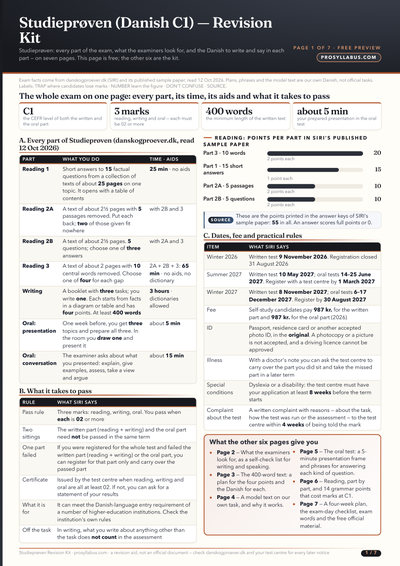
The Studieprøven revision kit is a seven-page PDF in English with the Danish you need: the whole exam on one page, what SIRI says is assessed turned into a self-check list, a plan and the Danish for each of the four points of the 400-word text, a full model text on a task of our own, the 30 minutes of the oral with a frame for the 5-minute presentation and phrases for each kind of question, reading part by part with 14 grammar points, and a four-week plan. Its exam facts come from danskogproever.dk; its model texts are our own, never official tasks. Page 1 is free to read in full before you decide.
Where to go next
If your text looks more like A than B, work on one point at a time: the self-study plan gives points 1–2 and points 3–4 a week each, and its 20 drills cover the word-order errors in text A. For practice tasks in the other parts, see the examples guide. And remember what the written grade is for: reading and writing must both reach 02 in the same term (the pass rule), and some programmes ask for more than a pass in writing (university requirements).
Frequently asked questions
What grade did SIRI’s published sample answer get?
SIRI’s assessment guide of October 2022 prints the same answer as its example of the grade 7.
How many words must the Studieprøven written text have?
At least 400. SIRI’s sample task also asks for the last point to be at least 25% of the answer.
Are the grades on this page official?
No. They are our estimates against SIRI’s published descriptions. Only the examiner and the appointed censor give a grade.
Which grades does SIRI describe in full?
12, 7 and 02. The grades 10 and 4 lie between them on the 7-point scale.
Does grammar decide the grade?
Not on its own. The guide says language and coherence are judged by how far they support the four points and cannot justify a grade by themselves.
Is it better to give many causes or few?
Few, developed. The guide says developing and nuancing one matter counts for more than listing several.
Must I agree or disagree completely in point 4?
No. The guide says partly agreeing is also a clear position, as long as you argue for it.
Do I need examples and counter-arguments?
They are not required, but the guide says they typically mark the exceptionally good answer (“den særdeles gode besvarelse”).
What happens if I write fewer than 400 words?
The assessment guide we read does not say. The requirement itself is clear: at least 400 words.
Can I write points 2 and 3 in one paragraph?
You can, but the censor must then judge whether both are answered. Separate paragraphs make that easy.
More in this series
- The pass rule: 02 in all three parts, reading and writing in one term (checker)
- The written day: reading strategies, a practice text and a reading clock; the 400-word essay (word planner)
- The oral: three topics, one drawn by lot, 5 + 15 minutes; ten example topics, two outlines, timer and self-check
- Self-study: the 1,974 kr fee, deadlines, the ~10 test centres, pass rates (calculators)
- Studieprøven or PD3: which test for university, citizenship, residence and STPS (chooser)
- Examples: one original task for each part, with what the censors look for
- University: the Studieprøven grades six Danish universities ask for (checker)
- The whole test in English: format, grades, dates, fee, and a dated timeline
- Preparation: an eight-week plan, a C1 grammar checklist and 20 drills
- Studieprøven notice board — official updates
Sources
- official — SIRI — Bedømmelsesvejledning, Studieprøven, skriftlig fremstilling, October 2022 (PDF, 28 pages; Wayback capture of 12 Sep 2025 — the file is no longer on danskogproever.dk)
- official — SIRI — Studieprøven bedømmerark, skriftlig fremstilling (assessor sheet, DOCX; Wayback capture of 12 Sep 2025)
- official — SIRI — Om bedømmelse ved danskprøverne (says the assessment guides are on SIRI’s assessor-training site)
- official — SIRI — Om Studieprøven og krav til at bestå (for candidates)
- official — SIRI — Om Studieprøven (SP): indhold og niveau (the page for language centres: focus and task type of each part)
- official — SIRI sample — SP written production task ("Opgave 3 Forbrug") (PDF)
- official — SIRI sample — example of a passed Studieprøven written answer, “Forbrug” (PDF)
- official — BEK nr 1687 af 16/12/2025 — tests in Danish education for adult foreigners, with bilag 1–3 (retsinformation.dk)
- official — BEK nr 1759 af 30/12/2024 — the 7-point grading scale for the Danish tests (retsinformation.dk)
official = a document published by the conducting body. reported = a news or coaching site we could not check against an original. Where sources disagree this page says so rather than picking one.


