

Checked 13 October 2026. Format from SIRI’s Studieprøven pages (for candidates and for language centres) and its published sample paper, read 12–13 October 2026. Assessment criteria from SIRI’s assessment guides for Studieprøven (written, October 2022; oral, May 2024), read from Wayback captures of 12 September 2025 because the files are no longer on danskogproever.dk. Every Danish task and text on this page is our own; names and figures in them are invented.
- Cheatsheet + revision sheet: key concepts in 2 lines each
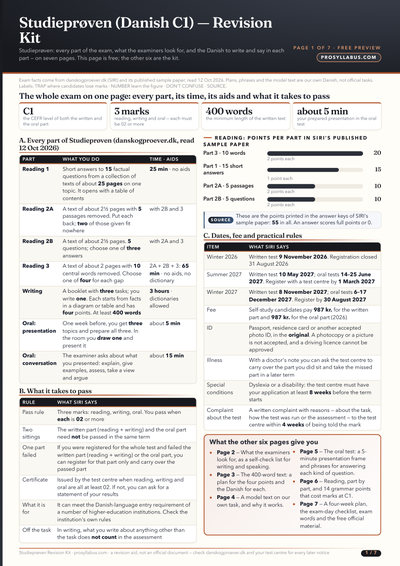
- All 7 parts: time, aids, marking
- 400-word text: plan for 4 points
- 1 model text of about 414 words
- 5-minute presentation frame
- 20 connectors, 14 grammar points
Studieprøven eksempler: what this set is, and what it is not
SIRI publishes exactly one sample of Studieprøven: one reading test with keys, one written task with a passed answer, one oral task sheet and a video of a passed oral. They are free on danskogproever.dk, and the written exam guide walks through them. Once you have sat them, they are used up. This page gives you something to practise on before you open them: one task of our own for each part, built in the official format, with the key, the reason for every answer and what the censors are told to look for.
Three things to know before you start. First, every task here is original; none is an official task and none is copied from a course book. Second, the towns, schools, associations and figures in the texts are invented for practice, so do not quote them anywhere. Third, the reading tasks are scaled down: a real delprøve 1 has about 25 pages of text and 15 questions, which no web page can reproduce. The table shows the real size beside ours.
| Part | In the real test | In this mini set | Suggested time (ours) |
|---|---|---|---|
| Reading, delprøve 1 | About 25 standard pages of factual texts on one theme, with a table of contents; 15 short-answer questions; 25 minutes | Three short texts with a table of contents; 5 questions | 4 minutes |
| Reading, delprøve 2A | A text of about 2.5 pages with 5 passages removed; 7 passages to choose from, 2 of which fit nowhere | A short text with 3 gaps; 4 passages, 1 of which fits nowhere | 6 minutes |
| Reading, delprøve 2B | A text of about 2.5 pages; 5 questions, 3 options each | A short text; 3 questions, 3 options each | 5 minutes |
| Reading, delprøve 3 | A text of about 2 pages with 10 central words removed; 4 options for each | One paragraph with 4 gaps; 4 options for each | 4 minutes |
| Written production | One task chosen from three; facts in a chart or table, a short introduction, four points; at least 400 words; 3 hours; dictionaries that are not internet-based allowed | One full task with invented figures | 3 hours, if you write it in full |
| Oral communication | Three topics prepared in advance, one drawn by lot; about 5 minutes of presentation, about 15 of questions; 30 minutes in all | A task sheet with three topics, a notes page for one and five questions | 5 + 15 minutes |
The left-hand column is from SIRI’s Studieprøven pages. The reading test allows no aids and no dictionary, so put yours away for the four reading tasks below.
Reading, delprøve 1: find five facts fast
SIRI’s page for language centres names the skill: reading fast to find and extract specific, factual information in large amounts of text. Its page for candidates adds the method: use the table of contents, get an overview, find where to read more closely, and write a short answer without information the question did not ask for [official]. Read the five questions first, then the table of contents, then only the lines you need.
Tekstsamling (our own; all names and figures invented)
1. Hvem er de frivillige? Tal fra Østerby Kommune
2. Foreningen Naboværket: sådan bliver du frivillig
3. Besøgsvenner på plejecentre: regler og forsikring
1. Hvem er de frivillige?
I en undersøgelse fra 2024 svarede 38 procent af de voksne i Østerby Kommune, at de havde udført frivilligt arbejde inden for det seneste år. Flest var aktive inden for idræt (14 procent), mens kun 4 procent arbejdede frivilligt på det sociale område. De frivillige brugte i gennemsnit 11 timer om måneden på arbejdet. Andelen var højest blandt de 40-49-årige og lavest blandt de 20-29-årige.
2. Foreningen Naboværket: sådan bliver du frivillig
Foreningen Naboværket blev stiftet i 2011 og har i dag omkring 260 frivillige. Nye frivillige begynder med et introduktionsmøde, som holdes den første tirsdag i hver måned. Derefter følger man en erfaren frivillig i tre uger, før man får sine egne opgaver. Det kræver ingen særlig uddannelse at blive frivillig, men man skal være fyldt 18 år. Foreningen betaler transportudgifter, hvis man har mere end ti kilometer til mødestedet.
3. Besøgsvenner på plejecentre: regler og forsikring
Frivillige, der besøger ældre på kommunens plejecentre, må ikke udføre opgaver, som personalet har ansvaret for, for eksempel at give medicin. De frivillige er dækket af kommunens ansvarsforsikring, mens de er på plejecentret, men ikke på vejen til og fra. Inden det første besøg skal den frivillige underskrive en erklæring om tavshedspligt. Besøgsvennerne mødes med plejecentrets leder fire gange om året for at dele erfaringer.
English: Three short texts about volunteering in an invented municipality: who the volunteers are, how to join an invented association, and the rules for volunteer visitors at care homes.
Spørgsmål — skriv et kort svar
2. Hvor mange timer om måneden brugte de frivillige i gennemsnit?
3. Hvor gammel skal man mindst være for at blive frivillig i Naboværket?
4. Hvad skal en besøgsven underskrive inden det første besøg?
5. Hvor længe følger en ny frivillig en erfaren frivillig?
English: 1. In which area were most volunteers active? 2. How many hours a month did the volunteers spend on average? 3. What is the minimum age to volunteer with Naboværket? 4. What must a volunteer visitor (besøgsven) sign before the first visit? 5. For how long does a new volunteer follow an experienced one?
Notice that the questions do not follow the order of the texts. In the real test the table of contents is what tells you which of some 25 pages to open.
Reading, delprøve 2A: put the passages back
Delprøve 2A tests careful reading of the whole: SIRI says you must understand the main points both of the text as a whole and of each passage [official]. The removed passages stand in random order on the task sheet, and some fit nowhere. The clues are words that point backwards (også, derfor, et år senere) and the sentence that follows each gap.
Tekst: Mobilfri skole – et års erfaringer (our own; the school is invented)
(1) ……
I frikvartererne er forandringen lettest at få øje på. Hvor eleverne tidligere sad hver for sig med skærmen, bliver der nu spillet bold og kortspil, og lærerne fortæller, at der er færre konflikter, som begynder på de sociale medier og fortsætter i klasseværelset.
(2) ……
Skolens ledelse understreger dog, at ordningen ikke løser alle problemer. Eleverne bruger stadig mange timer foran skærmen, når de kommer hjem, og det er netop om aftenen, at de fleste konflikter på nettet opstår.
(3) ……
Om andre skoler bør gå samme vej, er derfor ikke givet. Erfaringerne fra Søndervangskolen tyder på, at et forbud kan skabe ro i skoletiden, men at det kun virker, når elever, forældre og lærere forstår, hvorfor det er indført.
English: A text about an invented school one year after it began collecting pupils’ mobile phones each morning: the resistance at the start, the change in the breaks, what the ban does not solve, and whether other schools should follow.
Afsnit A–D (ét afsnit passer ikke i teksten)
B. Også i timerne mærker lærerne en forskel. De skal ikke længere bruge tid på at bede eleverne lægge telefonen væk, og flere elever fortæller, at de har lettere ved at koncentrere sig, når fristelsen ikke ligger i lommen.
C. Derfor har skolen suppleret forbuddet med undervisning i digital dannelse, hvor eleverne blandt andet taler om, hvordan man skriver til hinanden på nettet, og forældrene er blevet inviteret til møder om børnenes skærmvaner derhjemme.
D. Af samme grund har kommunen besluttet at købe nye computere til alle elever i udskolingen, så de kan aflevere deres opgaver digitalt og følge med i undervisningen hjemmefra.
English: A: a year later the criticism has almost fallen silent; three in four pupils are satisfied. B: in lessons too, teachers notice a difference. C: so the school has added teaching in digital literacy and meetings for parents. D: for the same reason the municipality has decided to buy new computers for the oldest pupils.
Reading, delprøve 2B: three questions, three options
The skill is the same careful reading, now of an informing or discussing text [official]. The trap is an option that is true in general, or that repeats words from the text, but is not what this text says.
Tekst: Gratis busser – en god idé? (our own; the town and its figures are invented)
Ser man nærmere på tallene, er billedet imidlertid mindre entydigt. De fleste nye passagerer er ikke tidligere bilister, men mennesker, som før gik eller cyklede. Biltrafikken i byens centrum er stort set uændret, og kommunen bruger nu penge på busdriften, som ellers kunne være gået til nye cykelstier eller hyppigere afgange.
Det betyder ikke, at forsøget er mislykket. Ældre og unge uden bil kommer mere ud, og butikkerne i centrum melder om flere kunder. Men hvis målet er at mindske biltrafikken, er gratis busser næppe nok i sig selv. Erfaringen fra Nordhavn tyder på, at prisen betyder mindre for bilisterne end rejsetiden, og at det derfor er vigtigere, at bussen kører ofte og hurtigt, end at den er gratis.
English: A discussing text about free buses in an invented town: passenger numbers are up by a third, but most new passengers used to walk or cycle, car traffic in the centre is largely unchanged, and frequency and speed matter more to drivers than the price.
Spørgsmål 1–3
A. Biltrafikken i centrum er faldet med en tredjedel.
B. Der er kommet flere buspassagerer, men ikke færre biler i centrum.
C. Kommunen har fået råd til flere cykelstier.
2. Hvem er de fleste nye passagerer?
A. Mennesker, som tidligere gik eller cyklede.
B. Mennesker, som tidligere kørte i bil.
C. Ældre, som tidligere ikke kom ud.
3. Hvad er tekstens hovedsynspunkt?
A. Gratis busser er spild af penge og bør afskaffes.
B. Gratis busser løser trafikproblemerne, hvis alle byer indfører dem.
C. Gratis busser har fordele, men mindsker ikke biltrafikken, medmindre busserne også kører ofte og hurtigt.
English: 1. What has happened in Nordhavn, according to the text, since the buses became free? 2. Who are most of the new passengers? 3. What is the main view of the text?
Reading, delprøve 3: the missing words
Delprøve 3 tests careful reading at single points in the text and the exact meaning of words and expressions [official]. Read the whole sentence around each gap, test all four words, and check the preposition as well as the meaning.
Tekst: Byhaver (our own)
(1) A. forsyne · B. forsørge · C. forsikre · D. forstyrre
(2) A. erstatte · B. estimere · C. etablere · D. eksistere
(3) A. mening · B. tid · C. lov · D. råd
(4) A. består · B. afhænger · C. handler · D. udgår
English: A paragraph about shared urban gardens: too small to supply residents with vegetables, valued as meeting places, cheap for municipalities to set up, but criticised for pushing rents up so that the original residents can no longer afford to stay.
- Cheatsheet + revision sheet: key concepts in 2 lines each
- All 7 parts: time, aids, marking
- 400-word text: plan for 4 points
- 1 model text of about 414 words
- 5-minute presentation frame
- 20 connectors, 14 grammar points
Answer key, with the reason for every answer
| Task | Key | Why |
|---|---|---|
| Delprøve 1, question 1 | Idræt | Text 1: “Flest var aktive inden for idræt (14 procent)”. The 38 per cent is everyone who volunteered, not an area |
| Delprøve 1, question 2 | 11 (timer) | Text 1: “i gennemsnit 11 timer om måneden” |
| Delprøve 1, question 3 | 18 år | Text 2: “man skal være fyldt 18 år” |
| Delprøve 1, question 4 | En erklæring om tavshedspligt | Text 3: a declaration of confidentiality, signed before the first visit |
| Delprøve 1, question 5 | Tre uger | Text 2: “følger man en erfaren frivillig i tre uger”. “Den første tirsdag i hver måned” is when the introduction meeting is held |
| Delprøve 2A, gap 1 | A | “Et år senere er kritikken næsten forstummet” answers the resistance in the first paragraph, and the paragraph after the gap starts describing the change |
| Delprøve 2A, gap 2 | B | “Også i timerne” needs an earlier place where a difference is noticed: the breaks, just before the gap |
| Delprøve 2A, gap 3 | C | “Derfor har skolen suppleret forbuddet” responds to the evening screen time just before it, and brings in the parents named in the last paragraph |
| Delprøve 2A, extra passage | D fits nowhere | Nothing in the text gives a “same reason” for buying computers, and the text is about phones, not about handing in work digitally |
| Delprøve 2B, question 1 | B | Passengers are up by a third, and “biltrafikken i byens centrum er stort set uændret”. A moves the third to car traffic; C reverses the point about cycle paths |
| Delprøve 2B, question 2 | A | “De fleste nye passagerer er ikke tidligere bilister, men mennesker, som før gik eller cyklede” |
| Delprøve 2B, question 3 | C | The text says the trial has not failed, but that free buses are “næppe nok i sig selv” and that frequency and speed matter more than price |
| Delprøve 3, gap 1 | A. forsyne | forsyne nogen med noget = supply. Forsørge is to support someone financially, forsikre to insure, forstyrre to disturb |
| Delprøve 3, gap 2 | C. etablere | A project is cheap to set up. Erstatte = replace, estimere = estimate, eksistere = exist (and takes no object) |
| Delprøve 3, gap 3 | D. råd | have råd til = be able to afford, which is what rising rents decide. Mening, tid and lov do not fit: “have mening til” is not Danish, and tid and lov do not describe what rising rents decide |
| Delprøve 3, gap 4 | B. afhænger | afhænge af = depend on. Bestå af is to consist of; handle and udgå do not take af in this sense |
Points. SIRI’s published sample keys give 1 point per correct answer in delprøve 1 and 2 points per correct answer in 2A, 2B and 3. Counted the same way, this mini set has 5 + 6 + 6 + 8 = 25 points (our arithmetic). No fixed number of points translates into a grade: SIRI adjusts its points-to-grade conversion table after each sitting [official: SIRI complaints guide], and we found no published table.
Written production: an original task in the official format
Every Studieprøven written task has the same skeleton: facts in a chart or table, a very short text that introduces the topic, and four points [official]. SIRI’s assessment guide explains why: each point tests one “sproghandling” (language act) that matters in higher education — conveying facts, explaining, assessing, and taking a position with arguments. Here is a task of ours in that skeleton. Its figures are invented.
Opgave: Hjemmearbejde (our own task; the figures are invented for practice)
Opgave
• Beskriv kort de vigtigste træk i udviklingen i hjemmearbejde fra 2019 til 2025 og de vigtigste forskelle mellem faggrupperne.
• Hvilke årsager kan der være til den udvikling og de forskelle, som tabellerne viser?
• Hvilke konsekvenser vurderer du, at udbredt hjemmearbejde kan få for arbejdspladserne og for samfundet?
• Tag stilling til udsagnet: ”Den, der arbejder hjemme, er en dårligere kollega.” (Besvarelsen af dette punkt skal udgøre mindst 25 % af den samlede besvarelse.)
Du skal skrive mindst 400 ord.
English: Since 2019 it has become far more common to work from home one or more days a week. Some see it as a gain for both employees and companies; others warn that the sense of community at work disappears. Task: describe briefly the main features of the development from 2019 to 2025 and the main differences between occupational groups · what causes can there be · what consequences do you judge that widespread working from home can have for workplaces and for society · take a position on the statement “The person who works from home is a worse colleague” (at least 25% of the answer). At least 400 words.
| 2019 | 2021 | 2023 | 2025 | Tabel 1 (invented) |
|---|---|---|---|---|
| 9 % | 34 % | 27 % | 26 % | Andel af beskæftigede, der arbejder hjemme mindst én dag om ugen |
| Tabel 2 (invented): andel i 2025 efter faggruppe | Andel |
|---|---|
| Kontor- og videnarbejde | 48 % |
| Undervisning | 12 % |
| Håndværk, transport og pleje | 3 % |
Before you write, plan one paragraph per point. The table gives an opening sentence in Danish for each; the rest is yours. Two complete model texts on a different task, with our estimate of the grade each would get, are in the essay guide.
| Point | A possible opening sentence (ours) | English |
|---|---|---|
| 1. Describe | Tabel 1 viser, at andelen af beskæftigede, der arbejder hjemme mindst én dag om ugen, steg fra 9 procent i 2019 til 34 procent i 2021, hvorefter den faldt til omkring en fjerdedel. | Table 1 shows that the share of employed people who work from home at least one day a week rose from 9 per cent in 2019 to 34 per cent in 2021, after which it fell to about a quarter. |
| 2. Explain | En nærliggende forklaring på den kraftige stigning er, at mange arbejdspladser under coronapandemien blev nødt til at lade medarbejderne arbejde hjemme. | An obvious explanation for the sharp rise is that many workplaces had to let their staff work from home during the corona pandemic. |
| 3. Assess | Efter min vurdering kan udbredt hjemmearbejde på længere sigt ændre både arbejdspladsernes indretning og bosætningsmønstret. | In my assessment, widespread working from home can in the longer run change both how workplaces are laid out and where people settle. |
| 4. Take a position | Jeg er overvejende uenig i udsagnet, fordi det forveksler fysisk tilstedeværelse med godt kollegaskab. | I mostly disagree with the statement, because it confuses physical presence with being a good colleague. |
What the censors look for in the written text
SIRI’s assessment guide for Studieprøven written production (October 2022) describes three grades in full: 12, 7 and 02. The table shortens and translates them; the wording is ours, the content SIRI’s. The guide is an internal working tool for censors and teachers and is no longer on danskogproever.dk, where SIRI now points to its assessor-training site, so we read it from an archived copy of 12 September 2025 and cannot rule out that a newer edition exists behind the login.
| Grade | SIRI’s words for it | The four points | Coherence | Language |
|---|---|---|---|---|
| 12 | Den fremragende præstation: særdeles god opfyldelse af de faglige mål | The most important facts are conveyed suitably and precisely, and the issues they reflect are clear. Explanations and perspectives are developed, clear and well reasoned. A clear position is taken, reasoned and nuanced in a consistent and very developed argument | The text hangs together very well and is very well organised, with many precise and varied linking words that support the message | Very good syntactic complexity and variation: many varied sentences with several subordinate clauses. Nuanced word choice. Only few spelling or grammar errors, and they do not disturb the reading |
| 7 | Den gode præstation: god opfyldelse af de faglige mål | The facts are conveyed mostly suitably. Explanations and perspectives are presented clearly and suitably, but in a few places without reasons. A position is taken and reasoned with a coherent, mostly clear argument | Hangs together well and is mostly well organised. Linking words are mostly suitable but somewhat stereotyped; faults can disturb the reading slightly but do not hinder understanding | Good syntactic complexity and some variation. Word choice allows precise writing about complex topics, with some stereotypy. Spelling and grammar errors bother the reading slightly but do not hinder understanding |
| 02 | Den tilstrækkelige præstation: en netop acceptabel grad af opfyldelse | Only the very broad main features of the facts are conveyed; several significant points are not mentioned or specified. Explanations and perspectives are both there, but only to a lesser degree supported with reasons or examples, so they can seem unclear. A position is taken and supported by arguments, but the argument as a whole is unclear and incoherent in several places | Only to a lesser degree coherent, with little organisation and little suitable use of linking words. Faults can hinder understanding to some degree, but the meaning can always be worked out from the context | Typically only little syntactic complexity and variation. Word choice just makes it possible to write about complex topics. Errors can hinder understanding, but the meaning can always be worked out from the context |
Four instructions in the same guide explain how those descriptions are applied [official]:
| Instruction to censors | What it means for you |
|---|---|
| Language, not knowledge | How much you know about the topic is not to be weighed. What counts is whether the content matches the task and how nuanced and precise your wording of complex matters is |
| The four points come first | The “pragmatic” skill, the four language acts, is what is weighed most. Grammar, vocabulary and coherence cannot justify a grade on their own; they are judged by how far they support the four points |
| Depth beats lists | In points 2 to 4, developing and nuancing one matter counts for more than listing several that are not developed |
| A clear position | In point 4 you must take a clear position (partly agreeing is also clear) and support it with one or more arguments. Examples and answering a possible objection are not required, but they typically mark the exceptionally good answer (“den særdeles gode besvarelse”) |
The guide also says that an untypical structure is not a fail in itself — if two points are written together in one paragraph, the censor must judge whether both are answered or one is missing — and it notes that the fixed four-point structure can be a particular challenge for self-studiers, who have not met it in class [official]. That is the best argument for practising it here.
- Cheatsheet + revision sheet: key concepts in 2 lines each
- All 7 parts: time, aids, marking
- 400-word text: plan for 4 points
- 1 model text of about 414 words
- 5-minute presentation frame
- 20 connectors, 14 grammar points
Oral communication: an original task sheet
For the oral you receive a task sheet with three complex, society-related topics and a list of key words (stikord) for each; you prepare a presentation on all three, and one is drawn by lot [official]. The key words are ideas only: SIRI says you are not expected to cover them all, and its guide tells examiners to ask about what you chose to talk about, not to work through the list. Timing, the draw and the notes rule are in the oral exam guide. This is a sheet of our own to prepare on.
Emneopgaver (our own sheet, in the format of the official one)
Digital post og selvbetjening. Borgere, der ikke kan bruge digitale løsninger. Effektivisering og besparelser. Datasikkerhed og privatliv. Kunstig intelligens i sagsbehandlingen. Tillid til myndighederne.
2. Frivilligt arbejde og foreningsliv i Danmark
Foreningslivets historie og betydning. Frivillige i velfærdsopgaver. Forholdet mellem frivillige og ansatte. Unge og foreningslivet. Integration gennem foreninger. Fremtidens frivillighed.
3. Den aldrende befolkning og fremtidens ældrepleje
Den demografiske udvikling. Pensionsalder og arbejdsmarked. Mangel på arbejdskraft i plejesektoren. Velfærdsteknologi. De pårørendes rolle. Privat og offentlig ældrepleje.
English: 1. Digitalisation of the public sector in Denmark. 2. Voluntary work and associations in Denmark. 3. The ageing population and the elder care of the future. Each with six key words on aspects you may choose from.
You may bring your own notes of up to one A4 page per topic, and the official sample sheet warns that reading longer passages aloud from them does not count in your favour [official]. So the page should hold key words, not sentences. Here is what a notes page for topic 2 could look like.
Notater til emne 2 (our own)
1. Baggrund: foreningsfrihed · idrætsforeninger · frivillige ledere og trænere
2. Frivillige i velfærden: besøgsvenner · lektiecaféer · fordele: tid og nærvær · grænser: ansvar, faglighed
3. Problemstilling: Må frivillige erstatte ansatte? Hvem har ansvaret, hvis noget går galt?
Afslutning: mit synspunkt: supplement, ikke erstatning · spørgsmål til diskussion
English: Introduction: why the topic — associations take up a large place in Danish everyday life. 1. Background: freedom of association, sports clubs, volunteer leaders and coaches. 2. Volunteers in welfare: volunteer visitors (besøgsvenner), homework cafés; advantages: time and presence; limits: responsibility, professional skill. 3. Issue: may volunteers replace employees? Who is responsible if something goes wrong? Ending: my view — a supplement, not a replacement; a question for discussion.
Point 3 is there on purpose: SIRI says the presentation must contain issues that invite a discussion and that the examiner can ask about afterwards.
After the presentation the examiner asks questions that make you perform the language acts the test is about. SIRI’s guide lists them as description, explanation, assessment, taking a position and argument, and tells the examiner to follow up so that you can show that you can develop and nuance an answer [official]. One question of each kind on topic 2:
| Language act | A question the examiner could ask (ours) | English |
|---|---|---|
| Describe | Kan du fortælle lidt nærmere om, hvilke opgaver frivillige typisk løser i ældreplejen? | Can you tell me a little more about which tasks volunteers typically carry out in elder care? |
| Explain | Hvad tror du er grunden til, at færre unge melder sig ind i foreninger? | What do you think is the reason that fewer young people join associations? |
| Assess | Hvordan vurderer du, at foreningslivet vil udvikle sig de næste ti år? | How do you think association life will develop over the next ten years? |
| Take a position | Nogle mener, at kommunerne bruger frivillige til at spare penge. Hvad mener du om det? | Some think that the municipalities use volunteers to save money. What do you think about that? |
| Argue against an objection | Men kan man ikke sige, at de ældre får flere besøg, uanset hvem der betaler? | But could one not say that the elderly get more visits, whoever pays? |
Et svar på forklaringsspørgsmålet (our own)
English: I think there are several reasons for it. First, many young people have a busy everyday life with studies and part-time jobs, so they find it hard to commit to fixed meeting times. Second, a large part of their social life takes place online, where you can take part when it suits you. That does not necessarily mean, however, that young people are less committed; they commit themselves to single causes rather than to one particular association.
Why it works: two reasons, each explained, joined by linking words, and a last sentence that nuances the premise of the question. The question said “fewer young people join”; we have not checked that claim, and nor would an examiner expect you to. Knowledge is not what is graded.
What examiner and censor look for in the oral
SIRI’s assessment guide for the oral (May 2024, same archived source and the same caveat) again describes 12, 7 and 02. Shortened and translated by us:
| Grade | Presentation and interview | Coherence | Language and pronunciation |
|---|---|---|---|
| 12 | The presentation is focused and well organised, with a clear account of facts and nuanced issues. The candidate interacts effortlessly with the examiner; explanations and assessments are nuanced and precise; views are developed, and the argument is clear, consistent and supported. Can talk their way to a point and develop it without support | A wide range of cohesive devices that support a focused, precise and clear account of complex matters | Vocabulary allows effortless talk about very complex and abstract matters, with very few or no avoidance strategies or searching for words. Varied, developed syntax; few errors, none that disturb. Pronunciation is precise and easy to understand |
| 7 | The presentation is focused, but the development of issues and points can jump about or be stereotyped. Good overall understanding of the examiner, but very complex or abstract questions may need repeating. Can develop a point in answer to follow-up questions; very complex matters are typically discussed with imprecise wording and some searching for words | Several cohesive devices, somewhat stereotyped. On very abstract sides of the topic the markers may be imprecise or missing, but the content hangs together and is mostly easy to follow | Vocabulary allows talk about complex matters; nuances are mostly clear, with several rephrasings and some searching. Mostly secure but not very varied syntax. Several errors that may bother, none that hinder understanding; nor do pronunciation errors |
| 02 | The presentation is fully understandable but not clearly focused and typically lacks organisation. Acceptable understanding of the examiner, but questions often need to be repeated and rephrased. Can just manage to give an account of facts and put forward explanations, assessments and arguments; points are brief and often imprecise, and follow-up questions get short, un-nuanced answers | Only limited use of cohesive devices; local markers are typically imprecise and can make the message unclear | Vocabulary just makes it possible to talk about complex matters; nuances show clear limits in vocabulary. Turns are marked by errors of syntax, morphology and pronunciation that can hinder understanding but do not cause actual breakdowns in communication |
Two lines in that guide are worth knowing. If a candidate has prepared no presentation, the test is run as an interview, part of the goals is then unmet, and the performance “kan derfor ikke gives en topkarakter” — cannot be given a top grade. And the examiner is told to insist on a full answer where a complex question is first answered thinly [official]. A repeated question is therefore not a sign that you have failed; it is a second chance to develop the answer.
Mark your mini set
The tool needs scripts. Without them, use the answer key table above: 1 point for each correct short answer, 2 points for each correct answer in the other three tasks, 25 in all.
The same exam on seven printable pages
This page gives you one task per part. The kit gives you what to write and say when the task is a different one.
The Studieprøven revision kit is a seven-page PDF in English with the Danish you need: the whole exam on one page, what SIRI says is assessed turned into a self-check list, a plan and the Danish for each of the four points of the 400-word text, a full model text on a task of our own, the 30 minutes of the oral with a frame for the 5-minute presentation and phrases for each kind of question, reading part by part with 14 grammar points, and a four-week plan. Its exam facts come from danskogproever.dk; its model texts are our own, never official tasks. Page 1 is free to read in full before you decide.
Where to go next
Sat the mini set? Then use the official sample, once, on the clock: the written exam guide lists the files and the minute plan. For writing, read two model texts with the grade each would get. For a dated plan and 20 grammar drills, see the self-study plan. If you are not sure what result you need, the pass rule and the grades Danish universities ask for come first, and the guide in English links everything in one place.
Frequently asked questions
Are these official Studieprøven tasks?
No. Every task and text on this page is written by us in the official format. SIRI’s own sample is free on danskogproever.dk.
How many sample papers has SIRI published?
One sample of each part: a reading test with keys, a written task with a passed answer, an oral task sheet and a video of a passed oral.
How many questions does the real reading test have?
15 short-answer questions in delprøve 1, 5 passages to place in 2A, 5 multiple-choice questions in 2B and 10 gaps in delprøve 3.
How many points do I need to pass reading?
We found no published threshold. SIRI adjusts the points-to-grade table after each sitting.
May I use a dictionary?
Not in the reading test. In written production you may use dictionaries that are not internet-based, but not a phrasebook with ready-made sentences.
Do I have to know a lot about the oral topics?
No. SIRI says examiner and censor do not assess how much you know or how qualified your views are, only whether you can discuss at the required language level.
What happens if I have not prepared a presentation?
The test is held as an interview, and SIRI’s assessment guide says the performance then cannot be given a top grade.
Is one weak part enough to fail?
Yes. Each of the three grades must be 02 or above; a high grade in one part cannot make up for a failed one.
Are the figures in the practice texts real?
No. The towns, schools, associations and figures are invented for practice.
Where are the official assessment guides?
SIRI now keeps them on its assessor-training site, which needs a login. We read archived copies of the October 2022 and May 2024 editions.
More in this series
- The pass rule: 02 in all three parts, reading and writing in one term (checker)
- The written day: reading strategies, a practice text and a reading clock; the 400-word essay (word planner)
- The oral: three topics, one drawn by lot, 5 + 15 minutes; ten example topics, two outlines, timer and self-check
- Self-study: the 1,974 kr fee, deadlines, the ~10 test centres, pass rates (calculators)
- Studieprøven or PD3: which test for university, citizenship, residence and STPS (chooser)
- The essay: two model texts on one task, with the grade each would get and why
- University: the Studieprøven grades six Danish universities ask for (checker)
- The whole test in English: format, grades, dates, fee, and a dated timeline
- Preparation: an eight-week plan, a C1 grammar checklist and 20 drills
- Studieprøven notice board — official updates
Sources
- official — SIRI — Om Studieprøven og krav til at bestå (for candidates)
- official — SIRI — Om Studieprøven (SP): indhold og niveau (the page for language centres: focus and task type of each part)
- official — SIRI — Bedømmelsesvejledning, Studieprøven, skriftlig fremstilling, October 2022 (PDF, 28 pages; Wayback capture of 12 Sep 2025 — the file is no longer on danskogproever.dk)
- official — SIRI — Bedømmelsesvejledning, Studieprøven, mundtlig kommunikation, May 2024 (PDF, 22 pages; Wayback capture of 12 Sep 2025 — the file is no longer on danskogproever.dk)
- official — SIRI — Om bedømmelse ved danskprøverne (says the assessment guides are on SIRI’s assessor-training site)
- official — SIRI sample — SP reading, delprøve 1 ("Grønland") (PDF)
- official — SIRI sample — SP reading, delprøve 2B ("Dunning-Kruger-effekten") (PDF)
- official — SIRI sample — SP reading, delprøve 3 ("Amning og det gode moderskab") (PDF)
- official — SIRI sample — SP written production task ("Opgave 3 Forbrug") (PDF)
- official — SIRI sample — example of a passed Studieprøven written answer, “Forbrug” (PDF)
- official — SIRI sample — SP oral communication task sheet (May–June 2020 topics) (PDF)
- official — SIRI — Klagevejledning til danskprøverne (complaints)
- official — BEK nr 1687 af 16/12/2025 — tests in Danish education for adult foreigners, with bilag 1–3 (retsinformation.dk)
official = a document published by the conducting body. reported = a news or coaching site we could not check against an original. Where sources disagree this page says so rather than picking one.


