Checked 8 October 2026. The question count, marking and topic scope are checked against the NVS JNVST 2027 prospectus. These 20 questions are original ProSyllabus practice, not an official paper or a prediction.
Searching for Navodaya Class 6 maths questions often leads to mixed-year PDFs and long video lists. This free workshop lets a child practise the current NVS JNVST 2027 Arithmetic Test in a compact set: twenty original four-choice problems, one for each place in a practice section. Every answer includes the operation, a check and a typical error. A browser grader identifies weak topic families; the complete answer key stays visible if scripts are off.
NVS JNVST 2027 prospectus; this page’s questions are independently written examples.
First, use the right 2027 syllabus
The official prospectus gives 20 Arithmetic questions, 25 marks and 30 suggested minutes in the two-hour paper. Every correct response earns 1.25 marks; there is no negative marking. It describes the section in prose as covering “12 topics”, but the numbered list visible in the same prospectus has nine entries. The map below follows those nine enumerated entries. This workshop gives at least one worked question per listed family, but its allocation is a teaching choice, not an NVS question-weight forecast.
| NVS-listed family | What to practise | Examples here |
|---|---|---|
| Number and numeric system | Place value, order, number names and rounding to 10, 100 or 1,000 | 1–3 |
| Four operations on whole numbers | Addition, subtraction, multiplication, division and checking a word problem | 4–6 |
| Factors and multiples | A number must pass both divisor checks in a common-factor or common-multiple question | 7–8 |
| Fractions | Like-denominator addition/subtraction and multiplication of fractions | 9–11 |
| Measurement | Length, mass, capacity, time and money conversions | 12–14 |
| Simplification | Order of operations in a numerical expression | 15 |
| Perimeter and area | Polygons, square, rectangle and triangle as half a rectangle | 16–17 |
| Angles and directions | Angle types, turns and simple maps | 18–19 |
| Data analysis | Read a bar diagram, table or pictograph before calculating | 20 |
The fraction wording matters. The prospectus specifically excludes addition of unlike fractions and division of fractions from this 2027 Arithmetic scope. If an older worksheet spends most of its time on those operations, use it only as extra arithmetic practice; it should not replace current-format preparation. The official list also includes mass and money within measurement even though this short set samples length, time and capacity. Rotate those omitted subskills into the next fresh set.
These bars describe this original practice set only; NVS does not publish a nine-family weighting.
How to use the 20-question workshop
| Pass | Action | Record |
|---|---|---|
| 1. Try | Give the child a 30-minute practice window or pause freely while learning. Keep answers hidden in the expandable panels. | Question number, chosen letter and any guess. |
| 2. Explain | Ask what is given, which operation fits, and what unit the answer needs. Check one answer by the reverse operation or estimation. | A short reason, not just an option letter. |
| 3. Repair | Use the grader and worked panels. Rewrite each miss with new numbers, then solve it without looking at the old answer. | The topic family and error, such as unit conversion or order of operations. |
Do not treat the score from these teaching examples as a likely selection score. A child may know the operation but lose marks through a rushed unit conversion; another may guess the correct option without knowing the method. Count those as different learning signals. The practice checker reads only the selected radio buttons and keeps no account, name or child profile.
Twenty original Navodaya Class 6 maths questions
Each item has four choices like the official response format. They are written for this page and are not copied from NVS samples, a past paper or a paid book. The sequence groups topics so a parent can see which operation is being learned. For a closer timed simulation, shuffle a fresh set after mastering these examples.
Number system
1. In 47,306, what is the place value of 7?
Number system · Original practice question
Show worked answer
D. 7,000. The 7 stands in the thousands place: 7 × 1,000 = 7,000. Read the place, not just the digit.
Watch for: Choosing 700 by moving one column too far right.
2. Which is the nearest hundred to 8,651?
Number system · Original practice question
Show worked answer
C. 8,700. 8,651 is 49 away from 8,700 and 51 away from 8,600, so 8,700 is nearer.
Watch for: Rounding down without comparing distances to the two hundreds.
3. Arrange 4,091; 4,901; 4,109; 4,019 from smallest to largest. Which comes second?
Number system · Original practice question
Show worked answer
B. 4,091. Compare the hundreds and then tens columns. The order is 4,019 < 4,091 < 4,109 < 4,901, so 4,091 is second.
Watch for: Comparing the last two digits before the hundreds column.
Whole-number operations
4. A library has 246 books and receives 178 more. It lends 59. How many remain?
Whole-number operations · Original practice question
Show worked answer
A. 365. First add the new books: 246 + 178 = 424. Then subtract those lent: 424 − 59 = 365.
Watch for: Adding all three numbers or subtracting before adding.
5. Seven boxes hold 36 notebooks each. How many notebooks are there?
Whole-number operations · Original practice question
Show worked answer
C. 252. Multiply 36 × 7 = (30 × 7) + (6 × 7) = 210 + 42 = 252.
Watch for: Forgetting the 42 from the ones place.
6. A teacher shares 168 pencils equally among 12 groups. How many pencils per group?
Whole-number operations · Original practice question
Show worked answer
C. 14. 168 ÷ 12 = 14 because 12 × 14 = 168. Check by multiplying the answer back.
Watch for: Stopping the division after the first digit.
Factors and multiples
7. Which number is a common multiple of 6 and 8?
Factors and multiples · Original practice question
Show worked answer
B. 24. 24 ÷ 6 = 4 and 24 ÷ 8 = 3, both whole numbers. The other options fail at least one division.
Watch for: Choosing a multiple of only one number.
8. What is the greatest common factor of 18 and 30?
Factors and multiples · Original practice question
Show worked answer
B. 6. Factors of 18 include 1, 2, 3, 6, 9, 18. Factors of 30 include 1, 2, 3, 5, 6, 10, 15, 30. The greatest shared factor is 6.
Watch for: Choosing 9 because it divides 18, without checking 30.
Fractions
9. What is 3/8 + 2/8?
Fractions · Original practice question
Show worked answer
B. 5/8. The denominators are the same, so add only the numerators: (3 + 2)/8 = 5/8.
Watch for: Adding the denominators as well as the numerators.
10. What is 7/10 − 3/10?
Fractions · Original practice question
Show worked answer
A. 4/10. With like denominators, subtract the numerators: (7 − 3)/10 = 4/10, which also simplifies to 2/5.
Watch for: Changing the denominator when subtracting like fractions.
11. What is 2/3 of 12 mangoes?
Fractions · Original practice question
Show worked answer
B. 8. One third of 12 is 4; two thirds is 2 × 4 = 8. Equivalently, (2/3) × 12 = 8.
Watch for: Multiplying 12 by 2 and forgetting to divide by 3.
Measurement
12. A ribbon is 3 m 45 cm long. How many centimetres is that?
Measurement · Original practice question
Show worked answer
A. 345 cm. 3 metres = 300 centimetres. Add 45 centimetres: 300 + 45 = 345 centimetres.
Watch for: Treating 1 metre as 10 centimetres.
13. A bus leaves at 09:35 and takes 1 hour 45 minutes. When does it arrive?
Measurement · Original practice question
Show worked answer
C. 11:20. Add one hour to get 10:35; add 45 minutes to get 11:20. The 60-minute carry matters.
Watch for: Treating 35 + 45 as 80 minutes without carrying an hour.
14. A bottle holds 750 mL. How many full bottles fill a 3 L vessel?
Measurement · Original practice question
Show worked answer
B. 4. 3 L = 3,000 mL. Divide 3,000 by 750 to get four full bottles.
Watch for: Dividing litres directly by millilitres without converting units.
Simplification
15. Calculate 36 − 4 × 5 + 8.
Simplification · Original practice question
Show worked answer
B. 24. Multiply first: 4 × 5 = 20. Then work left to right: 36 − 20 + 8 = 24.
Watch for: Working strictly left to right and subtracting before multiplication.
Perimeter and area
16. A rectangular garden is 9 m long and 5 m wide. What is its perimeter?
Perimeter and area · Original practice question
Show worked answer
B. 28 m. Perimeter is the distance around: 9 + 5 + 9 + 5 = 28 m, or 2 × (9 + 5).
Watch for: Giving 45 square metres, which is area.
17. A rectangle is 8 cm by 6 cm. A diagonal halves it into two equal triangles. What is the area of one triangle?
Perimeter and area · Original practice question
Show worked answer
B. 24 cm². The rectangle area is 8 × 6 = 48 cm². Its diagonal gives two equal triangles, so one has 48 ÷ 2 = 24 cm².
Watch for: Using perimeter or failing to halve the rectangle.
Angles and directions
18. Facing north, Mira turns a quarter-turn clockwise. Which direction is she facing?
Angles and directions · Original practice question
Show worked answer
A. East. A quarter-turn clockwise from north points east. Sketch N, E, S, W in clockwise order if unsure.
Watch for: Mixing clockwise with anticlockwise.
19. Which angle is obtuse?
Angles and directions · Original practice question
Show worked answer
C. 120°. An obtuse angle is greater than 90° but less than 180°. Of these choices, only 120° fits.
Watch for: Calling a straight angle of 180° obtuse.
Data from a table
20. A reading chart shows Mon 6 pages, Tue 9, Wed 4, Thu 11. How many more pages were read on Thursday than Wednesday?
Data from a table · Original practice question
Show worked answer
A. 7. Compare the two requested days only: 11 − 4 = 7 pages. Do not add all four days.
Watch for: Using the total instead of the Thursday–Wednesday difference.
Answer key and working table
This table is the script-free and AMP-safe answer key. The expanded panels above explain every calculation and name the trap; cover the answer column while a child works. There is exactly one correct option per question under the stated conventions.
| No. | Topic | Answer | Check in one line |
|---|---|---|---|
| 1 | Number system | D. 7,000 | The 7 stands in the thousands place: 7 × 1,000 = 7,000. Read the place, not just the digit. |
| 2 | Number system | C. 8,700 | 8,651 is 49 away from 8,700 and 51 away from 8,600, so 8,700 is nearer. |
| 3 | Number system | B. 4,091 | Compare the hundreds and then tens columns. The order is 4,019 < 4,091 < 4,109 < 4,901, so 4,091 is second. |
| 4 | Whole-number operations | A. 365 | First add the new books: 246 + 178 = 424. Then subtract those lent: 424 − 59 = 365. |
| 5 | Whole-number operations | C. 252 | Multiply 36 × 7 = (30 × 7) + (6 × 7) = 210 + 42 = 252. |
| 6 | Whole-number operations | C. 14 | 168 ÷ 12 = 14 because 12 × 14 = 168. Check by multiplying the answer back. |
| 7 | Factors and multiples | B. 24 | 24 ÷ 6 = 4 and 24 ÷ 8 = 3, both whole numbers. The other options fail at least one division. |
| 8 | Factors and multiples | B. 6 | Factors of 18 include 1, 2, 3, 6, 9, 18. Factors of 30 include 1, 2, 3, 5, 6, 10, 15, 30. The greatest shared factor is 6. |
| 9 | Fractions | B. 5/8 | The denominators are the same, so add only the numerators: (3 + 2)/8 = 5/8. |
| 10 | Fractions | A. 4/10 | With like denominators, subtract the numerators: (7 − 3)/10 = 4/10, which also simplifies to 2/5. |
| 11 | Fractions | B. 8 | One third of 12 is 4; two thirds is 2 × 4 = 8. Equivalently, (2/3) × 12 = 8. |
| 12 | Measurement | A. 345 cm | 3 metres = 300 centimetres. Add 45 centimetres: 300 + 45 = 345 centimetres. |
| 13 | Measurement | C. 11:20 | Add one hour to get 10:35; add 45 minutes to get 11:20. The 60-minute carry matters. |
| 14 | Measurement | B. 4 | 3 L = 3,000 mL. Divide 3,000 by 750 to get four full bottles. |
| 15 | Simplification | B. 24 | Multiply first: 4 × 5 = 20. Then work left to right: 36 − 20 + 8 = 24. |
| 16 | Perimeter and area | B. 28 m | Perimeter is the distance around: 9 + 5 + 9 + 5 = 28 m, or 2 × (9 + 5). |
| 17 | Perimeter and area | B. 24 cm² | The rectangle area is 8 × 6 = 48 cm². Its diagonal gives two equal triangles, so one has 48 ÷ 2 = 24 cm². |
| 18 | Angles and directions | A. East | A quarter-turn clockwise from north points east. Sketch N, E, S, W in clockwise order if unsure. |
| 19 | Angles and directions | C. 120° | An obtuse angle is greater than 90° but less than 180°. Of these choices, only 120° fits. |
| 20 | Data from a table | A. 7 | Compare the two requested days only: 11 − 4 = 7 pages. Do not add all four days. |
Three visual checks for the questions children most often rush
Original teaching diagram. A time such as 10:80 is not a clock reading.
Original teaching diagram. The units for area are square centimetres.
| Day | Focus | Fresh check |
|---|---|---|
| 1 | Place value and ordering | Write a five-digit number; change one digit and ask which place changed. |
| 2 | Whole operations | Make a two-step word problem and verify its answer backwards. |
| 3 | Factors and fractions | Test each common multiple by two divisions; draw eighths for like fractions. |
| 4 | Measurement and time | Convert m to cm, L to mL and add a clock time across 60 minutes. |
| 5 | Expression, shape and direction | State operation order, label area units, draw a clockwise compass turn. |
| 6 | Data reading | Draw a four-bar chart from a table and ask two difference questions. |
| 7 | Unseen mixed set | Attempt 20 fresh questions, review wrong and guessed answers, and update the weakest-family log. |
What does 7 marks in Arithmetic actually mean?
NVS prints a 7-mark minimum for the Arithmetic section. At 1.25 marks per correct answer and no negative marking, five correct answers give 6.25 marks and six give 7.5. So six is the smallest whole-number correct count that reaches that published minimum. This is a qualifying floor within the test, not a promise of selection. Selection depends on the full paper and applicable NVS rules; a better practice target is to understand and retest every missed operation.
| Correct in Arithmetic | Marks | Compared with 7-mark floor |
|---|---|---|
| 5 | 6.25 | Below |
| 6 | 7.50 | At or above |
| 12 | 15.00 | At or above |
| 20 | 25.00 | At or above |
The complete 2027 paper has Mental Ability 20, EVS 20, Arithmetic 20 and Language 20 questions. The separate Section 1 minimum is 14 marks across Mental Ability and EVS together; Language has a 7-mark minimum. An arithmetic practice score cannot compensate for a missed minimum elsewhere. See the current syllabus and figure workshop in the linked series below when planning a balanced study week.
Carry the methods into the final revision week
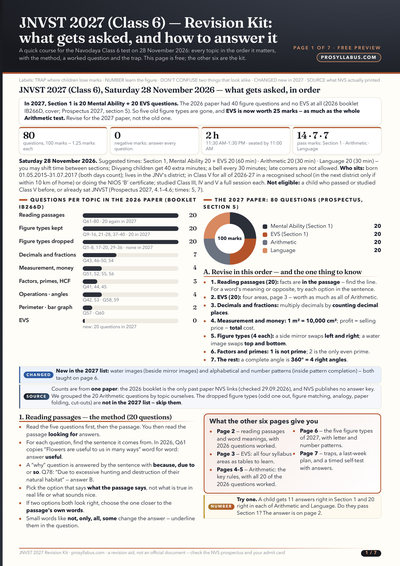
All twenty problems, the grader, diagrams and answer key here are free. The separate seven-page JNVST Class VI revision kit condenses the current paper pattern and arithmetic, figure, EVS and language reminders into a quick review. Preview its first page and check the current contents and price before purchase. Quiz and membership access are separate offers. ProSyllabus is independent of NVS.
Preview the JNVST Class VI revision kitHow many Maths questions are in Navodaya Class 6 JNVST 2027?
The official 2027 prospectus assigns 20 questions and 25 marks to the Arithmetic Test, with 30 minutes suggested within the two-hour paper.
Are these 20 questions official previous-year questions?
No. They are original ProSyllabus teaching questions. The official NVS 2027 prospectus is linked in the Sources section for the current scope and its own samples.
Does JNVST 2027 include unlike-fraction addition?
The Arithmetic list in the NVS 2027 prospectus excludes addition of unlike fractions and division of fractions. It includes like-fraction addition/subtraction and multiplication of fractions.
Is there negative marking in the Arithmetic section?
No. The NVS prospectus awards 1.25 marks per correct answer and states that there is no negative marking.
How many correct Arithmetic answers reach the 7-mark minimum?
Six correct answers give 7.5 marks and reach the published 7-mark section minimum; five give 6.25 and do not. That minimum is not an admission cutoff.
Why does this page cover nine topic families if the prospectus says twelve?
The official prose says twelve topics, but its visible numbered Arithmetic list has nine entries. This workshop follows those nine enumerated entries and does not invent the missing three.
Can I get the answer key without logging in?
Yes. Every worked answer and the full answer table are free and readable without login; the browser grader is optional.
Sources
- official — NVS JNVST 2027 Class VI prospectus: Arithmetic Test scope, composition, marks and minimum
official = a document published by the conducting body. reported = a news or coaching site we could not check against an original. Where sources disagree this page says so rather than picking one.
More in this series
- JNVST 2027 dates: test, admit card, result
- JNVST 2027 exam pattern and qualifying marks
- JNVST 2027 syllabus, section by section
- JNVST 2027 eligibility: age, Class V, district
- Navodaya rural quota and reservation
- Navodaya seats, schools, fees and migration
- 2027 Mental Ability: 15 worked figures
- JNVST Class 6 notice board — official updates


