Checked 12 October 2026. The NVS JNVST 2027 prospectus was re-downloaded and checked on 12 October 2026. This original practice set illustrates its format and four listed EVS areas; it is not an NVS paper, official answer key, or predicted topic weighting.
EVS is new in JNVST 2027, so a 2026 question paper cannot show you what this section will ask. The current NVS Class VI prospectus assigns questions 21–40 to Environmental Studies: 15 separate multiple-choice questions and one passage with five more. This free workshop follows that shape with twenty original four-option questions, explanations, a picture for the passage and a browser grader. It covers the four broad EVS areas NVS actually lists. The examples help a child practise reading and reasoning; they are not past questions or a forecast of the real paper.
NVS JNVST 2027 prospectus, section 7. This page’s practice questions are independently written.
The exact 2027 EVS format and four official areas
NVS puts EVS beside Mental Ability in Section 1: 20 questions in each, 25 marks each, with 60 minutes suggested for the combined 40 questions. Each correct answer earns 1.25 marks and there is no negative marking. The published minimum is 14 marks in the combined Mental Ability and EVS section; there is no separate EVS minimum. A child still needs the separate Arithmetic and Language minimums of 7 marks each. These are qualifying floors, not selection cutoffs.
| Official EVS area | Examples printed by NVS | Questions in this practice set |
|---|---|---|
| The natural world | Transport, rivers, mountains, land and water plants and animals, disasters, houses and shelters, water cycle | 1–4 |
| The human body | Food and nutrients, hygiene, super senses, digestive, circulatory and respiratory systems | 5–8 |
| Science in daily life | Food preservation, water and air pollution, water and soil conservation | 9–12 |
| Social surroundings | India superlatives, States and capitals, national symbols, landscapes, festivals, seasons, forests, crops, clothes and fibres | 13–15 |
| One passage | A short passage followed by five questions; the prospectus sample is about Ghadsisar and connected lakes | 16–20, our different school-garden passage |
NVS gives four EVS areas, but it does not publish a four-area question quota. Our four-four-four-three split for the 15 standalone questions is a teaching choice. The passage questions can combine reading with EVS facts. Do not infer that the real paper will put exactly four questions on water or exactly three on States. The official sample gives four single questions and a five-question water passage; it is a sample, not the entire 2027 question bank.
Our original practice allocation only; NVS specifies 15 standalone and five passage questions, not this topical split.
Why old question papers need a 2027 label
| Source | What it contains | How to use it now |
|---|---|---|
| NVS 2026 past booklet | 40 Mental Ability questions, 20 Arithmetic and 20 Language; no EVS section | Useful for retained figure, Arithmetic and Language practice, after checking changed topic lists. |
| NVS 2027 prospectus | Current 20 MAT + 20 EVS + 20 Arithmetic + 20 Language pattern and EVS examples | Controlling source for what to study and how to mark a 2027 practice sheet. |
| This free workshop | 15 original EVS MCQs plus an original five-question passage | Practise the new section, read every reason and make fresh variants. |
A page promising “JNVST 2027 EVS previous-year questions” should be read cautiously: EVS did not appear in the official 2026 booklet linked by NVS. The sample questions in the 2027 prospectus are official examples, but the items below are our own. This distinction matters because treating invented questions as a past-paper frequency pattern would mislead a family’s study plan.
A method for EVS questions that is more useful than memorising lists
| Step | For a standalone question | For the passage |
|---|---|---|
| 1. Name the setting | Is it a pond, kitchen, body system, farm or map? | Who, where and when are in the text? |
| 2. Find the action or link | What changes: water cools, roots hold soil, food spoils, the heart pumps? | Underline “because”, “instead of” and “used to”. |
| 3. Rule out the wrong job | A lung does not chew food; a boat is not a road vehicle. | Reject an option not supported by the text, even if it sounds generally true. |
| 4. Check the answer form | Choose one of four options and mark the matching OMR circle. | Return to the exact sentence before darkening the circle. |
Children often lose a simple EVS mark by answering a related question rather than the one on the page. A water-cycle question can ask what changes from gas to liquid, not just ask for a list of cycle words. A pollution question can ask which action removes waste, not which object is seen in a pond. Have the child say the cause and effect aloud before looking at the options. Keep the explanation short enough that a ten-year-old can repeat it.
Fifteen original standalone EVS questions
Try these in order once with no answer panels open. The panels show the correct letter, a one-sentence reason and the likely trap. Every item has one intended correct option. They are model questions written for this page, not NVS sample questions or copied 2026 items.
Natural world
1. Tiny drops form on the outside of a cold steel glass on a warm day. Which change makes those drops?
Natural world · Original practice question
Show answer and reason
B. Condensation. Water vapour in the surrounding air cools against the glass and condenses into liquid drops. The glass need not be leaking.
Watch for: Calling every water change evaporation.
2. Which plant has broad leaves that float on the surface of a pond?
Natural world · Original practice question
Show answer and reason
A. Water lily. A water lily grows in water and its broad leaves can float at the surface. The other choices are land plants.
Watch for: Choosing a familiar plant without checking its habitat.
3. A family needs to cross a river where there is no bridge. Which vehicle travels on the water?
Natural world · Original practice question
Show answer and reason
B. Boat. A boat travels on water. The question asks for the route, not which vehicle is fastest on a road.
Watch for: Reading “cross” but missing “river”.
4. After heavy rain, water runs quickly down a steep, bare hillside. What may it carry away?
Natural world · Original practice question
Show answer and reason
B. Loose soil. Flowing water can remove loose topsoil from a bare slope. Plants and roots can help keep that soil in place.
Watch for: Treating the rain as unable to change land.
Human body
5. Where does chewing begin to break food into smaller pieces?
Human body · Original practice question
Show answer and reason
A. Mouth. Teeth chew food in the mouth; saliva also begins the process of digestion. The heart and lungs have different jobs.
Watch for: Starting the digestive path at the stomach and forgetting the mouth.
6. Which organ takes in air and helps the body obtain oxygen?
Human body · Original practice question
Show answer and reason
A. Lungs. The lungs are part of the respiratory system. The stomach is part of digestion.
Watch for: Mixing respiratory and digestive organs.
7. What is the heart’s main job in the circulatory system?
Human body · Original practice question
Show answer and reason
A. Pump blood. The heart pumps blood through the body. That is why it belongs to the circulatory system.
Watch for: Choosing an action belonging to another body system.
8. Before eating after outdoor play, which action best reduces germs on the hands?
Human body · Original practice question
Show answer and reason
A. Wash with soap and clean water. Washing with soap and clean water removes dirt and many germs. The other actions leave hands unwashed.
Watch for: Mistaking dry-looking hands for clean hands.
Science in daily life
9. Which place best protects dry grain from moisture and pests at home?
Science in daily life · Original practice question
Show answer and reason
A. A clean, dry, closed container. Keeping grain dry and covered helps prevent spoilage and pest access. Wet storage encourages damage.
Watch for: Thinking that any covered-looking place is dry.
10. A plastic bag is floating in a pond. What is the best first choice for protecting the pond?
Science in daily life · Original practice question
Show answer and reason
A. Remove it safely and put it in the proper waste bin. Removing waste safely and disposing of it properly helps reduce water pollution. Hiding it does not remove it.
Watch for: Confusing out of sight with cleaned up.
11. Which action helps reduce soil being washed from a bare garden slope?
Science in daily life · Original practice question
Show answer and reason
A. Grow grass or other plants. Plant roots hold soil and slow the flow of water across it. This is one simple way to reduce erosion.
Watch for: Choosing more water when the problem is soil washed away.
12. Which action saves rainwater for later use?
Science in daily life · Original practice question
Show answer and reason
A. Collect roof rain in a clean covered tank. Collecting rainwater in a clean, covered tank makes some of it available later. Stored water must still be kept safe for its intended use.
Watch for: Assuming that any stored water is automatically safe to drink.
Social surroundings
13. Which fibre comes from a plant?
Social surroundings · Original practice question
Show answer and reason
A. Cotton. Cotton fibre grows on a cotton plant. Wool comes from animals, silk from silkworms, and leather is animal hide.
Watch for: Grouping all clothing materials as plant fibres.
14. What is the capital of Rajasthan?
Social surroundings · Original practice question
Show answer and reason
A. Jaipur. Jaipur is the capital of Rajasthan. Bhopal is in Madhya Pradesh, Patna in Bihar, and Lucknow in Uttar Pradesh.
Watch for: Recognising a city name without matching it to its State.
15. How many spokes are in the Ashoka Chakra at the centre of India’s national flag?
Social surroundings · Original practice question
Show answer and reason
C. 24. The navy-blue Ashoka Chakra has 24 spokes. Count or verify the symbol rather than guessing from a rough drawing.
Watch for: Guessing from how many lines are visible in a small picture.
One original EVS passage, then five questions
Read the passage once before looking at choices
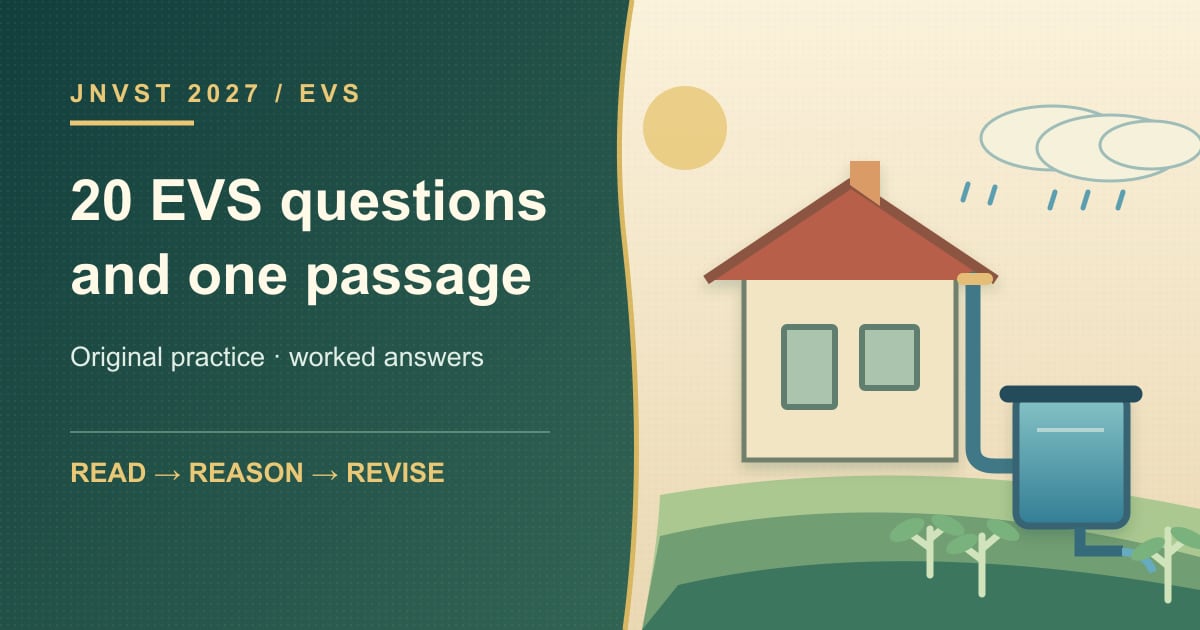
At the start of the rainy season, the children of Kiranpur School looked at the roof of their classroom. Rainwater used to run from the roof into the lane. With help from their teachers, they led the water through a pipe into a covered tank. They used some of it to water the school garden during dry weeks. They planted grass along the sloping edge of the garden so rain would carry away less soil. Fallen leaves went into a compost pit instead of the drain. Each week, a group checked that the tank cover was closed and the area around it was clean. The children did not drink the stored water without making sure it was safe. They learnt that saving water also means keeping it clean.
Original ProSyllabus passage. NVS’s official example is a different story about Ghadsisar; we have not copied it.
On the first reading, circle the change from “used to” to “now”. On the second, find the exact sentence for each question. Some options sound like sensible environmental actions, but only one answers what this passage actually says. The same approach helps with the separate Language section, though that section has four passages rather than one.
16. Before the school project, where did rainwater from the roof go?
Passage · Original practice question
Show answer and reason
A. Into the lane. The passage says the roof water used to run into the lane. Find the sentence with “used to”.
Watch for: Answering with what happened after the project.
17. What did the school use some stored water for in dry weeks?
Passage · Original practice question
Show answer and reason
A. Watering the garden. The passage directly says they watered the school garden during dry weeks.
Watch for: Choosing an activity not mentioned in the passage.
18. Why did the children plant grass along the sloping garden edge?
Passage · Original practice question
Show answer and reason
A. To help rain carry away less soil. The passage links grass on the slope with less soil being carried away by rain.
Watch for: Choosing a purpose not connected to the stated problem.
19. Where did the fallen leaves go?
Passage · Original practice question
Show answer and reason
A. Into a compost pit. The passage says the leaves went to the compost pit instead of the drain.
Watch for: Missing the words “instead of”.
20. Which statement matches the school’s rule about stored water?
Passage · Original practice question
Show answer and reason
A. Check that it is safe before drinking. The children did not drink stored water without first making sure it was safe. A covered tank alone is not a drinking-water test.
Watch for: Assuming collected rainwater is automatically safe to drink.
Complete answers and child-readable reasons
This table stays available on AMP and when scripts are blocked. Cover the answer column before practice. The “why” column checks the idea; the expanded panel at each question also names the tempting error. If a child guesses correctly, still ask for the reason before counting the concept as learned.
| No. | EVS area | Answer | Why this answer works |
|---|---|---|---|
| 1 | Natural world | B. Condensation | Water vapour in the surrounding air cools against the glass and condenses into liquid drops. The glass need not be leaking. |
| 2 | Natural world | A. Water lily | A water lily grows in water and its broad leaves can float at the surface. The other choices are land plants. |
| 3 | Natural world | B. Boat | A boat travels on water. The question asks for the route, not which vehicle is fastest on a road. |
| 4 | Natural world | B. Loose soil | Flowing water can remove loose topsoil from a bare slope. Plants and roots can help keep that soil in place. |
| 5 | Human body | A. Mouth | Teeth chew food in the mouth; saliva also begins the process of digestion. The heart and lungs have different jobs. |
| 6 | Human body | A. Lungs | The lungs are part of the respiratory system. The stomach is part of digestion. |
| 7 | Human body | A. Pump blood | The heart pumps blood through the body. That is why it belongs to the circulatory system. |
| 8 | Human body | A. Wash with soap and clean water | Washing with soap and clean water removes dirt and many germs. The other actions leave hands unwashed. |
| 9 | Science in daily life | A. A clean, dry, closed container | Keeping grain dry and covered helps prevent spoilage and pest access. Wet storage encourages damage. |
| 10 | Science in daily life | A. Remove it safely and put it in the proper waste bin | Removing waste safely and disposing of it properly helps reduce water pollution. Hiding it does not remove it. |
| 11 | Science in daily life | A. Grow grass or other plants | Plant roots hold soil and slow the flow of water across it. This is one simple way to reduce erosion. |
| 12 | Science in daily life | A. Collect roof rain in a clean covered tank | Collecting rainwater in a clean, covered tank makes some of it available later. Stored water must still be kept safe for its intended use. |
| 13 | Social surroundings | A. Cotton | Cotton fibre grows on a cotton plant. Wool comes from animals, silk from silkworms, and leather is animal hide. |
| 14 | Social surroundings | A. Jaipur | Jaipur is the capital of Rajasthan. Bhopal is in Madhya Pradesh, Patna in Bihar, and Lucknow in Uttar Pradesh. |
| 15 | Social surroundings | C. 24 | The navy-blue Ashoka Chakra has 24 spokes. Count or verify the symbol rather than guessing from a rough drawing. |
| 16 | Passage | A. Into the lane | The passage says the roof water used to run into the lane. Find the sentence with “used to”. |
| 17 | Passage | A. Watering the garden | The passage directly says they watered the school garden during dry weeks. |
| 18 | Passage | A. To help rain carry away less soil | The passage links grass on the slope with less soil being carried away by rain. |
| 19 | Passage | A. Into a compost pit | The passage says the leaves went to the compost pit instead of the drain. |
| 20 | Passage | A. Check that it is safe before drinking | The children did not drink stored water without first making sure it was safe. A covered tank alone is not a drinking-water test. |
Four tiny concept maps for revision
| Area | Say it in one line | Fresh home observation |
|---|---|---|
| Natural world | Water changes form; plants and animals suit their surroundings; water can reshape exposed land. | Watch condensation on a cold glass and notice where the drops appear. |
| Human body | Mouth starts digestion, lungs exchange gases, heart pumps blood, clean hands help prevent germs spreading. | Point to each organ’s job on a simple body drawing, not just its name. |
| Science in daily life | Keep food dry or cool as needed; keep waste out of water; protect soil with plants; save clean water. | Find one water-saving action and one possible pollution source at home. |
| Social surroundings | Connect a crop or fibre to its source, a State to its capital, and a national symbol to its meaning or appearance. | Use a labelled map and identify one State-capital pair accurately. |
These are memory hooks for our examples, not a replacement for the breadth of the official list. The natural-world heading also names mountains, shelters and natural disasters; the body heading names nutrients and super senses; social surroundings includes forests, festivals and seasons. If a child misses a question outside this short set, add that official subtopic to the next study day rather than inventing an “important topics only” list.
The marks check: no separate EVS pass mark
EVS and Mental Ability share Section 1. The prospectus prints a 14-mark minimum for the combined 40 questions. Because each correct answer is worth 1.25 marks, 11 correct across the two parts give 13.75 marks, which is short; 12 give 15, which reaches the floor. This is arithmetic about qualifying, not an estimate of admission. A child can do well on EVS and still need enough correct answers overall and in Arithmetic and Language. The recommended 60 minutes is for MAT plus EVS together, not a separate EVS timer.
| Correct across MAT + EVS | Marks at 1.25 each | Against 14-mark minimum |
|---|---|---|
| 11 | 13.75 | Below |
| 12 | 15.00 | At or above |
| 20 | 25.00 | At or above |
| 40 | 50.00 | At or above |
Seven small practice days before the 28 November test
| Day | Practice | Repair evidence |
|---|---|---|
| 1 | Read the four official EVS headings, then answer questions 1–4. | Explain one water or habitat change aloud. |
| 2 | Answer body questions 5–8 and draw the mouth–lungs–heart job map. | Match each organ with its job without choices. |
| 3 | Answer daily-life questions 9–12 and identify a real water-saving action. | Say why another option would worsen the problem. |
| 4 | Answer social questions 13–15 with a plant/animal fibre and State map. | Correct every mix-up using a source or map. |
| 5 | Read the passage, answer 16–20, then underline the sentence for each answer. | Every choice has a supporting phrase in the text. |
| 6 | Attempt all 20 in a fresh sitting, then inspect wrong and guessed answers. | Log whether the issue was a fact, a misread word or a rushed OMR choice. |
| 7 | Make five new questions from the weakest official subtopic and redo the misses. | A correct explanation survives changed wording. |
Keep all four test parts together in the final review
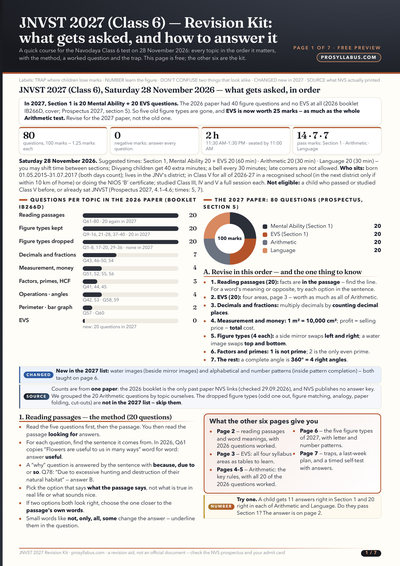
The kit is a separate seven-page revision companion for the current 2027 paper. Its EVS page condenses the four official areas, while the other pages cover figure methods, Arithmetic and Language. Read the full free questions and reasons here first; then use a compact sheet for recall. The kit purchase does not include a quiz subscription or membership, and ProSyllabus is independent of NVS. The live JNVST quizzes should be checked against the changed 2027 syllabus before using them as the only practice source.
Preview the Class VI revision kit
This full EVS workshop and its answers are free. See the current kit’s first page, contents and price before deciding whether a short final-week review would help your child.
Check the JNVST kit previewFor the other parts of the current test, use the free Mental Ability figure workshop, Arithmetic worked questions and complete 2027 syllabus map. These pages have different jobs; this one is the new EVS question and passage practice.
Questions parents ask
Frequently asked questions
Is EVS really in Navodaya Class 6 JNVST 2027?
Yes. The NVS 2027 Class VI prospectus gives questions 21–40 to Environmental Studies, alongside 20 Mental Ability questions in Section 1.
How many EVS questions are passage based?
The NVS prospectus says 15 standalone multiple-choice questions plus one passage followed by five questions.
Are these the official 2027 EVS questions or past-paper questions?
No. They are original ProSyllabus practice examples following the official 2027 format. The NVS prospectus has its own sample questions. The linked 2026 past booklet used the old paper format without EVS.
What are the four EVS syllabus areas?
The NVS prospectus lists the natural world, the human body, science in daily life, and social surroundings. It also specifies one passage with five questions.
Is there a separate EVS passing mark?
No. NVS prints 14 marks as the minimum for the combined Mental Ability and EVS Section 1, not for EVS alone.
Does guessing cost marks in JNVST 2027?
The NVS prospectus awards 1.25 marks for a correct answer and says there is no negative marking.
Can my child read the answers without login?
Yes. All twenty answer explanations and the complete answer table are free. The browser grader is optional.
Sources
- official — NVS — JNVST 2027 Class VI prospectus: EVS syllabus, 15 plus five format, marking and section minimum
- official — NVS — JNVST 2026 English past booklet (old format, no EVS)
official = a document published by the conducting body. reported = a news or coaching site we could not check against an original. Where sources disagree this page says so rather than picking one.
More in this series
- JNVST 2027 dates: test, admit card, result
- JNVST 2027 exam pattern and qualifying marks
- JNVST 2027 syllabus, section by section
- JNVST 2027 eligibility: age, Class V, district
- Navodaya rural quota and reservation
- Navodaya seats, schools, fees and migration
- 2027 Mental Ability: 15 worked figures
- 2027 Arithmetic: 20 worked questions
- JNVST Class 6 notice board — official updates


