Solutions
Class 12 Chemistry · Chemistry Part I · Chapter 1
163 members in the CBSE community
View all










CBSE Class 12 · Chemistry
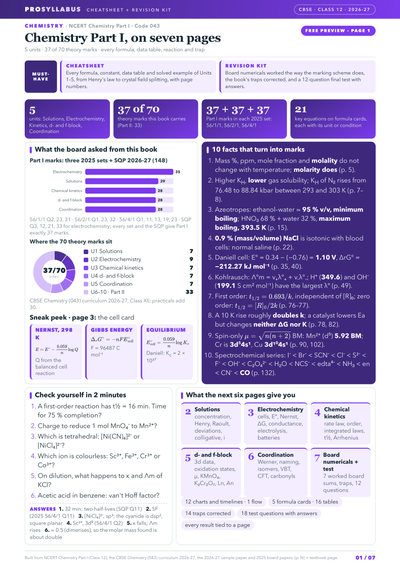
Electrochemistry: 9 marks, biggest unit- Marks booster + cheatsheet: key concepts in 2 lines each, common traps
- 7 marks each: the other four units
- 37 of 70 theory marks across 5 units
- Mixed traps, corrected
- Seven board sums, worked stepwise
- Every data table, with page numbers
CBSE Class 12 · Chemistry
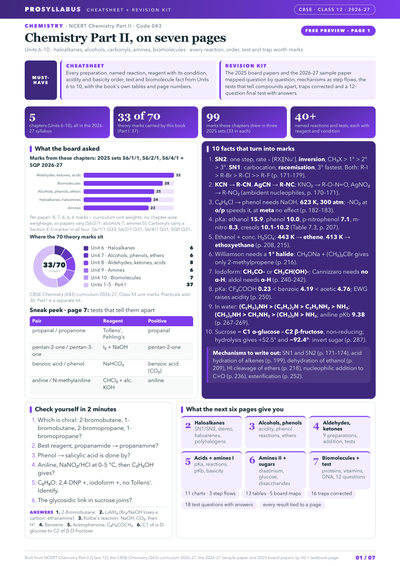
Unit 8 carbonyls: 8 marks, biggest unit- Marks booster + cheatsheet: key concepts in 2 lines each, common traps
- 7 marks in every paper: Biomolecules
- 6 marks in each 2025 set: Haloalkanes
- Common traps that cost marks, listed
- 4–5-mark question every paper: Alcohols
- Named reactions, reagents, conditions
Summary
A solution is a homogeneous mixture of two or more components whose composition and properties are uniform throughout; the component in largest amount is the solvent. Concentration can be expressed as mass percentage, volume percentage, parts per million, mole fraction, molarity \(M\) (moles of solute per litre of solution) and molality \(m\) (moles per kg of solvent), of which mole fraction and molality are temperature independent. The solubility of a gas in a liquid is governed by Henry's law, \(p=K_H x\), the partial pressure of a gas over a solution being proportional to its mole fraction. For liquid-liquid solutions Raoult's law states that the partial vapour pressure of each volatile component is proportional to its mole fraction, \(p_A=p_A^{\circ}x_A\); ideal solutions obey it over the whole range while real solutions show positive or negative deviations. Properties that depend only on the number of solute particles and not their nature are colligative: relative lowering of vapour pressure, elevation of boiling point \(\Delta T_b=K_b m\), depression of freezing point \(\Delta T_f=K_f m\), and osmotic pressure \(\Pi=CRT\). These properties give molar masses of solutes; abnormal values arise when solutes associate or dissociate, accounted for by the van't Hoff factor \(i\).