Coordination Compounds
Class 12 Chemistry · Chemistry Part I · Chapter 5
163 members in the CBSE community
View all









CBSE Class 12 · Chemistry
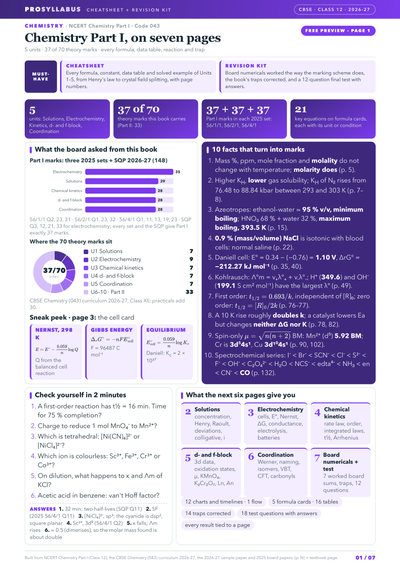
Electrochemistry: 9 marks, biggest unit- Marks booster + cheatsheet: key concepts in 2 lines each, common traps
- 7 marks each: the other four units
- 37 of 70 theory marks across 5 units
- Mixed traps, corrected
- Seven board sums, worked stepwise
- Every data table, with page numbers
CBSE Class 12 · Chemistry
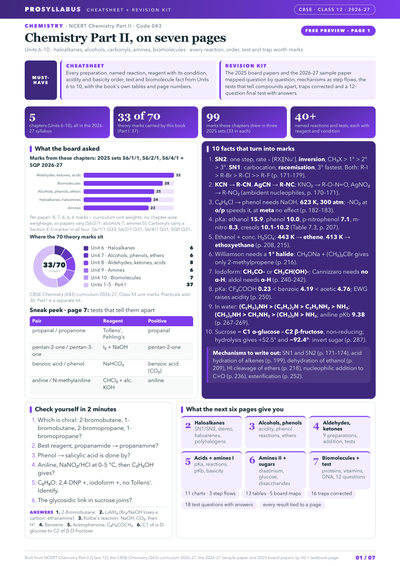
Unit 8 carbonyls: 8 marks, biggest unit- Marks booster + cheatsheet: key concepts in 2 lines each, common traps
- 7 marks in every paper: Biomolecules
- 6 marks in each 2025 set: Haloalkanes
- Common traps that cost marks, listed
- 4–5-mark question every paper: Alcohols
- Named reactions, reagents, conditions
Summary
Coordination compounds are formed when a central metal atom or ion binds a number of anions or neutral molecules, called ligands, by coordinate bonds in which the ligand donates a lone pair of electrons. Werner's theory introduced primary and secondary valencies: the primary valency is satisfied by negative ions and the secondary valency (the coordination number) fixes the geometry. Key terms include the central atom, ligand, coordination number, coordination sphere and coordination polyhedron; ligands may be unidentate, bidentate or polydentate, and chelating ligands form ring structures of extra stability. Compounds are named by systematic IUPAC rules and exhibit isomerism: structural isomerism (ionisation, linkage, coordination and hydrate types) and stereoisomerism (geometrical cis-trans and optical). Bonding is explained by Valence Bond Theory, which uses hybridisation to predict shape and magnetic behaviour, and by Crystal Field Theory, which treats ligands as point charges that split the d orbitals; the magnitude of splitting decides whether a complex is high spin or low spin and accounts for colour. Coordination compounds are vital in biological systems such as chlorophyll, haemoglobin and vitamin B12, and find use in metallurgy, analysis, medicine and electroplating.