Writing and City Life
Class 11 History · Themes in World History · Chapter 1
163 members in the CBSE community
View all











CBSE Class 11 · History
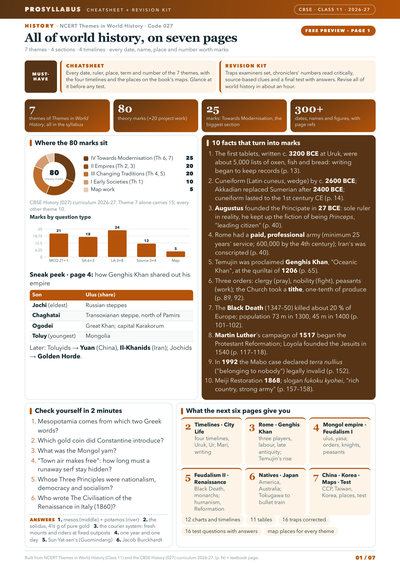
7 themes, 4 timelines, every date and ruler- Marks booster + cheatsheet: key concepts in 2 lines each, common traps
- 20 marks: Empires section
- 20 marks: Changing Cultural Traditions
- 15 marks: Paths to Modernisation, Japan
- 5 marks: map work on the book's maps
- Common traps, corrected
Summary
This theme explores the earliest cities of Mesopotamia, the land between the Euphrates and Tigris rivers in present-day Iraq, and the deep link between urban life and writing. From about 5000 BCE, settlements in the southern desert grew into cities such as Uruk, Ur and Mari, supported by silt-fed irrigation farming, sheep and goat herding, and long-distance trade in wood, copper, tin and stone that the resource-poor south lacked. Urban life rested on a division of labour, organised trade, efficient water transport and a social authority that issued commands. Writing began around 3200 BCE with picture-like signs on clay tablets recording temple transactions; by 2600 BCE it became wedge-shaped cuneiform, first in Sumerian and later in Akkadian. Temples, homes of gods like the Moon God of Ur and Inanna, became the main urban institutions, while war-leaders grew into kings who organised trade and labour. The chapter studies the temple town of Uruk, the residential city of Ur, and Mari, a prosperous trading town in a pastoral zone ruled by Amorite kings. Mesopotamia's lasting legacy includes time-reckoning (the 12-month year, 60-minute hour), mathematics, and early libraries such as Assurbanipal's at Nineveh.