ProSyllabusLearn a little. Grow every day.Log in
YOUR STUDY SPACE · CBSE

Relations and Functions — Class 12 Mathematics

Mathematics Part I · Chapter 1

173 members in the CBSE community

View all
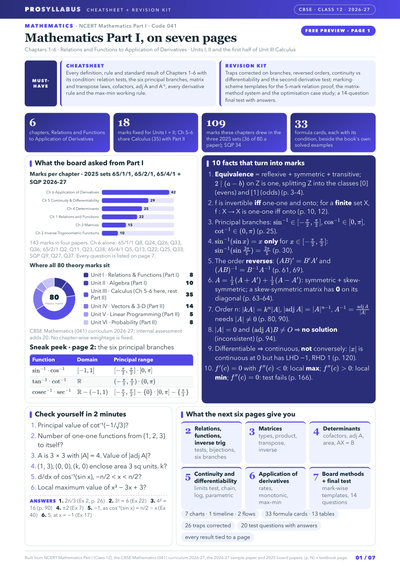
  • Marks booster + cheatsheet: key concepts in 2 lines each, common traps
  • 35 marks: Calculus, shared with Part II
  • 10 marks: Algebra, Ch 3–4
  • Common traps that cost marks, listed
  • 6 principal branches of inverse trig
  • Every derivative rule with its condition
Page 1 free about 8 min read, Full kit about 55 min read
£ 9₹159$ 12€ 11£ 9CHF 10DKK 83SEK 122NOK 130PLN 47CZK 278AED 47SAR 48QAR 47KWD 3.975OMR 4.989BHD 4.881CA$ 17A$ 19NZ$ 21S$ 16HK$ 101RM 55See the full kit
  • Marks booster + cheatsheet: key concepts in 2 lines each
  • 23 marks in the four papers: Vector Algebra
  • Integral tables with properties P0–P7
  • 3 methods for differential equations
  • 8 marks: Probability, with Bayes' theorem
  • Patterns the board repeats, by chapter
Page 1 free about 8 min read, Full kit about 55 min read
£ 9₹159$ 12€ 11£ 9CHF 10DKK 83SEK 122NOK 130PLN 47CZK 278AED 47SAR 48QAR 47KWD 3.975OMR 4.989BHD 4.881CA$ 17A$ 19NZ$ 21S$ 16HK$ 101RM 55See the full kit
View all amazing Class 12 Marks Booster kits →

Chapter summary

This chapter deepens the study of relations and functions begun in Class 11. A relation on a set is examined for the properties of being reflexive, symmetric and transitive; a relation that is all three is called an equivalence relation, and it partitions the set into disjoint equivalence classes. The chapter then classifies functions as one-one (injective), onto (surjective) and bijective. A function is one-one if , and onto if every element of is the image of some element of . Composition of functions is introduced, and a bijection is shown to have an inverse satisfying . These ideas form the backbone for inverse trigonometric functions and for understanding invertibility throughout calculus and algebra.
Types of relationsEquivalence relations and classesOne-one, onto and bijective functionsComposition of functionsInvertible functions

Key ideas & terms

Equivalence relation
A relation that is reflexive, symmetric and transitive.
One-one (injective)
Distinct inputs give distinct outputs: .
Onto (surjective)
Every element of the codomain is an image of some element of the domain.
Bijective
A function that is both one-one and onto.
Composition
, applying then .
Invertible function
A bijection for which exists with .

Extra questions & answers

Define an equivalence relation.

A relation on a set is an equivalence relation if it is reflexive (), symmetric () and transitive ().

When is a function one-one?

A function is one-one if implies ; equivalently, distinct inputs map to distinct outputs.

When is a function onto?

A function is onto if for every there exists with ; the range equals the codomain.

Define a bijective function.

A function that is simultaneously one-one and onto; only bijections are invertible.

What is the composition ?

For and , , a function from to .

State the condition for to exist.

must be a bijection; then satisfies and .

Is on one-one?

No, because ; distinct inputs share an output, so it is not one-one.

Show is an equivalence relation.

It is reflexive (), symmetric () and transitive (); hence an equivalence relation.

If and are one-one, is one-one?

Yes; the composition of two one-one functions is one-one, and likewise composition of onto functions is onto.

What is an equivalence class?

For an equivalence relation on , the equivalence class of is ; these classes partition .