ProSyllabusLearn a little. Grow every day.Log in
YOUR STUDY SPACE · CBSE

Continuity and Differentiability — Class 12 Mathematics

Mathematics Part I · Chapter 5

173 members in the CBSE community

View all
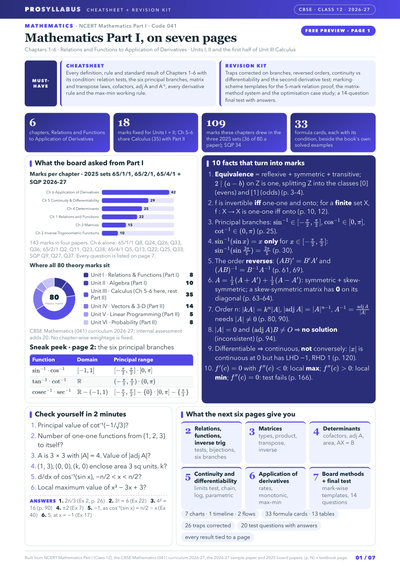
  • Marks booster + cheatsheet: key concepts in 2 lines each, common traps
  • 35 marks: Calculus, shared with Part II
  • 10 marks: Algebra, Ch 3–4
  • Common traps that cost marks, listed
  • 6 principal branches of inverse trig
  • Every derivative rule with its condition
Page 1 free about 8 min read, Full kit about 55 min read
£ 9₹159$ 12€ 11£ 9CHF 10DKK 83SEK 122NOK 130PLN 47CZK 278AED 47SAR 48QAR 47KWD 3.975OMR 4.989BHD 4.881CA$ 17A$ 19NZ$ 21S$ 16HK$ 101RM 55See the full kit
  • Marks booster + cheatsheet: key concepts in 2 lines each
  • 23 marks in the four papers: Vector Algebra
  • Integral tables with properties P0–P7
  • 3 methods for differential equations
  • 8 marks: Probability, with Bayes' theorem
  • Patterns the board repeats, by chapter
Page 1 free about 8 min read, Full kit about 55 min read
£ 9₹159$ 12€ 11£ 9CHF 10DKK 83SEK 122NOK 130PLN 47CZK 278AED 47SAR 48QAR 47KWD 3.975OMR 4.989BHD 4.881CA$ 17A$ 19NZ$ 21S$ 16HK$ 101RM 55See the full kit
View all amazing Class 12 Marks Booster kits →

Chapter summary

This chapter formalises continuity and differentiability. A function is continuous at if ; it is continuous on an interval if continuous at every point. Differentiability is stronger: exists if the limit defining the derivative exists, and differentiability implies continuity (but not conversely). The chapter develops rules for differentiating composite functions (chain rule), implicit functions, inverse trigonometric functions, exponential and logarithmic functions, and functions given in parametric form. Logarithmic differentiation handles products, quotients and variable exponents. Second-order derivatives are introduced, and the chapter closes with the Mean Value Theorems of Rolle and Lagrange, which connect the derivative to the behaviour of the function on an interval.
Continuity of functionsDifferentiability and the chain ruleDerivatives of inverse trig, exponential and log functionsLogarithmic and parametric differentiationMean Value Theorems

Key ideas & terms

Continuity at a point
.
Differentiability
Existence of .
Chain rule
for composite functions.
Implicit differentiation
Differentiating an equation in and without solving for .
Logarithmic differentiation
Taking before differentiating, useful for .
Mean Value Theorem
There is with (Lagrange).

Extra questions & answers

State the condition for continuity of at .

is continuous at if exists and equals .

Does differentiability imply continuity?

Yes; every differentiable function is continuous, but a continuous function need not be differentiable (e.g. at ).

State the chain rule.

If and , then .

Differentiate .

for .

Differentiate and .

and for .

When is logarithmic differentiation used?

For functions of the form , or complicated products/quotients; take of both sides first.

State Rolle's Theorem.

If is continuous on , differentiable on , and , then there exists with .

State Lagrange's Mean Value Theorem.

If is continuous on and differentiable on , there exists with .

Find for parametric .

, provided .

Why is not differentiable at ?

Its left-hand derivative is and right-hand derivative is ; the two do not match, so does not exist.