ProSyllabusLearn a little. Grow every day.Log in
YOUR STUDY SPACE · CBSE

Application of Derivatives — Class 12 Mathematics

Mathematics Part I · Chapter 6

173 members in the CBSE community

View all
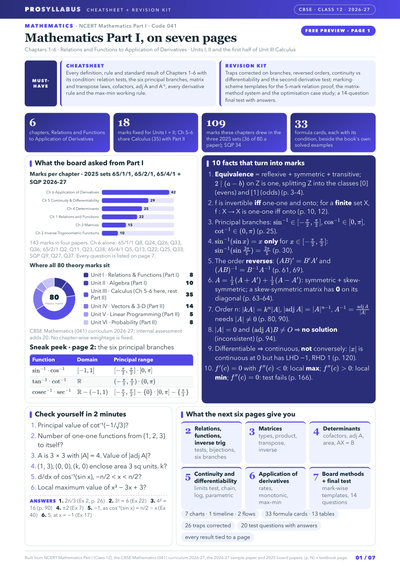
  • Marks booster + cheatsheet: key concepts in 2 lines each, common traps
  • 35 marks: Calculus, shared with Part II
  • 10 marks: Algebra, Ch 3–4
  • Common traps that cost marks, listed
  • 6 principal branches of inverse trig
  • Every derivative rule with its condition
Page 1 free about 8 min read, Full kit about 55 min read
$ 12₹159$ 12€ 11£ 9CHF 10DKK 83SEK 122NOK 130PLN 47CZK 278AED 47SAR 48QAR 47KWD 3.975OMR 4.989BHD 4.881CA$ 17A$ 19NZ$ 21S$ 16HK$ 101RM 55See the full kit
  • Marks booster + cheatsheet: key concepts in 2 lines each
  • 23 marks in the four papers: Vector Algebra
  • Integral tables with properties P0–P7
  • 3 methods for differential equations
  • 8 marks: Probability, with Bayes' theorem
  • Patterns the board repeats, by chapter
Page 1 free about 8 min read, Full kit about 55 min read
$ 12₹159$ 12€ 11£ 9CHF 10DKK 83SEK 122NOK 130PLN 47CZK 278AED 47SAR 48QAR 47KWD 3.975OMR 4.989BHD 4.881CA$ 17A$ 19NZ$ 21S$ 16HK$ 101RM 55See the full kit
View all amazing Class 12 Marks Booster kits →

Chapter summary

Derivatives measure rates of change and the local behaviour of functions, and this chapter applies them widely. The derivative as a rate of change links related quantities (for example, how a sphere's volume changes with its radius). A function is increasing where and decreasing where . The derivative also gives the slope of a tangent, so equations of tangents and normals follow at once. Maxima and minima are located using the first-derivative test and the second-derivative test: at a local maximum and , while at a local minimum and . These ideas drive optimisation problems — maximising area, minimising cost or material — that appear throughout applied mathematics.
Rate of change of quantitiesIncreasing and decreasing functionsTangents and normalsMaxima and minimaOptimisation problems

Key ideas & terms

Rate of change
gives the instantaneous rate of change of with respect to .
Increasing function
A function with on an interval.
Decreasing function
A function with on an interval.
Tangent slope
The slope of the tangent at a point equals there.
Critical point
A point where or does not exist.
Second-derivative test
At a critical point, gives a maximum and a minimum.

Extra questions & answers

How is the derivative interpreted as a rate of change?

is the instantaneous rate at which changes per unit change in ; related rates link several such derivatives.

When is a function increasing on an interval?

A differentiable function is increasing where and strictly increasing if throughout the interval.

How is the slope of the tangent found?

The slope of the tangent to at a point is evaluated there; the normal slope is its negative reciprocal.

State the first-derivative test for a local maximum.

If changes from positive to negative as increases through , then has a local maximum at .

State the second-derivative test.

If and , is a local maximum; if and , is a local minimum.

What is a critical point?

A point in the domain where or fails to exist; extrema can occur only at such points (or endpoints).

How do you find the equation of a tangent?

At , the tangent is .

What is the second-derivative test inconclusive case?

When and ; then the test fails and one falls back on the first-derivative test or higher derivatives.

Outline how an optimisation problem is solved.

Express the quantity as a function of one variable, differentiate, set the derivative to zero to find critical points, and use a derivative test to identify the maximum or minimum.

Give the normal line equation at a point.

At with , the normal is .