CBSE Class 12 · Mathematics
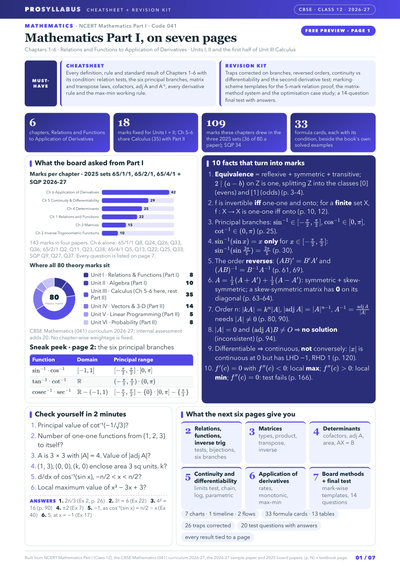
Every Part I question from 2025 + the SQP- Marks booster + cheatsheet: key concepts in 2 lines each, common traps
- 35 marks: Calculus, shared with Part II
- 10 marks: Algebra, Ch 3–4
- Common traps that cost marks, listed
- 6 principal branches of inverse trig
- Every derivative rule with its condition
£ 9₹159$ 12€ 11£ 9CHF 10DKK 83SEK 122NOK 130PLN 47CZK 278AED 47SAR 48QAR 47KWD 3.975OMR 4.989BHD 4.881CA$ 17A$ 19NZ$ 21S$ 16HK$ 101RM 55See the full kit