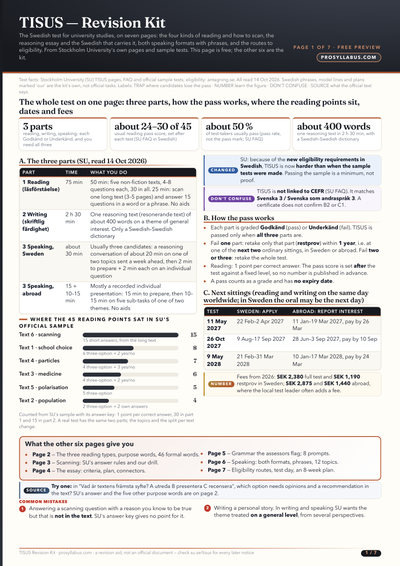
Checked 23 October 2026. Test dates, registration times, fees and the format of each sub-test were read on Stockholm University’s Tisus pages on 23 October 2026 (About Tisus last updated 2026-10-22). The eligibility and citizenship rules were read on antagning.se, in UHR’s assessment handbook (Bedömningshandboken) and at the Swedish Migration Agency on 14 October 2026. The university publishes no pass mark for writing or speaking. Check su.se again before you register.
Next TISUS · checked on su.se on 23 October 2026
Spring 2027: the test is on 11–12 May 2027 (abroad: Tuesday 11 May)
- Registration in Sweden: 22 February 2027, 09.00 – 2 April 2027, 16.00 (Swedish time). Seats are limited and can run out before the last day.
- Abroad: the interest form is open 11 January 2027, 09.00 – 19 March 2027, 16.00; the fee must be paid by 26 March 2027.
- Fee (from 2026): 2,380 SEK for the full test in Sweden, 2,875 SEK abroad.
- Results: assessment takes about 5 weeks, then the result is emailed to you.
- The sitting after that: 26–27 October 2027 (registration in Sweden 9 August – 17 September 2027).
The practice test is our own, in the same format as Stockholm University’s reading sub-test, and it is in Swedish like the real test: text 1 and the first three scanning questions are free. Stockholm University’s own sample tests are free too (links below). The 20–21 October 2026 sitting has already taken place.
The TISUS test at a glance
TISUS (Tisus, Test i svenska för universitets- och högskolestudier) is Stockholm University’s test in Swedish for university studies. In the university’s own words it is “a qualifying test in Swedish for university and college studies in Sweden” for anyone with an upper secondary school diploma from a foreign country who plans to apply for academic studies in Sweden and lacks a certificate in Swedish [official: su.se, About Tisus]. The whole test is in Swedish, so this page explains it in English for readers who are still deciding. Where we give our own view we say our reading or our advice. A longer version in Swedish is TISUS: provdatum, delprov och poänggräns.
| Question | What the official page says | Source |
|---|---|---|
| Who runs it? | The Department of Swedish Language and Multilingualism at Stockholm University | su.se, About Tisus |
| Who is it for? | Anyone with a foreign upper secondary diploma who plans to study in Sweden and lacks a certificate in Swedish | su.se, About Tisus |
| Parts | Three sub-tests: reading comprehension, writing proficiency, speaking proficiency | su.se, About Tisus |
| Test time | Reading 75 minutes; writing 2 hours 30 minutes; speaking in Sweden about 30 minutes; abroad usually 15 minutes of preparation and 10–15 minutes recorded (the online format used at some centres follows the Sweden format) | su.se, sub-test pages |
| Grades | Pass (Godkänt) or Fail (Underkänt); you must pass all three parts | su.se, About Tisus |
| Pass rate | Varies, but usually around 50% | su.se, FAQ |
| Next sittings | 11–12 May 2027, 26–27 October 2027, 9–10 May 2028, 24–25 October 2028 (in Sweden Tuesday–Wednesday; abroad the Tuesday) | su.se, About Tisus |
| Fee from 2026 | 2,380 SEK for the full test in Sweden; 2,875 SEK abroad | su.se, Om Tisus |
| Results | Emailed after about 5 weeks; a pass has no expiration date | su.se, About Tisus |
| CEFR level | None: TISUS corresponds to Svenska 3 / Swedish as a second language 3 at upper secondary level but is not linked to the CEFR | su.se, FAQ |
Checked on 23 October 2026.
ProSyllabus is an independent study site. We are not part of, and do not speak for, Stockholm University, the Swedish Council for Higher Education (UHR), antagning.se or the Swedish Migration Agency. The rules on this page are quoted or summarised from their own pages. Stockholm University decides everything about the test, and the admissions office decides your eligibility.
Who needs the TISUS test?
To study a programme taught in Swedish you need basic eligibility, and for applicants with foreign upper secondary schooling that includes Swedish. Antagning.se puts the requirement as Svenska nivå 3 or Svenska som andraspråk nivå 3 with at least the grade E, and lists a pass on TISUS as one of the other ways to meet it [official: antagning.se]. UHR’s assessment handbook lists TISUS among the tests that correspond to Svenska 3 [official: uhrporten.se]. You also need English for basic eligibility, which TISUS does not cover.
Stockholm University’s FAQ adds two practical points. You should have finished your foreign upper secondary school, or be in your last year, when you take TISUS, and the university advises against taking it if you are very young, because it can be difficult to pass. There are also courses in Swedish as a foreign language at Swedish universities that give the same eligibility as TISUS, if you are not yet at the level [official: su.se, FAQ].
TISUS is used outside admissions too. For Swedish citizenship, the Swedish Migration Agency lists a pass on “the Tisus test” among the qualifications that show knowledge of Swedish (read 14 October 2026) [official: migrationsverket.se]. For jobs, the university says the level of Swedish required varies and points to studera.nu. Our guide to the Swedish language requirement for citizenship covers the other routes.
Tisus · delprov 2 · skriftlig färdighet
Gratis snabbkoll: når din Tisus-text godkänt? Få en uppskattning
Klistra in en text du skrivit till delprov 2 (ungefär 400 ord, resonerande, med rubrik, inledning, resonemang och avslutning). Snabbkollen är gratis: en uppskattning av hur nära gränsen du är och de tre första problemen. Bedömningen följer Stockholms universitets publicerade kriterier och är kalibrerad mot universitetets egen bedömda exempeltext.
0 ord
Hela bedömningen av din text
- Godkänt eller underkänt, med hur stor marginalen är
- Resonemang, struktur och språk var för sig, mot universitetets kriterier
- Viktiga fel, med citat ur din text och ett omskrivningsförslag för varje
- Det enskilt viktigaste att ändra före provet
Engångsbetalning, inget abonnemang. Texten skickas för bedömning först när du trycker på knappen. På det riktiga provet läser och bedömer minst två bedömare texten; det här är en uppskattning.
The three parts of the TISUS test
The table sums up how Stockholm University describes each sub-test. Each component is equally weighted, the university says, and you need a pass in all three.
| Sub-test | What you do | Time | Aids | Marking |
|---|---|---|---|---|
| 1. Reading comprehension | Five texts with 4–8 questions each (three-option multiple choice or true/false), then scanning one longer text of 3–5 pages for 15 short answers | 75 min (50 + 25) | None | 1 mark per correct answer, 45 in all; the pass score is set after each test |
| 2. Writing proficiency | One coherent, reasoning text of about 400 words on a given subject of public interest | 2 h 30 min | A Swedish-Swedish word book | At least two raters; three aspects |
| 3. Speaking, in Sweden | A reasoning conversation in a group (usually three candidates) and a short individual task | About 30 min in all | Only the topic sheets, with no notes on them | Four aspects; video-recorded |
| 3. Speaking, abroad | An individual presentation of five sub-tasks, recorded with a test leader present; an online group format at some centres | 15 min preparation + 10–15 min recording | None | Assessed at Stockholm University; four aspects |
Reading comprehension: 75 minutes, two parts
The first part, 50 minutes, is general comprehension: five texts, each followed by 4–8 questions, either multiple choice with three options or statements you mark true or false [official: su.se, Reading comprehension]. The Swedish version of the page gives the length of each text, 500 to 900 words, and the total, 30 tasks. The second part, 25 minutes, is scanning: one longer text of 3–5 pages and 15 questions, which the university calls a high-speed reading skill; answers should generally be no longer than a word or a short phrase. No dictionaries or other aids are allowed.
Each correct answer gives one mark, so the maximum is 45. The university does not announce the pass score in advance, because it is set after each test so that the difficulty stays the same between versions. Here the two language versions of its FAQ disagree: the Swedish FAQ (last updated 3 March 2026) says the pass mark is usually around 24–30 of 45 points, while the English FAQ (last updated 12 December 2025) says around 28–32 [official: su.se, FAQ]. We print both. Our advice: aim above the higher figure in practice, since the line moves with each test.
Writing proficiency: 2 hours 30 minutes
You write a coherent text of about 400 words; the length can vary without necessarily affecting the grade [official: su.se, Writing proficiency]. The subject is of public interest and not tied to any field of study. It should be treated from a general perspective, from different angles and in an objective tone. The text has an introduction (for example, defining a term from the given issue), a longer critical reasoning part that makes up most of the text, and a conclusion. The imagined reader is an educated person who likes to read non-fiction, so the style is neutral and factual. You get an instruction sheet, an inspiration sheet you may use or ignore (if you refer to or quote it, or any other source, say so clearly), and paper to write on.
You may bring a Swedish-Swedish word book; the university names Bonniers svenska ordbok, Norstedts svenska ordbok, Natur och Kulturs svenska ordbok and Svensk ordbok from the Swedish Academy as examples. Thesauruses and bilingual dictionaries are not allowed, and the test leader does not have to provide a word book. At least two raters assess three things: clear, independent reasoning from a general perspective with enough linguistic range; a coherent, structured text with logical and varied links between its parts; and linguistic correctness and precision. To pass, the university says, the text must be clear and coherent and understandable without effort.
Speaking proficiency: different in Sweden and abroad
In Sweden there are two tasks [official: su.se, Speaking proficiency Sweden]. In the conversation task, usually three candidates and an interlocutor hold a reasoning conversation of about 20 minutes on one of two topics sent to you about a week before the test; the interlocutor picks the topic on the day. In the individual task, each candidate gets a question on paper, two minutes to take notes and two minutes to speak. The whole thing takes about 30 minutes and is video-recorded. In Stockholm the speaking tests are spread over two days.
Abroad, most centres use an individual presentation [official: su.se, Speaking proficiency abroad]: 15 minutes of preparation, then 10–15 minutes of recording on one of two topics, working through five sub-tasks of at least two minutes each, with a test leader present. Some centres now use an online format with a conversation and a short individual presentation, the same format as in Sweden but by video conference; the university lists Athens, Beijing, Hong Kong, Istanbul, Osaka, Tokyo, San Francisco and Shanghai and says it cannot guarantee the format each time. In both formats the same four things are assessed: reasoning on a general level from different perspectives, linguistic range, fluency and pronunciation.
How passing works
There are two grades, Pass (Godkänt) and Fail (Underkänt), and to pass TISUS you must pass all three parts [official: su.se, About Tisus]. If you fail one part, you retake only that part, a residual test (restprov), within a year: at one of the two following test dates, in Sweden or abroad. If you fail two or three parts, you retake the whole test. A grade cannot be appealed, but it can be reassessed if it is clearly incorrect, under the Higher Education Ordinance (1993:100), chapter 6, section 24; ask the Tisus administration for the form.
How many pass? The FAQ says the pass percentage varies but is usually around 50%. That is the only overall pass-rate figure the university publishes. Its English page adds a warning worth reading twice: with the new qualification requirements in Swedish, TISUS has an increased difficulty level compared with when the sample tests were developed [official: su.se, About Tisus]. Our reading: a comfortable score on the sample tests is a good sign, not a promise.
| Your result | What happens | Source |
|---|---|---|
| Pass in all three parts | You have passed TISUS. The result works like a grade and has no expiration date. | su.se, About Tisus |
| Fail in one part | Residual test in that part only, within 1 year (one of the next two sittings), in Sweden or abroad; 1,190 SEK in Sweden, 1,440 SEK abroad | su.se, About Tisus; Om Tisus |
| Fail in two or three parts | Retake the whole test | su.se, About Tisus |
| You think the grade is wrong | No appeal, but a reassessment if it is clearly incorrect; request the form from the Tisus administration | su.se, About Tisus |
TISUS dates and registration, 2027–2028
The test dates are the same in Sweden and abroad (abroad the test is on the Tuesday), but the registration windows differ [official: su.se, About Tisus]. In Sweden, reading and writing usually run on a Tuesday morning and take about four hours; the oral test can fall on the Tuesday or the Wednesday. All times are Swedish local time. When we read the page on 23 October 2026, registration opened at 09.00 and closed at 16.00; earlier versions of the page gave 08.00 and 17.00.
| Sitting | Test days | Sweden: registration | Abroad: interest form | Abroad: pay by |
|---|---|---|---|---|
| Spring 2027 | Tue–Wed 11–12 May 2027 (abroad Tue 11 May) | 22 Feb 2027 – 2 April 2027 | 11 Jan – 19 March 2027 | 26 March 2027 |
| Autumn 2027 | Tue–Wed 26–27 Oct 2027 (abroad Tue 26 Oct) | 9 Aug 2027 – 17 Sep 2027 | 28 June – 3 Sep 2027 | 10 Sep 2027 |
| Spring 2028 | Tue–Wed 9–10 May 2028 (abroad Tue 9 May) | 21 Feb 2028 – 31 March 2028 | 10 Jan – 17 March 2028 | 24 March 2028 |
| Autumn 2028 | Tue–Wed 24–25 Oct 2028 (abroad Tue 24 Oct) | 7 Aug 2028 – 15 Sep 2028 | 26 June – 1 Sep 2028 | 8 Sep 2028 |
TISUS registration check: is the window open?
Pick a sitting and where you want to sit the test. The check counts from today’s date and shows the official window, whether it is open yet, and the refund date we work out from Stockholm University’s rule.
Dates and times are Stockholm University’s (read 23 October 2026; Swedish time). The last day to cancel with a refund (11 calendar days before the test; an administrative fee is deducted) and the results date (about 5 weeks after) are our arithmetic from the university’s rules, not dates it publishes. Nothing you choose is saved.
In Sweden you register and pay in one go through a web form, which is in Swedish; seats are limited and a centre can fill up before the last day, in which case you are offered your second choice. Abroad it takes two steps: you send an interest form, wait for an email confirming a test centre, and then pay through the link in that email. The university stresses that your place is guaranteed only once you have the confirmation and have paid [official: su.se, Om Tisus]. Results come about five weeks after the test, before the admissions deadline for supplementing documents, so a pass in May can count for studies starting the following semester; the exact admission dates are on antagning.se and universityadmissions.se.
Fees, refunds and accommodations
From 2026 the fee in Sweden is 2,380 SEK for the full test and 1,190 SEK for a residual test; abroad it is 2,875 SEK and 1,440 SEK [official: su.se, Om Tisus]. You pay by card (VISA or MasterCard). Abroad, a separate fee to the local test leader is often added, paid on the test day, to cover costs such as postage, room hire and invigilation; no amount is published. The Scholarship Fund for Swedish Youth Abroad (Stipendiefonden för svensk utlandsungdom) gives scholarships for TISUS; its own page sets the conditions.
A refund is possible until 11 calendar days before the test, minus an administrative fee, so you cannot get the whole fee back; after that the registration is binding, and the fee cannot be moved to a later sitting or another person. If you have dyslexia or another lasting disability, the most common accommodation is 50% extra time. Send a professional assessment to the Tisus administration no later than 4 weeks before the test in Sweden or 6 weeks before abroad; abroad, extra time depends on the test leader, and other accommodations can usually only be offered in Sweden [official: su.se, FAQ; Om Tisus].
Where can you sit it? In Sweden: Linköping, Lund, Malmö, Stockholm, Umeå and Uppsala. Abroad there are no fixed centres; the test runs at about 70 places on every continent. To run it, Stockholm University cooperates primarily with Swedish embassies and consulates, Swedish schools abroad and universities that teach Swedish and Scandinavian studies. Both language versions list the centres with the most candidates in 2025 as Athens, London, San Francisco and Zürich, and the English page adds that this is no guarantee for future dates.
Results and the certificate
Assessment takes about five weeks, then the university emails the result. It sends a list of all passes to University Admissions before the supporting-documents deadline, so if you applied for the coming semester through universityadmissions.se or antagning.se you do not need to send the certificate yourself; for another programme or a later semester you send a copy yourself [official: su.se, About Tisus]. A pass is equivalent to a grade and never expires. Certificates are not translated into English or other languages, because the test exists for university entry in Sweden, and a TISUS certificate is not an official statement of a CEFR level [official: su.se, FAQ].
How to prepare for TISUS
The university calls TISUS a proficiency test, not a knowledge test: there is no set reading list and no required course, and it runs no special preparation courses [official: su.se, FAQ]. Its own advice is to read Swedish fiction and Swedish newspapers to build the large vocabulary the level needs, keeping in mind that the writing and speaking tests often assume some knowledge of Swedish society, current problems and current events. You can also read the literature for the 30-credit qualifying course in Swedish (Behörighetsgivande kurs i svenska), which gives the same eligibility.
Start with the university’s sample tests, all free and all in Swedish: reading comprehension sample assignments, a writing sample test with a commented essay, and the speaking samples and demo films for Sweden and abroad. Only the sample material is public; all other test material is classified. We walk through what each sample contains in TISUS exempelprov (in Swedish).
| Sub-test | What the test asks (su.se) | Our advice for practice |
|---|---|---|
| Reading | 30 tasks on five texts in 50 minutes; 15 scanning questions in 25 minutes | Time every attempt. Practise finding answers in a long text without reading all of it. |
| Writing | About 400 words; introduction, a longer reasoning part, conclusion; Swedish-Swedish word book | Write in 2 hours 30 minutes with the same word book you will bring. Compare with the commented sample essay. |
| Speaking (Sweden) | Two topics sent about a week ahead; group conversation plus 2 minutes of your own reasoning | Read up on both topics and discuss them with someone, as the university suggests. |
| Speaking (abroad) | 15 minutes of preparation, 10–15 minutes recorded, five sub-tasks | Record yourself for 10–15 minutes and listen for fluency and pronunciation. |
When you have done the official samples, our free reading practice test gives you text 1 and the first three scanning questions of a full test in the same format, in Swedish, with the clock running. Your score out of 45 is shown next to the band the university states, as a rough guide; it is not a prediction of your result.
TISUS Komplett
Reading, writing and a plan, in one purchase
- The TISUS kit, seven pages written in English: reading and scanning, the essay, the oral test and an eight-week plan
- 3 timed reading tests in Swedish, each with 30 tasks in 50 minutes and 15 scanning questions in 25 minutes, scored out of 45
- 3 assessments of your own TISUS essays against Stockholm University’s published criteria: an estimate of how close the text is to the pass level, with the errors that matter rewritten
The bundle costs less than its parts bought one by one. Independent practice material. The assessments are estimates, not test results from Stockholm University, which alone decides your result.
What we could not find
Stockholm University does not publish these on the pages we read on 14 and 23 October 2026, so we do not guess:
- A pass mark or scale for writing and speaking. Only the description of a pass exists.
- Pass rates per sitting or per sub-test. Only “usually around 50%”.
- Which reading pass band is current: the Swedish FAQ says 24–30, the older English FAQ 28–32.
- The size of the administrative fee kept on a refund, or of the test leader’s fee abroad.
- A fee for 2027. The pages give the fees “from 2026”.
- Any link to the CEFR. The university says there is none.
Frequently asked questions
What is the TISUS test?
TISUS (Test i svenska för universitets- och högskolestudier) is Stockholm University’s qualifying test in Swedish for university and college studies in Sweden, for applicants with a foreign upper secondary diploma who lack a certificate in Swedish.
When is the next TISUS test?
On 11–12 May 2027. In Sweden, registration is open from 22 February 2027 at 09.00 to 2 April 2027 at 16.00. Abroad, the interest form is open 11 January – 19 March 2027 and the fee must be paid by 26 March 2027. The next sitting after that is 26–27 October 2027.
How much does TISUS cost?
From 2026, 2,380 SEK for the full test in Sweden and 2,875 SEK abroad; a residual test is 1,190 SEK in Sweden and 1,440 SEK abroad. Abroad, a fee to the local test leader is often added on the day.
What is the pass mark for TISUS reading?
It is set after each test. Stockholm University’s Swedish FAQ (updated March 2026) says it is usually around 24–30 of 45 points; its English FAQ (updated December 2025) says around 28–32. Writing and speaking have no published pass mark.
How many people pass TISUS?
Stockholm University says the pass percentage varies but is usually around 50%.
Can I use a dictionary in TISUS?
Only in the writing test, and only a Swedish-Swedish word book. Thesauruses and bilingual dictionaries are not allowed. No aids are allowed in reading. In the speaking test in Sweden you may bring the topic sheets you were sent, with no notes on them; abroad, no aids are allowed.
What happens if I fail one part?
You retake only that part, a residual test, within one year, at one of the next two sittings. If you fail two or three parts you retake the whole test.
Does a TISUS pass expire?
No. Stockholm University says a pass is equivalent to a grade and has no expiration date.
Which CEFR level is TISUS?
None officially. TISUS corresponds to Svenska 3 and Swedish as a second language 3 at upper secondary level, but Stockholm University says it is not linked to the CEFR.
Can I take TISUS outside Sweden?
Yes, at about 70 places worldwide, where Stockholm University works primarily with Swedish embassies and consulates, Swedish schools abroad and universities. There are no fixed centres: you send an interest form and are told which centre can run the test.
Is there a free TISUS practice test?
Yes. Stockholm University publishes free sample tests for all three sub-tests on its sub-test pages, in Swedish. Our own reading practice test also has its first text and three scanning questions free.
Is TISUS accepted for Swedish citizenship?
The Swedish Migration Agency lists a pass on the Tisus test among the qualifications that show knowledge of Swedish (read 14 October 2026).
More in this series
- TISUS 2026–2027: provdatum, de tre delproven, poänggräns och behörighet (på svenska)
- TISUS pris och anmälan: avgift, datum 2026–2028, provorter, återbetalning (på svenska)
- TISUS exempelprov: vad universitetets exempel innehåller och hur du använder dem (på svenska)
- Förberedelse inför TISUS: 8-veckorsplan, strategier per delprov och kurs eller självstudier (på svenska)
- TISUS läsförståelse: upplägg, poänggräns, de fyra läsarterna och en övningstext med facit
- TISUS uppsats: skriftlig färdighet, struktur, bedömning och ett kommenterat exempel
- Underkänt på ett delprov i TISUS? Så fungerar restprovet, anmälan 2027 och hur du övar på delen du missade (på svenska)
- TISUS anslagstavla — officiella uppdateringar
- Språkkrav för svenskt medborgarskap: nivå och självtest (på engelska)
Sources
- official — Stockholm University — About Tisus (English version: test and application dates, test locations, results, sample tests and their difficulty; last updated 2026-10-22, read 23 October 2026)
- official — Stockholm University — Tisus, Reading comprehension (last updated 2026-01-12; read 23 October 2026)
- official — Stockholm University — Tisus, Writing proficiency (last updated 2026-01-12; read 23 October 2026)
- official — Stockholm University — Tisus, Speaking proficiency Sweden (last updated 2025-10-30; read 23 October 2026)
- official — Stockholm University — Tisus, Speaking proficiency abroad, including the online format (last updated 2025-10-30; read 23 October 2026)
- official — Stockholm University — FAQ Tisus, Frequently asked questions (English; last updated 2025-12-12; read 23 October 2026)
- official — Stockholms universitet — FAQ Tisus, vanliga frågor (Swedish; pass mark in reading; last updated 2026-03-03; read 23 October 2026)
- official — Stockholms universitet — Om Tisus: anmälan och avgift i Sverige och utlandet, prov- och anmälningsdatum, provorter, förberedelse, resultat, restprov, omprövning (senast uppdaterad 2026-10-22; läst 23 oktober 2026)
- official — antagning.se — Behörighet i svenska (utländsk gymnasieutbildning; senast uppdaterad 22 januari 2026)
- official — UHR, Bedömningshandboken — Kurser och test motsvarande Svenska 3
- official — Migrationsverket — Medborgarskap för vuxna: kunskaper i svenska språket, godkända meriter (läst 14 oktober 2026)
- official — Stipendiefonden för svensk utlandsungdom — Stipendier för TISUS-tester (villkor, ansökningstider, belopp)
official = a document published by the conducting body. reported = a news or coaching site we could not check against an original. Where sources disagree this page says so rather than picking one.