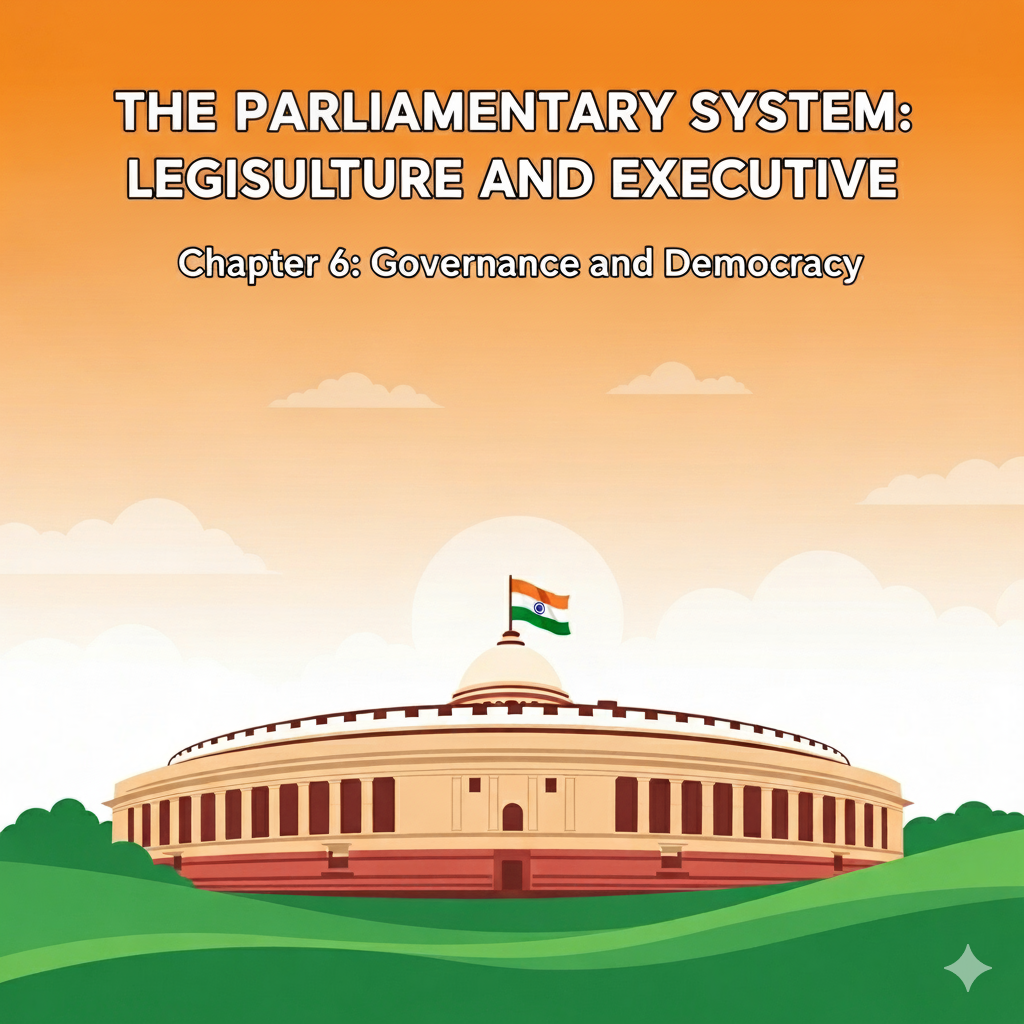
The Parliamentary System: Legislature and Executive
Chapter 6: Governance and Democracy
Complete Study Guide with Interactive Learning
Chapter Overview
What You'll Learn
Parliamentary System
Understanding India’s parliamentary structure and its bicameral nature.
Key Functions
Exploring lawmaking, accountability, and constitutional roles of Parliament.
Legislature and Executive
Roles at union and state levels, including separation of powers.
Challenges
Addressing disruptions, productivity, and effective functioning.
Historical Context
This chapter explores India’s parliamentary system, inspired by Britain but rooted in ancient republics and colonial experiences. The Constitution, drafted post-independence, established a bicameral Parliament with the Lok Sabha and Rajya Sabha. The new Parliament building symbolizes balance and inclusivity, while the old one (Samvidhan Sadan) hosted the Constituent Assembly. The 18th Lok Sabha was constituted in 2024, highlighting ongoing democratic evolution.
Key Highlights
Parliament upholds constitutional values through lawmaking and executive oversight. It practices federalism, with union and state levels mirroring structures. Challenges like disruptions affect productivity, but citizen engagement strengthens democracy.
Summary of All Topics
- Introduction: India’s independence led to the Constitution with universal franchise; Parliament as supreme legislative body.
- Composition: Bicameral system with President, Lok Sabha (550 max members), Rajya Sabha; based on population.
- Influences: British system, ancient republics, colonial experience; federalism for balance.
- Functions: Presiding officers ensure order; Union Executive includes President, Vice President, Council of Ministers.
- Legislative Functions: Constitutional, lawmaking (bill to act process), executive/financial accountability.
- Lawmaking Example: RTE Act journey from bill to law.
- Executive Accountability: Question Hour, committees; poetry/humour in debates.
- Executive Functions: President’s role, Prime Minister/Council of Ministers; civil servants implement laws.
- Differences: Legislature makes laws, Executive enforces; checks and balances with Judiciary.
- State Level: Vidhan Sabha/Parishad; Union/State/Concurrent Lists.
- Challenges: Disruptions, low productivity, criminal cases; media role, citizen engagement.