Checked 25 September 2026. From the SNLE guide (Sep 2025), the Nursing Technician blueprint (2024), SCFHS fee schedule (Nov 2023) and Prometric's minimum-qualification list. How SCFHS classifies a particular Indian diploma is decided case by case during classification.
SCFHS classifies nurses into grades, and the grade decides the exam. A nurse with a bachelor's degree is classified as a nurse specialist and sits the Saudi Nursing Licensure Examination (SNLE). A nurse with a diploma is classified as a nursing technician and sits the Nursing Technician exam. They are different papers, with different lengths, blueprints, pass marks and fees.
Where other pages get this wrong
There is no single "SCFHS nursing exam" — which one you sit depends on your classification.
Commonly published instead: Preparation courses and forum posts that treat the Saudi Prometric exam for nurses as one paper for everyone.
The SNLE guide requires a recognised primary degree (BSN or equivalent). Prometric's SCFHS minimum-qualification list defines a Nurse Technician by a two-year nursing diploma. SCFHS's own list of classification exams shows a separate Nursing Technician exam. Your classification application decides which you are eligible for.
The two exams side by side
| Point | SNLE | Nursing Technician exam |
|---|---|---|
| For | Nurse specialist — a recognised BSN or equivalent (the guide also allows interns and students one year from graduation; final-year sitting is described for Saudi students) | Nursing technician — nursing diploma (two-year diploma in Prometric's qualification list) |
| Questions | 200 MCQs (up to 10% unscored) | 150 MCQs |
| Time | 2 blocks × 120 minutes, 30-minute break | 3 hours |
| Pass mark | Scaled 500 on a 200–800 scale | 45% |
| Attempts | Up to 4 a year; one per window | General classification-exam rule (Prometric FAQ 2022): three attempts in total, eligibility about 3 months, SCFHS reactivation needed for the last attempt |
| Classification + registration fees (exam track) | SAR 1,340 (Nurse Specialist; one row of the schedule prints 1,430) | SAR 760 |
The blueprints compared
| Area | SNLE weight | Nursing Technician weight |
|---|---|---|
| Fundamentals | 20% | 15–25% |
| Adult nursing | 40% | 30–50% |
| Maternal-child nursing | 30% | 25–35% |
| Management / leadership | 10% (Nursing Management and Leadership) | 5–15% (Unit Management and Leadership) |
Illustrative only: the Technician blueprint gives ranges (Fundamentals 15–25, Adult 30–50, Maternal-child 25–35, Management 5–15) whose mid-points match the SNLE weights, but a real paper can sit anywhere in those ranges.
So the two exams cover the same four areas in broadly similar proportions. What differs is emphasis and depth — the SNLE names sub-sections such as critical care, community and psychiatric nursing, informatics and research, which the technician exam treats more lightly — and the scoring: a fixed 45% for technicians against a scaled, standard-set 500 for the SNLE.
Which one applies to you?
Which Saudi nursing exam will you sit?
Indian qualifications — what we can and cannot say
- A B.Sc. Nursing is a bachelor's degree in nursing, so it matches the SNLE's "BSN or equivalent" wording.
- SCFHS does not publish how it classifies Indian GNM or ANM diplomas. The published categories are a bachelor's degree (nurse specialist) and a two-year diploma (nurse technician); a three-year diploma is decided case by case during classification.
- If your qualification is not on SCFHS's list of recognised qualifications, a Qualification Study comes before classification.
We do not guess a classification outcome. Apply for classification through Mumaris+ to get SCFHS's own decision on your grade.
Scaled 500 versus a fixed 45%: what the difference means
The Nursing Technician exam uses a fixed pass mark: 45% of the questions, published in its blueprint. The SNLE uses a scaled pass score of 500, set by a standard-setting panel, on which SCFHS does not publish a percentage equivalent. For a candidate, the practical difference is predictability: on the technician exam you know the target in advance; on the SNLE you know the standard but not the raw number of correct answers it takes on your particular set of questions.
It also changes how to use practice tests. For the technician exam, a practice score comfortably above 45% is a direct signal. For the SNLE, practice percentages are only a rough guide — the official SCFHS practice exam, sampled from the real item bank, is the closest check available.
What 45% of 150 means
- 45% of 150 questions is 67.5, so if all 150 are scored a candidate needs 68 correct answers — SCFHS does not say whether the technician paper includes unscored items.
- That is a lower bar than it looks only if you can rely on it: aim for comfortably more in practice, because practice questions are rarely calibrated to the real paper.
- For the SNLE there is no such calculation — the pass score is a scaled 500, and SCFHS does not publish its percentage equivalent.
Other SCFHS exams in the nursing family
| Exam | For |
|---|---|
| Saudi Nursing Licensure Examination (SNLE) | Nurses with a bachelor's degree (nurse specialist) |
| Nursing Technician | Nurses with a nursing diploma |
| Midwifery Specialist | Midwives |
| Nursing Health Assistant | Nursing assistants |
| Anesthesia Technology Specialist | Anaesthesia technologists |
From SCFHS's classification-exam list and Prometric's SCFHS test list. Make sure the exam on your scheduling permit is the one your classification calls for before you prepare.
Grades and titles
Among the nursing grades in the SCFHS fee schedule, three matter for this guide: Nurse Specialist, Senior Nurse Specialist and Nursing Technician (the schedule also lists others, such as consultant and health assistant). The grade you are classified into sets your professional title in Saudi Arabia, and employers generally recruit to a specific grade — so check that a job offer matches the grade you are likely to receive.
If you are waiting for SCFHS to decide your grade, prepare for the four shared areas first — they are the same in both blueprints — and add the SNLE's extra depth (critical care, community, psychiatric nursing, informatics, research) once your classification confirms the SNLE. Time spent on the shared core is never wasted, whichever exam you end up sitting.
If you do not pass
For the SNLE, the SCFHS guide allows up to four attempts a year, one per testing window. For other classification exams, including the Nursing Technician exam, Prometric's 2022 SCFHS FAQ describes three attempts in total, with SCFHS reactivating your eligibility for the last one. Ask SCFHS directly about any other option.
Preparing for each
| If you are sitting | Emphasise | References SCFHS lists |
|---|---|---|
| SNLE | Adult nursing depth (medical, surgical, critical care, community, psychiatric); maternal-child; research and informatics basics | Brunner & Suddarth, Lewis Med-Surg, Kozier & Erb, Wong's Pediatrics, Marquis & Huston (leadership) and others |
| Nursing Technician | Core fundamentals and bedside skills; adult and maternal-child care at technician level; unit leadership basics | A similar list, including the ANA Code of Ethics and SCFHS's ethics booklet |
SCFHS notes in both documents that the reference lists are study aids, not endorsements. The practical message is the same for both exams: study the four areas in proportion to their weights, and practise scenario questions, not just recall. For the technician exam, bedside fundamentals and safe practice carry the most value; for the SNLE, depth in adult nursing and prioritisation in complex scenarios does. In both, pharmacology and infection control appear across every section, so a weak spot there costs marks everywhere.
Four-area readiness tracker
Tick an area when you can score consistently on timed practice questions in it. Saved in this browser.
0 of 9 done
Ticks are saved only in this browser on this device.
Practise it, don't just read it
The library quizzes follow the same four areas and suit both exams.
The ProSyllabus SCFHS nursing library has eight topic quizzes that map onto the SNLE blueprint: Fundamentals (20%) — Fundamentals of Nursing and Pharmacology for Nurses; Adult Nursing (40%) — Medical-Surgical Nursing and Critical Care and Emergency Nursing; Maternal-Child (30%) — Maternal and Newborn Nursing and Pediatric Nursing; plus two cross-cutting quizzes, Infection Prevention and Control and Professional Practice, Ethics and Patient Safety, useful across sections. The fourth blueprint section, Nursing Management and Leadership (10%), has no dedicated quiz yet. Each has worked explanations for every option.
Which SCFHS exam do BSN nurses take?
The Saudi Nursing Licensure Examination (SNLE), which the SCFHS guide says requires a recognised primary degree, a BSN or equivalent. It has 200 questions and a pass mark of 500 on a 200 to 800 scale.
Which SCFHS exam do diploma nurses take?
The Nursing Technician exam, which has 150 multiple-choice questions in 3 hours with a pass mark of 45%, according to the SCFHS Nursing Technician blueprint. Prometric's SCFHS qualification list defines a nurse technician by a two-year nursing diploma.
Can GNM nurses work in Saudi Arabia?
SCFHS decides each applicant's grade during professional classification from the verified qualification. Its published categories are a bachelor's degree for nurse specialist and a two-year diploma for nurse technician; it does not publish how a three-year GNM diploma is classified, so apply for classification to get a decision.
What is the pass mark for the SCFHS Nursing Technician exam?
45%, according to the SCFHS Nursing Technician blueprint published in 2024.
What happens if I fail the SNLE?
You can retake it — up to four attempts a year, one per testing window. For any other option, ask SCFHS directly.
How many questions are in the SCFHS Nursing Technician exam?
150 multiple-choice questions in 3 hours, according to the 2024 Nursing Technician blueprint. With a 45% pass mark, that is at least 68 correct answers if all 150 questions are scored.
Is the Nursing Technician syllabus different from the SNLE?
It covers the same four areas — fundamentals, adult, maternal-child and unit leadership — with ranges (15-25%, 30-50%, 25-35%, 5-15%) whose mid-points match the SNLE weights. The SNLE goes deeper, adding named sub-sections such as critical care, community and psychiatric nursing, informatics and research.
More in this series
- The SNLE blueprint, topic by topic
- SNLE pass score, attempts and testing windows
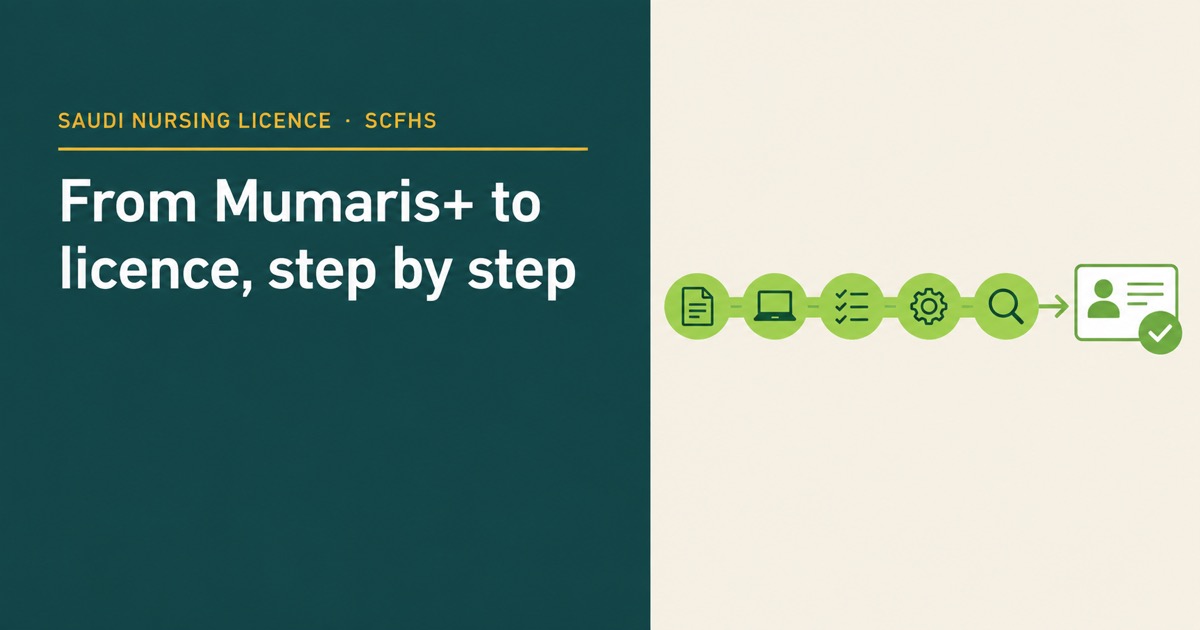
- SCFHS nursing licence process, step by step, with fees
- Gulf nursing licences compared: Saudi, UAE, Qatar, Kuwait, Oman, Bahrain
- A 12-week SNLE study plan, mapped to the official references
- SCFHS nursing notice board — official updates
Sources
- official — SNLE Applicant Guide, September 2025 (SCFHS)
- official — Nursing Technician Blueprint 2024 (SCFHS)
- official — Prometric SCHS minimum qualifications list
- official — SCFHS classification and registration fee schedule (Nov 2023)
- official — Prometric SCFHS FAQ (2022)
- official — SCFHS professional classification requirements
- official — Mumaris+ FAQ (SCFHS)
official = a document published by the conducting body. reported = a news or coaching site we could not check against an original. Where sources disagree this page says so rather than picking one.