Checked 25 September 2026. From the SCFHS SNLE Applicant Guide dated September 2025. SCFHS revises the guide periodically (2024 and 2025 editions differ); check the current guide before you apply, as you must confirm you have read it.
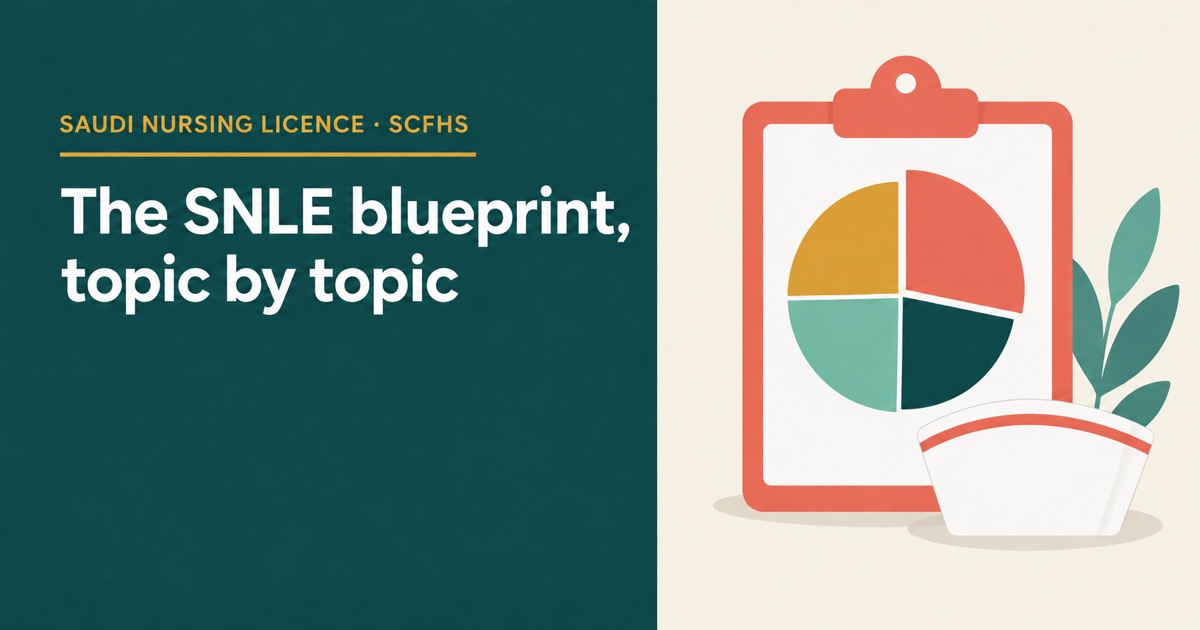
The Saudi Nursing Licensure Examination (SNLE) is the exam a nurse with a bachelor's degree sits to be classified as a nurse specialist by the Saudi Commission for Health Specialties (SCFHS). It is 200 multiple-choice questions in two blocks of 100, two hours each, and SCFHS publishes what those questions are built from: a blueprint of four sections with official target weights, each allowed to vary by up to 5 percentage points. This guide goes through every line of it.
SNLE Applicant Guide, September 2025.
The blueprint at a glance
| Section | Weight | ≈ Questions of 200 | Sub-sections |
|---|---|---|---|
| Nursing Fundamentals | 20% | 40 | Nursing physical assessment; Pharmacology; Basic sciences |
| Adult Nursing | 40% | 80 | Medical; Surgical; Critical care; Community; Mental/psychiatric nursing |
| Maternal-Child Nursing | 30% | 60 | Maternity; Gynecology; Neonatal; Pediatric medical; Pediatric surgical |
| Nursing Management and Leadership | 10% | 20 | Resources to support and coordinate care; Quality and safe care at the frontline; Nursing teams and interprofessional relations; Nursing informatics; Research and evidence-based practice |
The question counts are our arithmetic on the weights, and approximate for two reasons the guide states: each section may vary by up to 5 percentage points, and up to 10% of the 200 questions may be unscored pilot items. Treat them as the scale of each section, not a promise.
Official weights; each may vary by ±5 percentage points.
What changed in the September 2025 guide
Where other pages get this wrong
Clinical nutrition is no longer a named SNLE sub-section — "basic sciences" replaced it, and research and evidence-based practice was added.
Commonly published instead: Guides and course outlines still built on the 2024 blueprint, which listed clinical nutrition under Fundamentals.
Comparing the 2024 and September 2025 SCFHS guides: under Fundamentals, "Clinical nutrition" became "Basic sciences"; under Management and Leadership, "Research and Evidence Based Practice" was added. The four weights (20/40/30/10) did not change. Nutrition is still part of nursing care, so do not drop it — but anatomy, physiology and microbiology basics now have a named place.
Section 1 — Nursing Fundamentals (20%)
SCFHS defines it as the spectrum of basic human needs and the nursing competence to respond to them at a basic level, including prioritisation of care. In practice that means three sub-sections.
What to cover
- Physical assessment: vital signs and their normal ranges, systematic head-to-toe assessment, recognising abnormal findings.
- Pharmacology: drug classes, safe administration, dosage calculation, adverse effects and nursing implications.
- Basic sciences: anatomy, physiology, microbiology and biochemistry as they underpin nursing decisions.
- Cross-cutting: infection prevention, safety, prioritisation (airway–breathing–circulation, Maslow).
Section 2 — Adult Nursing (40%)
The largest section: care of adult patients in medical and surgical settings, from minor conditions to acute and long-term illness, including patients with complex needs in critical care — plus community and mental-health nursing. At about 80 questions it is a third larger than Fundamentals and Management combined (about 60), twice Fundamentals and four times Management.
What to cover
- Medical and surgical nursing: cardiovascular, respiratory, renal, endocrine, gastrointestinal, neurological and musculoskeletal conditions; pre- and post-operative care.
- Critical care: shock, sepsis, ventilated patients, cardiac emergencies, fluid and electrolyte balance.
- Community nursing: prevention, screening, communicable diseases, home care.
- Mental and psychiatric nursing: common disorders, therapeutic communication, risk assessment, psychotropic medication.
Section 3 — Maternal-Child Nursing (30%)
Care of child-bearing women and their families, and of neonates and children up to adolescence. The guide describes it as treating birth as a natural life event rather than a medical procedure — a framing worth remembering in scenario questions.
What to cover
- Maternity: antenatal care, labour stages, postpartum care and complications.
- Gynecology: common gynecological conditions and their nursing care.
- Neonatal: newborn assessment, APGAR, thermoregulation, neonatal jaundice, feeding.
- Pediatric medical and surgical: growth and development milestones, common childhood illnesses, pediatric dosing, pre- and post-operative care of children.
Section 4 — Nursing Management and Leadership (10%)
Leadership at the frontline — a nursing unit — to ensure that care is delivered safely and that every patient receives adequate care, including the essentials of nursing informatics. The management processes named are planning, organising, staffing, directing and controlling.
What to cover
- Delegation, prioritisation of a unit's workload, staffing and resource coordination.
- Quality improvement and patient safety at the bedside; incident reporting.
- Teamwork and interprofessional communication (e.g. structured handover).
- Nursing informatics for safe and legal care; documentation.
- Research and evidence-based practice (new in 2025): levels of evidence, reading a study, applying evidence to care.
The seven competencies that run through every section
Every question is also written to test one of seven competencies. They are not extra topics; they are the lens the scenario questions use.
| Competency | What a question tests |
|---|---|
| Professionalism | Accountability, and moral, ethical, legal and regulatory principles in care |
| Patient-centred care | Respecting patients' preferences and values; the patient as partner |
| Evidence-based practice and research | Appraising evidence and deciding with clinical expertise and patient values |
| Leadership and management | Influencing care delivery toward shared goals |
| Quality and safety management | Using data to improve care; minimising harm to patients and staff |
| Health education and promotion | Identifying needs and teaching healthy behaviour across ages and cultures |
| Communication and information technology | Communicating with patients, families and colleagues; using IT for decisions |
What a competency-based scenario looks like
Two illustrations written for this guide — not SNLE questions — show how a blueprint section and a competency combine in one item, and the reasoning that finds the best answer.
Illustration 1 — Adult Nursing × Quality and safety
- A patient on a surgical ward, a day after abdominal surgery, suddenly becomes breathless and anxious, with a falling oxygen saturation. Which action comes first?
- Reasoning: an acute change in breathing threatens airway, breathing and circulation, so the first nursing actions are to assess the airway and breathing, position the patient to ease breathing, give oxygen as the local protocol allows, and call for urgent help. Documenting, reassuring or waiting for the next scheduled observations are all correct things to do — later. SNLE-style questions reward recognising the order.
Illustration 2 — Management and Leadership × Leadership and management
- Which task is most appropriate to delegate to a nursing assistant: admitting a new patient, teaching a patient to use an inhaler, or measuring vital signs of a stable post-operative patient?
- Reasoning: assessment, teaching and evaluation stay with the registered nurse; routine tasks for stable patients with predictable outcomes can be delegated. The best answer is vital signs of the stable patient — with the nurse still responsible for acting on the results.
Illustrations of reasoning, written for this guide; follow your local protocols in practice.
Split your study time by the blueprint
The simplest defensible rule is to study in proportion to the weights, then shift time towards your weakest section once a practice test shows where it is. Choose the testing window you are aiming for; the planner counts the weeks and splits your hours.
SNLE study-hours planner
Choose your likely exam day and how many hours a week you can study. The planner counts the weeks left from today and splits your total hours across the paper.
The dates offered are the first and last days of the October (1–22), November (1–24) and December (1–24) 2026 windows shown as open on the SCFHS dates page; you book a specific day inside a window.
SNLE blueprint tracker
Tick each sub-section once you have revised it and answered practice questions on it. Saved in this browser.
0 of 18 done
Ticks are saved only in this browser on this device.
Practise it, don't just read it
The eight library quizzes cover every blueprint section — start with Adult Nursing, the largest.
The ProSyllabus SCFHS nursing library has eight topic quizzes that map onto the SNLE blueprint: Fundamentals (20%) — Fundamentals of Nursing and Pharmacology for Nurses; Adult Nursing (40%) — Medical-Surgical Nursing and Critical Care and Emergency Nursing; Maternal-Child (30%) — Maternal and Newborn Nursing and Pediatric Nursing; plus two cross-cutting quizzes, Infection Prevention and Control and Professional Practice, Ethics and Patient Safety, useful across sections. The fourth blueprint section, Nursing Management and Leadership (10%), has no dedicated quiz yet. Each has worked explanations for every option.
How many questions are in the SCFHS nursing exam?
The Saudi Nursing Licensure Examination (SNLE) has 200 multiple-choice questions, up to 10% of them unscored pilot items, in two blocks of 100 questions with 120 minutes each and a 30-minute break.
What is the SNLE blueprint?
Four sections with official weights: Nursing Fundamentals 20%, Adult Nursing 40%, Maternal-Child Nursing 30% and Nursing Management and Leadership 10%. Each may vary by up to 5 percentage points.
What changed in the SNLE blueprint in 2025?
In the September 2025 applicant guide, clinical nutrition under Fundamentals was replaced by basic sciences, and research and evidence-based practice was added under Management and Leadership. The section weights did not change.
Who takes the SNLE?
Nurses with a recognised bachelor's degree in nursing (BSN or equivalent), as well as interns and final-year students, according to the SCFHS guide. Nurses with a two-year diploma sit the separate Nursing Technician exam.
Are SNLE questions only recall questions?
No. The guide says the exam contains recall questions and scenario questions that test interpretation, analysis, decision-making, reasoning and problem-solving. Each question has four options with one best answer.
Is nutrition still in the SNLE?
Clinical nutrition is no longer a named sub-section in the September 2025 blueprint; basic sciences took its place under Fundamentals. Nutrition remains part of nursing care in adult and maternal-child scenarios, and the SCFHS reference list still includes a nutrition text.
More in this series
- SNLE pass score, attempts and testing windows
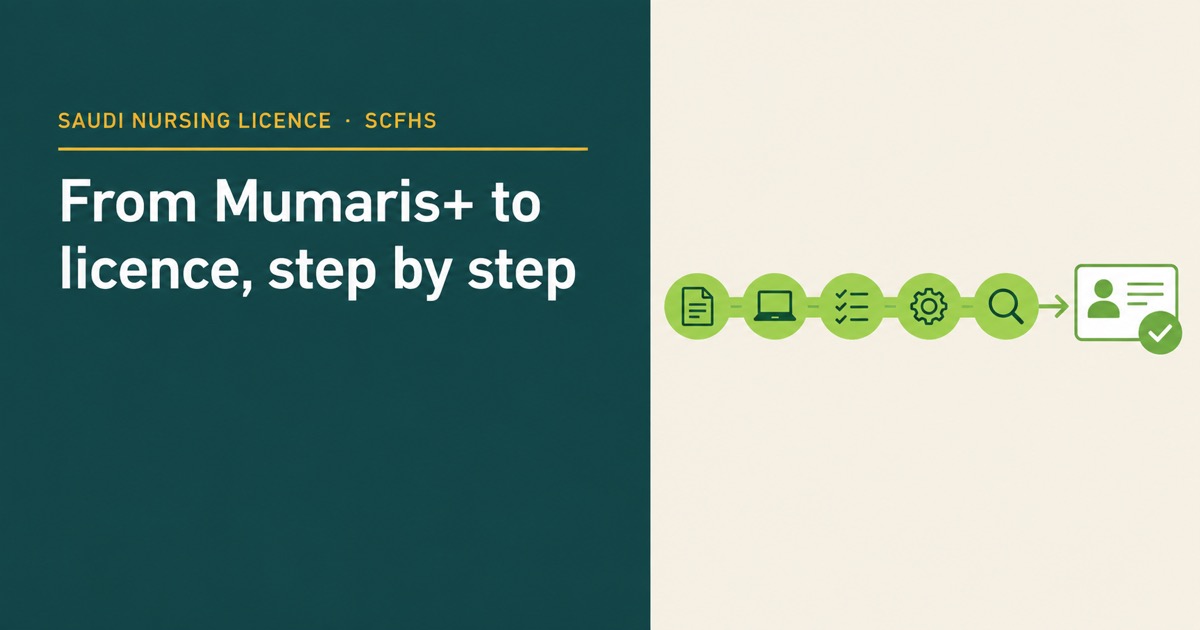
- SCFHS nursing licence process, step by step, with fees
- SNLE or Nursing Technician exam — BSN vs diploma
- Gulf nursing licences compared: Saudi, UAE, Qatar, Kuwait, Oman, Bahrain
- A 12-week SNLE study plan, mapped to the official references
- SCFHS nursing notice board — official updates
Sources
- official — SNLE Applicant Guide, September 2025 (SCFHS)
- official — SNLE Applicant Guide 2024 (SCFHS)
- official — SCFHS licensure examination dates (SPLE/SNLE windows)
- official — Nursing Technician Blueprint 2024 (SCFHS)
- official — Prometric SCHS minimum qualifications list
official = a document published by the conducting body. reported = a news or coaching site we could not check against an original. Where sources disagree this page says so rather than picking one.