Checked 25 September 2026. Fees are from the SCFHS schedule dated November 2023, still linked from its service pages. The SNLE seat fee and DataFlow fee are not published by SCFHS; figures shown for them are reported or left for you to enter.
Getting licensed as a nurse in Saudi Arabia is a sequence, and doing it out of order is the most common way to lose time and money. SCFHS calls the first legal step professional classification — deciding your professional title and grade from your verified qualifications and experience plus an evaluation, which for nurses is usually a written exam. Registration, which lets you practise, comes after. This guide lays out the official order, with fees and processing times.
Where other pages get this wrong
The exam is a step inside classification — it is not the first thing you do.
Commonly published instead: "Book your Prometric exam first, then do the paperwork."
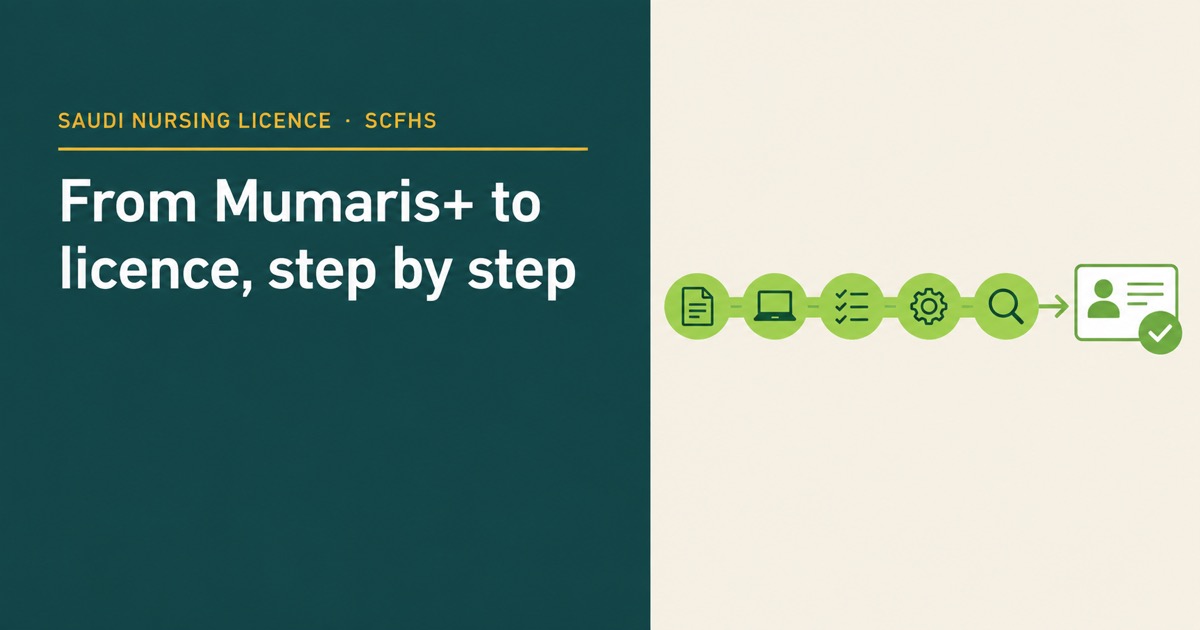
The official order is: Mumaris+ account → apply for professional classification (possible from outside Saudi Arabia) → primary-source verification through SCFHS's approved company → eligibility and exam booking → classification → professional registration. Registration needs a valid Saudi residence ID, so in practice it happens after you have a job and have moved.
The steps, in order
| Step | What | Where | Notes |
|---|---|---|---|
| 1 | Create an account on Mumaris+ | portal.scfhs.org.sa | Everything that follows runs through this account |
| 2 | Apply for professional classification | Mumaris+ | Possible from outside Saudi Arabia. If your degree is not on SCFHS's list of recognised qualifications, a Qualification Study service comes first |
| 3 | Primary-source verification | SCFHS-approved verification company (DataFlow) | Qualifications from outside Saudi Arabia must be verified; attach the final report |
| 4 | Eligibility and exam booking | Prometric for the SNLE (the SNLE guide names SCFHS-approved Prometric centres) | Scheduling permit with an eligibility period; booking up to about three months ahead |
| 5 | Pass the exam; classification issued | Mumaris+ | SNLE results 2–6 weeks after the window closes |
| 6 | Professional registration | Mumaris+ | Once you are in Saudi Arabia with a valid residence ID; valid 2 years |
What SCFHS asks for at classification
Requirements for non-Saudi nurses (SCFHS classification-requirements page)
- A recognised qualification, verified through SCFHS's approved verification company.
- At least one year of experience for non-Saudis (graduates of Saudi universities are exempt).
- Current registration in your home country — or a Ministry of Health letter where no registering body exists.
- A "Letter of Employment Identification" dated within the last three months, confirming current practice (a classification requirement).
A classification more than a year old before you register must be redone (Mumaris FAQ).
SCFHS application checklist
Tick each item as you complete it. Saved in this browser.
0 of 14 done
Ticks are saved only in this browser on this device.
Fees
| Grade | Admin (SAR) | Classification (SAR) | Registration (SAR) | Total (SAR) |
|---|---|---|---|---|
| Nurse Specialist | 200 | 900 | 240 | 1,340 |
| Senior Nurse Specialist | 200 | 900 | 320 | 1,420 |
| Nursing Technician | 200 | 400 | 160 | 760 |
From the SCFHS fee schedule dated November 2023. One row of that schedule prints a Nurse Specialist exam total of 1,430 although its components add to 1,340 — almost certainly a typo, but confirm the amount shown in Mumaris+ before paying. Other official fees: SNLE eligibility service SAR 120; Qualification Study SAR 300; SNLE practice exam USD 129.
Your total SCFHS cost
Official SCFHS fees are filled in. SCFHS does not publish the SNLE seat fee or the DataFlow fee — enter what your booking and DataFlow application actually quote. Add today's exchange rates to see a rupee total.
| Classification + registration for your grade — Specialist 1,340 · Technician 760 · Senior Specialist 1,420 (edit) | SAR |
| Qualification Study, only if your degree is not listed (as shown in Mumaris+) | SAR |
| SNLE eligibility service | 120 SAR |
| DataFlow verification (as quoted to you) | SAR |
| SNLE seat fee at the test centre (as quoted) | USD |
| Official practice exam (optional) | USD |
SCFHS does not publish a DataFlow fee and third-party estimates vary widely; use the amount on your own DataFlow application.
Three words that get mixed up
| Term | What it is | When |
|---|---|---|
| Professional classification | SCFHS's decision on your professional title and grade (e.g. Nurse Specialist or Nursing Technician), based on verified qualifications and experience plus an evaluation such as the SNLE | First — can be done from outside Saudi Arabia |
| Professional registration | The step that lets you practise in Saudi Arabia; needs a Saudi residence ID and an employment letter; valid two years | After classification, once employed |
| Verification (DataFlow) | Primary-source verification of your documents directly with the issuers | During classification, before the exam result can be used |
Where applications usually stall
Common causes of delay (practical, not official rules)
- Names that do not match. The name on your scheduling permit must match your passport exactly; mismatches between passport, degree and registration documents also slow verification.
- Employers who do not respond. Verification contacts each employer on your experience letters; a hospital that has changed name or closed can hold up the whole file. Give accurate, current contact details.
- Expired home registration. SCFHS asks for current registration in your home country — renew it before you apply.
- An old employment letter. The employment identification letter must be dated within the last three months.
- A classification that ages out. If more than a year passes between classification and registration, it must be redone.
These are practical observations about what the official requirements imply, not additional SCFHS rules.
If you work with a recruitment agency, the official steps and fees on this page are what SCFHS itself charges and requires; anything else an agency charges is its own service fee. You can create the Mumaris+ account and apply for classification yourself, and keeping your own login means you can see the status of your file at any time.
How long it takes
| Stage | Official processing time |
|---|---|
| Classification — direct decision | 7 working days |
| Classification — practical evaluation | 35 working days |
| Classification — electronic written exam (Prometric, Pearson VUE) | 30 working days |
| Results approved and shown on Mumaris+ | Up to 14 working days |
| SNLE results (SNLE guide) | 2–6 weeks after the testing window closes |
| Professional registration | 5 working days |
The two result times measure different things: the SNLE guide's 2–6 weeks is how long psychometric analysis takes after a window closes; the Mumaris+ figure of up to 14 working days is how long approval takes once results exist. Plan on the longer, SNLE-guide figure.
Mumaris+ FAQ. DataFlow verification time is separate and not published by SCFHS; start it early.
| Month (illustration) | Step | Runs in parallel with |
|---|---|---|
| 1 | Mumaris+ account; classification application; start DataFlow | Exam study begins |
| 2 | DataFlow verification in progress | Exam study |
| 3 | Verification report attached; eligibility; book a window | Timed practice |
| 4 | Sit the SNLE; result 2–6 weeks after the window | Job applications |
| 5+ | Classification issued; registration after employment and residence ID | — |
An illustration of how the steps overlap, not an official timetable: verification time depends on how fast your university, council and employers respond, and the official figures above cover SCFHS's own processing only.
The critical path is usually verification, not the exam. DataFlow has to contact your university, nursing council and employers; any one of them can take weeks to answer. Starting verification before you begin intensive exam study is the single most effective way to shorten the whole process.
Three points worth knowing
- If you fail: the SNLE allows up to four attempts a year, one per testing window. Ask SCFHS directly about any alternative classification — we could not verify reports of a technician fallback.
- Two test providers: SCFHS lists Prometric and Pearson VUE for classification written exams generally; the SNLE guide names Prometric centres. Your permit states where to book.
- Recency: the Mumaris FAQ says a classification more than a year old before registration must be redone.
Practise it, don't just read it
Verification runs in the background for weeks — a good time to start the SNLE practice questions.
The ProSyllabus SCFHS nursing library has eight topic quizzes that map onto the SNLE blueprint: Fundamentals (20%) — Fundamentals of Nursing and Pharmacology for Nurses; Adult Nursing (40%) — Medical-Surgical Nursing and Critical Care and Emergency Nursing; Maternal-Child (30%) — Maternal and Newborn Nursing and Pediatric Nursing; plus two cross-cutting quizzes, Infection Prevention and Control and Professional Practice, Ethics and Patient Safety, useful across sections. The fourth blueprint section, Nursing Management and Leadership (10%), has no dedicated quiz yet. Each has worked explanations for every option.
What is the process to get an SCFHS nursing licence?
Create a Mumaris+ account, apply for professional classification, complete primary-source verification through SCFHS's approved company (DataFlow), book and pass the exam, receive your classification, and then apply for professional registration once you have a valid Saudi residence ID.
How much does SCFHS classification cost for nurses?
Under the SCFHS fee schedule dated November 2023, SAR 1,340 in total for a Nurse Specialist (200 admin, 900 classification, 240 registration) and SAR 760 for a Nursing Technician. The SNLE eligibility service is SAR 120. The exam seat fee and DataFlow fee are not published by SCFHS.
Can I apply for SCFHS classification from India?
Yes. SCFHS's Mumaris FAQ says professional classification can be applied for from outside Saudi Arabia. Registration, the final step, requires a Saudi residence ID and an employment letter.
How much experience do I need for SCFHS as a nurse?
At least one year for non-Saudi applicants, according to SCFHS's professional classification requirements. Graduates of Saudi universities are exempt.
How long does SCFHS classification take?
The Mumaris+ FAQ lists 7 working days for a direct decision, 35 for a practical evaluation and 30 for an electronic written exam, up to 14 working days for results approval and 5 for registration. Verification time is additional, and SNLE results take 2-6 weeks after a window closes.
Do I need a job offer before applying to SCFHS?
Not for classification, which can be applied for from outside Saudi Arabia. Professional registration, the final step, needs a valid Saudi residence ID, so in practice it follows employment and relocation.
What is the SCFHS Qualification Study?
An SCFHS service for applicants whose qualification is not on SCFHS's list of recognised qualifications; it comes before classification, and its fee is shown in Mumaris+.
More in this series
- The SNLE blueprint, topic by topic
- SNLE pass score, attempts and testing windows
- SNLE or Nursing Technician exam — BSN vs diploma
- Gulf nursing licences compared: Saudi, UAE, Qatar, Kuwait, Oman, Bahrain
- A 12-week SNLE study plan, mapped to the official references
- SCFHS nursing notice board — official updates
Sources
- official — Mumaris+ FAQ (SCFHS)
- official — SCFHS professional classification requirements
- official — SCFHS classification and registration fee schedule (Nov 2023)
- official — SCFHS SNLE eligibility service (fee)
- official — SCFHS SNLE practice exam service
- official — DataFlow — Saudi Commission for Health Specialties
- official — Pearson VUE — SCFHS
- official — SNLE Applicant Guide, September 2025 (SCFHS)
official = a document published by the conducting body. reported = a news or coaching site we could not check against an original. Where sources disagree this page says so rather than picking one.