Checked 25 September 2026. Blueprint and references from the SNLE Applicant Guide (September 2025). Window dates are those open on the SCFHS dates page on 25 September 2026.
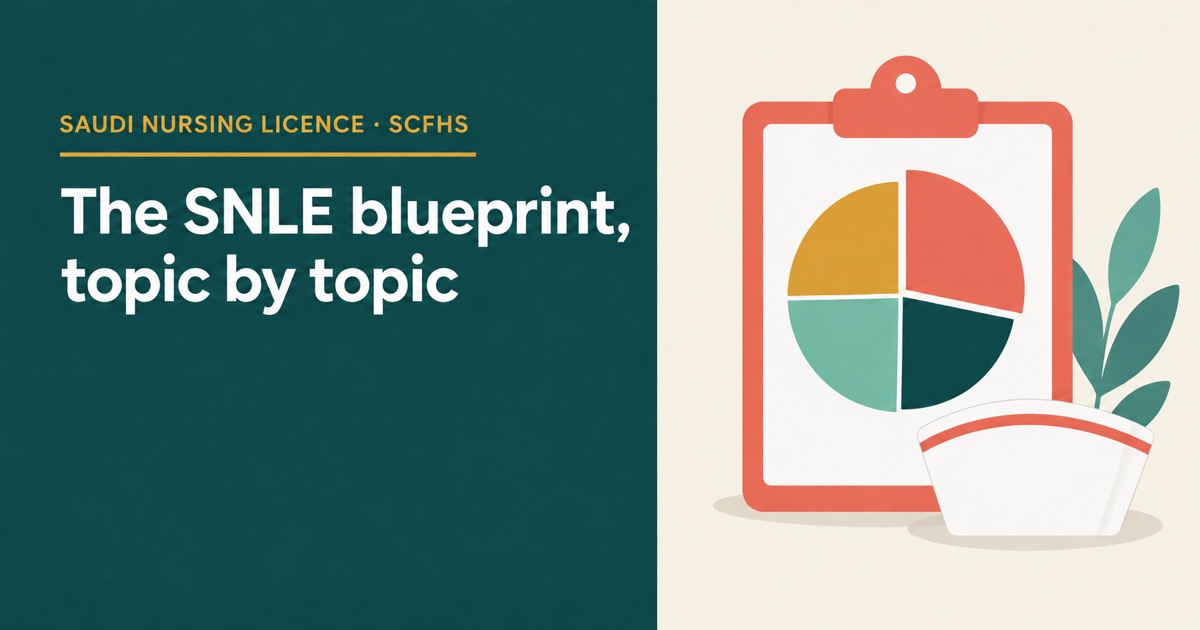
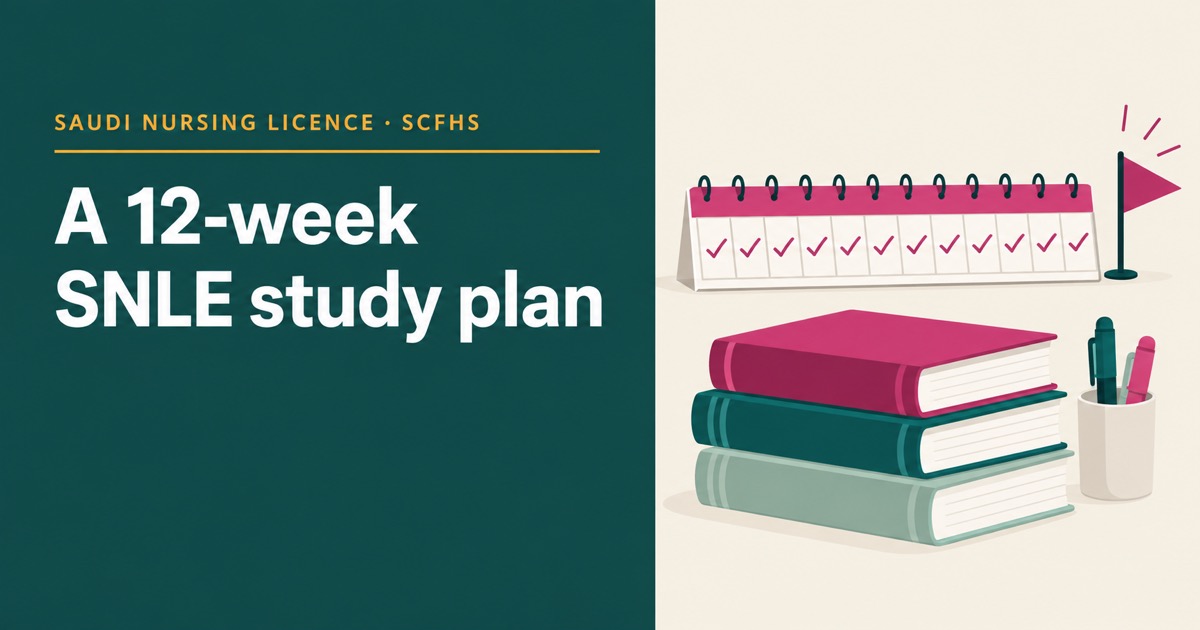
Most nurses preparing for the Saudi Nursing Licensure Examination are working full shifts, so a plan has to fit around a job. This one assumes about 12 hours a week for 12 weeks — roughly 1½ hours on four working days and three hours on each day off — and allocates time by the official blueprint: Adult Nursing 40%, Maternal-Child 30%, Fundamentals 20%, Management and Leadership 10%.
Hours by section
| Section | Weight | Hours (of ≈144) | Weeks |
|---|---|---|---|
| Adult Nursing | 40% | ≈ 58 | 3–6 |
| Maternal-Child Nursing | 30% | ≈ 43 | 7–9 |
| Nursing Fundamentals | 20% | ≈ 29 | 1–2 |
| Management and Leadership | 10% | ≈ 14 | ≈6 h in week 9 + ≈8 h of leadership scenarios inside weeks 3–8 |
SNLE study-hours planner
Choose your likely exam day and how many hours a week you can study. The planner counts the weeks left from today and splits your total hours across the paper.
Fundamentals comes first even though it is only 20%: physical assessment, pharmacology and basic sciences sit underneath every adult and maternal-child scenario question.
The 12 weeks
| Week | Focus | Practice |
|---|---|---|
| 1 | Fundamentals: physical assessment, vital signs, safety, infection control | Diagnostic set of mixed questions (to find your baseline) |
| 2 | Fundamentals: pharmacology and dosage calculation; basic sciences | Pharmacology and calculation drills |
| 3 | Adult: cardiovascular and respiratory | Topic questions |
| 4 | Adult: renal, endocrine, gastrointestinal; perioperative care | Topic questions |
| 5 | Adult: neurological, musculoskeletal; critical care and emergencies | Scenario sets |
| 6 | Adult: community nursing; mental and psychiatric nursing | First 100-question timed block |
| 7 | Maternal-child: antenatal, labour, postpartum; gynecology | Topic questions |
| 8 | Maternal-child: neonatal care; pediatric medical | Topic questions |
| 9 | Pediatric surgical; Management & Leadership (delegation, quality, informatics, research) | Second 100-question timed block |
| 10 | Weakest section from your blocks | Full session: 2 × 100 questions × 120 min with a 30-min break |
| 11 | Second-weakest section; pharmacology review | Full session (or the official SCFHS practice exam) |
| 12 | Light review; exam-day logistics | One final full session early in the week |
Management and Leadership is also woven into scenario practice throughout.
The official reference list, mapped to the plan
| Plan weeks | SCFHS-listed references |
|---|---|
| 1–2 (Fundamentals) | Timby (12e); Kozier & Erb (10e); Bates' Nursing Guide (2e); McCuistion Pharmacology (9e); Dudek Nutrition (9e) |
| 3–6 (Adult) | Brunner & Suddarth (14e); Lewis Medical-Surgical (11e); Perry & Potter clinical skills; Urden Critical Care (9e); Morton Critical Care (11e); Rector, and Stanhope, community health; Videbeck Psychiatric |
| 7–9 (Maternal-child) | Murray/McKinney and Ricci maternity texts; Wong's Pediatrics |
| 9 (Management) | Marquis & Huston Leadership (10e); Sewell Nursing Informatics (6e); Polit & Beck, Essentials of Nursing Research (9e) |
SCFHS says the list is a study aid, not an endorsement, and you do not need every book. A realistic approach: one core medical-surgical text for Adult Nursing, one maternal-child text, a pharmacology reference, and the leadership text for the 10% section — using the others only to look up topics you are weak in.
Two calculations you must be able to do fast
Dosage and infusion rate — worked examples
- Ordered 500 mg; available as 250 mg per 5 mL. Volume = (500 ÷ 250) × 5 = 10 mL.
- 1,000 mL to run over 8 hours by pump: 1,000 ÷ 8 = 125 mL/h. By gravity with a 20 drops/mL set: 125 × 20 ÷ 60 = 41.7, so 42 drops/min.
- Always check the units first (mg vs mcg, mL vs L) and whether the answer is plausible for the route.
Illustrative arithmetic for practice; follow your institution's policies in practice.
Using the library quizzes week by week
| Plan weeks | Quizzes |
|---|---|
| 1–2 | Fundamentals of Nursing; Pharmacology for Nurses; Infection Prevention and Control |
| 3–6 | Medical-Surgical Nursing; Critical Care and Emergency Nursing |
| 7–8 | Maternal and Newborn Nursing; Pediatric Nursing |
| 9 | Professional Practice, Ethics and Patient Safety |
| 10–12 | Retake the quiz for your weakest section after revising it |
A working-week template
| Day | Time | What |
|---|---|---|
| Working day 1 | 1½ h | Read one topic from the week's focus |
| Working day 2 | 1½ h | 40 practice questions on it, with rationales |
| Working day 3 | 1½ h | Second topic |
| Working day 4 | 1½ h | 40 questions on the second topic |
| Day off 1 | 3 h | Weak points from the error log; pharmacology drill |
| Day off 2 | 3 h | Timed block (from week 6) or a mixed set |
| Remaining day | Rest | Rest — shift workers need it |
Night-shift weeks will not fit this pattern; move the reading days to the days after your nights and keep the timed block on a rested day. What matters is the weekly total and the order of the weeks, not the day each task falls on — and protecting sleep before a timed block.
Only six weeks?
| Week | Focus | Practice |
|---|---|---|
| 1 | Fundamentals and pharmacology, fast | Diagnostic set |
| 2–3 | Adult Nursing, highest-yield systems first (cardiovascular, respiratory, critical care) | Topic sets daily |
| 4 | Maternal-child | Topic sets; first timed block |
| 5 | Leadership and weakest areas | Full 200-question session |
| 6 | Review only | One final session; logistics |
Whichever version you follow, measure progress the same way: your error log should shrink section by section, and your timed-block results should improve week on week. If a section is not improving after two weeks of work, change the method — switch from reading to questions, or to a different reference — rather than adding more hours of the same.
The final week
What to do — and not do
- One last full session early in the week, then stop taking long tests; read your error log and pharmacology notes instead.
- Confirm the centre address and travel time. Centres open at 7:30 a.m.; arriving more than 30 minutes after the time on your admission ticket, or not arriving, means no entry and counts as an attempt unless SCFHS accepts a documented reason.
- Bring your scheduling permit (printed or on your phone) and an unexpired passport — or, in Saudi Arabia, your national/residence ID. The name must match the permit exactly.
- Sleep. Two 120-minute blocks plus a 30-minute break is about four and a half hours in the chair — a rested brain matters more than one more night of reading.
How to use practice questions
Three rules
- Read the rationale for every option, including the ones you got right. SNLE scenario questions reward knowing why the other options are wrong.
- Practise in blocks of 100 against the clock. The real exam gives 120 minutes per 100 questions — 72 seconds each. Build to two blocks in one sitting by week 10.
- Keep an error log by section. After each block, note the section and sub-section of every miss; that log decides weeks 10 and 11.
Priority questions (the SNLE pattern)
- Many scenario questions ask what to do first. Use a consistent order: immediate threats to airway, breathing and circulation; then safety; then the rest by Maslow's hierarchy.
- Assessment before intervention, unless the scenario describes an emergency that needs immediate action.
- Choose the option within a nurse's scope; options that require a physician's order are rarely the first nursing action.
12-week SNLE plan tracker
Tick each week when you have done its focus and its practice. Saved in this browser.
0 of 12 done
Ticks are saved only in this browser on this device.
Practise it, don't just read it
The library's eight quizzes line up with this plan week by week — Fundamentals and Pharmacology for weeks 1–2, Medical-Surgical and Critical Care for weeks 3–6, Maternal-Newborn and Pediatric for weeks 7–9, and Professional Practice for week 9.
The ProSyllabus SCFHS nursing library has eight topic quizzes that map onto the SNLE blueprint: Fundamentals (20%) — Fundamentals of Nursing and Pharmacology for Nurses; Adult Nursing (40%) — Medical-Surgical Nursing and Critical Care and Emergency Nursing; Maternal-Child (30%) — Maternal and Newborn Nursing and Pediatric Nursing; plus two cross-cutting quizzes, Infection Prevention and Control and Professional Practice, Ethics and Patient Safety, useful across sections. The fourth blueprint section, Nursing Management and Leadership (10%), has no dedicated quiz yet. Each has worked explanations for every option.
How long does it take to prepare for the SNLE?
For a practising nurse, about 12 weeks at 12 hours a week is a realistic plan: roughly 144 hours split by the official blueprint — Adult Nursing 40%, Maternal-Child 30%, Fundamentals 20%, Management and Leadership 10%.
Which books are recommended for the SNLE?
The SCFHS applicant guide lists references including Brunner and Suddarth, Lewis Medical-Surgical Nursing, Kozier and Erb, Timby, McCuistion Pharmacology, Wong's Pediatrics, maternity texts by Murray/McKinney and Ricci, Videbeck Psychiatric Nursing, and Marquis and Huston on leadership. SCFHS says the list is a study aid, not an endorsement.
How many minutes per question in the SNLE?
Each block of 100 questions has 120 minutes, which is 72 seconds per question on average.
Which SNLE section should I study first?
Nursing Fundamentals — physical assessment, pharmacology and basic sciences — because they underpin the adult and maternal-child scenarios. Then spend the most time on Adult Nursing, which is 40% of the exam.
Is the official SNLE practice exam worth taking?
It is the official practice exam, which SCFHS says is sampled from the SNLE item bank. SCFHS lists its fee as USD 129; taking it in weeks 10 or 11 gives a realistic check before your testing window.
Can I prepare for the SNLE while working full time?
Yes — this plan assumes about 12 hours a week, around 1.5 hours on four working days and three hours on each day off, for 12 weeks. Night-shift weeks need the reading moved to rested days.
What if I have only six weeks for the SNLE?
Compress it: fundamentals and pharmacology in week one, adult nursing in weeks two and three, maternal-child in week four, leadership and weak areas in week five with a full session, and review only in week six.
More in this series
Sources
- official — SNLE Applicant Guide, September 2025 (SCFHS)
- official — SCFHS licensure examination dates (SPLE/SNLE windows)
- official — SCFHS SNLE practice exam service
official = a document published by the conducting body. reported = a news or coaching site we could not check against an original. Where sources disagree this page says so rather than picking one.