
Checked 13 October 2026. The assessment wording is from SIRI’s Bedømmelsesvejledning for the written part (May 2025) and the oral part (December 2024), read as archived copies on 13 October 2026; SIRI now keeps these guides on its assessor-training site behind a login. The choice of six areas and all drills are ours.
Dansk grammatik fejl in Prøve i Dansk 3: what is actually assessed
Prøve i Dansk 3 (PD3) has no grammar paper. Nobody asks you to conjugate a verb or to name a word class. Grammar is assessed inside your writing and your speech, as one part of what SIRI’s assessment guides call lingvistisk færdighed. The written guide spells that out as “ordvalg, syntaks, morfologi, retskrivning”: choice of words, sentence structure, word forms and spelling. The matching heading in the oral guide reads “ordvalg, syntaks, morfologi, udtale”, with pronunciation in the place of spelling [official: Bedømmelsesvejledning, written May 2025 and oral December 2024].
So grammar sits inside one of three things the examiners read for in the 200-word text: linguistic skill (lingvistisk færdighed: word choice, syntax, morphology, spelling). The other two are pragmatisk færdighed (do you do what the task asks: describe, explain, argue) and diskursiv færdighed (is the text organised and connected). A text with flawless verb endings that never answers the third point of the task is not a strong answer. The reverse is also true, and it is the reason for this page: errors that disturb the reader weigh heavily in the language grade, because SIRI’s descriptions sort grades by how far errors disturb reading.
PD3 has no grammar paper [official: BEK 1687/2025 bilag 1]. The 4 is our count of the list in the heading of SIRI’s written assessment guide. The last two figures describe this page.
What the grade descriptions say about errors
The target for the test is stated in the guide’s list of learning goals for writing: the candidate “kommunikerer med en forholdsvis høj grad af syntaktisk og morfologisk korrekthed”, and “retskrivningen er overvejende korrekt” — a fairly high degree of correctness in syntax and word forms, and spelling that is correct for the most part [official]. “Fairly high” is not “complete”. The descriptions of the three anchor grades make the scale visible.
| Grade | Language in the 200-word text (SIRI’s wording) | In English (our translation) | What it means for you |
|---|---|---|---|
| 12 | “kun få lingvistiske fejl”; control of “en varieret syntaks” | Only a few language errors; control of varied sentence structure, with several subordinate clauses | Errors are allowed even at the top. Variety is expected |
| 7 | “nogle lingvistiske fejl, der dog kun i mindre grad er forstyrrende for læsningen” | Some language errors, which disturb the reading only to a small degree | The question is whether the reader is disturbed, not how many errors there are |
| 02 | “en del lingvistiske fejl, der indimellem er forstyrrende for læsningen”; “forholdsvis elementær syntaks” | A good many language errors, which now and then disturb the reading; fairly elementary sentence structure | Still a pass. Simple sentences with errors that sometimes get in the way |
For the e-mail, the description of grade 02 is the most concrete sentence about grammar in either guide. It says there may be “enkelte eksempler på fejl i verbetider, substantivendelser og i elementær syntaks”: a few errors in verb tenses, in noun endings and in elementary sentence structure [official]. Those three named things are tense, endings and elementary sentence structure (elementær syntaks; word order is the commonest case of it), and they account for five of the six areas below.
Errors do not mean failure
SIRI’s own example of an answer graded 12 is not free of errors. Its e-mail contains “min kørekort” (the noun is an et-word: mit kørekort) and “i din første dag” (standard Danish: på din første dag). The examiners’ reasoning still calls the e-mail’s formulations linguistically correct “i overvejende grad”, for the most part [official: written guide, answer and reasoned assessment for grade 12; the two corrections are ours]. That is the standard you are held to: a text that works, written by a person who is still learning.
Two limits on what follows. The choice of these six areas is ours. We know of no published count of which errors PD3 candidates make most often, so we make no claim about frequency. We chose areas where Danish differs from English in a rule that can be stated in one line and checked in your own text in a minute. And single sentences are easier than a text: the drills teach you to see a pattern, and the test asks you to keep it under control while you are thinking about your argument.
1. Verb second: the verb is the second element of a main clause
In a Danish declarative main clause (a statement) the finite verb comes second. If the clause begins with anything other than the subject — a time, a place, an adverb such as derfor or desværre, or a whole subordinate clause — the subject moves to the place after the verb. Danish teaching calls this omvendt ordstilling or inversion. English keeps subject before verb (“Yesterday I worked”), which is why the error is so easy to make.
| Not standard Danish | Standard Danish | English | The rule |
|---|---|---|---|
| I Danmark man betaler en høj skat. | I Danmark betaler man en høj skat. | In Denmark people pay a high tax. | A place first: verb, then subject |
| Desværre jeg kunne ikke komme til mødet. | Desværre kunne jeg ikke komme til mødet. | Unfortunately I could not come to the meeting. | An adverb first: verb, then subject |
| Da jeg kom hjem, jeg lavede mad. | Da jeg kom hjem, lavede jeg mad. | When I came home, I cooked. | A whole clause first counts as one element |
| Bussen er dyr. Derfor jeg cykler på arbejde. | Bussen er dyr. Derfor cykler jeg på arbejde. | The bus is expensive. That is why I cycle to work. | Derfor is an adverb and takes the first place |
| Jeg ville gerne komme, men kunne jeg ikke få fri. | Jeg ville gerne komme, men jeg kunne ikke få fri. | I wanted to come, but I could not get time off. | After og, men, eller and for the order starts again: when the new clause opens with its subject, it is subject, verb |
The last row is the over-correction. Once inversion has been learned, some writers invert after every small word. The conjunctions og, men, eller, for join two clauses and take no place in either. Derfor, alligevel and desuden are adverbs: they do take the first place, and the verb follows them.
2. Subordinate clauses: ikke goes before the verb
After at, fordi, hvis, når, selvom, som, der and the other words that open a subordinate clause, the order is subject, then the adverb (ikke, aldrig, altid, også, gerne), then the finite verb. (If the word that opens the clause is itself the subject, as in som ikke kan lide møder, there is no separate subject, and the adverb still comes before the verb.) In an ordinary main clause the adverb comes after the verb. This difference is one concrete case of what the guides mean when they ask for control of sentences with several subordinate clauses.
| Not standard Danish | Standard Danish | English | The rule |
|---|---|---|---|
| Hun fortalte, at toget var ikke kommet. | Hun fortalte, at toget ikke var kommet. | She said that the train had not come. | at + subject + ikke + verb |
| Selvom det regner altid om efteråret, cykler jeg på arbejde. | Selvom det altid regner om efteråret, cykler jeg på arbejde. | Although it always rains in the autumn, I cycle to work. | altid behaves like ikke |
| Jeg har en kollega, som kan ikke lide møder. | Jeg har en kollega, som ikke kan lide møder. | I have a colleague who does not like meetings. | A relative clause is a subordinate clause |
| Jeg ved ikke, hvor bor han. | Jeg ved ikke, hvor han bor. | I do not know where he lives. | An indirect question has subject before verb |
A quick test for your own text: find every ikke. If it stands in a clause opened by one of the words above, it should be to the left of the verb.
3. sin, sit, sine or hans, hendes, deres
English has one “his” and one “her”. Danish has two sets. Sin, sit, sine point back to the subject of the same clause, when that subject is third person singular (han, hun, den, det or a noun naming one person or thing); for jeg and du the words are min, din and so on. Hans, hendes, dens, dets point to somebody else — or are used when the owner is not the subject of that clause. With a third-person plural owner the word is always deres (the first and second person plural are vores and jeres).
| Danish | English | Why this form |
|---|---|---|
| Anna besøger sin mor hver søndag. | Anna visits her (own) mother every Sunday. | The owner, Anna, is the subject of the clause |
| Anna besøger hendes mor hver søndag. | Anna visits her (another woman’s) mother every Sunday. | Correct Danish, but it means a different mother |
| Han siger, at hans kone arbejder i Aarhus. | He says that his wife works in Aarhus. | Sin can only point back to the subject of its own clause. Here the owner, han, is in the main clause, and “hans kone” is itself the subject of the at-clause |
| De solgte deres hus sidste år. | They sold their house last year. | Plural owner: deres, never sit |
| Hun tog sit pas og sine nøgler. | She took her passport and her keys. | sit with an et-word, sine with a plural |
The second row matters in the test because it is not an error a spell checker or a dictionary can find: the sentence is grammatical and says something you did not mean. An examiner reading it has to stop and work out whose mother it is, which is exactly the kind of error that disturbs reading (that reading of “disturbing” is ours, not a SIRI definition).
4. en or et, and the endings that follow
- Cheatsheet + revision sheet: key concepts in 2 lines each
- All 8 parts: time, aids, marking
- 2.0 to pass, oral counts double
- 45 connectors and opinion phrases
- 2 model texts: e-mail and 200 words
- 10 oral topics with questions
Almost every Danish noun is an en-word or an et-word, and there is no dependable rule for which. It has to be learned with the noun. The gender then decides three more things: the definite ending (-en or -et), the adjective ending after en/et, and the article in front of an adjective (den or det). One wrong gender can therefore produce three errors in a line.
| Form | en-word | et-word | Note |
|---|---|---|---|
| Indefinite | en bil | et hus | Learn the article with the noun |
| Indefinite with adjective | en rød bil | et gammelt hus | The adjective takes -t with an et-word |
| Definite | bilen | huset | The article is an ending |
| Definite with adjective | den røde bil | det gamle hus | Article in front, adjective in -e, and no ending on the noun |
| Plural | biler, de røde biler | huse, de gamle huse | Adjective in -e in the plural |
| After a possessive | min bil, min røde bil | mit hus, mit gamle hus | No definite ending on the noun after min, din, sin, hans or a genitive such as Peters |
One slip in this group deserves a separate look, doubling the definite: det store problemet for det store problem. Norwegian and Swedish do double it, so anyone who has met those languages should be careful. The last row shows the first slip in SIRI’s grade-12 example quoted above: a possessive takes the gender of its noun, so mit kørekort.
5. Prepositions that do not follow English
Prepositions cannot be translated one for one, and the dictionary you may bring to the writing test is the right tool for them: look up the verb or adjective, not the preposition. Some pairings are worth knowing by heart because they come up whenever you write about work, family or opinions.
| Danish | English | Fixed pairing |
|---|---|---|
| Jeg er god til at lave mad. | I am good at cooking. | god til |
| Mange er bange for at miste deres job. | Many are afraid of losing their job. | bange for |
| Vi er afhængige af bilen. | We depend on the car. | afhængig af |
| Jeg tænker tit på min familie. | I often think about my family. | tænke på |
| Jeg er enig med dig i, at det er dyrt. | I agree with you that it is expensive. | enig med (a person), enig i (a view) |
| Om mandagen arbejder jeg hjemme. | On Mondays I work from home. | om + definite day: every Monday |
| På mandag har jeg fri. | This coming Monday I am off. | på + day: the next one |
| I mandags var jeg syg. | Last Monday I was ill. | i + day in -s: the last one |
| Jeg har boet her i fem år. | I have lived here for five years. | i + a length of time: for |
| Jeg flyttede hertil for fem år siden. | I moved here five years ago. | for … siden: ago |
6. Tense: datid or førnutid
Danish and English mostly agree here, which makes the differences easy to overlook. Use the past tense (datid) when the time is finished and named: i går, sidste år, i 2020, da jeg var barn. Use the perfect (førnutid) when the time is not finished or not named, and the result still counts. Task 2B of the writing test begins with your own experience, so in that task the first paragraph of your text is where this shows.
| Not standard Danish | Standard Danish | English | The rule |
|---|---|---|---|
| I 2020 har jeg fået mit første job. | I 2020 fik jeg mit første job. | In 2020 I got my first job. | A named, finished time takes datid |
| Jeg bor i Danmark i fem år. | Jeg har boet i Danmark i fem år. | I have lived in Denmark for five years. | Began in the past and still true: førnutid, not the present |
| Jeg har boet i Polen i fem år, før jeg flyttede. | Jeg boede i Polen i fem år, før jeg flyttede. | I lived in Poland for five years before I moved. | A finished period takes datid |
| Han har kommet til Aarhus. | Han er kommet til Aarhus. | He has come to Aarhus. | Many verbs of movement or change with a result take er (er kommet, er gået, er blevet); check the verb in the dictionary |
| Hvis jeg har mere tid, ville jeg læse mere. | Hvis jeg havde mere tid, ville jeg læse mere. | If I had more time, I would read more. | An unreal condition: datid in the hvis-clause, ville in the main clause |
The 20 drills
Each drill shows one sentence in three versions. One is correct standard Danish; the other two carry an error from the group named in its heading. In the sin or hans drills the owner is always the person the sentence is about (the subject), as the English meaning shown after your answer makes clear. The checker reports your score for each of the six groups and tells you which rule to read again. If scripts are switched off, the two tables under the tool give every correct sentence, its English meaning, the wrong versions and the rule.
20 correction drills: pick the correct sentence
Each item shows one sentence three ways. Two contain an error of the kind named in the heading; one is correct standard Danish. Choose, then check: every item answers with the rule in English.
All 60 sentences are written for this page. The answers are also printed in the table below, so the page works without scripts. Nothing you choose is stored.
How the 20 drills are divided. The numbers say how many drills we wrote for each area, not how often candidates make the error.
Answers to drills 1–10
| # | Correct sentence | English | Wrong versions in the drill | Rule |
|---|---|---|---|---|
| 1 | I weekenden besøgte vi mine svigerforældre i Aalborg. | At the weekend we visited my parents-in-law in Aalborg. | I weekenden vi besøgte mine svigerforældre i Aalborg. / I weekenden besøgte mine svigerforældre vi i Aalborg. | A time phrase stands first, so the verb must come second and the subject third: besøgte vi. |
| 2 | Efter min mening er det vigtigt at spare på energien. | In my opinion it is important to save energy. | Efter min mening det er vigtigt at spare på energien. / Efter min mening vigtigt er det at spare på energien. | Efter min mening fills the first place. The verb er follows at once, then the subject det. |
| 3 | Derfor flytter mange unge til de store byer. | That is why many young people move to the big cities. | Derfor mange unge flytter til de store byer. / Derfor flytter til de store byer mange unge. | Derfor is an adverb in first place, not a conjunction: verb second, subject third. |
| 4 | Hvis man bor på landet, har man ofte brug for en bil. | If you live in the country, you often need a car. | Hvis man bor på landet, man har ofte brug for en bil. / Hvis man bor på landet, ofte man har brug for en bil. | A whole hvis-clause in first place counts as one element. The main clause starts with its verb: har man. |
| 5 | Jeg tog cyklen, fordi bussen ikke kom til tiden. | I took the bike because the bus did not come on time. | Jeg tog cyklen, fordi bussen kom ikke til tiden. / Jeg tog cyklen, fordi ikke bussen kom til tiden. | In a subordinate clause ikke stands before the finite verb: bussen ikke kom. |
| 6 | Hun siger, at hun aldrig har prøvet at bo alene. | She says that she has never tried living alone. | Hun siger, at hun har aldrig prøvet at bo alene. / Hun siger, at aldrig hun har prøvet at bo alene. | Aldrig behaves like ikke: after at it goes before the finite verb har. |
| 7 | Det er en ordning, som mange forældre ikke kender. | It is a scheme that many parents do not know. | Det er en ordning, som mange forældre kender ikke. / Det er en ordning, som ikke mange forældre kender den. | A relative clause with som is a subordinate clause too: ikke before kender, and no extra den. |
| 8 | Peter cykler hver dag til sit arbejde. | Peter cycles to his own workplace every day. | Peter cykler hver dag til hans arbejde. / Peter cykler hver dag til sin arbejde. | The owner is the subject of the same clause, so the reflexive form is used, and arbejde is an et-word: sit. |
| 9 | Maria og hendes mand bor i Odense. | Maria and her husband live in Odense. | Maria og sin mand bor i Odense. / Maria og sit mand bor i Odense. | Sin cannot be part of the subject itself. Inside the subject you need hendes. |
| 10 | Forældrene henter deres børn klokken fire. | The parents fetch their children at four. | Forældrene henter sine børn klokken fire. / Forældrene henter sin børn klokken fire. | Sin, sit and sine refer to one owner. With a plural subject the word is deres. |
Answers to drills 11–20
| # | Correct sentence | English | Wrong versions in the drill | Rule |
|---|---|---|---|---|
| 11 | Vi har købt et nyt hus tæt på skolen. | We have bought a new house close to the school. | Vi har købt en nyt hus tæt på skolen. / Vi har købt et ny hus tæt på skolen. | Hus is an et-word, and the adjective takes -t with it: et nyt hus. |
| 12 | Det store problem er, at boligerne er for dyre. | The big problem is that the homes are too expensive. | Det store problemet er, at boligerne er for dyre. / Den store problem er, at boligerne er for dyre. | After det + adjective the noun has no definite ending, and problem is an et-word: det store problem. |
| 13 | Kommunen har lukket biblioteket i vores bydel. | The council has closed the library in our part of town. | Kommunen har lukket biblioteken i vores bydel. / Kommunen har lukket det biblioteket i vores bydel. | Bibliotek is an et-word, so the definite form ends in -et, and with no adjective there is no det in front. |
| 14 | Mange unge mennesker vil gerne arbejde i udlandet. | Many young people would like to work abroad. | Mange ung mennesker vil gerne arbejde i udlandet. / Mange ungt mennesker vil gerne arbejde i udlandet. | In the plural the adjective ends in -e: unge mennesker. |
| 15 | Jeg er meget interesseret i dansk politik. | I am very interested in Danish politics. | Jeg er meget interesseret for dansk politik. / Jeg er meget interesseret på dansk politik. | The fixed pairing is interesseret i. |
| 16 | Vi venter på bussen hver morgen. | We wait for the bus every morning. | Vi venter for bussen hver morgen. / Vi venter til bussen hver morgen. | English wait for is vente på in Danish. |
| 17 | Min søn går i børnehave, og jeg læser på universitetet. | My son goes to kindergarten, and I study at the university. | Min søn går på børnehave, og jeg læser i universitetet. / Min søn går til børnehave, og jeg læser ved universitet. | Fixed choices that have to be learned: gå i børnehave, læse på universitetet. |
| 18 | I går arbejdede jeg hjemme hele dagen. | Yesterday I worked from home all day. | I går arbejder jeg hjemme hele dagen. / I går har jeg arbejdet hjemme hele dagen. | I går names a finished time, which takes the past tense (datid), not the present or the perfect. |
| 19 | Jeg flyttede til Danmark i 2019. | I moved to Denmark in 2019. | Jeg er flyttet til Danmark i 2019. / Jeg flytter til Danmark i 2019. | A stated finished point in time (i 2019) takes the past tense. The perfect is for a result that still holds, with no finished time named. |
| 20 | Da jeg var barn, spiste vi altid sammen klokken seks. | When I was a child, we always ate together at six. | Da jeg var barn, har vi altid spist sammen klokken seks. / Da jeg var barn, spiser vi altid sammen klokken seks. | The da-clause sets the story in the past, so the main clause stays in the past tense too: spiste vi. |
From drills to your own text
A drill score says little about the test, because in a drill you are looking for an error and you know which kind. In the writing room you have 2½ hours for both tasks and may use dictionaries; that leaves time for a check at the end, and a check works best as separate passes, one pattern at a time [official: BEK 1687/2025 bilag 1 pt 3.22 for the time and aids; the method is our advice].
| Pass | Look for | Ask yourself |
|---|---|---|
| 1 | The first word of every sentence | In a main clause that starts with something other than the subject, is the verb next? |
| 2 | Every ikke, aldrig, altid, også | Is it inside an at-, fordi-, hvis- or som-clause? Then it goes before the verb |
| 3 | Every sin, sit, sine, hans, hendes, deres | Who owns it, and is that person the subject of this clause? |
| 4 | Every den and det followed by an adjective | Adjective in -e, and no ending on the noun? |
| 5 | Every time expression | Finished and named: usually datid. Still going on or still relevant now: førnutid |
| 6 | Nouns you were unsure of | en or et? The dictionary answers this in ten seconds |
Then put the grammar back in its place. The writing grade is set by the whole text, and SIRI’s guide tells examiners to judge language, not knowledge of the topic. A weaker and a stronger answer to the same task, with the differences marked against the official descriptions, are in the model-answers guide; the parts and timing of the written day are in the written exam guide; and because the oral grade counts twice, read the pass rule before you decide how many evenings grammar deserves. In the oral, most of the same areas are heard, not read (spelling drops out, pronunciation comes in), and a slip you correct yourself in the next breath shows that you control the form. The six-week plan puts these drills in week 3.
The same exam on seven printable pages
Page 6 of the kit carries 15 grammar points beside the reading method, part by part.
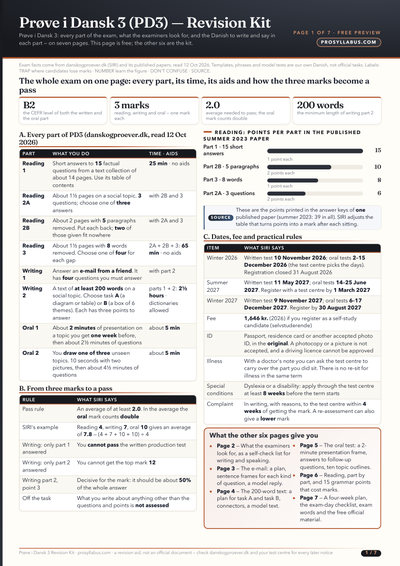
The Prøve i Dansk 3 revision kit is a seven-page PDF in English with the Danish you need: the whole exam on one page, what the examiners look for as a self-check list, a plan and sentence frames for the e-mail, a plan and connectors for the 200-word text, a frame for the 2-minute presentation with ten topic outlines, reading part by part with 15 grammar points, and a four-week plan. Its exam facts come from danskogproever.dk; its model texts are our own, never official tasks. Page 1 is free to read in full before you decide.
Frequently asked questions
Is there a grammar section in Prøve i Dansk 3?
No. Grammar is assessed inside your written texts and your speech, as part of what the assessment guides call lingvistisk færdighed.
What does lingvistisk færdighed cover?
In writing: choice of words, syntax, morphology and spelling. In the oral: choice of words, syntax, morphology and pronunciation. This is the wording of SIRI’s assessment guides.
How many grammar errors can I make and still pass?
No number is published. The description of grade 02 in writing speaks of a good many language errors that now and then disturb the reading. Examiners judge the whole text.
Can an answer with errors get 12?
Yes. The description of 12 says only a few language errors, and SIRI’s own example of a 12 answer contains a wrong noun gender and a wrong preposition.
What is omvendt ordstilling?
Inversion: when a main clause begins with something other than the subject, the verb stays second and the subject comes after it. I går arbejdede jeg hjemme.
Where does ikke go in a subordinate clause?
Before the finite verb: fordi bussen ikke kom. In a main clause it comes after the verb: bussen kom ikke.
When do I use sin and when hans or hendes?
Sin, sit and sine when the owner is the third-person singular subject of the same clause (han, hun, den, det or one noun). Hans or hendes for another person, and deres for a third-person plural owner. For jeg and du it is min and din.
How do I know whether a noun is en or et?
There is no dependable rule. Learn the article with the noun, and look it up in the dictionary you may bring to the writing test.
Are these the most common PD3 mistakes?
We do not claim that. No published count exists that we know of. The six areas are our choice of rules that are easy to state and to check.
May I use a dictionary in the test?
In the writing test, yes. In the reading test, no. The oral has no aids apart from your own one-page notes for the presentation.
Do the drills use real exam sentences?
No. All 60 sentences were written for this page. PD3 has no correction task; the drills train you to see patterns in your own writing.
More in this series
- The pass rule: oral counts double, 2.0 with no rounding (calculator)
- The written day: three reading parts (four sections), two writing tasks
- The oral exam: 2-minute presentation and a drawn picture topic
- PD2 or PD3 for permanent residence and citizenship (chooser)
- Self-study: registration, the 1,646 kr fee, pass rates, 10/7/7 for doctors
- Examples: one original task for each part, with what the examiner looks for
- Written: two tasks, a weaker and a stronger answer to each, with our grade estimates
- Past papers: where the official PDFs are, what is not published, and a practice planner
- A six-week study plan, dated for your sitting, built on the pass rule
- Alinea dansk prøve: the Bliv klar books and the official material, part by part
- PD3 notice board — official updates
Sources
- official — SIRI — Bedømmelsesvejledning, skriftlig del af Prøve i Dansk 3, May 2025 (PDF, 33 pages; Wayback index lists a capture of 12 Sep 2025, but its replay returned 404 on 13 Oct 2026 — SIRI has since moved its assessment guides to its assessor-training site)
- official — SIRI — Bedømmelsesvejledning, mundtlig del af Prøve i Dansk 3, December 2024 (PDF, 34 pages; Wayback capture of 12 Sep 2025)
- official — SIRI — Bedømmelsesvejledninger og lydfiler (says the guides have moved to the assessor-training site)
- official — SIRI — Om bedømmelse ved danskprøverne
- official — BEK nr 1687 af 16/12/2025 — tests in Danish education for adult foreigners, with bilag 1–3 (retsinformation.dk)
- official — SIRI — Om Prøve i Dansk 3 (PD3), indhold og niveau (for language centres)
- official — SIRI — Om Prøve i Dansk 3 og krav til at bestå (for candidates)
official = a document published by the conducting body. reported = a news or coaching site we could not check against an original. Where sources disagree this page says so rather than picking one.