
Checked 13 October 2026. The assessment rules and the grade descriptions are from SIRI’s Bedømmelsesvejledning for the written part of PD3, May 2025, read as an archived copy because SIRI has moved the guide to a site that needs a login; a newer edition may exist there. The tasks and the four answers are ours, and every grade named for them is our estimate, not an official grade.
Prøve i Dansk 3 skriftlig eksempel: what is on this page, and what is not
If you search for a written example of Prøve i Dansk 3 (PD3), the best material is official and free: SIRI publishes a past paper and one answer that passed, and its guide for examiners prints seven real answers with the grade each was given. Those are indexed in the past-papers guide. What they do not give you is the same task answered at two levels, with the differences pointed out one by one.
That is what this page does. There are two tasks written for this page in the official format, an e-mail (delprøve 1) and a text of at least 200 words (delprøve 2, task B). Each is answered twice in Danish. Every line of comment is tied to SIRI’s published description of a grade. One thing must be clear from the start: the grades named here are our estimates against those descriptions. Only an examiner and a censor can give a grade, and they give one grade for both tasks together.
Descriptions: SIRI’s assessment guide for the written part of PD3, May 2025 [official, archived copy]. Tasks, answers and estimates are ours.
How the writing grade is set
Writing gives one grade for the two tasks, and the answer to task 2 is what decides it (BEK 1687/2025 bilag 1 pt 3.23) [official]. SIRI’s assessment guide tells the examiner how to get there: read the answer, take notes and judge it as a whole against the goals of the test; then read it again against separate focus points; then settle the grade. On the examiner’s sheet each focus point is placed at Top, Midt, Bund or Under niveau [official: assessment guide, May 2025, “Bedømmerark”].
| Focus point on the examiner’s sheet | What it covers | Source |
|---|---|---|
| Task 1 — communicative language ability | One judgement for the e-mail: the speech acts, the organisation and the language together | Assessment guide, bedømmerark |
| Task 2 — pragmatic ability (sproghandlinger) | Whether you do what each of the three points asks: describe or tell, explain or comment, discuss and argue | Assessment guide, bedømmerark |
| Task 2 — discourse ability (organisering, kohærens og kohæsion) | Paragraphs, how they are tied together, and the linking words | Assessment guide, bedømmerark |
| Task 2 — linguistic ability (ordvalg, syntaks, morfologi, retskrivning) | Word choice, sentence structure, word forms and spelling | Assessment guide, bedømmerark |
| Rule | What SIRI’s guide says |
|---|---|
| Which task decides | Task 2 decides the final grade, point 3 above all: it is about 50% of the answer and is where the candidate is tested at B2 level |
| What the e-mail is for | When the examiners are in doubt between two grades, the e-mail can act as a guide: a good one speaks for the higher grade, a poorer one pulls towards the lower. That includes doubt between 00 and 02 |
| Only the e-mail answered | No pass grade is possible: only 00 or -3 |
| Only task 2 answered | One grade is taken off from the start; SIRI’s candidate page puts it as: 12 cannot be reached |
| Neither answered | -3 for writing; reading is still graded |
| Answering something else | An answer that misses the task is marked down. SIRI’s candidate page adds that what is not an answer to the task is not assessed |
| An introduction and a conclusion | The three points give the structure. A general opening before point 1 or a closing after point 3 that does not hang together with the rest can cost marks |
| The 200 words | A guide for the candidate. Examiners are not to count words; only substantial shortfalls pull the grade down |
The three grades SIRI describes in words are these, shortened and translated by us. For 10, 4, 00 and -3 the guide prints example answers but no description.
| Grade | SIRI’s words for it | E-mail (task 1) | Text of 200 words (task 2) |
|---|---|---|---|
| 12 | Særdeles god opfyldelse af de faglige mål | Answered in a personal, speech-like style that fits the genre; well organised; refers back to the friend’s mail in a natural way; very few language errors; good, precise word choices | Each point clear and precise, with relevant elaboration; suitable paragraphs that are tied together well; precise linking words; only few errors; varied syntax with several subordinate clauses; control of a fair number of less common words and expressions |
| 7 | God opfyldelse af de faglige mål | A good many personal, speech-like phrasings; mostly well organised, but with abrupt transitions or stereotyped references back to the mail; some errors and a few less precise word choices | Points mostly clear and precise; elaborations and reasons can be simplified and stereotyped; paragraphs typically joined by stereotyped openings; some errors that disturb the reading only slightly; mostly in control of a varied syntax and of some less common words |
| 02 | Den netop acceptable grad af opfyldelse | The points are answered, but not in quite speech-like phrasings; typically organised as a list; typically no natural reference back to the mail; a few errors in verb tenses, noun endings and elementary syntax; imprecise choices in common phrases | Description may lack precision; causes or comments not quite clear, with little elaboration; opinions and arguments only to a lesser degree clear, with simplified and unclear reasons; less suitable paragraphs, openings stereotyped or missing, so the text reads as a list; a good many errors that sometimes disturb the reading; fairly elementary syntax |
Task 1: the e-mail
Delprøve 1 (our task) — En e-mail
… Tak for din hilsen på min første studiedag, den blev jeg glad for. Du skrev, at du skulle til samtale om en ny stilling i sidste uge. Hvordan gik det?
Jeg er den ældste på holdet, og de fleste andre er kun lige fyldt 20. Hvad synes du, jeg skal gøre for at blive en del af gruppen?
Vi har meget læsestof, og jeg har også to børn, der skal hentes og have aftensmad. Har du et godt råd til, hvordan jeg får tid til det hele?
Min mand foreslår, at jeg siger mit weekendjob i butikken op, men så får vi færre penge. Hvad ville du vælge, hvis du var mig? …
Opgave: Skriv et svar til din veninde.
• Sig tak for mailen.
• Svar på de understregede spørgsmål i mailen.
• Foreslå, at I ses en aften i næste måned.
English: Your Danish friend Louise has just started nursing school after many years as a shop assistant. She asks how your job interview went; what she should do to become part of the group, as the oldest in a class of twenty-year-olds; whether you have advice on finding time for everything, with a lot of reading and two children; and what you would choose in her place, since her husband suggests she gives up her weekend job in the shop. Thank her, answer the underlined questions and suggest meeting one evening next month.
Written for this page. Louise is invented.
The weaker answer
Answer A (ours, 116 words, with deliberate errors)
Tak for din mail. Jeg er glad for at høre fra dig.
Min samtale gik godt. Jeg er meget nervøs, men chefen var venlig. Jeg får svar i næste uge.
Du skal snakke med de andre i pausen. Du er en sød person, så de kan lide dig. Du kan også tage en kage med.
Det er svært med børn og skole. Du skal lave en plan for uge. Din mand skal også hjælpe med at lave mad.
Jeg synes du skal ikke stoppe i butikken, fordi I har brug for penge. Men måske kan du arbejde lidt mindre.
Skal vi mødes en aften? I næste måned jeg har tid alle fredage.
Hilsen
NN
English: Hi Louise. Thanks for your mail. I am glad to hear from you. My interview went well. I am very nervous, but the boss was friendly. I get an answer next week. You must talk to the others in the break. You are a sweet person, so they like you. You can also bring a cake. It is hard with children and school. You must make a plan for the week. Your husband must also help with cooking. I think you should not stop in the shop, because you need money. But maybe you can work a little less. Shall we meet one evening? Next month I have time every Friday. Regards.
| In the answer | What is weak | The description it matches | A better version |
|---|---|---|---|
| Min samtale gik godt. … Du skal snakke … Det er svært … | Each paragraph starts cold. The reader has to work out which question is being answered | 02: “typically organised as a list”, no natural reference back to the mail | Du spørger, hvordan min samtale gik. … / Med hensyn til de andre på holdet … |
| Jeg er meget nervøs, men chefen var venlig. | Present tense about last week | 02: errors in verb tenses | Jeg var meget nervøs, men chefen var venlig. |
| Du skal lave en plan for uge. | The noun needs its definite ending | 02: errors in noun endings | Du skal lave en plan for ugen. |
| Jeg synes du skal ikke stoppe i butikken | Word order in the clause after synes | 02: errors in elementary syntax | Jeg synes ikke, du skal stoppe i butikken |
| I næste måned jeg har tid alle fredage. | No inversion after a fronted time phrase | 02: errors in elementary syntax | I næste måned har jeg tid alle fredage. |
| Du skal lave en plan … Din mand skal også hjælpe … | Advice given as orders, with no reason and no softening | 02: “not quite speech-like phrasings” | Måske kan din mand stå for aftensmaden et par dage om ugen. |
Our estimate for answer A: at SIRI’s 02 description. It does what a pass needs: all four questions are answered, the mail is thanked for, a meeting is proposed, and every sentence can be understood. But it is a list, it never picks up the friend’s words, and it has the three error types the 02 description names. On its own it would not decide the grade either way, because the grade is set by task 2.
The stronger answer
Answer B (ours, 192 words)
Tusind tak for din mail, og tillykke med studiestarten! Jeg synes, det er modigt at begynde på en ny uddannelse, når man har arbejdet i så mange år.
Du spørger, hvordan min samtale gik. Den gik faktisk bedre, end jeg havde regnet med. Jeg var nervøs i starten, men lederen var meget imødekommende, og i går ringede hun og tilbød mig stillingen.
Jeg tror ikke, du skal være bekymret for aldersforskellen. Hvis jeg var dig, ville jeg foreslå en læsegruppe, for man lærer hurtigt hinanden at kende, når man arbejder sammen om en opgave. Desuden har du erfaring fra butikken, som de unge kan få glæde af.
Med hensyn til tiden er mit bedste råd, at du læser om morgenen, inden børnene står op, selvom det lyder hårdt. Måske kan din mand også stå for aftensmaden et par dage om ugen.
Weekendjobbet ville jeg nok beholde det første halve år og så se, hvordan det går. Det er lettere at sige op senere end at få jobbet tilbage.
Skal vi ikke ses en aften i næste måned? Jeg giver middag, så du kan fortælle om det hele.
Kærlig hilsen
NN
English: Dear Louise. Many thanks for your mail, and congratulations on starting your studies! I think it is brave to begin a new education after working for so many years. You ask how my interview went. It actually went better than I had expected. I was nervous at first, but the manager was very welcoming, and yesterday she rang and offered me the post. I do not think you should worry about the age difference. If I were you, I would suggest a reading group, because people get to know each other quickly when they work together on a task. Besides, you have experience from the shop that the young ones can benefit from. As for time, my best advice is to read in the morning before the children get up, even though it sounds hard. Perhaps your husband can also take care of dinner a couple of days a week. I would probably keep the weekend job for the first half year and then see how it goes. It is easier to resign later than to get the job back. Shall we meet one evening next month? Dinner is on me, so you can tell me all about it. Love.
| In the answer | What it shows | The description it matches |
|---|---|---|
| Du spørger, hvordan min samtale gik. / Med hensyn til tiden … / Weekendjobbet ville jeg nok beholde … | Each answer is hooked to the friend’s question, and in three different ways | 12: refers back to the mail in a natural way |
| tillykke med studiestarten! … Jeg giver middag | The tone of one friend writing to another | 12: a personal, speech-like style that fits the genre |
| Hvis jeg var dig, ville jeg foreslå en læsegruppe, for man lærer hurtigt hinanden at kende, når … | A suggestion, its reason and a condition in one sentence | Regulation pt 3.27: suggest, explain and comment |
| bedre, end jeg havde regnet med · inden børnene står op, selvom det lyder hårdt | Subordinate clauses with correct word order and tense | 12: very few language errors |
| imødekommende · aldersforskellen · stå for aftensmaden | Exact words where answer A has venlig and hjælpe | 12: good, precise word choices |
Our estimate for answer B: at SIRI’s 12 description for the e-mail. Notice that it is about two-thirds longer than answer A without being long. No length is set for the e-mail (bilag 1 pt 3.26) [official]; the extra words are the reasons and the references back.
Task 2B: the text of at least 200 words
- Cheatsheet + revision sheet: key concepts in 2 lines each
- All 8 parts: time, aids, marking
- 2.0 to pass, oral counts double
- 45 connectors and opinion phrases
- 2 model texts: e-mail and 200 words
- 10 oral topics with questions
Task B comes with a box of six examples and three points: tell briefly about your own experience, comment on one or two of the examples, and discuss a question, giving reasons [official: SIRI candidate page; the published 2022 and 2023 papers]. In both published papers point 3 carried a printed note that it should make up about 50% of the answer.
Delprøve 2B (our task) — Et godt sted at bo
• Gode naboer
• Indkøbsmuligheder tæt på
• Grønne områder
• En god skole
• Offentlig transport
• Et aktivt foreningsliv
Opgave
• Fortæl kort om et sted, du har boet eller kender, hvor det var godt at bo.
• Kommentér én eller to af tingene på listen.
• Vurdér, om det er kommunen eller beboerne selv, der har det største ansvar for, at et lokalområde er godt at bo i. Begrund dine synspunkter. (Dette punkt bør fylde ca. halvdelen af din tekst.)
Du skal skrive mindst 200 ord.
English: Various things can matter for whether you are happy living in your local area, for example: good neighbours; shops close by; green areas; a good school; public transport; active clubs and associations. Tell briefly about a place you have lived in or know where it was good to live. Comment on one or two of the things on the list. Assess whether it is the council or the residents themselves who have the greater responsibility for a local area being good to live in, and give your reasons. This point should fill about half of your text. At least 200 words.
Written for this page.
The weaker answer
Answer C (ours, 205 words, with deliberate errors)
Jeg vil kommentere gode naboer og en god skole. Gode naboer er vigtig, fordi man føler sig ikke alene. Hvis man har et problem, man kan spørge naboen. En god skole er også vigtig. Alle forældre vil gerne have en god skole til deres børn. Når skolen er dårlig, familier flytter til en anden by.
Jeg synes, at både kommunen og beboerne har ansvar. Kommunen skal lave veje og skoler og busser. Det koster mange penge, og beboerne kan ikke betale det. Kommunen får penge fra skat, så den skal bruge dem på området. Men beboerne skal også gøre noget. De skal holde rent og være venlige. Hvis beboerne er ikke venlige, det hjælper ikke med en ny skole. I min by lavede vi en fest hvert år, og det var godt. Jeg tror, at beboerne er vigtigst, men kommunen er også vigtig. Det er svært at sige. Alt i alt mener jeg, at et godt lokalområde er vigtigt for alle mennesker.
English: I have lived in a small town near Vejle for three years. It was a good place to live. There was a lake and a forest, and the neighbours were sweet. We talked every day, and they helped me when I was new. — I will comment on good neighbours and a good school. Good neighbours are important because you do not feel alone. If you have a problem you can ask the neighbour. A good school is also important. All parents want a good school for their children. When the school is bad, families move to another town. — I think that both the council and the residents have responsibility. The council must make roads and schools and buses. It costs a lot of money, and the residents cannot pay for it. The council gets money from tax, so it must spend it on the area. But the residents must also do something. They must keep things clean and be friendly. If the residents are not friendly, a new school does not help. In my town we had a party every year, and it was good. I think the residents are most important, but the council is also important. It is hard to say. All in all I think a good local area is important for all people.
| In the answer | What is weak | The description it matches |
|---|---|---|
| Det var en god sted at bo. | Sted is an et-word: et godt sted | 02: a good many language errors |
| Gode naboer er vigtig, fordi man føler sig ikke alene. | Plural adjective (vigtige) and ikke after the verb in a fordi-clause (ikke føler sig) | 02: fairly elementary syntax, with errors |
| Hvis man har et problem, man kan spørge naboen. · Når skolen er dårlig, familier flytter … · Hvis beboerne er ikke venlige, det hjælper ikke … | No inversion after a fronted clause, three times: kan man · flytter familier · hjælper det. The third also has ikke after the verb in a hvis-clause (ikke er venlige) | 02: errors that sometimes disturb the reading |
| Jeg vil kommentere gode naboer og en god skole. | The paragraph opens by repeating the task | 02: openings stereotyped or missing |
| Alle forældre vil gerne have en god skole til deres børn. | A statement, not a comment: no reason, no example | 02: little relevant elaboration |
| Jeg tror, at beboerne er vigtigst, men kommunen er også vigtig. Det er svært at sige. | The task asks who has the greater responsibility; the answer backs away from choosing | 02: views and arguments only to a lesser degree clear |
| Alt i alt mener jeg, at et godt lokalområde er vigtigt for alle mennesker. | A closing line that does not sum up point 3 | SIRI’s reasoned 02 example calls such an ending “påklistret” (stuck on) |
Our estimate for answer C: at SIRI’s 02 description, the lowest pass. It earns that because the task is done: three points in the right order, more than 200 words, point 3 at 52% of the text by our count, and a reader can follow it. What holds it there is in the table: sentences of one clause, reasons that stop after one step, and word-order errors in the very sentences that carry the argument. A real examiner pair could place it lower if they found the errors more disturbing than we do.
The stronger answer
Answer D (ours, 242 words)
Af tingene på listen betyder gode naboer mest for mig. Når man kender dem, man bor ved siden af, føler man sig tryg, og man har altid nogen at spørge, hvis man mangler hjælp til noget praktisk. Grønne områder er næsten lige så vigtige, fordi de giver beboerne et naturligt sted at mødes. Uden græsplænen havde vi næppe lært hinanden at kende.
Spørgsmålet er så, hvem der har det største ansvar for, at et område er godt at bo i. På den ene side er det kommunen, der bestemmer, om der skal være en skole, en busforbindelse og en legeplads i nærheden. Hvis de rammer mangler, hjælper det ikke meget, at beboerne er engagerede, for børnefamilierne flytter alligevel. På den anden side kan kommunen ikke skabe et fællesskab. En ny legeplads bliver først et mødested, når nogen tager initiativ til en arbejdsdag eller en sommerfest, og det kan kun beboerne selv gøre. Efter min mening har kommunen derfor ansvaret for rammerne, mens beboerne har ansvaret for indholdet. Skal jeg vælge, mener jeg, at beboernes indsats vejer tungest, fordi selv et kvarter med få faciliteter kan blive et godt sted at bo, når naboerne vil hinanden.
English: For four years I lived in a terraced-house neighbourhood on the edge of Odense, and it is still the place I have been happiest to live. The houses stood round a shared lawn where the children played and where the adults often ended up having coffee together in the afternoon. — Of the things on the list, good neighbours matter most to me. When you know the people you live next to, you feel safe, and you always have someone to ask if you need help with something practical. Green areas are almost as important, because they give residents a natural place to meet. Without the lawn we would hardly have got to know each other. — The question, then, is who has the greater responsibility for an area being good to live in. On the one hand it is the council that decides whether there is to be a school, a bus connection and a playground nearby. If that framework is missing, it does not help much that the residents are committed, because families with children move anyway. On the other hand the council cannot create a community. A new playground becomes a meeting place only when someone takes the initiative for a working day or a summer party, and only the residents themselves can do that. In my opinion the council therefore has responsibility for the framework, while the residents have responsibility for the content. If I have to choose, I think the residents’ effort weighs most, because even a neighbourhood with few facilities can become a good place to live when the neighbours want each other’s company.
| In the answer | What it shows | The description it matches |
|---|---|---|
| Husene lå omkring en fælles græsplæne, hvor børnene legede … | Point 1 is short and exact, and the lawn it introduces is used again in point 2 | 12: experience described briefly, clearly and precisely; paragraphs tied together well |
| Grønne områder er næsten lige så vigtige, fordi … Uden græsplænen havde vi næppe lært hinanden at kende. | A comment, its reason and a concrete case | 12: commented clearly, with relevant elaboration |
| Spørgsmålet er så, hvem der har det største ansvar … | The paragraph opens by turning the task into a question of its own, instead of “Jeg vurderer, at …” | 12 against 7 and 02, where openings are “stereotyped” |
| På den ene side … Hvis de rammer mangler, hjælper det ikke meget, at … På den anden side … | Both sides are argued before a choice is made | 12: views and arguments expressed clearly and precisely |
| Skal jeg vælge, mener jeg, at beboernes indsats vejer tungest, fordi selv et kvarter … | A clear position with its reason: exactly what point 3 asks for | The guide’s reasoned 7 and 02 examples both lose marks for not choosing |
| udkanten · engagerede · rammerne · faciliteter · vejer tungest | Less common words used correctly | 12: control of a fair number of less common words and expressions |
Our estimate for answer D: at SIRI’s 12 description; an examiner and a censor could as well give 10. Point 3 is 55% of the text by our count. Nothing in it is beyond a careful B2 writer: no rare grammar, no proverb, no statistics. What lifts it is that every opinion is followed by its reason and that the paragraphs hand over to each other.
Counted by splitting on spaces, greeting and sign-off included. Both task-2 answers pass the 200-word minimum, so the difference between them is not length.
| Feature | Answer C (weaker) | Answer D (stronger) |
|---|---|---|
| Words (our count) | 205 | 242 |
| Share of the text given to point 3 | 52% | 55% |
| Position taken in point 3 | Only a tentative guess (“Jeg tror, at beboerne er vigtigst”), then it backs away: “Det er svært at sige” | Yes: the residents, with the reason |
| How paragraphs open | By repeating the task | By carrying the previous point forward |
| Typical sentence | One main clause | A main clause with one or two subordinate clauses |
| Word-order errors | Five, all listed above | None intended |
| Our estimate | SIRI’s 02 description | SIRI’s 12 description (10 is as likely) |
Check your own answer
Word count and checklist for your own answer
Write your own answer to one of the two tasks on this page before you read the model answers, paste it here, and tick what you have checked. Leave a blank line between paragraphs.
The count splits on spaces, which is our method: SIRI publishes the 200-word minimum but not how words are counted, and its assessment guide tells examiners not to count. The tool does not judge your Danish. Nothing you type is stored or sent.
The official examples are the benchmark, not ours. SIRI’s assessment guide prints real answers at all seven grades, to the papers of summer 2022 and winter 2015, with written reasons for 12, 7 and 02 [official]. One detail is useful: the “example of a passed answer” that SIRI links from its candidate page is, with many wording errors corrected and the closing sentence dropped, the answer the guide prints as its example of grade 7. The candidate page itself names no grade for it [official: both files compared by us on 13 October 2026].
What moves an answer up
From the 02 description towards 7 and 12 — in the guide’s own terms
- Answer the question that is asked in point 3. In SIRI’s reasoned examples, both the 7 and the 02 answer are criticised for not saying which of the two things was more important.
- Give the reason, then the reason for the reason. The 7 description speaks of “simplified” reasons, the 02 description of “simplified and unclear” ones.
- Open paragraphs with content, not with the task. Openings such as “Der er mange, der siger …” are what the guide calls stereotyped.
- Drop the pasted-on ending. If the last sentence could close any text on any topic, it is not a conclusion.
- Vary the sentence. The top description asks for sentences with several subordinate clauses. Start some with the object, a time phrase or a hvis-clause, and invert.
- Use the exact word. Control of less common words is named at every level, as the thing that makes it possible to state a view precisely.
Our reading of SIRI’s assessment guide for the written part of PD3, May 2025. It is advice, not a marking scheme.
The word-order points in that list are drilled one by one in the grammar mistakes guide. A task A, with a table, is in the examples guide, and the rules of the written day, including what you may bring, are in the written exam guide. How the writing grade enters the average is in the pass rule and calculator.
The same exam on seven printable pages
Two tasks show the method. The kit gives you the building blocks to repeat it on any task: frames for each kind of question in the e-mail, and 45 linking words sorted by what they do.
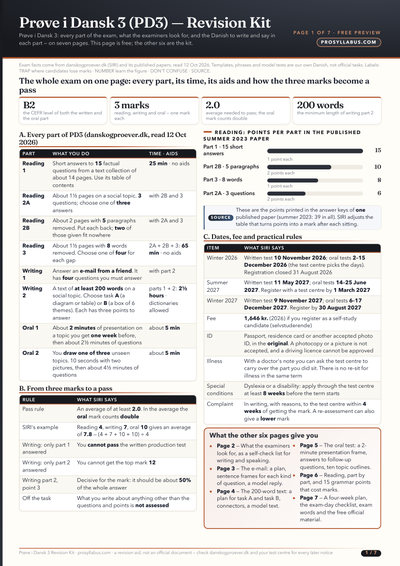
The Prøve i Dansk 3 revision kit is a seven-page PDF in English with the Danish you need: the whole exam on one page, what the examiners look for as a self-check list, a plan and sentence frames for the e-mail, a plan and connectors for the 200-word text, a frame for the 2-minute presentation with ten topic outlines, reading part by part with 15 grammar points, and a four-week plan. Its exam facts come from danskogproever.dk; its model texts are our own, never official tasks. Page 1 is free to read in full before you decide.
Frequently asked questions
Are the grades on this page official?
No. They are our estimates against SIRI’s published descriptions of the grades 12, 7 and 02. Only an examiner and a censor give a grade, and they give one for both writing tasks together.
Where can I see a real graded PD3 answer?
SIRI’s assessment guide for the written part, May 2025, prints real answers at 12, 10, 7, 4, 02, 00 and -3. SIRI has moved it to its assessor-training site; an archived copy is linked in the sources.
What grade did SIRI’s published passed answer get?
SIRI’s candidate page does not say. The assessment guide prints the same answer, with more wording errors left in and a closing sentence added, as its example of grade 7.
Does a good e-mail matter if task 2 decides the grade?
Yes. The guide says that when examiners are in doubt between two grades, a good e-mail speaks for the higher one. And with no e-mail at all, one grade is taken off from the start.
How long should the e-mail be?
No length is set. Our stronger model is about two-thirds longer than the weaker one, because it gives reasons and refers back to the friend’s questions.
Will I fail if my task 2 is 190 words?
The guide tells examiners not to count words and says only substantial shortfalls pull the grade down. Aim well above 200 so the question never arises.
Should I write an introduction and a conclusion in task 2?
You do not need to. The three points are the structure, and the guide warns that a general opening or closing that does not connect to the rest can cost marks.
How much of task 2 should point 3 be?
About half. The two published papers print that instruction next to point 3, and the guide calls point 3 the place where candidates are tested at B2 level.
Do grammar errors mean a fail?
No. The 02 description, which is a pass, speaks of a good many errors that sometimes disturb the reading. What matters is how much they get in the reader’s way.
Is it better to choose task A or task B?
Neither is marked more kindly. A asks you to describe figures and explain causes; B asks for your own experience and a comment. Choose the one whose point 3 you have more to say about.
Can I use a dictionary in the writing test?
Yes, dictionaries are allowed in writing, but not phrase books with ready sentences. The details are in our written exam guide.
More in this series
- The pass rule: oral counts double, 2.0 with no rounding (calculator)
- The written day: three reading parts (four sections), two writing tasks
- The oral exam: 2-minute presentation and a drawn picture topic
- PD2 or PD3 for permanent residence and citizenship (chooser)
- Self-study: registration, the 1,646 kr fee, pass rates, 10/7/7 for doctors
- Examples: one original task for each part, with what the examiner looks for
- Past papers: where the official PDFs are, what is not published, and a practice planner
- A six-week study plan, dated for your sitting, built on the pass rule
- Six grammar areas, 20 correction drills with an answer checker
- Alinea dansk prøve: the Bliv klar books and the official material, part by part
- PD3 notice board — official updates
Sources
- official — SIRI — Bedømmelsesvejledning, skriftlig del af Prøve i Dansk 3, May 2025 (PDF, 33 pages; Wayback index lists a capture of 12 Sep 2025, but its replay returned 404 on 13 Oct 2026 — SIRI has since moved its assessment guides to its assessor-training site)
- official — SIRI — Bedømmelsesvejledninger og lydfiler (says the guides have moved to the assessor-training site)
- official — SIRI — Om Prøve i Dansk 3 og krav til at bestå (for candidates)
- official — SIRI — Om Prøve i Dansk 3 (PD3), indhold og niveau (for language centres)
- official — BEK nr 1687 af 16/12/2025 — tests in Danish education for adult foreigners, with bilag 1–3 (retsinformation.dk)
- official — SIRI sample — PD3 written production paper, summer 2022 (PDF)
- official — SIRI — PD3 written production paper, May–June 2023 (PDF, 8 pages; Wayback capture of 20 Apr 2025 — no longer on the live site)
- official — SIRI sample — example of a passed PD3 written answer, at its current address (PDF, 2 pages)
- official — BEK nr 1759 af 30/12/2024 — the 7-point grading scale for the Danish tests (retsinformation.dk)
official = a document published by the conducting body. reported = a news or coaching site we could not check against an original. Where sources disagree this page says so rather than picking one.