Checked 14 October 2026. Built on the 2017 NPPE blueprint, which the blueprint page still linked on 14 October 2026 while saying a review was "estimated to launch in mid-2026". If a revised blueprint is published, the ranges, the weights and the sub-topic tables here change with it. The plans and the "be able to" column are our suggestions.
This is a study plan for the NPPE, not another description of it. The exam tests six content areas, and the 2017 blueprint gives each one a range of questions out of 100 scored. We turn those ranges into hours, lay the hours out over 4 weeks or 8 weeks, and give a builder that does the same for your own exam date and weekly hours. Then, area by area, we list the blueprint’s own sub-topic titles, what we think you should be able to do for each, and which item on the official reading list covers it. There are no practice questions here: the only official ones are the NPPE program’s paid practice tests. ProSyllabus is an independent study site. We are not affiliated with, or endorsed by, Engineers Canada, APEGA, Meazure Learning or any provincial or territorial regulator; every rule below is quoted or summarised from their published pages, and your regulator decides every individual case.
FreeTests: II. Ethics · III. Professional Practice · IV. Law for Professional Practice
NPPE Essentials: free sample
Answer 3 questions against the clock, like the real exam. You then see the right answer, the reason and your time on each. About 5 minutes · free · no sign-in.
3 questions to answer
Start nowabout 5 minThis one is free · no sign-in needed
Your result shows how long each question took you.
Quick facts
| Item | What the official pages say | Source |
|---|---|---|
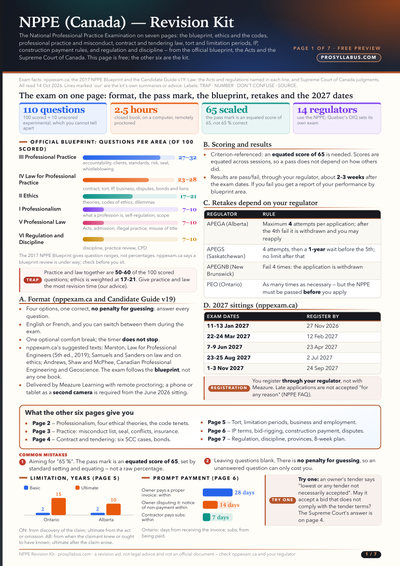
| Format | Closed book; 110 multiple-choice questions, 100 scored and 10 experimental, which you cannot tell apart; 2.5 hours | NPPE Exam Format page |
| What is tested | Six content areas in the 2017 blueprint; "any of the topics listed could be tested to a greater or lesser extent in each exam" | NPPE blueprint page |
| How weight is published | As a range of questions per area (for example, Ethics "17 to 21 questions"), not as a percentage | NPPE blueprint page |
| Blueprint review | "estimated to launch in mid-2026"; on 14 October 2026 the page still linked the 2017 blueprint | NPPE blueprint page |
| What to read | Most candidates find "one legal resource and one resource on professional practice and ethics" useful; no book is required | NPPE Suggested Reading Materials |
| Practice tests | Paid; previously administered questions; a diagnostic report by blueprint area; passing one is "NOT a guarantee" | NPPE Practice Test Site page |
| Recommended study hours | None published | Our reading of the NPPE pages and Candidate Guide V19 |
| Pass rule | A scaled score of 65, not 65 percent | NPPE Candidate Guide V19 |
| Next sitting open for registration | 11-13 January 2027; NPPE registration deadline 27 November 2026 | NPPE Exam Dates page |
Checked on 14 October 2026 against the pages named in the last column.
Ranges from the NPPE blueprint page, read 14 October 2026. The percentages and the hours are ours.
Already covered elsewhere in this series, so only a pointer here: every sub-topic of the blueprint in the blueprint guide; the four textbooks and ten free items, with condensed notes on areas III and IV, in the study material guide; every 2026-2027 window and deadline in the exam dates guide; and the scaled pass mark and mastery report in the pass mark guide.
From question ranges to study hours
The blueprint gives each area a range out of the 100 scored questions. Because there are exactly 100 scored questions, a range of 7 to 10 questions is also 7 to 10 percent of the scored paper; that conversion is our arithmetic, not a figure the program prints. To turn ranges into one number per area we use the midpoint of each range; the six midpoints add up to 99.5 (our sum), and each area’s share of 99.5 is its share of your study hours.
| Area | Blueprint range (questions) | Share of the 100 scored (our arithmetic) | Midpoint weight (our arithmetic) | Hours in our 4-week plan | Hours in our 8-week plan |
|---|---|---|---|---|---|
| I. Professionalism | 7 to 10 | 7-10% | 8.5% | 3.5 h | 4.5 h |
| V. Professional Law | 7 to 10 | 7-10% | 8.5% | 3.5 h | 4.5 h |
| VI. Regulation of Members and Discipline | 7 to 10 | 7-10% | 8.5% | 3.5 h | 4.5 h |
| II. Ethics | 17 to 21 | 17-21% | 19.1% | 7.5 h | 10 h |
| III. Professional Practice | 27 to 32 | 27-32% | 29.6% | 11.5 h | 15 h |
| IV. Law for Professional Practice | 23 to 28 | 23-28% | 25.6% | 10 h | 13 h |
Our arithmetic from the 2017 blueprint ranges. In both plans 80% of the hours go to the six areas in these proportions, 5% to orientation and 15% to review; hours are rounded to the nearest half hour.
Our allocation by blueprint midpoints. The three small areas get the same hours because their ranges are identical (7 to 10).
Why the plans study the small areas first
- Our suggestion, not the program’s: areas I, V and VI (Professionalism, Professional Law, Discipline) set out what a regulator is, what a licence and a seal mean, and how a member is disciplined. Ethics (II) and Professional Practice (III) keep referring back to those ideas.
- They are also the areas most tied to your own regulator’s Act and pages, which are free and short; reading them first gives you the vocabulary for the textbooks.
- Law (IV) comes last among the areas because it is the most self-contained and the one a law textbook covers almost alone.
Our reading of the blueprint’s structure. Reorder freely: the blueprint sets no order.
The 4-week plan (12 hours a week)
For someone who has already read around the subject, or who registered late. Forty-eight hours is our example, not a recommendation from the program, which publishes none.
| Week | What to study (our suggestion, hours rounded) |
|---|---|
| 1 | Orientation (blueprint, your two books, optional first practice test): 2.5 h; I. Professionalism: 3.5 h; V. Professional Law: 3.5 h; VI. Regulation of Members and Discipline: 3 h |
| 2 | II. Ethics: 7.5 h; III. Professional Practice: 4.5 h |
| 3 | III. Professional Practice: 7 h; IV. Law for Professional Practice: 5 h |
| 4 | IV. Law for Professional Practice: 5 h; Review (weakest areas first, optional second practice test, readiness check): 7 h |
Generated by the same function as the plan builder below, with 4 weeks and 12 hours a week. The practice tests are optional and paid; PEO suggests one early and another later, which is why they sit in week 1 and the last week.
FreeTests: II. Ethics · III. Professional Practice · IV. Law for Professional Practice
NPPE Essentials: free sample
Answer 3 questions against the clock, like the real exam. You then see the right answer, the reason and your time on each. About 5 minutes · free · no sign-in.
3 questions to answer
Start nowabout 5 minThis one is free · no sign-in needed
Your result shows how long each question took you.
The 8-week plan (8 hours a week)
For a first attempt alongside a full-time job. Eight weeks is a little more than the gap between a registration deadline and its window (38 to 52 days for the 2027 sittings, our count from the NPPE dates page), so in practice you start studying before the deadline, not after it.
| Week | What to study (our suggestion, hours rounded) |
|---|---|
| 1 | Orientation (blueprint, your two books, optional first practice test): 3 h; I. Professionalism: 4.5 h; V. Professional Law: 0.5 h |
| 2 | V. Professional Law: 4 h; VI. Regulation of Members and Discipline: 4 h |
| 3 | VI. Regulation of Members and Discipline: 0.5 h; II. Ethics: 7.5 h |
| 4 | II. Ethics: 2 h; III. Professional Practice: 6 h |
| 5 | III. Professional Practice: 8 h |
| 6 | III. Professional Practice: 1.5 h; IV. Law for Professional Practice: 6.5 h |
| 7 | IV. Law for Professional Practice: 6.5 h; Review (weakest areas first, optional second practice test, readiness check): 1.5 h |
| 8 | Review (weakest areas first, optional second practice test, readiness check): 8 h |
Generated by the same function as the plan builder, with 8 weeks and 8 hours a week.
Build your own plan
NPPE plan builder: your exam date and hours per week
Enter the day you will sit (a day in a published window) and the hours you can give each week. The builder counts the whole weeks from today on your device, splits your total hours across the six blueprint areas by the midpoint of each area’s question range, and lays the hours out week by week.
Our arithmetic and our suggestion, not the NPPE program’s: 5% of your hours for orientation, 80% split by the 2017 blueprint ranges, 15% for review. The program publishes no recommended number of study hours. Window dates from the NPPE dates page, read 14 October 2026.
If the builder does not load (it needs JavaScript), the two tables above are what it produces for 4 weeks at 12 hours and 8 weeks at 8 hours. Scale the hours per area in the first table to your own total.
One study week, step by step
Our suggested rhythm for each area, using only the official list and your regulator’s pages:
| Step | What it does | Time share (our suggestion) |
|---|---|---|
| 1. Read the blueprint list for the area | Tells you what can be asked. Read the sub-topic titles in the tables below, then the full list on the NPPE blueprint page | A few minutes |
| 2. Read the matching chapters of your textbook | One law book for area IV; one practice-and-ethics book for I, II and III | About half the area’s hours |
| 3. Read the free official document for the area | Your Act and code of ethics (I, II, V, VI); your regulator’s practice standards (III); the CIPO guides (IV.7); your OH&S Act (IV.12) | About a quarter |
| 4. Write the "be able to" column in your own words | Turns reading into something you can do; anything you cannot write is the gap | The rest |
| 5. End of the week: re-read your code of ethics | Ethics runs through areas II, III and VI; a weekly re-read keeps its wording fresh | 15 minutes |
Our method. The NPPE program says only that candidates "should gain mastery of the topics covered on the exam in any way that work best for them".
FreeTests: II. Ethics · III. Professional Practice · IV. Law for Professional Practice
NPPE Essentials: free sample
Answer 3 questions against the clock, like the real exam. You then see the right answer, the reason and your time on each. About 5 minutes · free · no sign-in.
3 questions to answer
Start nowabout 5 minThis one is free · no sign-in needed
Your result shows how long each question took you.
Area by area: what to be able to do, and what to read
Each table below takes the sub-topic titles exactly as the NPPE blueprint page prints them, adds what we think you should be able to do for each (our reading, not the program’s), and names the item on the official reading list that covers it. It is not a list of questions: the program publishes none outside its paid practice tests, and we write none. For the full bullet list under each title, see the blueprint guide; for condensed notes on III and IV, the study material guide.
I. Professionalism (7 to 10 questions)
| Blueprint sub-topic (official wording) | Be able to (our reading) | Reading that covers it (official list) |
|---|---|---|
| I.1 Definition and Interpretation of Professionalism and Professional Status | Tell a profession from another occupation using the elements the blueprint lists: advanced knowledge the public takes on trust, service in the public interest, a distinct ethical code, a self-governing body, long preparation and continued study | Concepts of Professionalism; "The Soul of Professionalism"; a practice-and-ethics textbook |
| I.2 The Role and Responsibilities of Professionals in Society | Say who "the public" is in a given situation (general public, client, employer, fellow workers) and which kind of protection is at stake (physical safety, environmental protection, economic safety) | A practice-and-ethics textbook |
| I.3 Engineering and Geoscience Professions in Canada; Definitions and Scopes of Practice | Explain, at the "high level" the blueprint asks for, who licenses and disciplines, what title and scope reservation mean, what Engineers Canada and Geoscientists Canada do, and what the iron and earth rings are | Your jurisdiction’s Act; a practice-and-ethics textbook |
| I.4 The Value of Engineering and Geoscience Professions to Society | Connect the listed fields (infrastructure, energy, resources, manufacturing, research) to public benefit, and to the item the list ends on, "Limits and sustainability" | A practice-and-ethics textbook |
II. Ethics (17 to 21 questions)
| Blueprint sub-topic (official wording) | Be able to (our reading) | Reading that covers it (official list) |
|---|---|---|
| II.1 The Role of Ethics in Society; Cultures and Customs | Explain the chain the blueprint draws from a society’s moral principles to its laws, and notice where customs differ, which matters on foreign assignments | A practice-and-ethics textbook |
| II.2 Ethical Theories and Principles | Recognise utilitarian, duty, rights and virtue reasoning when you meet it in an argument, and see why two theories can reach different answers. The blueprint says rote knowledge of the theories is not required | A practice-and-ethics textbook |
| II.3 Codes of Ethics of Professional Engineers and Geoscientists in Canada | Say where your code gets its legal force (the blueprint: "Derived from the acts"), apply each core tenet to a situation, and know your own regulator’s wording, since "minor differences exist between regulators" | Your regulator’s code of ethics; APEGA Guideline for Ethical Practice |
| II.4 Common Ethical Issues and Dilemmas; Making Ethical Decisions | Work through a dilemma from the list (conflict of interest, technical against management authority, whistleblowing, loyalty, competence limits, plagiarism, reviewing others’ work, confidentiality, foreign assignments) by naming the code duty each option serves or breaks | Your code of ethics; APEGA Guideline for Ethical Practice; CIPO copyright guide (plagiarism) |
III. Professional Practice (27 to 32 questions)
| Blueprint sub-topic (official wording) | Be able to (our reading) | Reading that covers it (official list) |
|---|---|---|
| III.1 Professional Accountability for Work, Workplace Issues, Job Responsibilities, and Standards of Practice | Say where responsibility for a piece of work rests, including juniors’ work and multi-discipline work, and what changes when you rely on work prepared by others | Your regulator’s practice standards; a practice-and-ethics textbook |
| III.2 The Role and Responsibilities of Professionals to Employers and Clients | Recognise a conflict of interest, and weigh duty to an employer or client against duty to the public | Your code of ethics; APEGA Guideline for Ethical Practice |
| III.3 Relations with Other Professionals and Non-Professionals; Business Practices | Decide when to consult an expert outside your field, and describe what reviewing another professional’s work involves | A practice-and-ethics textbook |
| III.4 Statutory and Non-Statutory Standards and Codes of Practice | Tell a code given force by law from a voluntary standard, and say which body or level of government sets which | Your regulator’s practice standards |
| III.5 Risk Management, Insurance, Quality Management and Due Diligence | Explain transfer, retention and monitoring of risk; what errors and omissions insurance is for and why its retroactive date matters; and due diligence in the blueprint’s terms of foreseeability, preventability and controllability | A practice-and-ethics textbook; your regulator’s guidance |
| III.6 Environmental Responsibilities and Sustainable Development | Apply the listed behaviours (using specialists, counting environmental costs, responding in a timely way) "from a non-politicized perspective" | A practice-and-ethics textbook |
| III.7 Use of Software, Computers and Internet-based Tools; Liability for Software Errors | Explain why you remain responsible for a program’s outputs and how you would validate analysis or design software | A practice-and-ethics textbook; CIPO copyright guide (software piracy) |
| III.8 Document Authentication and Control | Explain what a seal on a document signifies, who may apply it, and how revisions, as-built drawings and records are controlled | Your regulator’s authentication standard |
| III.9 Duty to Inform; Whistleblowing | Decide whom to inform among those the blueprint lists (clients or employers, regulatory agencies, the public) and what "the WHOLE story" means in practice | APEGA Guideline for Ethical Practice; your code of ethics |
| III.10 Communication | Use the professional title correctly and handle electronic documents and records | Your Act (title rules); a practice-and-ethics textbook |
IV. Law for Professional Practice (23 to 28 questions)
| Blueprint sub-topic (official wording) | Be able to (our reading) | Reading that covers it (official list) |
|---|---|---|
| IV.1 The Canadian Legal System | Place a dispute in the right system: common law or Quebec civil law; private or public; criminal, civil or administrative | A law textbook |
| IV.2 Contract Law - Elements, Principles, and Applications | Decide whether a contract was formed, spot a breach and its remedy, and say what a limitation-of-liability, exemption, liquidated-damages or indemnity clause does | A law textbook |
| IV.3 Tort Law - Elements, Principles, and Applications | Run the steps of a negligence action against a set of facts, and tell liability in contract from liability in tort | A law textbook |
| IV.4 Civil Law in Quebec | Recognise contractual and extra-contractual liability and the contract of enterprise or for services | A law textbook |
| IV.5 Business, Employment, and Labour Law | Tell an employee from an independent contractor, and recognise a restrictive covenant | A law textbook |
| IV.6 Dispute Resolution | Say how litigation, arbitration, negotiation and mediation differ | A law textbook |
| IV.7 Intellectual Property (Patents, Trade Secrets, Copyright, Trademarks); Intellectual Property Issues | Say which right protects what, and who owns what an employee or a consultant creates | The four CIPO guides; a law textbook |
| IV.8 Expert Witness | Describe the expert’s role, neutrality and fees | A law textbook |
| IV.9 Bonds and Construction Liens | Tell bid, performance and payment bonds apart, and explain who may claim a lien and what a holdback is | A law textbook; your province’s lien act |
| IV.10 International Law | Ask which law governs work abroad, and whether your home code and Act still apply | A law textbook |
| IV.11 Environmental Law | Recognise a duty-to-report situation and the steps of an environmental assessment | A law textbook |
| IV.12 Workers Compensation and Occupational Health & Safety | Explain the prime contractor’s role and what happens when an accident occurs, at the level "common for all" regulators | Your jurisdiction’s OH&S Act; a law textbook |
| IV.13 Human Rights and Privacy Legislation | Recognise when human rights or privacy law is engaged | A law textbook |
| IV.14 Further Areas of Law | Recognise real property against chattels, delay and impact claims, and Aboriginal and securities law issues by name | A law textbook |
V. Professional Law (7 to 10 questions)
| Blueprint sub-topic (official wording) | Be able to (our reading) | Reading that covers it (official list) |
|---|---|---|
| V.1 The Acts, Regulations, and Bylaws of Provincial and Territorial Regulators | Explain self-regulation, right to title and scope of practice from your own Act, and what Engineers Canada and Geoscientists Canada do | Your jurisdiction’s Act, regulations and bylaws |
| V.2 Admission to the Professions | List the building blocks of licensure (academics, experience, examinations, mobility agreements) and explain a permit to practise for firms | Your regulator’s admission pages |
| V.3 Illegal Practice, Enforcement Against Unlicensed Practice, and Misuse of Title | Tell a practice-related offence from a title-related one | Your Act |
| V.4 Professional and Technical Societies | Tell a professional or technical society from a regulator | A practice-and-ethics textbook |
VI. Regulation of Members & Discipline Processes (7 to 10 questions)
| Blueprint sub-topic (official wording) | Be able to (our reading) | Reading that covers it (official list) |
|---|---|---|
| VI.1 Discipline Procedures | Tell unprofessional conduct from unskilled practice, and follow a complaint from receipt to consequence | Your Act; your regulator’s discipline pages |
| VI.2 Practice Review of Individuals | State the purpose, procedure and consequences of a practice review of a member | Your regulator’s practice review pages |
| VI.3 Practice Review of Firms | The same for a firm | Your regulator’s practice review pages |
| VI.4 Continuing Professional Development | Describe the common high-level purpose and requirements of CPD across regulators | Your regulator’s CPD standard |
Sub-topic titles: NPPE blueprint page, read 14 October 2026. Middle column: ours. Last column: items from the NPPE Suggested Reading Materials page ("Practice Standards and Guidelines published by your regulator", "Engineering and Geoscience Act in your jurisdiction", "Occupational Health and Safety Act in your jurisdiction", the CIPO guides and the APEGA documents), matched to the sub-topic by us.
Where the practice tests fit
The NPPE program sells practice tests built from previously administered questions, on the same platform as the exam, with a diagnostic report by blueprint area and a rationale for each answer. It also says their difficulty is "NOT identical" to the real exam and that passing one is "NOT a guarantee". Our suggestion is to use the diagnostic report the way the plans do: one test at the start to see which areas to weight up, one near the end to check the gaps closed. A practice test score is not a forecast of your NPPE result, which is a scaled score.
If you have already sat the NPPE once, your mastery report beats any plan: put most of the hours where it says "Not mastered" or "Borderline mastered". The pass mark guide explains how to read it. If you will write from India, the equipment rules and IST conversions are in the remote proctoring guide, and the P.Eng. route for Indian degrees is in the P.Eng. guide.
What we could not find
The NPPE program publishes no recommended number of study hours and no study plan, so every hour figure here is ours. It publishes no question counts per sub-topic, only ranges per area, so within an area the plans weight nothing. We did not read the textbooks and make no claim about which chapter covers which sub-topic. Whether the revised blueprint, "estimated to launch in mid-2026", will change the six areas or their ranges is not stated; on 14 October 2026 it had not been published.
FreeTests: II. Ethics · III. Professional Practice · IV. Law for Professional Practice
NPPE Essentials: free sample
Answer 3 questions against the clock, like the real exam. You then see the right answer, the reason and your time on each. About 5 minutes · free · no sign-in.
3 questions to answer
Start nowabout 5 minThis one is free · no sign-in needed
Your result shows how long each question took you.
Frequently asked questions
How long should I study for the NPPE?
The NPPE program does not say. Our examples are 48 hours over 4 weeks and 64 hours over 8 weeks; the plan builder on this page works out a plan for your own date and weekly hours.
Which NPPE areas should I spend the most time on?
Professional Practice (27 to 32 questions) and Law for Professional Practice (23 to 28). Together they are 50 to 60 of the 100 scored questions, by our addition of the 2017 blueprint ranges.
Are the NPPE area weights published as percentages?
No. The blueprint gives a range of questions per area. Because 100 questions are scored, a range of 7 to 10 questions is also 7 to 10 percent; that conversion is our arithmetic.
Is a 4-week NPPE plan enough?
It can be for someone who has read some of the material or works with codes and contracts daily; the program gives no minimum. If your first official practice test shows several weak areas, the 8-week plan is the safer choice (our suggestion).
Do I need to memorise ethical theories for the NPPE?
No. The blueprint says candidates are not required to know the theories by rote but should recognise their principles in application.
Does this guide have NPPE practice questions?
No. The only official questions are in the NPPE program’s paid practice tests. Each sub-topic here comes with what to be able to do and what to read instead.
What should I read for the NPPE?
The program suggests one legal resource and one practice-and-ethics resource, plus free items such as your own Act, OH&S Act and practice standards. The study material guide in this series goes through every item.
Will the plan change when the new blueprint launches?
Probably, if the areas or ranges change. On 14 October 2026 the NPPE blueprint page still linked the 2017 blueprint and gave no launch date beyond "mid-2026".
More in this series
- NPPE exam: format, the six blueprint areas, scoring and how to pass
- NPPE fee by province: what each regulator charges
- Writing the NPPE from India: remote proctoring, second camera, IST
- NPPE pass rate and pass mark: scaled score of 65, why people fail, attempts
- P.Eng. in Canada for Indian engineers: NBA, Washington Accord, NPPE
- NPPE exam dates 2026-2027 and registration deadlines by regulator
- NPPE study material: every official reading explained, and what to skip
- APEGA NPPE: what Alberta applicants need to know
- NPPE practice questions: free sample by blueprint area
- Canada NPPE notice board — official updates
Sources
- official — NPPE — Blueprint page (2017 blueprint; review "estimated to launch in mid-2026"; read 14 October 2026)
- official — NPPE — Exam Format (110 questions, 100 scored, 2.5 hours, closed book; read 14 October 2026)
- official — NPPE — Suggested Reading Materials (read 14 October 2026)
- official — NPPE — Practice Test Site (read 14 October 2026)
- official — NPPE Candidate Guide V19 (PDF; same file re-downloaded 14 October 2026)
- official — NPPE — Exam Dates and Deadlines to Register (2026 and 2027 tables; read 14 October 2026)
- official — PEO — National Professional Practice Exam (registration portal periods, results dates, suggested textbooks; read 14 October 2026)
- official — NPPE — Testing System Requirement (readiness check at least 24 hours before; read 14 October 2026)
official = a document published by the conducting body. reported = a news or coaching site we could not check against an original. Where sources disagree this page says so rather than picking one.