Checked 29 September 2026. From the NPPE Results, Scoring and Pass or Fail pages and the Candidate Guide V19 (April 2026), plus APEGA, APEGS and PEO pages read 29 September 2026. The published cut score is a scaled 65, and the exam still follows the 2017 blueprint; a revised blueprint has been announced but had not launched on 29 September 2026. The NPPE program publishes no pass rates.
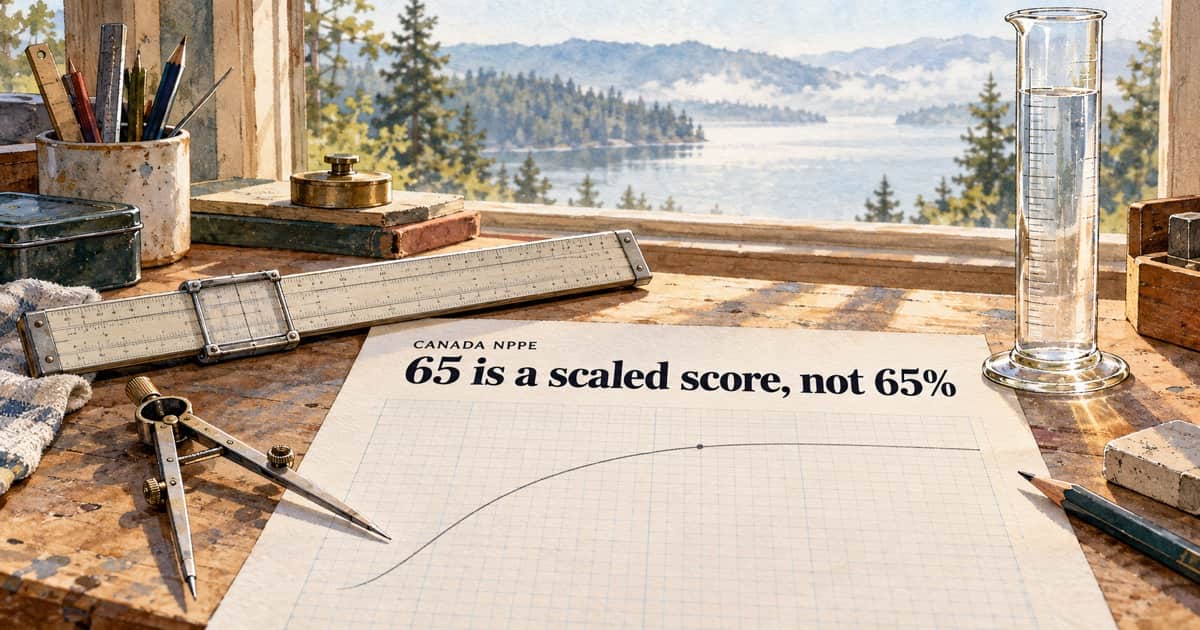
The NPPE pass mark is published, in plain words: "The cut score on the NPPE is a scaled score of 65." And in the next line the program warns against the obvious misreading: the passing score "is NOT equivalent to a percent score of 65 (i.e., correctly answer 65% of the questions)." This guide explains what a scaled, equated score is, why nobody can tell you how many correct answers you need, what the mastery report shows if you fail, and how many attempts each regulator allows. The rules on attempts do not agree across sources, and we print both sides. ProSyllabus is an independent study site. We are not affiliated with, or endorsed by, Engineers Canada, APEGA, Meazure Learning or any provincial or territorial regulator; every rule below is quoted or summarised from their published pages, and your regulator decides every individual case.
NPPE Results, Scoring and Pass or Fail pages; Candidate Guide V19; PEO, EGBC and APEGNB NPPE pages.
Where other pages get this wrong
The NPPE has a published pass mark: an equated, scaled score of 65, set by the modified-Angoff method. It is not 65 percent of the questions.
Commonly published instead: Our own notice board for this exam says "there is no fixed pass percentage" and "no predetermined pass percentage", and advises readers not to chase a percentage from forums, without ever stating the cut score. Other pages print "65%".
Both are wrong in different directions. "No predetermined percentage" on the NPPE site refers to the share of candidates who pass: "Each NPPE is scored with no predetermined percentage of candidates that should pass or fail." The cut score itself is fixed and published as a scaled score of 65. A scaled 65 does not convert to a count of correct answers, because each session is statistically equated.
How the NPPE is scored
| Rule | What the program says | Source |
|---|---|---|
| Type of exam | Criterion-referenced: your score reflects your knowledge against the blueprint, not against other candidates | NPPE Results page |
| Raw points | 1 point per correct answer on the operational (scored) questions; 10 experimental questions are unscored | Scoring page; exam format page |
| Wrong and blank answers | No penalty for incorrect answers; unanswered questions are scored as incorrect | Scoring page; candidate agreement |
| Cut score | A scaled score of 65, set with the modified-Angoff method by subject matter experts and volunteer committee members from across Canada | Results page; Candidate Guide V19 |
| Equating | Statistical equating accounts for differences in difficulty between sessions | Scoring page |
| Share who pass | No predetermined percentage of candidates should pass or fail | Scoring page |
| Repeat takers | First-time and repeat takers are graded to the same standard | Scoring page |
| What you receive | Pass or fail only. Passers get no score detail; failers get a mastery report | Pass or Fail page |
Sources as listed in the last column, all on nppexam.ca, read 29 September 2026.
Put simply, and this is our explanation rather than the program's: in a modified-Angoff study, experts judge how a minimally competent candidate would do on each question, which fixes a standard. Equating then maps each session's raw scores onto one scale so that the same level of knowledge gives the same scaled score whether you sat an easier or a harder form. The program places the standard at 65 on that scale. Because the raw-to-scale mapping differs by session, "how many correct answers do I need" has no fixed answer, and the program says the equated score cannot be back-calculated from the mastery report either.
What follows for exam technique
- Answer every question. A wrong answer costs nothing and a blank is scored as wrong (Scoring page; candidate agreement).
- Do not over-invest in any single question: 10 of the 110 do not count, and you cannot tell which.
- Cover every blueprint area. The program says candidates should come "ready to demonstrate their knowledge on all of the blueprint areas".
- Ignore forum "percent needed" figures. The program publishes no raw-score threshold, and the scale is equated per session.
The first three points restate NPPE pages; the framing is ours.
If you fail: reading the mastery report
A candidate who fails receives a mastery report by content area, showing where they did well and where they did not. The NPPE pass/fail page describes the categories candidates see, including "Not mastered" and "Borderline mastered", and says candidates "don't have to master every blueprint area" but should focus on those areas. Both the page and the Candidate Guide V19 show a clear fail, with little knowledge shown in areas I, II and IV. Their near-pass examples differ: the Pass or Fail page's candidate did well in I, III, IV and V but not in II and VI, while the Candidate Guide's was strong in I, II and VI, borderline in a few others, and weakest in IV, which "had the greatest impact". The lesson is the same in both: study hardest where the report is weakest. APEGA says its examination department sends the mastery report to failing APEGA applicants.
| If your report shows | Our suggested response | Program basis |
|---|---|---|
| Most areas "Not mastered" | Treat it as a fresh start: work through the whole blueprint with one law book and one practice-and-ethics book, then take an official practice test | Pass or Fail page, clear-fail example |
| One or two areas "Not mastered", the rest fine | Put most hours into those areas, keep the rest warm with short reviews | Pass or Fail page, near-pass example |
| Several "Borderline mastered" | Breadth problem: review every sub-topic of those areas rather than a few deeply | Pass or Fail page: borderline areas are ones to focus on |
| Weak in II (Ethics) or VI (Discipline) | Read your regulator's code of ethics and discipline process directly; they are short | Blueprint areas II.3 and VI.1 |
Middle column: our study advice, not the program's. The report cannot be turned into a score, so do not try to calculate how close you were.
There is effectively no re-marking. The Scoring page says responses are captured by the computer-based testing system and processed "with little to no manual intervention", with no manual inspection of responses, and the Candidate Guide says a review of the exam result "would not change the outcome". If something went wrong on the day, report it to the proctor during the session or the same day: the Candidate Guide says there are "limited options" afterwards, and only exam-security issues, emergencies that could not be reported that week, and other exceptional circumstances (with an explanation of why they were not reported on exam day) are investigated later. EGBC adds that technical issues must be reported the same day to nppe@egbc.ca.
When results arrive
Results reach you through your regulator; Meazure does not send them. The NPPE site says results are "not available immediately", arrive approximately 2-3 weeks after the exam, and come at least a week before the next registration deadline, so a failing candidate can register for the next session. They are not given by phone or email. Regulators give their own timings, which are longer:
| Source | Results timing |
|---|---|
| NPPE Candidate Guide V19 and site | Approximately 2-3 weeks; at least a week before the next registration deadline |
| EGBC | Approximately 3-4 weeks, through the Application Status portal, before the next application deadline |
| Engineers Geoscientists Manitoba | Within four weeks, in your online profile |
| APEGA | Before the next registration deadline, in myAPEGA, with an email notice |
| APEGNB | Notified before the next registration deadline; pass or fail, no score |
Sources: Candidate Guide V19; NPPE Scoring page; EGBC Registration FAQs (Wayback 21 March 2026); Engineers Geoscientists Manitoba; APEGA and APEGNB NPPE pages. Our reading: plan on up to four weeks. APEGS candidates should note that APEGS deadlines are a few days earlier than the NPPE site's, and we found no APEGS statement that results precede its own deadline.
How many attempts you get
Where other pages get this wrong
Attempt limits are set by each regulator, and they differ: four at APEGA and APEGNB, four plus a fifth after a one-year wait at APEGS, no stated cap at PEO, and no limit "at this time" at EGBC, which may impose a 12-month wait after three consecutive fails.
Commonly published instead: The NPPE Candidate Guide says: "In most jurisdictions, candidates are allowed a maximum of four attempts to pass the NPPE." Pages that repeat this as a national rule are wrong for Ontario and British Columbia.
The NPPE Pass or Fail page itself says policies on attempts "may vary by regulator" and tells candidates to ask theirs. PEO says you may "write the exam as many times as necessary to ensure success". EGBC says there is no limit at present. APEGS allows a fifth attempt after a one-year wait. APEGNB's application form withdraws the application after four fails. Engineers Yukon gives one year from the Board of Examiners letter when the NPPE is the last requirement. For Manitoba, Nova Scotia, PEI and NAPEG we found no stated cap.
| Regulator | Attempts | Time limits |
|---|---|---|
| NPPE program | "In most jurisdictions ... a maximum of four"; policies "may vary by regulator" | — |
| APEGA (Alberta) | Maximum four; four fails withdraws the application | One year from the Board of Examiners letter if the NPPE is the last requirement |
| APEGS (Saskatchewan) | Four, then a one-year wait before a fifth; failing the fifth closes the file | Not stated beyond the wait |
| PEO (Ontario) | No cap stated: "as many times as necessary" | Pre-15 May 2023 applicants: pass within two years of academic clearance |
| EGBC (British Columbia) | No limit "at this time"; a new fee each attempt | May have to wait 12 months before a fourth attempt after three consecutive fails |
| APEGNB (New Brunswick) | Four fails withdraws the application; a new one is needed | Not found |
| Engineers Yukon | Not found | One year from the Board of Examiners letter if the NPPE is the last requirement |
| EGM, Engineers NS, PEI, NAPEG | Not found | Not found |
Sources: Candidate Guide V19; NPPE Pass or Fail page; APEGA NPPE page (Wayback 19 July 2026); APEGS NPPE page; PEO NPPE page (Wayback 23 August 2026); EGBC NPPE page (read 29 September 2026); APEGNB NPPE application form (September 2025); Engineers Yukon applicant page (Wayback 13 April 2026).
Attempt planner: the earliest windows for each attempt
Pick your regulator and your first window. The planner lays out the earliest published window for each later attempt if you re-register straight after each result, and shows where your regulator's cap falls.
Our planning arithmetic. It assumes the result arrives before the next registration deadline, which the NPPE program promises ("at least a week before"), and that you register at once. Windows after November 2027 are not yet published.
The practical point for an Indian candidate is the APEGA clock. If you apply to APEGA and the NPPE turns out to be your last requirement, the one-year limit from the Board of Examiners decision letter means only about five sittings are available (five a year), and four fails ends the application whatever the time left. Attempts made earlier count: APEGA's example is a candidate with two attempts before the letter, who then has two more within the year.
Thirteen regulators or fourteen?
A stale count in the Candidate Guide
- The Candidate Guide V19 (April 2026) says "Thirteen engineering and geoscience" regulators use the NPPE, and refers to "the 13 Canadian jurisdictions".
- The NPPE home page, APEGA and APEGNB say fourteen, and the NPPE regulator list names fourteen: APEGA, APEGNB, APEGS, Engineers Yukon, ASET, EGBC, EGM, Engineers Nova Scotia, Engineers PEI, Geoscientists Nova Scotia, NAPEG, PEGNL, PEO and PGO.
- Our reading: fourteen is current and the guide's count is stale text. Quebec (OIQ) is not among them and runs its own French-language professional exam with a pass mark of 60 percent.
Sources: Candidate Guide V19; NPPE home and Regulator Links pages; APEGA and APEGNB NPPE pages; OIQ professional exam page.
What is not published
The NPPE program publishes no pass rates, and none appears on the regulator NPPE pages we read, so we give none. Figures for individual sittings do surface in some regulators' council papers; we have not verified any, and a single sitting says little about yours. The raw number of correct answers that corresponds to a scaled 65 is not published and changes by session. Whether the cut score will be reset when the revised blueprint launches is not stated; the blueprint review was "estimated to launch in mid-2026" and had not launched on 29 September 2026.
What is the NPPE pass mark?
A scaled (equated) score of 65, set by the modified-Angoff method. It is not 65 percent of the questions.
How many questions do I need to get right to pass?
Not published, and not fixed. Each session is statistically equated, so the number of correct answers that maps to a scaled 65 varies.
Is there negative marking on the NPPE?
No. One point per correct answer and no penalty for a wrong one. Unanswered questions are scored as incorrect, so answer everything.
What is the NPPE pass rate?
The NPPE program does not publish one, and we found none on the regulator NPPE pages we read. Treat forum or coaching figures with care.
Will I see my score if I pass?
No. Passing candidates receive a pass with no score detail. Failing candidates receive a mastery report by content area.
How many times can I take the NPPE?
It depends on the regulator. APEGA and APEGNB allow four. APEGS allows four, then a fifth after a one-year wait. PEO states no cap, and EGBC has no limit at present but may require a 12-month wait after three consecutive fails. The Candidate Guide says four in most jurisdictions.
Can I ask for my NPPE to be re-marked?
In effect, no. The Candidate Guide says a review of the result would not change the outcome, since marking is automated.
How soon can I retake after failing?
Results arrive before the next registration deadline, so you can usually register for the next session, five of which run each year. Check your regulator's deadline, which may be earlier.
More in this series
Sources
- official — NPPE — Results (cut score: a scaled score of 65)
- official — NPPE — Scoring (equating, no penalty for wrong answers)
- official — NPPE — Pass or Fail (equated score of 65; mastery report)
- official — NPPE Candidate Guide V19 (April 2026, PDF)
- official — NPPE Candidate Instructions and Statement of Understanding (February 2024, PDF)
- official — NPPE — Exam Format (110 questions, 2.5 hours, English and French)
- official — APEGA — National Professional Practice Examination (read from the Wayback capture of 19 July 2026)
- official — APEGS — National Professional Practice Exam (deadlines, attempts, refunds)
- official — PEO — National Professional Practice Exam (Wayback 23 August 2026)
- official — EGBC — National Professional Practice Examination (deadlines, deferrals, attempts)
- official — EGBC — Registration FAQs (Wayback 21 March 2026)
- official — Engineers Geoscientists Manitoba — National exam page and Fees
- official — APEGNB — NPPE
- official — APEGNB — NPPE Application to Write (September 2025 form, PDF: four fails withdraws the application)
- official — Engineers Yukon — First-time L.L.(Eng.) applicants (Wayback 13 April 2026: one year from the Board of Examiners letter)
- official — NPPE program — home page (fourteen regulators; Meazure Learning)
- official — NPPE — Regulator Links (the fourteen partner regulators)
- official — NPPE — Blueprint page (2017 blueprint; review "estimated to launch in mid-2026")
- official — Ordre des ingénieurs du Québec — Professional exam
official = a document published by the conducting body. reported = a news or coaching site we could not check against an original. Where sources disagree this page says so rather than picking one.