Checked 26 October 2026. Format, blueprint, dates and scoring from the NPPE site, re-read on 26 October 2026. The blueprint page still says a review of the 2017 blueprint is "estimated to launch in mid-2026"; when a revised blueprint is published, the areas and ranges below may change. The law behind each sample answer was read on the official e-Laws, Engineers and Geoscientists BC, Engineers Canada and Supreme Court of Canada sites; laws and codes are amended, so check the current text before relying on a section.
The NPPE tests whether you can apply law, ethics and professional practice to situations an engineer or geoscientist meets at work. This page gives you two practice questions in the exam's format, each answer explained from the rule it rests on, then what each of the six blueprint areas asks about and how to practise and score yourself the way the NPPE is marked.
ProSyllabus is an independent study site. We are not affiliated with, or endorsed by, Engineers Canada, APEGA, Meazure Learning or any provincial or territorial regulator; every rule below is quoted or summarised from their published pages, and your regulator decides every individual case.
Exam facts: NPPE Exam Format and Results pages, read 26 October 2026.
FreeTests: II. Ethics · III. Professional Practice · IV. Law for Professional Practice
NPPE Essentials: free sample
Answer 3 questions against the clock, like the real exam. You then see the right answer, the reason and your time on each. About 5 minutes · free · no sign-in.
3 questions to answer
Start nowabout 5 minThis one is free · no sign-in needed
Your result shows how long each question took you.
How the NPPE asks its questions
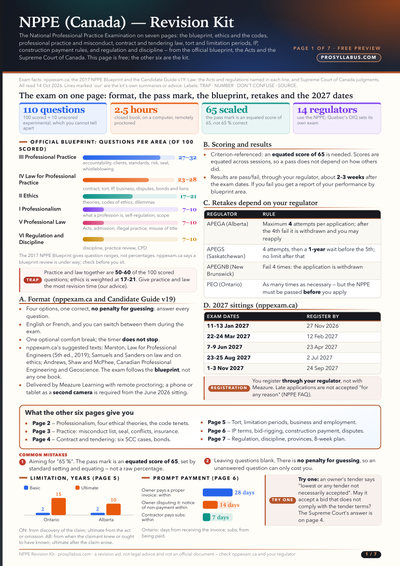
Every NPPE question is multiple choice with four options and only one correct answer. Each is scored 0 or 1 and there is no penalty for guessing, so a blank answer can only cost you. Of the 110 questions, 100 are scored and 10 are experimental questions that are not scored; you cannot tell which is which, so treat every question as if it counts. The exam is closed book, lasts 2.5 hours, and you can switch between English and French at any time. The official site says the exam is checked to read at about a grade 10-11 level; it is not a test of English.
Many questions describe a situation and ask what the professional should do, which duty applies, or how a court or regulator would treat it. Recognising the rule is not enough: you have to pick the option that applies it correctly to the facts given.
Question 1: ethics
Question 1 · II. Ethics
An engineer at a consulting firm is asked to recommend a pump supplier for a municipal client. Her brother owns one of the bidding suppliers. What should she do first?
- (A) Disclose the interest to the client before taking any further part
- (B) Say nothing, because she will not benefit personally from the contract
- (C) Ask her brother to lower his price so the choice looks fair
- (D) Recommend her brother's firm if its price is the lowest, since that helps the client
Show the answer
Answer: (A) Disclose the interest to the client before taking any further part. The codes require a conflict of interest to be avoided or disclosed. Ontario Reg. 941 s.77.4 says a practitioner must disclose immediately to the client any interest, direct or indirect, that might be construed as prejudicial in any way to their professional judgement, and s.72(2)(i) makes failure to make prompt, voluntary and complete disclosure professional misconduct. An indirect family interest counts, whatever the price. Province note: EGBC Code of Ethics principle 8 requires registrants to avoid real or perceived conflicts of interest, to ensure they are properly disclosed and to take the necessary measures so a conflict does not bias decisions or recommendations. The Engineers Canada guideline adds that where full disclosure is insufficient, or could be seen to be insufficient, the registrant should withdraw totally from the issue and/or use extraordinary means involving independent parties.
An original ProSyllabus question, written from the law and codes named in the answer. Not an NPPE question.
Why it matters: conflicts of interest appear in several blueprint topics (II.3, II.4 and III.2), and each code words the rule its own way. Ontario's Code of Ethics requires immediate disclosure to the client of any interest that might be construed as prejudicial to your judgement; the EGBC Code requires you to avoid real or perceived conflicts, disclose them properly and take measures so they do not bias your recommendations; and the Engineers Canada guideline says that where full disclosure is insufficient, or could be seen to be insufficient, you should withdraw totally from the issue and/or use extraordinary means involving independent parties.
FreeTests: II. Ethics · III. Professional Practice · IV. Law for Professional Practice
NPPE Essentials: free sample
Answer 3 questions against the clock, like the real exam. You then see the right answer, the reason and your time on each. About 5 minutes · free · no sign-in.
3 questions to answer
Start nowabout 5 minThis one is free · no sign-in needed
Your result shows how long each question took you.
Question 2: law for professional practice
Question 2 · IV. Law for Professional Practice
An owner calls for tenders on a building. A contractor submits a tender with a bid deposit, finds a large arithmetic error after the tenders are opened, and asks to withdraw. The tender terms say tenders are irrevocable and the deposit is forfeited on withdrawal. Following Ron Engineering, what is the likely result?
- (A) The deposit must be returned because the mistake was honest
- (B) The owner must accept the corrected price
- (C) The deposit is forfeited: a contract arose when the tender was submitted
- (D) The contractor may withdraw, since no contract exists until the owner accepts a tender
Show the answer
Answer: (C) The deposit is forfeited: a contract arose when the tender was submitted. In R. v. Ron Engineering (SCC 1981) the contractor's tender omitted $750,058 and the owner kept the $150,000 deposit. The Court held that submitting a tender in response to the call created a unilateral contract, 'Contract A', whose terms (irrevocability, forfeiture of the deposit) bound the bidder; the later construction contract is 'Contract B'. A mistake disclosed after tenders closed did not let the bidder escape Contract A. Rests on: Ron Engineering [1981] 1 SCR 111. Later decisions refine when Contract A arises: M.J.B. Enterprises (1999) ties it to the parties' intentions, and Tercon (2010) to the express and implied terms of the tender call.
An original ProSyllabus question, written from the law and codes named in the answer. Not an NPPE question.
Why it matters: the formal tendering and bid process is a listed contract-law topic in the blueprint (IV.2), and engineers often prepare and evaluate tenders. Ron Engineering is the starting point for "Contract A" and "Contract B"; later Supreme Court decisions refine when a Contract A arises: M.J.B. Enterprises (1999) ties it to the intentions of the parties, and Tercon (2010) to the express and implied terms of the tender call.
What each blueprint area tests
The 2017 blueprint gives a range of questions for each area. Read it as a guide to weight, not a fixed split: the blueprint page says any listed topic can be tested to a greater or lesser extent in each exam.
| Area | Questions (2017 blueprint range) | Topics in the 2017 blueprint |
|---|---|---|
| I. Professionalism | 7 to 10 | I.1 definition of professionalism and professional status; I.2 role and responsibilities of professionals in society; I.3 engineering and geoscience professions in Canada, scopes of practice, brief histories, the iron and earth rings; I.4 value of the professions to society |
| II. Ethics | 17 to 21 | II.1 ethics in society, cultures and customs; II.2 ethical theories (utilitarianism, duty, rights, virtue) recognised in application, not by rote; II.3 codes of ethics of Canadian engineers and geoscientists; II.4 dilemmas: conflict of interest, whistleblowing, loyalty, competence, confidentiality, foreign assignments |
| III. Professional Practice | 27 to 32 | III.1 accountability and standards of practice; III.2 duties to employers and clients; III.3 relations with other professionals; III.4 statutory and non-statutory codes and standards; III.5 risk management, insurance, quality management, due diligence; III.6 environment and sustainable development; III.7 software and liability for software errors; III.8 document authentication (stamps and seals) and control; III.9 duty to inform, whistleblowing; III.10 communication |
| IV. Law for Professional Practice | 23 to 28 | IV.1 Canadian legal system; IV.2 contract law; IV.3 tort law; IV.4 civil law in Quebec; IV.5 business, employment and labour law; IV.6 dispute resolution; IV.7 intellectual property; IV.8 expert witness; IV.9 bonds and construction liens (holdbacks); IV.10 international law; IV.11 environmental law; IV.12 workers compensation and OH&S; IV.13 human rights and privacy; IV.14 further areas (real property, delay claims, Aboriginal law, securities) |
| V. Professional Law | 7 to 10 | V.1 the Acts, regulations and bylaws of the regulators, right to title, scope of practice, role of Engineers Canada; V.2 admission (experience, academics, examinations, mobility agreements, permits to practice for firms); V.3 illegal practice and misuse of title; V.4 professional and technical societies |
| VI. Regulation of Members and Discipline | 7 to 10 | VI.1 discipline procedures (unprofessional conduct, unskilled practice); VI.2 practice review of individuals; VI.3 practice review of firms; VI.4 continuing professional development |
Bar length = the top of each range. Source: NPPE Blueprint 2017 and the blueprint page, read 26 October 2026.
In our experience writing NPPE-style questions, the law areas (IV and V) reward knowing the exact rule, such as a limitation period, a holdback percentage or what a privilege clause can and cannot do, while the ethics and practice areas (II and III) reward reading the scenario carefully: who the professional owes the duty to, whether the risk reaches the public, and what the first step is. That is our advice, not the NPPE's.
How to practise, area by area
| Area | Read first | Practise |
|---|---|---|
| I. Professionalism | Your own regulator's Act: the definition of practice, reserved titles, the regulator's object | Questions on who may practise and use the title, and what self-regulation means |
| II. Ethics | Your regulator's code of ethics, then the Engineers Canada guideline on the code of ethics | Scenarios on conflicts, overruled judgement, competence and reporting |
| III. Professional Practice | Your regulator's rules on seals and authentication, practice standards and any firm permit rules | Sealing, relying on others, software, insurance, risk and quality questions |
| IV. Law for Professional Practice | A law text from the official reading list for contract, tort, IP and construction | Tendering, negligence, limitation periods, liens and holdbacks, IP terms, OHS |
| V. Professional Law | Your Act's licensing, offence and permit sections | Licensing requirements, unlicensed practice, permits and title offences |
| VI. Regulation and Discipline | Your Act's discipline sections and your regulator's CPD rules | What counts as misconduct, discipline orders, practice review, CPD |
For a week-by-week plan by area, see the NPPE study guide; for what each official reading covers, see NPPE study material.
FreeTests: II. Ethics · III. Professional Practice · IV. Law for Professional Practice
NPPE Essentials: free sample
Answer 3 questions against the clock, like the real exam. You then see the right answer, the reason and your time on each. About 5 minutes · free · no sign-in.
3 questions to answer
Start nowabout 5 minThis one is free · no sign-in needed
Your result shows how long each question took you.
Score your practice the way the NPPE is marked
The NPPE pass mark is an equated (scaled) score of 65. The official Results page says this is NOT the same as answering 65% of questions correctly, because statistical equating adjusts for differences in difficulty between exam forms, and that an equated NPPE score cannot be reverse-calculated from the percentage scores in a mastery report. Each exam is scored with no predetermined share of candidates passing or failing.
So a practice percentage is a measure of how well you know the material, not a forecast of an NPPE score. What it can tell you is where you are weak. Candidates who fail the NPPE receive a mastery report by content area, and the official site advises focusing on the areas shown as "Not mastered" or "Borderline mastered". Practising by area and tracking your score in each one gives you the same kind of map before the exam. See also our guide to the NPPE pass mark and attempts.
The official NPPE practice tests
The NPPE program sells its own online practice tests through its practice test site. The official page says they use the same testing platform as the real exam, that their questions were previously administered on past NPPE exams, and that every candidate gets a diagnostic report by blueprint area with a rationale for each question. It also says their difficulty is not identical to the real exam and that passing one is not a guarantee of passing the NPPE. Registered candidates also get free access to a tutorial of the exam interface several weeks before their exam date.
Want more questions like these?
The ProSyllabus NPPE Practice Exam has a full-length timed mock of 110 questions in 2.5 hours and a timed set for each of the six blueprint areas, scored by area, with the Act section, code clause or court decision behind every law answer and a note where the provinces differ. Three questions are free to try in the test player, including one on professional practice not shown here. Our own questions, not the NPPE's, and not made or endorsed by Engineers Canada or any regulator.
FreeTests: II. Ethics · III. Professional Practice · IV. Law for Professional Practice
NPPE Essentials: free sample
Answer 3 questions against the clock, like the real exam. You then see the right answer, the reason and your time on each. About 5 minutes · free · no sign-in.
3 questions to answer
Start nowabout 5 minThis one is free · no sign-in needed
Your result shows how long each question took you.
Frequently asked questions
Are these real NPPE questions?
No. They are ProSyllabus's own questions, written from the law and codes of ethics named in each answer. NPPE questions are not published; the official practice tests use previously administered questions.
How many questions are on the NPPE and how long is it?
110 multiple-choice questions (100 scored and 10 unscored experimental) in 2.5 hours, each with four options and one correct answer, according to the official Exam Format page.
Is there negative marking on the NPPE?
No. Each question scores 0 or 1, and there is no penalty for guessing, so answer every question.
What score do I need to pass?
An equated (scaled) score of 65 or more. It is not 65% correct, and the official site says it cannot be calculated from a percentage.
Which province do the questions follow?
The NPPE is one national exam built on the 2017 blueprint. Where the rules differ, as with codes of ethics, seals or discipline powers, a good practice question names the province or Act, and you should read your own regulator's Act and code.
When is the next NPPE?
The official dates page lists 2-4 November 2026 (registration closed 18 September 2026) and 11-13 January 2027 (registration deadline 27 November 2026), then 22-24 March, 7-9 June, 23-25 August and 1-3 November 2027. You register through your regulator; our NPPE exam dates guide covers each regulator.
More in this series
- NPPE exam: format, the six blueprint areas, scoring and how to pass
- NPPE fee by province: what each regulator charges
- Writing the NPPE from India: remote proctoring, second camera, IST
- NPPE pass rate and pass mark: scaled score of 65, why people fail, attempts
- P.Eng. in Canada for Indian engineers: NBA, Washington Accord, NPPE
- NPPE exam dates 2026-2027 and registration deadlines by regulator
- NPPE study material: every official reading explained, and what to skip
- NPPE study guide: 4- and 8-week plans by blueprint area
- APEGA NPPE: what Alberta applicants need to know
- Canada NPPE notice board — official updates
Sources
- official — NPPE — Exam Format (110 questions, 100 scored, four options, no penalty for guessing, 2.5 hours; read 26 October 2026)
- official — NPPE — Blueprint (2017 blueprint current; review "estimated to launch in mid-2026"; read 26 October 2026)
- official — NPPE Blueprint – 2017 (PDF)
- official — NPPE — Scoring (1 point per correct answer, no penalty, equating; read 26 October 2026)
- official — NPPE — Results (scaled score of 65, not 65 percent; read 26 October 2026)
- official — NPPE — Pass or Fail (equated score of 65; mastery report; read 26 October 2026)
- official — NPPE — Practice Test Site (previously administered questions, diagnostic report; read 26 October 2026)
- official — NPPE — Exam Dates and Deadlines to Register (2026 and 2027; read 26 October 2026)
- official — Ontario Regulation 941 under the Professional Engineers Act (s.72 professional misconduct, s.77 Code of Ethics; e-Laws)
- official — Engineers and Geoscientists BC — Code of Ethics (Bylaws under the Professional Governance Act, 2021)
- official — Engineers Canada — Guideline on the code of ethics (2024)
- official — Supreme Court of Canada — R. (Ont.) v. Ron Engineering & Construction (Eastern) Ltd., [1981] 1 SCR 111
official = a document published by the conducting body. reported = a news or coaching site we could not check against an original. Where sources disagree this page says so rather than picking one.