Checked 25 September 2026. Rules from the GATE 2027 Information Brochure; question-type counts from the official EE final answer keys 2024–2026 (our count). The mix in the 2027 paper is not known in advance.
GATE EE is 65 questions and 100 marks in three hours, and only one kind of question can cost you marks: the multiple-choice question (MCQ). What most guides miss is how much the paper has shifted towards MCQs. In the official 2024 EE paper, 32 of the 85 subject marks were MCQ; in 2026 it was 55 of 85. More marks exposed to negative marking means guessing matters more — and in 2025, 5,263 candidates finished GATE EE with a negative total. This guide sets out the marking rules and what the numbers say about attempting.
GATE 2027 IB; official EE answer keys; GATE 2025 Statistical Report.
Where other pages get this wrong
GATE EE uses three question types — MCQ, MSQ (multiple select) and NAT (numerical answer) — and only MCQs carry negative marking.
Commonly published instead: Exam-pattern tables listing only MCQ and NAT.
The GATE 2027 brochure defines all three types, and the official 2026 EE paper had five MSQs.
The marking rules
| Type | Marks | Answers | Wrong answer |
|---|---|---|---|
| MCQ (multiple choice) | 1 or 2 | One correct of four | −1/3 (1-mark), −2/3 (2-mark) |
| MSQ (multiple select) | 1 or 2 | One or more correct of four | No negative marks; no partial marks — all correct options must be chosen |
| NAT (numerical answer) | 1 or 2 | A number typed on the virtual keypad | No negative marks; no partial marks; round only at the end, to the places the question asks for |
GATE 2027 IB. General Aptitude is 15 marks (5 × 1-mark and 5 × 2-mark questions); the subject is 85 marks, of which Engineering Mathematics is 13.
You may use only the on-screen virtual scientific calculator; a physical calculator, including one on a watch, is prohibited. Scribble pads are issued one at a time and returned at the end. You may take your seat from 40 minutes before the start and log in to read the instructions from 20 minutes before; you cannot enter more than 15 minutes after the start or leave before the end. Malpractice can lead to a ban from GATE for three years.
The question mix is shifting towards MCQs
| Year | MCQ 1m | MCQ 2m | MSQ 1m | MSQ 2m | NAT 1m | NAT 2m | MCQ marks (of 85) | NAT marks |
|---|---|---|---|---|---|---|---|---|
| 2024 | 18 | 7 | 2 | 5 | 5 | 18 | 32 | 41 |
| 2025 | 17 | 15 | 2 | 2 | 6 | 13 | 47 | 32 |
| 2026 | 19 | 18 | 2 | 3 | 4 | 9 | 55 | 22 |
Our count of the 55 subject questions in the official EE final answer keys. General Aptitude (15 marks) was all MCQ in all three years.
Our count of the official EE answer keys. MSQ marks: 2024 = 2×1 + 5×2; 2025 = 2×1 + 2×2; 2026 = 2×1 + 3×2.
In 2024, NAT questions — which cannot lose you marks — were worth 41 of the 85 subject marks; by 2026 they were worth 22, while MCQs rose to 55. We cannot know whether 2027 continues the trend, but the recent papers are clear: the share of the paper where a careless guess costs marks has grown sharply. Three questions in the three papers were awarded “marks to all” in the final keys (2024 GA Q7 and EE Q18; 2026 EE Q58, a two-mark NAT on economic load dispatch), which is the organisers’ remedy for a flawed question.
What guessing costs: candidates below zero
| Year | Appeared | Negative total | Lowest mark |
|---|---|---|---|
| 2024 | 59,599 | 620 (1.0%) | −8.33 |
| 2025 | 67,701 | 5,263 (7.8%) | −15.67 |
| 2026 | 65,801 | 1,763 (2.7%) | −18.67 |
GATE statistical reports (appeared-marks tables and lowest marks); percentages our arithmetic.
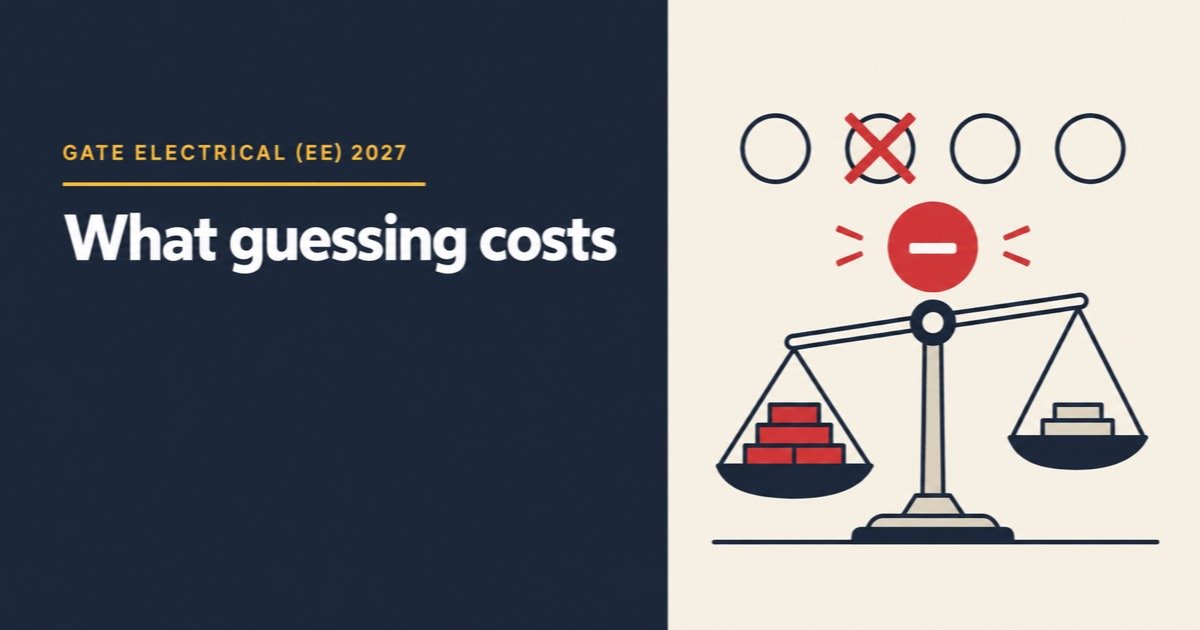
A negative total means that, over the whole paper, the penalties for wrong MCQs exceeded everything earned. In 2025 almost one EE candidate in thirteen did that. The arithmetic is simple: on a four-option MCQ a pure guess has a 1-in-4 chance of +1 and a 3-in-4 chance of −1/3, an expected value of exactly zero — but with real variance, so a string of blind guesses usually costs marks. Eliminating even one option makes a guess worth attempting on average.
Should you guess? The negative-marking calculator
Pick the question type and how many of the four options you can confidently rule out. The calculator shows your expected marks from answering versus leaving it blank.
Expected value of a guess, worked out
| Situation | 1-mark MCQ | 2-mark MCQ |
|---|---|---|
| Blind guess (4 options left) | 0.25 × 1 − 0.75 × 1/3 = 0 | 0.25 × 2 − 0.75 × 2/3 = 0 |
| One option eliminated (3 left) | 1/3 × 1 − 2/3 × 1/3 = +0.11 | 1/3 × 2 − 2/3 × 2/3 = +0.22 |
| Two options eliminated (2 left) | 0.5 × 1 − 0.5 × 1/3 = +0.33 | 0.5 × 2 − 0.5 × 2/3 = +0.67 |
| Any MSQ or NAT | No penalty — attempt | No penalty — attempt |
Our arithmetic from the GATE 2027 marking scheme.
The expected value of a blind guess is exactly zero, but the spread is what hurts: ten blind 2-mark guesses most often produce two or three right — two right and eight wrong is a net loss of about 1.3 marks, three right and seven wrong a net gain of about 1.3 — so the outcome is a coin toss with real downside. As soon as you can eliminate one option, the average turns positive and attempting is worth it. The same logic explains the negative totals in the statistics: a candidate who attempts every MCQ without knowing the material is likely to lose marks, not gain them.
An attempt strategy built on the rules
- Enter every NAT and MSQ answer you have worked out. A wrong MSQ or NAT scores zero, the same as a blank, so a worked answer should never be left unentered — but a random entry wastes time you could spend elsewhere.
- For MCQs, attempt when you can eliminate at least one option, and leave true blind guesses. The calculator above shows why.
- Watch the rounding on NATs: compute with full precision on the virtual calculator and round only at the end, to the number of decimal places the question states.
- For MSQs, choose only the options you are sure of — there are no partial marks, so a wrong or incomplete set scores zero; unlike an MCQ, it does not deduct marks.
- Practise on the virtual calculator, not a physical one. Its layout slows many candidates down in the first mock.
What the shift means for practice sets
Most question banks were built when NATs were the bigger share of the EE paper. If the 2026 balance holds, a practice set should now look like the 2026 paper: roughly two-thirds of subject marks as MCQs, a handful of MSQs and the rest NATs. Score every set with the penalty applied, and keep a separate count of how many MCQ marks you lost to wrong answers — if that number is regularly above three or four marks, the fix is attempt discipline, not more study. The 2024 paper, with its heavy NAT share, is still excellent practice for numerical accuracy; just do not use it as your guide to how much guessing costs.
The time budget is three hours for 65 questions, a little under three minutes each. GA is usually the fastest 15 marks on the paper, and Engineering Mathematics is fixed at 13 marks by rule, although our reading of the 2026 paper found about 18 marks of questions that were essentially mathematics (the divergence theorem, an ODE classification, a skew-symmetric quadratic form, orthogonal matrices, a contour integral, probability and a definite integral). Securing those before the long power-system and machines problems is a sound order of work.
Practise it, don't just read it
Practise with negative marking switched on in your head: score every practice set as right minus a third of wrong for 1-mark MCQs and two-thirds for 2-mark ones. The ProSyllabus quizzes cover the core EE topics for exactly that kind of drill.
The ProSyllabus GATE EE library has topic quizzes on Fourier series and transforms, transfer functions and block diagrams, state space, the Nyquist criterion, transformers, synchronous machines, rectifiers, nodal and mesh analysis, transients, two-port networks, load flow and power system protection — the first quiz is free.
Is there negative marking in GATE EE?
Only on MCQs: −1/3 for a wrong 1-mark and −2/3 for a wrong 2-mark question.
Is there negative marking for MSQ in GATE?
No, and no partial marks either.
Is there negative marking for NAT in GATE?
No.
How many questions are in GATE EE?
65 questions for 100 marks: 10 General Aptitude (15 marks) and 55 subject questions (85 marks).
How many marks is Engineering Mathematics in GATE EE?
13 marks by rule.
Can I use my own calculator in GATE?
No — only the on-screen virtual scientific calculator.
How many MCQs were in GATE EE 2026?
37 subject MCQs worth 55 of 85 marks, plus 10 GA MCQs (our count of the official key).
How many candidates got negative marks in GATE EE?
5,263 in 2025, 1,763 in 2026 and 620 in 2024.
Should I guess in GATE?
A blind four-option guess has an expected value of zero; eliminating at least one option makes it positive.
What does “marks to all” mean?
The final key awards the marks to every candidate for a flawed question; it happened three times in the 2024–2026 EE papers.
How should I round NAT answers?
Compute at full precision and round only at the end, to the decimal places stated in the question.
How many questions should I attempt in GATE EE?
There is no official number; attempt all NATs and MSQs you can work on, and MCQs where you can eliminate an option.
More in this series
- GATE EE 2027: what changed (and what did not)
- Marks vs score vs rank, 2023–2026, with calculator
- Previous papers decoded: section counts 2024–2026
- PSU jobs through GATE EE: official vacancies and cut-offs
- M.Tech after GATE EE: CCMT 2026 and IIT cut-offs
- A 19-week GATE EE 2027 revision plan
- GATE Electrical Engineering 2026: exam date, syllabus weightage and PSU guide
- GATE 2026 EE: Power Systems weightage and forenoon strategy
- GATE EE notice board — official updates
Sources
- official — GATE 2027 Information Brochure, IIT Madras (revised 17 Sep 2026)
- official — GATE 2026 EE final answer key (PDF)
- official — GATE 2025 EE final answer key (PDF)
- official — GATE 2024 EE final answer key (PDF)
- official — GATE 2026 EE question paper (PDF)
- official — GATE 2026 Statistical and Performance Report (IIT Guwahati, PDF)
- official — GATE 2025 Statistical and Performance Report (IIT Roorkee, PDF)
- official — GATE 2024 Statistical and Performance Report (IISc, PDF; archived copy)
- reported — PW — GATE EE syllabus 2027 (reported; see corrections)
official = a document published by the conducting body. reported = a news or coaching site we could not check against an original. Where sources disagree this page says so rather than picking one.