
Checked October 14, 2026. Medium. The four areas come from the practice-test page last modified Feb 18, 2026. The Suggested Reading List is a 2013 file and may be withdrawn or replaced without notice. No official topic list below the four areas exists; if one appears, this guide will be rewritten around it.
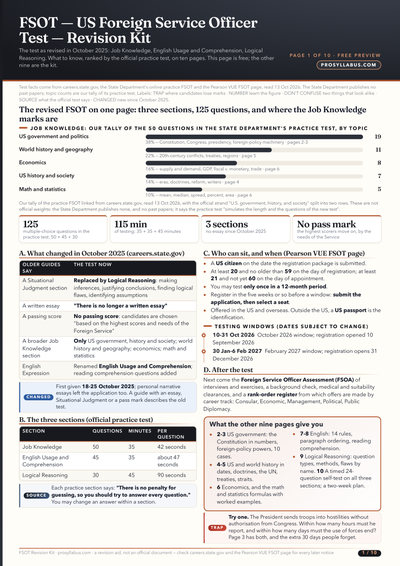
Job Knowledge is Part 1 of the FSOT: 50 multiple-choice questions in 35 minutes on the official practice test. Since the October 2025 revision the State Department limits it to four areas. In its words, the section's "content has been revised to only have questions on U.S. government, history, and society; world history and geography; economics; and math and statistics". This guide quotes that description, works through four free practice questions, one from each area, and sets the areas beside the Department's own reading list. ProSyllabus is an independent study site. It is not affiliated with the US Department of State, its Board of Examiners or Pearson VUE, and nothing here is official. Every rule is quoted or summarised from State Department, Pearson VUE and Federal Register pages, and the Department decides every candidacy.
Official practice test (read Oct 14, 2026) and its instructions page (modified Feb 18, 2026).
Where other pages get this wrong
Job Knowledge no longer ranges over management, communication and computing. It has four named areas.
Commonly published instead: Topic lists of eight or more Job Knowledge areas, including management principles, communication, and technology or computers. The State Department's own Suggested Reading List, a 2013 file that is still online, has headings for "Management and Human Behavior", "Public Affairs and the Media" and "Computer Applications".
The practice-test instructions (modified Feb 18, 2026) say the content was "revised to only have questions on" the four areas. The word "only" is the Department's. The State Department Media Note of September 5, 2025 says the job knowledge questions were made "more closely aligned with job requirements".
The four areas, in the State Department's words
The official description is one sentence, quoted in full above. It names the areas and nothing below them: no topic list, no number of questions per area and no weights. The table sets the official wording beside what our own practice questions test inside each area. The third column describes our set; it is not an official syllabus.
| Area (official wording, split by us) | What the Department says | What our practice questions test in it (our choice) |
|---|---|---|
| US government, history and society | Named in the sentence "U.S. government, history, and society; world history and geography; economics; and math and statistics". Nothing more specific is published. | The Constitution's allocation of powers (declaring war, treaties, vetoes, revenue bills, amendments), landmark Supreme Court decisions, and turning points such as the Louisiana Purchase, the Monroe Doctrine and the Nineteenth Amendment |
| World history and geography | Named in the sentence "U.S. government, history, and society; world history and geography; economics; and math and statistics". Nothing more specific is published. | Settlements and conferences that shaped the state system (Westphalia, Vienna, Berlin), twentieth-century institutions and endings (the Security Council, NATO, the Soviet Union), and physical geography that matters to trade, such as the Suez Canal and the Strait of Hormuz |
| Economics | Named in the sentence "U.S. government, history, and society; world history and geography; economics; and math and statistics". Nothing more specific is published. | Opportunity cost, supply and demand, price ceilings, GDP, real wages, fiscal and monetary policy, comparative advantage, tariffs, exchange rates, elasticity, public goods, externalities and tax structure |
| Math and statistics | Named in the sentence "U.S. government, history, and society; world history and geography; economics; and math and statistics". Nothing more specific is published. | Percentage change, ratios, simple and compound interest, average speed, weighted means, the effect of an outlier, simple probability, currency conversion and map scale |
One more official signal exists. The State Department fact sheet of April 1, 2026 says the Department "overhauled the Foreign Service Officer Test, adding questions on American history and logical reasoning". American history is the only subject within Job Knowledge that an official page singles out.
We spread the 50 questions almost evenly because no official page gives a split. The real test may weight the areas differently.
Four free worked examples, one from each area
These four are the free Job Knowledge questions of the ProSyllabus FSOT practice test, shown here with the explanations the set gives. The ProSyllabus FSOT practice test is our own work: original questions written to the State Department's published description of the three parts, with every answer explained. It is not the State Department's test, it does not contain State Department questions, and a score on it predicts nothing about a real candidacy. We show only the free questions; the other 46 Job Knowledge questions are in the paid part of the set on this page.
Free example 1 · US government, history and society
Under the US Constitution, which body has the power to declare war?
- The Supreme Court
- The President
- The Joint Chiefs of Staff
- Congress
Answer: D. Article I, Section 8 gives Congress the power to declare war. The President is commander in chief of the armed forces under Article II, but the declaration itself belongs to Congress.
How to work it (our note): Questions on the Constitution usually turn on which branch holds a power. Two options here name real roles the President has in war, which is why the question is worth a second look: commanding is not declaring.
From the ProSyllabus FSOT practice test, Job Knowledge part (an original question, not a State Department one). It is one of the free questions of that set.
Free example 2 · World history and geography
The Peace of Westphalia (1648), which ended the Thirty Years' War, is most often cited as a foundation of which principle?
- The free movement of people across borders
- Collective security through a world organization
- The right of colonies to independence
- The sovereignty of states over their own territory
Answer: D. The Westphalian settlement is conventionally treated as the origin of the modern system of sovereign states, each with authority within its own borders.
How to work it (our note): Read the date and the war first. A treaty question asks what the settlement is remembered for, so discard options that belong to a later century.
From the ProSyllabus FSOT practice test, Job Knowledge part (an original question, not a State Department one). It is one of the free questions of that set.
Free example 3 · Economics
A government has funds for one project and chooses to build a bridge rather than a school. In economic terms, what is the opportunity cost of the bridge?
- The tolls that drivers will later pay to cross the bridge
- The money paid to the firms that built the bridge
- The taxes raised to pay for the bridge
- The value of the school that was not built
Answer: D. Opportunity cost is the value of the best alternative given up. Here the alternative forgone is the school.
How to work it (our note): Opportunity cost is never money spent. Look for the option that names the thing given up.
From the ProSyllabus FSOT practice test, Job Knowledge part (an original question, not a State Department one). It is one of the free questions of that set.
Free example 4 · Math and statistics
A consulate processed 80 applications in March and 100 in April. By what percentage did the number rise?
- 25 percent
- 125 percent
- 20 percent
- 80 percent
Answer: A. The rise is 20 on a starting figure of 80, and 20 / 80 = 0.25, or 25 percent. Twenty percent would be the fall from 100 back to 80.
How to work it (our note): Percentage change is the change divided by the starting figure. Write the starting figure down before you look at the options; the common wrong answer divides by the end figure.
From the ProSyllabus FSOT practice test, Job Knowledge part (an original question, not a State Department one). It is one of the free questions of that set.
| Example | Area or skill | Answer |
|---|---|---|
| 1 | US government, history and society | D: Congress |
| 2 | World history and geography | D: The sovereignty of states over their own territory |
| 3 | Economics | D: The value of the school that was not built |
| 4 | Math and statistics | A: 25 percent |
The table repeats the four answers for readers on a page version that does not show the cards.
What the four examples tell you about the part
- Each question tests one settled fact or one short calculation. None of the four needs current events, and the official description names no current-affairs area.
- The wrong options are near misses: a real power of another branch, a real principle of a later era, a real cost that is not the opportunity cost, the percentage taken on the wrong base.
- At about 42 seconds a question (our arithmetic from 50 questions in 35 minutes), a question you do not know should get your best guess and a flag. The practice test says there is no penalty for guessing.
- The math is arithmetic you can do in your head or on the on-screen whiteboard. Pearson VUE lists calculators among the items not allowed in the room for a test taken at home.
The first two points describe our four questions, not the State Department's test.
How the four areas map to the State Department's Suggested Reading List
A careers.state.gov FAQ dated June 2, 2022 says: "To prepare for the FSOT, the Department of State recommends you have a broad academic foundation, intellectual curiosity, and good writing skills", and points to the practice test "as well as a Suggested Reading List". That list is a six-page PDF whose file name dates it to August 2013; it opened in Chrome on October 14, 2026, where we re-read page 1, and the headings below come from our text extraction of the same file that day. It says of itself that "it is difficult to provide a definitive reading list" and that it "illustrates the kinds of books and readings that can set you in the right direction". It was written for the older test, so the mapping below is ours.
| Job Knowledge area | Heading on the reading list | Examples the list names |
|---|---|---|
| US government, history and society | United States (culture, foreign policy, history, politics) | Norton and others, "A People and a Nation: A History of the United States"; Davidson and others, "Nation of Nations"; Rosati, "The Politics of United States Foreign Policy" |
| World history and geography | World History and Geography; Area Studies | Craig and others, "The Heritage of World Civilizations"; "Atlas of the World" (Oxford University Press); Gilbert, "A History of the Twentieth Century" |
| Economics | Economics and Public Policy | Mankiw, "Principles of Microeconomics"; Hall and Papell, "Macroeconomics: economic growth, fluctuations, and policy" |
| Math and statistics | None. The list has no mathematics or statistics heading | None |
| Not a Job Knowledge area now (our reading) | Management and Human Behavior; Public Affairs and the Media; Computer Applications; Consular and Immigration | Listed in the PDF, but the revised description of Job Knowledge does not name these subjects |
| Part 2, English (for reference) | English Usage | "Chicago Manual of Style"; Strunk and White, "The Elements of Style" |
Three cautions. First, the editions the list names are those of 2013 or earlier; a current edition of the same textbook does the same job. Second, the list also recommends periodicals and a major daily newspaper under "Current Affairs", but the revised description of Job Knowledge names no current-affairs area, so we would not treat news reading as test preparation for this part. That is our reading, not an official statement. Third, the same fact sheet of April 2026 lists readings for A-100, the orientation course for new officers; those are for people already hired, not a reading list for the test.
A study order that follows from the official description (ours)
- Sit Part 1 of the official practice test first, timed at 35 minutes, and sort your misses into the four areas.
- US government: read the Constitution itself, Articles I to V and the amendments. Many questions on powers are answered by its text.
- US history: one survey textbook, with the list's United States heading as a guide to the level. The April 2026 fact sheet names American history.
- World history and geography: one survey of world history and an atlas. Know the main straits, canals and mountain ranges and why they matter.
- Economics: the principles chapters of an introductory textbook, micro then macro.
- Math and statistics: percentages, ratios, interest, averages and simple probability, done without a calculator.
- Then practise at pace: 50 questions in 35 minutes, with no notes.
The order is our suggestion. The State Department publishes no study plan for the revised test.
On this page you will find the ProSyllabus FSOT practice test. The first four questions of each part are free to answer here, twelve in all, with the answer and the reason shown after each; the rest of the set, and a timed run of each part, are paid. For the other two parts and the pacing of all three, see the format guide; for every free official resource, see the free practice test guide.
What we could not find
- An official list of topics inside each of the four areas.
- How many of the 50 questions each area gets, on the practice test or on the live test, as an official figure.
- Whether the four areas carry equal weight in the score.
- What "society" covers in "U.S. government, history, and society"; no official page defines it.
- A State Department reading list written for the revised test. The only list online is the 2013 one.
- Whether the live test's Job Knowledge part has exactly the practice test's 50 questions and 35 minutes; the Department says only that the practice test simulates the length of the new test.
We do not reproduce the State Department's practice questions here; take them on its own form, linked in the sources.
Nothing on this page is legal, immigration or career advice. Questions about your own case go to the State Department at FSOTQuestions@state.gov.
Frequently asked questions
What is on the FSOT Job Knowledge section?
The State Department says its content was revised to only have questions on US government, history, and society; world history and geography; economics; and math and statistics.
How many Job Knowledge questions are there, and how long do I get?
On the official practice test, 50 questions in 35 minutes. The State Department says the practice test simulates the length of the new test.
Where can I find free FSOT Job Knowledge practice questions?
Part 1 of the State Department's free online practice test has 50. This page also shows the four free Job Knowledge questions of the ProSyllabus practice test with their explanations; those are our own questions.
Does FSOT Job Knowledge still include management and computer questions?
The official description no longer names them. It says the content was revised to only have questions on four areas, and management, communication and computing are not among them.
Is there math on the FSOT?
Yes. Math and statistics is one of the four Job Knowledge areas the State Department names. No official page lists the topics within it.
Can I use a calculator for the FSOT math questions?
For a test taken at home, Pearson VUE lists calculators among the items not allowed in the room. A digital whiteboard is provided on screen.
Does the State Department publish an FSOT reading list?
Yes, a Suggested Reading List PDF that is still online. Its file name dates it to August 2013, so it predates the October 2025 revision and includes subjects the revised Job Knowledge description no longer names.
Do I need to follow current events for Job Knowledge?
The revised official description names no current-affairs area. The 2013 reading list recommends periodicals and newspapers, but it was written for the older test. Whether current events are tested is not stated anywhere official.
Is there a penalty for wrong answers in Job Knowledge?
No. The official practice test says there is no penalty for guessing, so you should try to answer every question.
More in this series
- FSOT eligibility: citizenship and age
- FSOT sections, question counts and timing
- FSOT scoring: no passing score
- FSO selection stages and the Register
- FSOT dates, registration and the 12-month rule
- Free FSOT practice test and test day
- FSOT essay and Personal Narratives
- US FSOT notice board — official updates
Sources
- official — careers.state.gov — "Instructions to the Online Practice FSOT" (modified 18 Feb 2026; re-read 14 Oct 2026, unchanged): purpose, no automatic timer, feedback, the revised content of each part, no written essay, no passing score, the later stages
- official — State Department "Online FSOT Practice Test" (Microsoft Form linked from the instructions page; all 13 pages stepped through read-only on 14 Oct 2026 with the Next button, nothing answered or submitted): Part 1 Job Knowledge, 50 questions in 35 minutes; Part 2 English Understanding and Comprehension, 45 questions in 35 minutes; Part 3 Logical Reasoning, 30 questions in 45 minutes; no penalty for guessing; the last page says what the result shows
- official — US Department of State, Media Note "Foreign Service Officer Test (FSOT) Updates" (5 Sep 2025): the revamped FSOT first given Oct 18-25, 2025; logic and reasoning added, situational judgement discontinued, Personal Narratives removed
- official — US Department of State, Fact Sheet "U.S. Department of State Announces Reforms to the U.S. Foreign Service" (1 Apr 2026): Written Examination replaces the Qualification Evaluation Panel; oral exam redesigned; A-100 reformed
- official — careers.state.gov FAQ — "How can I prepare for the Foreign Service Officer Test (FSOT)?" (2 Jun 2022): the practice test and the Suggested Reading List
- official — careers.state.gov — "FSOT Suggested Reading List" PDF (file named Aug 2013, six pages, opens in Chrome on 14 Oct 2026; page 1 re-read there, the headings on later pages are from our text extraction of the same file the same day; it predates the October 2025 revision of the test)
- official — Pearson VUE — Foreign Service Officer Test (FSOT) page (read 14 Oct 2026): eligibility, registration steps, testing windows for October 2026 and February 2027, exam-day rules for at-home testing, the 12-month rule
- official — Pearson VUE — online testing requirements for Department of State tests (read 14 Oct 2026): no breaks, technology and desk rules, check-in, the digital whiteboard
- official — careers.state.gov — Foreign Service Officer page (page metadata modified 9 Oct 2026): the five career tracks and the registration link. The paragraph about the revamped FSOT ("we removed the requirement for personal narrative essays") is in the page's HTML but inside a block marked hidden, so a visitor does not see it on screen on 14 Oct 2026; the same sentence is visible in the 5 Sep 2025 Media Note
official = a document published by the conducting body. reported = a news or coaching site we could not check against an original. Where sources disagree this page says so rather than picking one.
The FSOT changed in October 2025. Practise the new test at full length.
125 original questions across Job Knowledge, English and the new Logical Reasoning part, at the lengths of the State Department's practice test. Check each answer and read the reasoning. The first 4 of each part are free, below.
- 125questions
- 3timed parts
- 115minutes in all
- 125answers explained
Every answer comes with its reasoning, and every question was cross-checked before it went into the test.
Every consular officer at the post has completed crisis training. No one who has completed crisis training is exempt from the weekend duty roster. Ana is exempt from the weekend duty roster. Which of the following must be true?
The other 113 questions and the three timed runs are in the full test
- 125 questions: Job Knowledge 50 in 35 min · English 45 in 35 min · Logical Reasoning 30 in 45 min
- A timed run for each part with a clock, which the official practice test does not have
- Your score for each part and each skill, so you know where your marks are going
- The reasoning behind every answer, including why the tempting wrong option is wrong
Independent practice material. Not written or endorsed by the US Department of State; these are original questions, not items from the official practice test or the live FSOT.