
Checked October 14, 2026. High. The essay and the Personal Narratives were removed in 2025 and a Written Examination was announced on April 1, 2026 with no published format. The State Department may publish that format, or sample material, at any time. Re-check careers.state.gov before you plan writing practice.
If you are looking for FSOT essay examples or Personal Narrative examples, first check whether you need them: today's FSOT has neither. The State Department's practice-test page says "There is no longer a written essay." Its Media Note of September 5, 2025 says "we removed the requirement for personal narrative essays, streamlining the application process." Both changes took effect with the test first given on October 18-25, 2025. Writing is still assessed, but later: a fact sheet of April 1, 2026 says the Department "has returned to the use of a Written Examination to replace the Qualification Evaluation Panel". Its format has not been published. ProSyllabus is an independent study site. It is not affiliated with the US Department of State, its Board of Examiners or Pearson VUE, and nothing here is official. Every rule is quoted or summarised from State Department, Pearson VUE and Federal Register pages, and the Department decides every candidacy.
State Department pages re-read on Oct 14, 2026.
Where other pages get this wrong
You do not write an essay in the FSOT, and you do not submit Personal Narratives with the application.
Commonly published instead: Guides and paid courses that teach a timed FSOT essay and six Personal Narratives of a fixed length. Two official pages still describe them as well: the selection-process page whose body says "Updated: March 2024", and the US Mission Korea page, which on October 14, 2026 still said the registration package includes "a set of personal narrative questions".
The newer official statements are explicit. The Media Note of September 5, 2025 says the requirement for personal narrative essays was removed. The same sentence sits in the HTML of the careers.state.gov Foreign Service Officer page (metadata modified October 9, 2026) inside a block marked hidden, so a visitor does not see it there on screen; we therefore rely on the Media Note. The practice-test instructions (modified February 18, 2026) say there is no longer a written essay. The Pearson VUE FSOT page, read October 14, 2026, describes registration as two steps, "submitting an application and selecting a seat", and does not mention narratives at all.
What is required now, stage by stage
| Stage | Writing required? | Source and date |
|---|---|---|
| Registration with Pearson VUE | No narratives. An application and a seat | Pearson VUE FSOT page, read Oct 14, 2026; Media Note, Sep 5, 2025 |
| The FSOT | No. Three multiple-choice parts; "There is no longer a written essay" | Practice-test instructions, modified Feb 18, 2026 |
| Written Examination | Yes, by its name and stated purpose. Format, length, prompts, scoring and delivery are not published | State Department fact sheet, Apr 1, 2026 |
| Oral exam (FSOA) | Not stated for the redesigned exam. The older format included a 90-minute written Case Management Exercise | Fact sheet, Apr 1, 2026; selection-process page ("Updated: March 2024") |
A gap between two official pages. The practice-test instructions list the stages after the FSOT as the Foreign Service Officer Assessment, a background check, medical clearance, suitability clearance and the register, and do not mention a Written Examination. That page was last modified on February 18, 2026, six weeks before the fact sheet. The fact sheet is the newer statement, so we treat the Written Examination as a real stage, but no careers.state.gov page we could find describes it. The stages are set out in the selection stages guide.
How the writing requirement changed
| Period | In the test | With the application | After the test |
|---|---|---|---|
| Before October 2025 | A Written Essay, the last of four sections | Personal Narratives answering six prompts, scored by the Qualifications Evaluation Panel with the FSOT score | Oral assessment with a written Case Management Exercise |
| From the October 18-25, 2025 test | No essay | No Personal Narratives | As before until April 2026 |
| From the April 1, 2026 fact sheet | No essay | No Personal Narratives | A Written Examination replaces the Qualification Evaluation Panel; the oral exam is redesigned |
Our count from the official pages: six Personal Narrative prompts plus the Written Essay before, neither since. The Written Examination comes after the FSOT and is not counted here because its content is not published.
What the Personal Narratives asked, in the State Department's own words
The clearest official account of the retired narratives is still online, on the selection-process page whose body is dated March 2024. We quote it because it is the Department's own statement of what it looked for in a candidate's writing about themselves, and nothing newer has replaced it. It is history, not a current requirement.
"In your Personal Narratives (PNs), you will answer questions prompting you to describe the knowledge, skills, and abilities you would bring to the Foreign Service. The PNs offer the opportunity to highlight not just what you have done, but how you did it and what you learned." Panels of trained Foreign Service Officers assessed "each candidate's file based on responses to six prompts which reflect the skills that predict success in the Foreign Service". The six skills, as that page lists them:
| Skill the prompts reflected | The page's description (verbatim) |
|---|---|
| Leadership | innovation, decision making, teamwork, openness to dissent, community service and institution building |
| Interpersonal | professional standards, persuasion and negotiation, workplace perceptiveness, adaptability, representational skills |
| Communication | ability to effectively convey, interpret, and retain information; active listening, public outreach, foreign language skills |
| Management | operational effectiveness, performance management and evaluation, management resources, customer service |
| Intellectual | information gathering and analysis, critical thinking, active learning, leadership and management training |
| Substantive Knowledge | Understanding of U.S. history/ government/culture and ability to apply such understanding in international situations; knowledge or application of relevant career track information. |
The same page told candidates how to write them: "Use the skills above as a guide to (1) give positive examples that demonstrate your abilities; (2) identify learning experiences; and (3) indicate how your learning experience will contribute to success in your chosen Foreign Service career track." And: "Please make sure you directly address each question as asked." A 2023 FAQ adds that the panels looked "at the 'total candidate' to rank order all the candidates in a given career track".
What that page does not give. It does not print the six prompts themselves, a word or character limit, or a sample response. We found no official page still online that does. Limits and prompt wordings quoted on forums and prep sites may well be accurate recollections of the old application form, but we could not confirm them from a State Department or Pearson VUE page, so we do not print them.
No official sample essays or sample narratives are published
We searched careers.state.gov on October 14, 2026 for "personal narrative", "essay", "written examination" and "written exam". The results were the stale selection-process page, three FAQ items about the older process, the Foreign Service Officer page, the practice-test page and pages for Foreign Service Specialist jobs. None contains a sample essay, a sample narrative or a scored example. We therefore print no model essay and no model narrative: a "sample" here would be our invention with nothing official to measure it against, written to a format that no longer exists.
What the State Department says good writing is, today
One current official page does describe the writing the Service wants. The "Foreign Service Officer and Specialist Competencies" page, modified September 22, 2026, lists eleven competencies. Written Communication reads: "To write concisely yet comprehensively; to use clear arguments and facts; to use correct English grammar and syntax; to use appropriate vocabulary to promote understanding." The fact sheet gives the reason for the Written Examination in similar terms: "the ability to think critically and write clear prose continues to be an essential skill for Foreign Service Officers".
| Competency (current page) | Official wording |
|---|---|
| Written Communication | To write concisely yet comprehensively; to use clear arguments and facts; to use correct English grammar and syntax; to use appropriate vocabulary to promote understanding. |
| Critical Thinking | To discern what is appropriate, practical, and realistic in a given situation; to demonstrate an understanding of competing demands and weigh their relative merits using sound judgment; to consider multiple points of view when making recommendations; to formulate creative alternatives or solutions to resolve problems; to show flexible and innovative thinking/problem solving. |
| Information Integration & Analysis | To evaluate the importance, reliability, and usefulness of information; to distill relevant details from available information; to absorb and retain complex information drawn from a variety of sources; to synthesize and analyze available information; to recognize patterns or trends and draw reasoned conclusions from data; to demonstrate a breadth of knowledge across domains and generate original, nuanced conclusions. |
| Objectivity / Integrity | To be fair and honest; to keep an open mind; to present issues frankly and fully; to be consistent and dependable in words and actions; to demonstrate a healthy skepticism of their own position; to make claims that are measured and do not presume the agreement of others. |
The page lists seven more competencies: Cultural Proficiency, Mission & Motivation, Leadership, Negotiation, Planning & Organizing, Presentation Skills and Teamwork. We quote the four that bear most directly on a written argument; that selection is ours. The page does not say which competencies the Written Examination scores.
How to structure a response against those words (structure, not a sample)
Because the Written Examination's task is unpublished, nobody outside the Department can show you a model answer to it. What can be practised is structure, and the official wording above is specific enough to build one. Each row takes a phrase the Department uses and turns it into a check you can run on any piece of your own writing. The right-hand column is our reading.
| Official phrase | Structural check for your draft (ours) |
|---|---|
| "use clear arguments and facts" | State your position or recommendation in the first two sentences. Each paragraph after it gives one reason and the fact that supports it. |
| "write concisely yet comprehensively" | Cover every part of the task you were set, then cut any sentence that neither states a reason nor supports one. |
| "consider multiple points of view when making recommendations" | Give one paragraph to the strongest opposing view, stated fairly, and say why your recommendation still holds. |
| "draw reasoned conclusions from data" | Where the task supplies figures or documents, use them by name. The older Case Management Exercise asked for a memo "that incorporates data and other numerical analysis". |
| "make claims that are measured and do not presume the agreement of others" | Remove absolutes you cannot support, and do not assume the reader shares your view. |
| "correct English grammar and syntax" | Leave the last five minutes of any timed piece for proofreading only. |
| "directly address each question as asked" (retired narrative guidance) | Underline the verbs in the prompt before you write, and tick each one off when the draft is done. |
If you want to write about your own experience, for an interview or in case narratives return, the retired guidance gives a three-part skeleton in the Department's own numbering: a positive example that demonstrates the ability, what you learned from it, and how that learning would help in your chosen career track. Fill it with your own true material. The Pearson VUE page warns that the Department "may verify content provided by candidates by contacting references", and the older page says that "any exaggeration of your experience and qualifications" will weaken a candidacy.
What to practise instead, while the format is unpublished (ours)
- The three multiple-choice parts come first. Nobody reaches a writing stage without being selected on the FSOT score.
- Part 2 of the FSOT tests the mechanics that any written exam will also reward: grammar, usage and reading comprehension.
- Write one timed argument a week on a question of policy or history: position first, reasons with facts, the opposing view, a measured conclusion. Then run the seven checks in the table above.
- Read the kind of prose the Department names for its new officers. The April 2026 fact sheet lists readings for the A-100 course, including selections from the Federalist Papers and works by George Kennan. They are for onboarding, not a reading list for the Written Examination.
- Do not memorise sample essays. Pearson VUE's Plagiarism and AI Policy says the Department may cancel an application or withhold results for "candidate misconduct and plagiarism".
This list is our suggestion. The State Department has published no preparation advice for the Written Examination.
On this page you will find the ProSyllabus FSOT practice test. The first four questions of each part are free to answer here, twelve in all, with the answer and the reason shown after each; the rest of the set, and a timed run of each part, are paid. It has no essay part, because the FSOT has none. The ProSyllabus FSOT practice test is our own work: original questions written to the State Department's published description of the three parts, with every answer explained. It is not the State Department's test, it does not contain State Department questions, and a score on it predicts nothing about a real candidacy.
What we could not find
- The format of the Written Examination: its length, the number and kind of prompts, whether it is typed at home or at a test center, how it is scored and when in the process it is taken.
- Whether the Written Examination asks for an argument, a memo, a summary of documents, or something else.
- Any official sample essay, sample narrative or scored example, for the old formats or the new one.
- The wording of the six retired Personal Narrative prompts and their length limit, on any official page still online.
- The time limit and scoring rules of the retired Written Essay: the FSOT Information Guide PDF (88 pages) opens in Chrome, but we could not read its text on October 14, 2026, so we state nothing from it.
- Whether the redesigned oral exam keeps a written exercise.
- Any statement that Personal Narratives will return.
If the Department publishes the Written Examination's format, this guide will be rewritten around it.
Nothing on this page is legal, immigration or career advice. Questions about your own case go to the State Department at FSOTQuestions@state.gov.
Frequently asked questions
Does the FSOT have an essay in 2026?
No. The State Department's practice-test page says there is no longer a written essay. The test has three multiple-choice parts.
Do I still have to write Personal Narratives for the FSOT?
No. The State Department says it removed the requirement for personal narrative essays, starting with the test first given on October 18-25, 2025.
Where can I find official FSOT essay examples?
We found none. A search of careers.state.gov on October 14, 2026 returned no sample essay, sample narrative or scored example.
What were the six Personal Narrative topics?
The State Department's older selection-process page says the six prompts reflected these skills: Leadership, Interpersonal, Communication, Management, Intellectual and Substantive Knowledge. It does not print the prompts themselves.
What is the Foreign Service Written Examination?
A stage announced in a State Department fact sheet on April 1, 2026, which says the Department returned to a Written Examination to replace the Qualification Evaluation Panel. Its format has not been published.
What replaced the Qualifications Evaluation Panel?
The Written Examination, according to the April 1, 2026 fact sheet. The panel used to score candidates on their Personal Narratives together with the FSOT score.
Why do some official pages still mention Personal Narratives?
They have not been updated. The selection-process page says "Updated: March 2024" in its body, and the US Mission Korea page still described personal narrative questions on October 14, 2026. The newer State Department statements say the requirement was removed.
How should I prepare for the writing stage?
The format is unpublished, so practise structure against the Department's published Written Communication competency: clear arguments and facts, concise but complete, correct grammar. The FSOT itself comes first and has no writing.
What was the character limit for a Personal Narrative?
We could not confirm a limit from any State Department or Pearson VUE page still online, so we do not state one.
More in this series
- FSOT eligibility: citizenship and age
- FSOT sections, question counts and timing
- FSOT scoring: no passing score
- FSO selection stages and the Register
- FSOT dates, registration and the 12-month rule
- Free FSOT practice test and test day
- FSOT Job Knowledge practice questions
- US FSOT notice board — official updates
Sources
- official — careers.state.gov — "Instructions to the Online Practice FSOT" (modified 18 Feb 2026; re-read 14 Oct 2026, unchanged): purpose, no automatic timer, feedback, the revised content of each part, no written essay, no passing score, the later stages
- official — careers.state.gov — Foreign Service Officer page (page metadata modified 9 Oct 2026): the five career tracks and the registration link. The paragraph about the revamped FSOT ("we removed the requirement for personal narrative essays") is in the page's HTML but inside a block marked hidden, so a visitor does not see it on screen on 14 Oct 2026; the same sentence is visible in the 5 Sep 2025 Media Note
- official — US Department of State, Media Note "Foreign Service Officer Test (FSOT) Updates" (5 Sep 2025): the revamped FSOT first given Oct 18-25, 2025; logic and reasoning added, situational judgement discontinued, Personal Narratives removed
- official — US Department of State, Fact Sheet "U.S. Department of State Announces Reforms to the U.S. Foreign Service" (1 Apr 2026): Written Examination replaces the Qualification Evaluation Panel; oral exam redesigned; A-100 reformed
- official — Pearson VUE — Foreign Service Officer Test (FSOT) page (read 14 Oct 2026): eligibility, registration steps, testing windows for October 2026 and February 2027, exam-day rules for at-home testing, the 12-month rule
- official — careers.state.gov — "Foreign Service Officer and Specialist Competencies" (modified 22 Sep 2026): the eleven competencies, including Written Communication
- official — careers.state.gov — "FSO Selection Process – Text Version" (modified 24 Feb 2026; its body says "Updated: March 2024", so its test format, Personal Narratives and QEP are out of date): Register, bump-up points, clearance, offers, training, the $72 no-show fee
- official — careers.state.gov FAQ — "What are the changes to the FSOT?" (30 Mar 2023; describes the 2023 Personal Narrative model, now replaced)
- official — careers.state.gov FAQ — "What are the Qualifications Evaluation Panels?" (30 Mar 2023; the QEP was replaced in April 2026)
- official — US Mission Korea — Foreign Service Officer Test page (read 14 Oct 2026): still describes "a set of personal narrative questions" and about three hours for the registration package, and still lists the October 2026 window as Oct 10-17
- official — careers.state.gov — FSOT Information Guide PDF (88 pages; opens in Chrome on 14 Oct 2026 with the cover "U.S. Department of State Information Guide to the Foreign Service Officer..."; we could not read its text in that check, so the description of it as the 2016-17 guide for the old four-part test is carried from our earlier reading, not re-read on 14 Oct 2026)
official = a document published by the conducting body. reported = a news or coaching site we could not check against an original. Where sources disagree this page says so rather than picking one.
The FSOT changed in October 2025. Practise the new test at full length.
125 original questions across Job Knowledge, English and the new Logical Reasoning part, at the lengths of the State Department's practice test. Check each answer and read the reasoning. The first 4 of each part are free, below.
- 125questions
- 3timed parts
- 115minutes in all
- 125answers explained
Every answer comes with its reasoning, and every question was cross-checked before it went into the test.
Every consular officer at the post has completed crisis training. No one who has completed crisis training is exempt from the weekend duty roster. Ana is exempt from the weekend duty roster. Which of the following must be true?
The other 113 questions and the three timed runs are in the full test
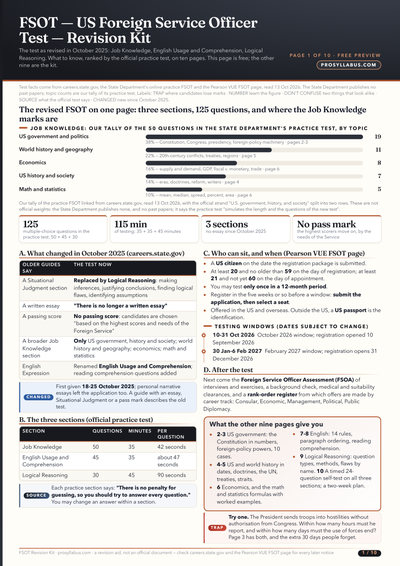
- 125 questions: Job Knowledge 50 in 35 min · English 45 in 35 min · Logical Reasoning 30 in 45 min
- A timed run for each part with a clock, which the official practice test does not have
- Your score for each part and each skill, so you know where your marks are going
- The reasoning behind every answer, including why the tempting wrong option is wrong
Independent practice material. Not written or endorsed by the US Department of State; these are original questions, not items from the official practice test or the live FSOT.