Factors of Production
Chapter 7: Economic Life Around Us
Complete Study Guide with Interactive Learning
Chapter Overview
What You'll Learn
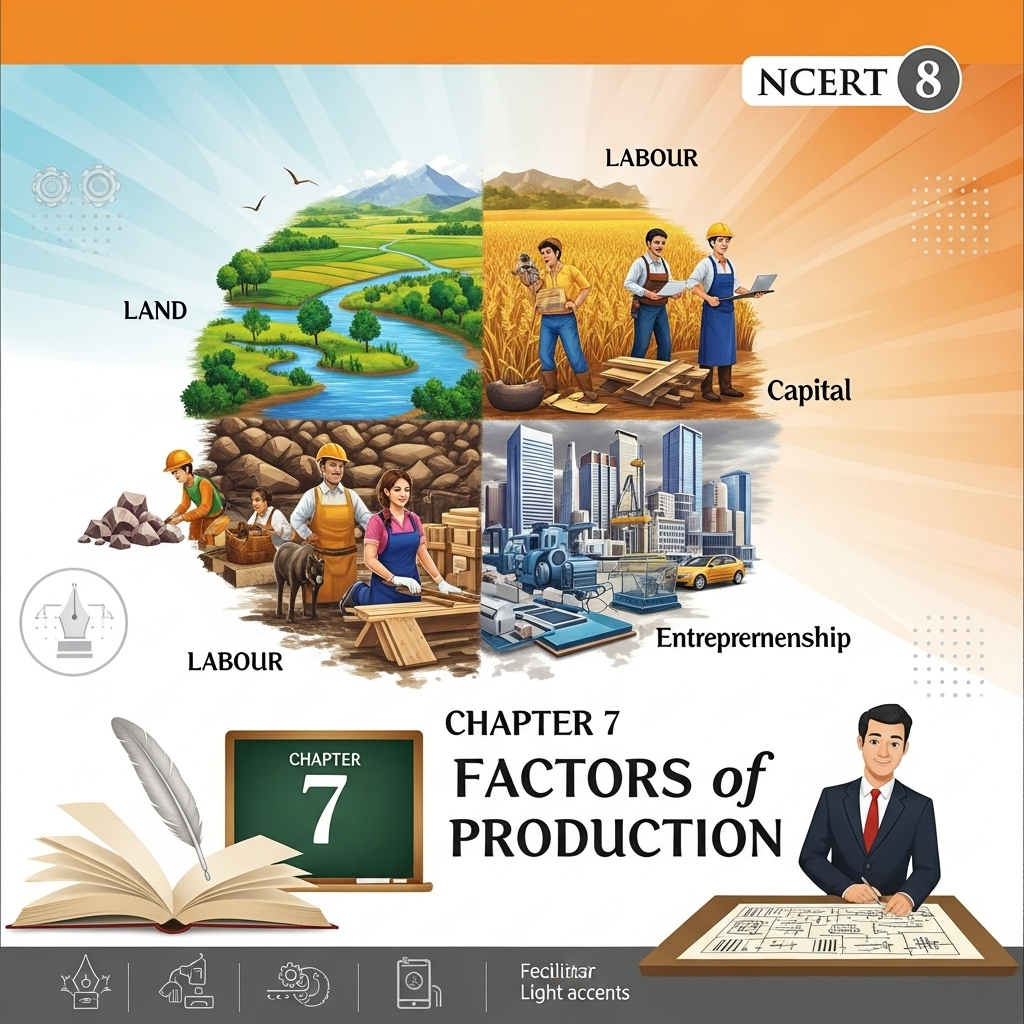
Factors of Production
Understanding land, labour, capital, and entrepreneurship as key inputs.
Interconnections
Exploring how factors combine in production processes.
Human Capital
Role of skills, knowledge, and facilitators like education.
Technology's Role
How technology enhances efficiency in using factors.
Historical Context
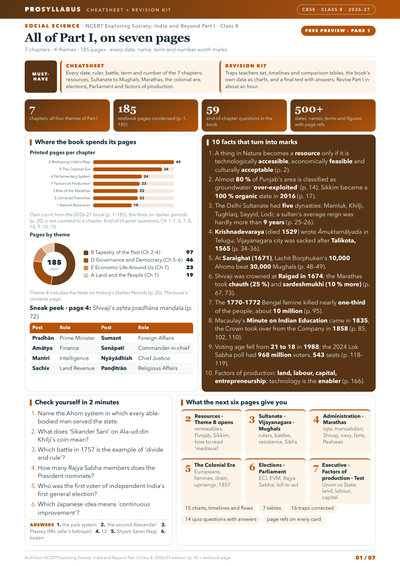
This chapter discusses efficient use of land, labour, and capital for India's growth, as noted by Bibek Debroy. It examines production processes for goods like clothes and furniture, classifying inputs into four factors, with technology as a facilitator. Examples like Ratna's restaurant illustrate real-world application.
Key Highlights
Factors are interconnected; human capital is enhanced by education/training. Businesses combine inputs to create goods/services, generating economic activities. Local reports highlight diverse inputs in shops/restaurants.
Summary of All Topics
- Introduction: Production involves inputs like land, labour, capital, entrepreneurship; technology facilitates efficiency.
- Factors of Production: Classified as land (natural resources), labour (human effort), capital, entrepreneurship.
- Land: Includes soil, forests, water, minerals; businesses buy/rent it.
- Labour: Physical/mental effort; varies by skill/knowledge.
- People as Resource: Human capital: specialized skills/knowledge for efficient labour.
- Facilitators of Human Capital: Education/training for knowledge/skills; health for productivity.
- Interconnections: Factors combine; e.g., land + labour + capital in farming.
- Role of Human Capital: Applies knowledge to create goods/services; requires dedication.
- Business Examples: Restaurant needs location (land), staff (labour), equipment (capital).
- Local Economic Activities: Goods/services in shops; inputs like produce, tools.