
Cubes and Cube Roots
Chapter 6: Mathematics — Complete Study Guide
Clear concepts, worked examples, summaries & exam-style questions
Chapter Overview
What you'll learn
Definition & Patterns
What are cubes and cube roots; patterns in cube endings and sums of odd numbers giving cubes.
Prime-factor method
How to test perfect cubes and find cube roots via grouping prime factors in triples.
Smallest multiplier/divisor
How to find the least number to multiply/divide to get a perfect cube (by adjusting prime exponents to multiples of 3).
Applications
Volume-side relationships of cubes and useful numeric identities (e.g., sums of consecutive odd numbers).
Quick context
This chapter introduces cubes (numbers of form \(n^3\)) and cube roots (the inverse operation). You will see examples, interesting numerical patterns (like Hardy–Ramanujan type facts), and techniques to decide if a number is a perfect cube and to compute cube roots using prime factorisation. Practical tasks include finding the least multiplier or divisor to make a number a cube and interpreting relationship between volume and side of cubes.
Comprehensive Chapter Summary
1. Introduction to cubes
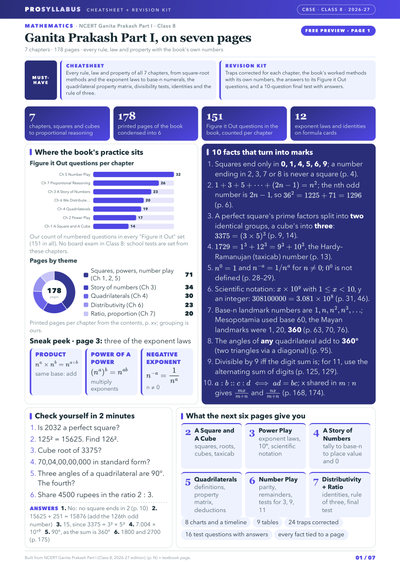
Cube of a number \(n\) is \(n^3 = n \times n \times n\). Perfect cubes among small numbers: \(1, 8, 27, 64, 125, 216, 343, 512, 729, 1000,\dots\). The chapter highlights interesting numbers like 1729 — the smallest number expressible as sum of two cubes in two different ways (\(1729 = 1^3+12^3 = 9^3+10^3\)). :contentReference[oaicite:0]{index=0}
2. Recognising perfect cubes
Prime factor rule
A number is a perfect cube if, in its prime factorisation, every prime exponent is a multiple of 3. Example: \(216=2^3\cdot3^3\) so \(216=(2\cdot3)^3=6^3\). :contentReference[oaicite:1]{index=1}
Unit-digit patterns
The one's digit of cubes follows patterns (e.g., numbers ending in 2 have cubes ending in 8). Try examples like \(3331^3\), \(1024^3\). :contentReference[oaicite:2]{index=2}
3. Smallest multiplier / divisor to get a cube
To make a number \(N\) a perfect cube, adjust its prime exponents so each becomes a multiple of 3. If a prime \(p\) appears \(e\) times and \(e \bmod 3 = r\), you multiply by \(p^{(3-r)}\). Similarly, to divide to get a cube, divide out the primes whose exponents cannot be grouped in threes. Worked examples: 392 requires multiplication by 7 to become \(2744=14^3\); 1188 must be divided by 44 to yield 27.
4. Cube roots
Cube root is denoted \(\sqrt[3]{\cdot}\). Using prime factorisation, group primes in triples and multiply the base primes left after grouping. Examples: \(\sqrt[3]{3375}=15\) since \(3375=3^3\cdot5^3\). Other examples: \(\sqrt[3]{8000}=20,\ \sqrt[3]{13824}=24.\)
5. Patterns & identities
Some numeric patterns: sums of consecutive odd numbers give cubes (e.g., \(1=1^3,\;3+5=2^3,\;7+9+11=3^3\)). Differences of cubes follow a factor pattern: \(a^3-b^3=(a-b)(a^2+ab+b^2)\). Explore ending-digit behaviour and growth comparisons like \(m^2 < m^3\) for suitable integers. :contentReference[oaicite:5]{index=5}
6. What we practiced
- Identify perfect cubes, compute cube roots by prime factor method.
- Find least numbers to multiply/divide to obtain perfect cubes.
- Understand patterns: Hardy–Ramanujan number, unit-digit patterns, sums of odd numbers producing cubes.
Key Concepts & Formulas
Cube
\(n^3 = n \times n \times n\). Example: \(5^3 = 125\).
Cube root
\(\sqrt[3]{x}\) is the number whose cube is \(x\). E.g. \(\sqrt[3]{27}=3\).
Prime-factor method
Write \(N=\prod p_i^{e_i}\). If every \(e_i\) is multiple of 3, \(N\) is a perfect cube. \(\sqrt[3]{N}=\prod p_i^{e_i/3}\).
Make a cube
To make \(N\) a cube by multiplication, for each prime with \(e_i \bmod 3 = r\), multiply by \(p_i^{3-r}\).
Selected formulas (for book-like display)
Basic algebraic identities related to cubes (rendered via MathJax):
\(\displaystyle (a+b)^3 = a^3 + 3a^2b + 3ab^2 + b^3\)
\(\displaystyle a^3 - b^3 = (a-b)\bigl(a^2 + ab + b^2\bigr)\)
\(\displaystyle a^3 + b^3 = (a+b)\bigl(a^2 - ab + b^2\bigr)\)
Questions and Answers — Chapter 6
Short Questions (brief answers)
Q1. What is a perfect cube? Give two examples.
Q2. Is 500 a perfect cube?
Q3. Find \(\sqrt[3]{8000}\).
Q4. What is the cube of 12?
Q5. Give the cube root of 3375.
Q6. Is 243 a perfect cube?
Q7. State the prime-factor test for perfect cubes.
Q8. What is 20³?
Q9. What is the cube root of 13824?
Q10. If a number ends with digit 8, can it be a cube? (Give example or counter)
Q11. Is 27000 a perfect cube?
Q12. What is special about 1729?
Q13. How many cubes are there between 1 and 1000?
Q14. Is 10648 a perfect cube? If yes, what is its cube root?
Q15. What is the cube of 5?
Medium Questions — (Answer in ~3 marks)
Q1. Using prime factorisation find the cube root of 46656.
Q2. Find the smallest number by which 392 must be multiplied to get a perfect cube.
Q3. By which smallest number should 53240 be divided to obtain a perfect cube?
Q4. Find cube root of 110592 by prime factorisation (hint: used in exercises).
Q5. Find the smallest number by which 68600 must be multiplied to get a perfect cube.
Q6. Check whether 1000 and 9000 are perfect cubes.
Q7. Find \(\sqrt[3]{175616}\) by prime factorisation.
Q8. Express 63 as sum of consecutive odd numbers using the cube-sum pattern.
Q9. Decide true/false: "Cube of any odd number is even."
Q10. Find the cube root of 46656 using prime factorisation (exercise item).
Q11. If \(N = 2^4\cdot3^2\cdot5\), what smallest multiplier makes \(N\) a perfect cube?
Q12. Why is 243 not a cube though it is a high power of 3?
Q13. Find the cube root of 91125 from the exercise list.
Q14. Show that 343000 is a perfect cube and find its cube root.
Q15. For \(n\in\mathbb{N}\), check whether \(n^2 < n^3\) always holds. Explain.
Long Questions — (Detailed answers)
Q1. Explain in detail how to use prime factorisation to test whether a number is a perfect cube and find the smallest multiplier to make it a cube. Illustrate with 68600.
Step 1: Prime-factorise: \(68600 = 2^3\cdot5^2\cdot7^3\). Step 2: Check exponents: for a perfect cube each exponent must be multiple of 3. Here exponents are 3 (OK), 2 (not OK), 3 (OK). Step 3: For exponent 2, need \(3-2=1\) extra factor of 5. So multiply by \(5\) to get \(68600\times5=343000\). After multiplication prime exponents become \(2^3\cdot5^3\cdot7^3\), all multiples of 3. Hence \(343000=(2\cdot5\cdot7)^3=70^3\). So the smallest multiplier is 5 and cube root of resulting cube is 70. :contentReference[oaicite:31]{index=31}
Q2. Work out fully: find the smallest number by which 1188 must be divided so that quotient is a perfect cube and state the cube root of the quotient.
Q3. Prove the formula \(a^3-b^3=(a-b)(a^2+ab+b^2)\) and give an example with numbers.
Q4. Using the cube-sum pattern (sum of odd numbers), show how 125 can be obtained as a sum of consecutive odd numbers.
Q5. Demonstrate with full working how \(\sqrt[3]{74088}=42\) using prime factorisation.
Q6. A cuboid has dimensions \(15\times30\times15\) cm. How many such cuboids are needed to make a perfect cube? Explain.
Q7. Show with steps how to find \(\sqrt[3]{13824}\).
Q8. From the chapter: list ten cubes from \(1^3\) to \(10^3\) and explain why only ten cubes lie below 1000.
Q9. How do unit-digit patterns help to quickly reject non-cubes? Illustrate with 243 and 500.
Q10. Explain the concept of Hardy–Ramanujan numbers and give one example besides 1729.
Q11. Given \(N=2^5\cdot3^4\cdot7\), find the smallest number to multiply with \(N\) to get a perfect cube and find cube root of the result.
Q12. Using examples from the chapter, explain how to find the least number to divide \(53240\) to get a perfect cube.
Q13. Evaluate and explain: Does any perfect cube end with two zeros? (Reference tasks in the chapter.)
If a number ends with two zeros, it's divisible by 100 = \(2^2\cdot5^2\). For it to be a cube, exponents of 2 and 5 in prime factorisation must be multiples of 3. Since 2 and 5 each contribute at least exponent 2, we need extra factors to make them multiples of 3 (e.g., exponent 3 is possible if multiplied suitably). So while some numbers with two ending zeros can be cubes (e.g., 1000 ends with three zeros and is \(10^3\)), a cube ending with exactly two zeros is not possible because exponent-of-5 and 2 would not both be multiples of 3 with exactly two trailing zeros. (Chapter has related true/false items). :contentReference[oaicite:41]{index=41}
Q14. Prove that if each prime factor of a number appears three times, the number is a perfect cube. Give an example.
Q15. Discuss patterns observed in cubes of numbers ending with digits 1–9; illustrate how the one's digit of cube depends on unit digit of original number.
3 of 45 model answers are free on this page. Unlock the other 42 answers with the Class 8 Maths pack
Source (chapter used to prepare the above questions & answers):
Interactive Knowledge Quiz
Test your understanding of Cubes & Cube Roots
Quick Revision Notes
Key facts
- Cube \(= n^3\)
- Cube root \(\sqrt[3]{x}\)
- Prime-exponent multiples of 3 ⇒ perfect cube
Common cubes
- \(2^3=8\), \(3^3=27\), \(4^3=64\), \(5^3=125\)
- \(10^3=1000\), \(20^3=8000\), \(30^3=27000\)
How to make a cube
- Adjust prime exponents to multiples of 3
- Multiply by missing prime powers
Exam tips
- Use prime factorisation for exact cube roots
- Unit-digit rule for quick elimination
- Memorise small cubes table
Practice sequence
- Prime-factor small numbers and group exponents in 3s.
- Try the smallest-multiplier problems from the exercises.
- Use the identities for algebraic manipulations of cubes.