Checked 29 September 2026. From the CLAT 2027 UG question format and syllabus pages and the result notifications of CLAT 2023, 2024, 2025 and 2026, and the 17 May 2025 modification to the CLAT 2025 UG final answer key.
CLAT 2027 on Sunday 6 December 2026, 2:00 to 4:00 PM, is a pen-and-paper test of 120 multiple-choice questions, one mark each, with 0.25 deducted for every wrong answer. The Consortium gives each of the five sections a range rather than a fixed number. What it asked in practice is printed in each year's result notification. This guide puts the two side by side, explains what each section's passages look like, and ends with a net-score and pacing check.
CLAT 2027 UG question format and UG instructions pages.
The official format for CLAT 2027
| Section | Questions (official range) | Share of paper |
|---|---|---|
| English Language | 22-26 | roughly 20% |
| Current Affairs, including General Knowledge | 28-32 | roughly 25% |
| Legal Reasoning | 28-32 | roughly 25% |
| Logical Reasoning | 22-26 | roughly 20% |
| Quantitative Techniques | 10-14 | roughly 10% |
| Total | 120 | 120 marks, 2 hours, 0.25 negative |
CLAT 2027 UG question paper format page, consortiumofnlus.ac.in.
Where other pages get this wrong
CLAT UG is 120 questions in an offline, pen-and-paper test.
Commonly published instead: "150 questions" (byjus, last modified 2023; testbook; getmyuni prints both 150 and 120) and "computer-based test" (testbook).
CLAT moved from 150 to 120 questions with CLAT 2024. The CLAT 2027 format page gives 120 questions of one mark each, and the UG instructions say the examination "shall be in OFFLINE mode".
What each year actually asked
| Section | CLAT 2023 (Dec 2022) | CLAT 2024 (Dec 2023) | CLAT 2025 (Dec 2024) | CLAT 2026 (Dec 2025) | 2027 range |
|---|---|---|---|---|---|
| English Language | 30 | 24 (23 scored) | 24 | 24 | 22-26 |
| Current Affairs incl. GK | 35 | 28 | 28 | 28 | 28-32 |
| Legal Reasoning | 40 | 32 (31 scored) | 32 | 30 | 28-32 |
| Logical Reasoning | 30 | 24 | 24 | 26 | 22-26 |
| Quantitative Techniques | 15 | 12 | 12 | 12 | 10-14 |
| Total questions | 150 | 120 | 120 | 120 | 120 |
| Scored out of | 149 (1 withdrawn) | 118 (2 withdrawn) | 116 at the Dec 2024 result; 113 after the 17 May 2025 modified key (7 withdrawn) | 119 (1 withdrawn) | — |
Section tables in the Consortium's result notifications for CLAT 2023, 2024, 2025 and 2026. The CLAT 2024 notice prints its section counts after two withdrawals (English 23, Legal 31, total 118); the 9 Dec 2023 final-key notice says one English and one Legal question were withdrawn, so the booklet counts of 24 and 32 are our addition. The CLAT 2025 withdrawals are from the 17 May 2025 modification to the final answer key, issued after the Supreme Court and Delhi High Court orders; it withdrew five Logical Reasoning and two Quantitative Techniques questions in total.
Result notifications, CLAT 2023-2026; CLAT 2024 booklet counts as explained under the table.
Since the move to 120 questions the split has stayed inside a narrow band. English and quant were identical in all three papers (24 and 12). CLAT 2024 and 2025 set the same split; in 2026 legal and logical reasoning traded two questions: legal went from 32 to 30, logical from 24 to 26. Current affairs sat at the bottom of its range every year, at 28. Legal reasoning was the largest section in 2024, 2025 and 2026, and it also breaks ties: the instructions say equal marks are separated first by higher marks in the legal aptitude component, then by age, then by a computerised draw of lots.
What the passages are like
| Section | What the 2027 syllabus says |
|---|---|
| English Language | Passages of about 450 words from contemporary or historically significant fiction and non-fiction, readable by a Class 12 student in about 5-7 minutes; questions on comprehension, inference, arguments and vocabulary in context |
| Current Affairs incl. GK | Passages of up to 450 words from news, journalistic sources and other non-fiction; may examine legal information in the passage but need no legal knowledge beyond it |
| Legal Reasoning | Passages of around 450 words on fact situations, public-policy questions or moral-philosophical enquiries; no prior knowledge of law required — apply the principle given |
| Logical Reasoning | Short passages of about 450 words; identify arguments, premises and conclusions, critically analyse reasoning, infer, and spot relationships and analogies |
| Quantitative Techniques | Short sets of facts, graphs or other representations of numerical information; 10th-standard operations such as ratios, basic algebra, mensuration and statistical estimation |
Summarised from the CLAT 2027 UG syllabus page.
The consequence is that CLAT is a reading test before it is anything else. Four sections out of five arrive as ~450-word passages. The legal section in particular does not reward memorised law: the syllabus says you "will not require any prior knowledge of law", and the task is to apply the principle printed in the passage to the facts in the question. The same syllabus adds that you "will benefit from a general awareness of contemporary legal and moral issues to better apply general principles or propositions to the given fact scenarios" — so reading the news helps, but the answer still has to come from the principle given.
Negative marking: when to attempt
| Your accuracy on a question type | Expected marks per attempt | Our reading |
|---|---|---|
| 100% (sure) | +1.00 | Always attempt |
| 50% (two options left) | +0.375 | Attempt |
| 33% (three options left) | +0.167 | Attempt, if time allows |
| 25% (blind guess, four options) | +0.0625 | Marginal — only with time to spare |
| 20% | 0.00 | Break-even |
Our arithmetic: expected marks = accuracy × 1 − (1 − accuracy) × 0.25. The 0.25 deduction is from the 2027 format page.
With four options and a quarter-mark penalty, even a blind guess has a tiny positive expectation. The real cost of guessing is time, not marks: 120 questions in 120 minutes leaves an average of one minute per question including reading the passage. Guessing is worth doing on questions you have already read; it is not a reason to skim passages you have not.
After the paper: answer keys and objections
CLAT is scored against a key that candidates can challenge, which is why the "scored out of" total changes each year. The CLAT 2026 cycle shows how the process runs. The Consortium published all four series of question booklets with their provisional answer keys on 10 December 2025, three days after the exam. Objections could be filed on the website from 5:00 PM that day until 5:00 PM on 12 December, at ₹500 per objection, refunded to the same account only if the objection was sustained. Objections by email, support ticket or phone were not accepted. A subject expert committee reviewed them, and the final answer key and results followed on 16 December 2025.
| Step (CLAT 2026) | Date | Detail |
|---|---|---|
| Exam | 7 Dec 2025 | Four series of question booklets |
| Provisional keys and booklets published | 10 Dec 2025, 5:00 PM | Objection portal opens |
| Objection window closes | 12 Dec 2025, 5:00 PM | ₹500 per objection, refunded if sustained |
| Final answer key and results | 16 Dec 2025 | Reviewed by a subject expert committee; one UG question withdrawn |
Consortium notifications of 10 and 16 December 2025.
Two practical points follow. First, because the question booklets are published, you can check your own answers against the provisional key within days — keep your question booklet if the rules let you take it, or note your series. Second, a withdrawn question is removed for everyone: in CLAT 2026 the UG paper became a paper out of 119. It does not change the marking rule. The published scheme scores the common paper's raw marks; none of the Consortium documents cited here describes any normalisation, and every candidate sits the same paper at the same time.
What this means for mocks: score them on the full 120, but when you compare yourself with a past year's toppers or cut-offs, compare like with like. A mark of 90 was 75.6% of CLAT 2026's 119 scoreable marks, 76.3% of CLAT 2024's 118, and 79.6% of CLAT 2025's final 113 (our arithmetic). Seven withdrawn questions moved the same mark by four percentage points, which can be wider than the band between two NLUs.
| A score of 90 on | Share of scoreable marks (ours) |
|---|---|
| CLAT 2026 (out of 119) | 75.6% |
| CLAT 2024 (out of 118) | 76.3% |
| CLAT 2025 (final, out of 113) | 79.6% |
A time budget for 120 minutes
| Section | Suggested minutes | Why |
|---|---|---|
| Legal Reasoning (about 30) | 32 | Longest passages; tie-break section |
| Current Affairs (about 28) | 18 | Passage gives context; recall does most of the work |
| English Language (about 24) | 22 | Read once, answer from the text |
| Logical Reasoning (about 26) | 28 | Argument questions need a second read |
| Quantitative Techniques (about 12) | 14 | Data sets; skip a set that stalls |
| Buffer and OMR check | 6 | Pen-and-paper: bubbling takes time |
Our suggestion, not an official split. Section sizes are the CLAT 2026 counts, rounded.
Net score and time check
Enter how many of the 120 questions you answered in a mock and how many of those were right. The tool applies CLAT's marking (+1 right, −0.25 wrong, 0 blank) and shows the break-even accuracy and the time you had per attempted question.
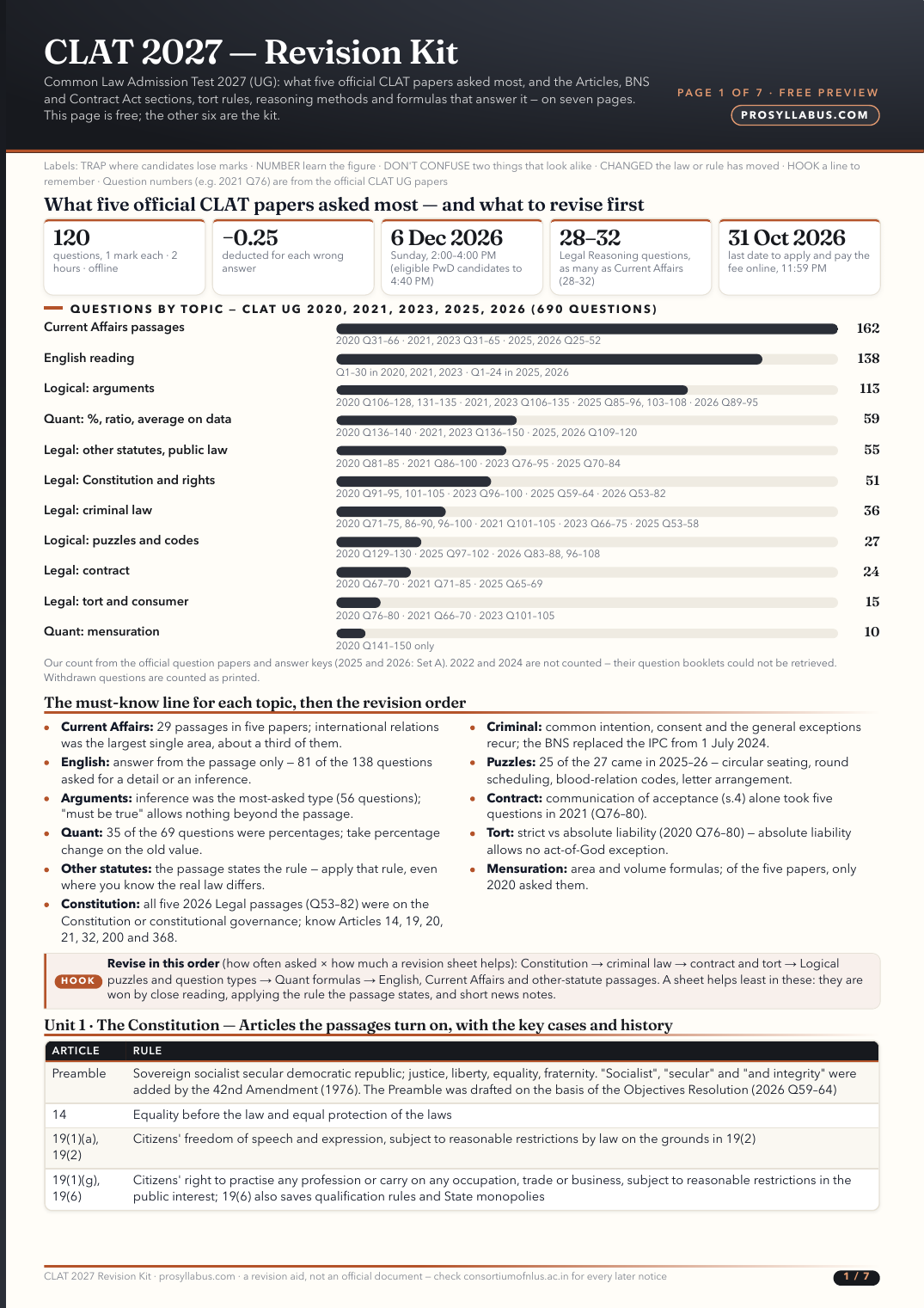
The Consortium's pattern and past papers are also the basis of our paid CLAT 2027 Revision Kit, a PDF that ranks syllabus units by how often five official CLAT UG papers asked them.
Plan the weeks left
Weeks to CLAT 2027, split by section
Choose your likely exam day and how many hours a week you can study. The planner counts the weeks left from today and splits your total hours across the paper.
The split follows the official approximate shares (25/25/20/20/10). Shift hours toward your weakest section.
Practise it, don't just read it
Passage-based practice is the only kind that matches the paper.
The ProSyllabus CLAT library has three quizzes today: reading-comprehension inference (English), international treaties and summits (current affairs) and constitutional-law principle application (legal reasoning).
How many questions are there in CLAT 2027?
120 multiple-choice questions of one mark each, in 2 hours.
Is there negative marking in CLAT?
Yes: 0.25 marks is deducted for each wrong answer. Unanswered questions score zero.
Is CLAT 2027 online or offline?
Offline. The CLAT 2027 instructions say the examination shall be in offline mode; applications are online.
How many legal reasoning questions are in CLAT?
The 2027 range is 28-32. CLAT 2024 and CLAT 2025 each set 32 and CLAT 2026 set 30.
Is CLAT 150 questions or 120?
120 since CLAT 2024. CLAT 2023 (held December 2022) was the last 150-question paper.
Do I need to know law for CLAT legal reasoning?
No. The syllabus says no prior knowledge of law is required; you apply the principle given in the passage.
How is a tie broken in CLAT?
By higher marks in legal aptitude, then higher age, then a computerised draw of lots.
What maths is asked in CLAT?
Class 10 level: ratios and proportions, basic algebra, mensuration and statistical estimation, applied to data sets. The 2027 range is 10-14 questions.
Sources
- official — Consortium of NLUs — CLAT 2027 UG question paper format
- official — Consortium of NLUs — CLAT 2027 UG syllabus
- official — Consortium of NLUs — CLAT 2027 UG instructions
- official — Consortium of NLUs — CLAT 2027 press release (22 Jul 2026)
- official — Consortium of NLUs — CLAT 2026 results notification (16 Dec 2025)
- official — Consortium of NLUs — CLAT 2025 results notification (7 Dec 2024)
- official — Consortium of NLUs — Modification to the Final Answer Key, CLAT UG 2025 (17 May 2025)
- official — Consortium of NLUs — CLAT 2024 results notification (10 Dec 2023)
- official — Consortium of NLUs — CLAT 2024 final answer key notification (9 Dec 2023)
- official — Consortium of NLUs — CLAT 2023 results notification (23 Dec 2022)
- reported — Third-party CLAT pattern pages (byjus.com, testbook.com, getmyuni.com), read 26 Sep 2026
official = a document published by the conducting body. reported = a news or coaching site we could not check against an original. Where sources disagree this page says so rather than picking one.