
Checked 21 October 2026. Preparation guidance from Acuity Insights' "How to Prepare for Casper" page and Help Centre, read 21 Oct 2026. The practice scenario and the analysis of it are ours, not Acuity's.
Acuity Insights, which runs Casper, takes a firm line on outside preparation, and it is the right place to start. This guide sets out what Acuity says about practising, what it says strong responses do, and then works through one original scenario of ours to show those moves in practice. It is not a list of model answers: Acuity says there are no "right" answers.
Acuity Insights "How to Prepare for Casper", Myth vs. Fact and Help Centre, read 21 Oct 2026.
Sitting Casper in the January-February 2027 wave? On 27 October 2026 the Dates and Fees page listed U.S. Medicine on 5 January and 9 February, and English Casper 2 in Canada on 7 January, 21 January and 18 February (Eastern time). The countdown below runs to the next official date for your test type; every type and time is in our Casper test dates guide.
Countdown to the next Casper date for medicine
Dates from Acuity Insights' Dates and Fees page, read 27 October 2026; start times as Acuity lists them in Eastern time, then in your own time zone. The countdown runs to the published start time and does not reset. Check the page and your Acuity account before you book: dates can change, and each program accepts only certain dates.
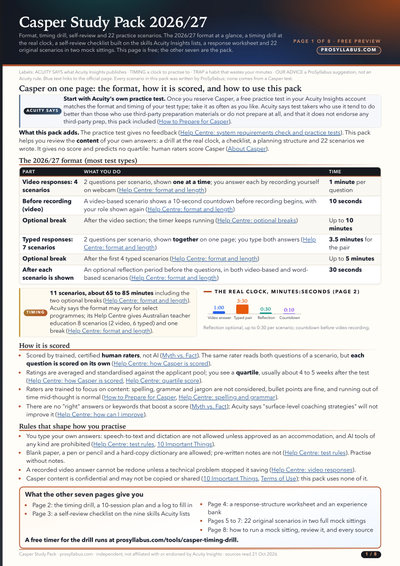
- 22 original scenarios in two full mock sittings
- A timing drill at the 2026/27 clocks, with a pacing log
- A self-review checklist on the nine skills Acuity lists
- A response worksheet and an experience bank
- A 10-session plan, ending with Acuity's own practice test
Start with the official practice test
After you reserve your Casper test, a practice test appears in your Acuity Insights account (log in, open the Casper section, choose "Start practice test"). Acuity says it is designed to match the format and experience of the test type you booked, including approved accommodations; applicants with extra time get a separate link with their own timing. You can take it "as many times as you'd like". Your answers there are not saved, scored or reviewed, and no feedback is given. Acuity also says it "is not intended to reflect the specific content or level of difficulty of your actual assessment."
Acuity's claim about outside preparation is blunt. Its prep page says test takers who use the official practice test "tend to do better on Casper than those who use third-party preparation materials or don't prepare at all". It is not affiliated with any prep company, does not endorse them, and offers no paid prep or coaching itself. Its Help Centre adds that "surface-level coaching strategies" aimed at being "test-wise" or "fake good" will not improve a score.
What the official practice test is, and is not
- It is: representative of the test type you booked, with typed and video responses, and in Acuity's words the best way to become familiar with the format, timing and overall testing experience.
- It is not: scored. You get no feedback, and its scenarios are not meant to match the content or difficulty of your actual test.
- So: use it for format and timing, as often as you like, and use your own review (or a trusted person's) for the content of your answers.
Acuity suggests recording yourself on your computer's camera app and asking someone you trust for feedback before the video portion.
What Acuity says a strong response does
Acuity says Casper is not graded using a fixed rubric, but across its pages it says the same few things about stronger responses. Put together, they read as five moves:
| Move | Acuity's words | In practice |
|---|---|---|
| 1. Say what you would do AND why | Strong responses explain both what you would do and why you would do it | Every action you name comes with its reason. An action with no reason is half an answer. |
| 2. Consider the other people in it | Applicants placed in a higher quartile "may demonstrate certain competencies", which "may include" empathy: they "considered all perspectives in a meaningful way" | Name what each person involved needs or fears, including the one behaving badly. |
| 3. Work through it rather than jump | Stronger responses "thoughtfully work through complex situations, consider different perspectives, explain decisions clearly" | Find out what you do not know before acting; weigh options; say what you would do if the facts were different. |
| 4. Use the time, for every question | "Use the total time allotted"; "allow enough time to answer each" | Each question is scored on its own. Do not spend 3 minutes on question 1. |
| 5. Be yourself, not a script | Casper "is designed to elicit authentic responses"; there are no "right" answers or keywords that boost your score | Answer as you would actually act. Acuity says keywords do not boost your score. |
Acuity lists nine skills that contribute to the social intelligence and professionalism Casper assesses, introducing them with the word "including", so the list may not be complete: collaboration, communication, empathy, ethics, fairness, motivation, problem solving, resilience and self-awareness. They sit behind these moves. In our reading, a good scenario puts two or three of them in tension, and a strong answer notices that and explains how you would balance them.
Practice scenario
Here is one original scenario in the typed format. Read it, set a timer for 3.5 minutes, and answer both questions before you read the analysis.
Practice scenario (typed, 3.5 minutes for both questions)
You are a student volunteer at a weekend community health fair, working the registration desk with another volunteer, Sam. An older man arrives at 3:40pm, twenty minutes before the free blood-pressure checks close. He has been waiting for a bus, he is visibly anxious, and he says he has not seen a doctor in two years. The nurse running the checks has told the desk to send no one else after 3:30pm because she must leave on time to collect her child. Sam tells the man, a little sharply, that he is too late and should come next month.
1. What would you do in this situation? Explain why.
2. Describe a time when following a rule meant someone did not get help they wanted. What did you do, and what did you learn?
Written by ProSyllabus for practice. It is not a Casper question and is not taken from any Acuity material. Set a 3.5-minute timer and type your answer before reading on.
What a strong answer to question 1 does
Notice first what is pulling against what. The nurse's rule protects a colleague with a real obligation (fairness to her, and the reason the rule exists). The man has a health need and has made an effort to come (empathy, and arguably a duty to someone vulnerable). Sam has acted within the rule but unkindly (professionalism, and how you treat a colleague who has done nothing wrong on paper). These needs compete, and an answer that pretends they all fit easily reads as thin.
| A thin answer | Why it is thin | What a stronger answer adds |
|---|---|---|
| "I would let him in because health comes first." | Ignores the nurse entirely and overrides her decision without asking. | Ask the nurse, briefly and privately, whether a quick check is possible, and accept her answer. |
| "Rules are rules; I would agree with Sam." | Leaves an anxious man with nothing and ignores the tone problem. | Even if the answer is no, give him something: next date, a nearby clinic, how to get a check sooner, and an apology for the way he was told. |
| "I would tell Sam he was rude." | Correcting a colleague in front of the public escalates and embarrasses everyone. | Speak to Sam afterwards, privately, starting from what they were trying to do (follow the instruction). |
| "I would ask if he has symptoms." | A good instinct, left unfinished. | Say what you would do with the answer: if he describes symptoms that sound urgent, this is no longer about a closing time, and you get the nurse or call for help. |
Put together, a strong typed answer to question 1 might run, in plain bullets: step in calmly and acknowledge him, because an anxious person listens better once he feels heard; check with the nurse whether a quick reading is still possible, because she set the rule and may have flexibility you do not know about; if not, explain why kindly and make sure he leaves with a concrete next step, so he is not left with nothing; if he reports worrying symptoms, escalate at once, because his safety outweighs a closing time; afterwards, talk to Sam privately about tone, so the correction does not embarrass anyone in public. Each bullet carries its reason.
What a strong answer to question 2 does
Question 2 is the kind of reflective prompt Acuity shows in its own word-based example. A strong answer picks one real, specific moment (not the most impressive one you can think of), says briefly what the rule was and why it existed, what you actually did, and what you learned that changed how you act now. Do not leave out the learning. Acuity says to explain your motivations: say why you would do something, not just what you would do.
Acuity says each question is scored individually, so leave time for both, and use the whole time; this split is one way to do that. Video answers are 1 minute each and are recorded separately.
Acuity says raters focus on the rationale and quality of your responses, not typing speed, response length alone, format, spelling or grammar, and that it is normal to run out of time before you finish a response, so the split above is about protecting question 2, not about hitting a word count. If typing is slow for you, Acuity suggests free typing practice; it also says to feel free to use bullets, and suggests capturing your key ideas first as one strategy that may help if you are concerned about time. The table below is simple arithmetic to show how much room each pace gives you in 95 seconds:
| Typing speed | Words in about 95 seconds | What that fits |
|---|---|---|
| 25 words a minute | About 40 | Three short bullets: action, reason, one other perspective |
| 40 words a minute | About 63 | Four to five bullets with reasons |
| 60 words a minute | About 95 | Short sentences covering action, reasons, perspectives and a fallback |
- 22 original scenarios in two full mock sittings
- A timing drill at the 2026/27 clocks, with a pacing log
- A self-review checklist on the nine skills Acuity lists
- A response worksheet and an experience bank
- A 10-session plan, ending with Acuity's own practice test
Practising the video section
Each video answer is one minute; for a video-based scenario Acuity lists a 10-second countdown before recording, with your role shown again, and Acuity says a recorded response cannot be re-recorded unless there was a technical problem and the response did not save correctly. That makes the habit of starting cleanly worth practising. Acuity's own suggestions: speak as clearly as you can, use gestures if that is how you naturally talk, keep distractions around you to a minimum, and practise in front of your camera. It also says raters evaluate content, not appearance.
A two-week Casper practice routine
Tick each item as you do it. The first group follows Acuity's own advice; the rest is a routine we suggest.
0 of 9 done
Ticks are saved only in this browser on this device.
The last item is the one we would not skip. Some word-based questions ask about your own experience, as Acuity's own example does. We suggest having a handful of real moments already in mind, without scripting what you will say about them, so they come to you more easily during the test: Acuity does not allow pre-written notes during the test, so keep these in your head, not on paper.
ProSyllabus is an independent study site, not part of or endorsed by Acuity Insights. Every rule, date and fee here is quoted or summarised from Acuity Insights' own pages or, where named, a program's own page.
Frequently asked questions
Is there an official Casper practice test?
Yes. After you reserve your test, a free practice test appears in your Acuity Insights account. You can take it as many times as you like. Answers are not saved or scored and no feedback is given.
Does third-party Casper prep help?
Acuity Insights says applicants who use third-party preparation materials, or do not prepare, tend to do worse than those who use its free practice test. It is not affiliated with any prep company and does not endorse them.
Are there right answers on Casper?
No. Acuity says there are no "right" answers or keywords that boost your score. What it says matters is how you think through the situation, the perspectives you consider and how clearly you explain what you would do and why.
Should I use bullet points on Casper?
You may. Acuity says bullets are fine and that spelling and grammar do not affect the score. Make sure each point explains why, not only what.
What if I do not finish my Casper answer in time?
Acuity says running out of time is normal and raters focus on your overall point. Leave enough time for both questions, because each is scored individually.
Can I re-record a Casper video answer?
No, unless there was a technical problem and the response did not save correctly.
Is the practice scenario on this page a real Casper question?
No. It was written by ProSyllabus for practice and is not taken from any Acuity material.
Do I need medical knowledge for Casper?
Acuity describes Casper as assessing social intelligence and professionalism, and the skills it lists (introduced with the word "including") are collaboration, communication, empathy, ethics, fairness, motivation, problem solving, resilience and self-awareness. The Acuity pages we read do not say whether any medical knowledge is needed, so ask your program if you are unsure.
More in this series
Sources
- official — Acuity Insights: "How to Prepare for Casper" (no date on the page; read 21 Oct 2026): the official practice test, strategies during the test, what to do before test day
- official — Acuity Insights: "About Casper" (no date on the page; read 21 Oct 2026): 2 sections and 11 scenarios, about 65-85 minutes, video and typed response timings, human raters
- official — Acuity Help Centre: "How to access the system requirements check and practice tests?" (page dated August 6, 2026; read 21 Oct 2026)
- official — Acuity Help Centre: "Does Acuity Insights offer test prep services for a fee?" (page dated March 18, 2026; read 21 Oct 2026)
- official — Acuity Help Centre: "How can I improve, should I need to take the Casper again?" (page dated March 5, 2026; read 21 Oct 2026)
- official — Acuity Help Centre: "How can I view and understand my Casper quartile score?" (page dated March 10, 2026; read 21 Oct 2026)
- official — Acuity Help Centre: "Will spelling or grammar mistakes affect my score?" (page dated March 4, 2026; read 21 Oct 2026)
- official — Acuity Help Centre: "What if I am unhappy with my video response?" (page dated August 16, 2024; read 21 Oct 2026)
- official — Acuity Help Centre: "What is the Casper test format and length ?" (page dated March 11, 2026; read 21 Oct 2026)
- official — Acuity Insights: "Myth vs. Fact" (PDF, no date in it; read 21 Oct 2026)
- official — Acuity Insights: "A Step-by-Step Guide for Test Takers" (PDF, no date in it; read 21 Oct 2026)
official = a document published by the conducting body. reported = a news or coaching site we could not check against an original. Where sources disagree this page says so rather than picking one.