
Checked 21 October 2026. Scoring method from Acuity Insights' Help Centre and guides, read 21 Oct 2026. Acuity says it is exploring ways to potentially share more with applicants, so how results are reported may change.
Casper has no right answers and no pass mark, and applicants are currently not given their own score. That makes its scoring easy to mythologise; Acuity's own Myth vs. Fact sheet takes on the rumours about keywords and AI grading directly. This guide sets out what Acuity Insights actually says about how responses are rated, how the overall score is formed, what the quartile you receive means, and what the programs see instead.
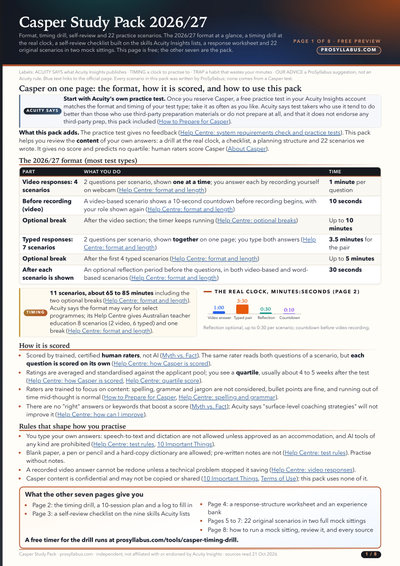
- 22 original scenarios in two full mock sittings
- A timing drill at the 2026/27 clocks, with a pacing log
- A self-review checklist on the nine skills Acuity lists
- A response worksheet and an experience bank
- A 10-session plan, ending with Acuity's own practice test
Who scores your answers
Acuity is direct about this: Casper is "scored by certified human raters", and its Myth vs. Fact sheet answers the AI rumour with "All responses are evaluated by trained human raters who follow structured scoring guidelines, not AI." Raters complete a training program, are accredited before they score, are certified annually and are monitored for consistency. The Step-by-Step Guide adds that training covers scoring criteria, calibration and implicit bias.
Summarised from Acuity Insights' Help Centre ("How is the Casper test scored and evaluated?"; "Can I have my test re-scored?") and its Step-by-Step Guide.
The design choice that matters most to you is the one-rater-per-scenario rule. Acuity says each rater is assigned a single scenario and is presented with multiple responses from different applicants to it, and that "no rater scores an applicant more than once". So a weak first scenario cannot colour how your fifth is read, and no single rater determines your overall result. The two questions inside one scenario are reviewed by the same rater, who sees the whole scenario, but they are scored independently: Acuity says scores are assigned "at the individual question level, not as one score for the whole scenario."
| Question you might have | What Acuity says |
|---|---|
| Does one bad scenario drag down the rest? | Each scenario has a different rater, and how you respond to one scenario does not influence how you are scored for the others. |
| Do raters know who I am? | Responses are anonymised. Raters see no name, age or photo, only the typed or video response. |
| Do spelling and grammar count? | Raters focus on content: typos, incomplete sentences and small grammatical mistakes do not affect the score. Bullet points are fine. |
| Does a longer answer score higher? | Raters evaluate ideas and quality, "not response length, writing mechanics, or format". |
| Does my appearance count? | Raters are trained to evaluate the content of your responses, not your appearance. |
| What if I run out of time mid-sentence? | It is normal; raters know you are under a time limit and focus on your overall point. |
From ratings to one standardised score
Once every response is rated, Acuity says "the individual ratings are averaged" and the result is "standardized to represent the relative rankings of each applicant compared to the applicant pool." Typed and video responses are both part of this one overall score. Elsewhere Acuity describes Casper as "rated and z-scored relative to the strength of your peers’ responses", and its 10 Important Things sheet says the scores are standardised using statistical methods "resulting in a final scaled score and quartile ranking."
Two consequences follow. There is no mark to reach: Acuity says it is "not a pass-or-fail test, nor is it graded using a fixed rubric". And your result is relative. It depends on how strong the other responses to the same scenarios were. Separately, each program decides how to use the result, and Acuity says the same result can be more competitive for some programs than for others, depending on how competitive each program's applicant pool is.
- 22 original scenarios in two full mock sittings
- A timing drill at the 2026/27 clocks, with a pacing log
- A self-review checklist on the nine skills Acuity lists
- A response worksheet and an experience bank
- A 10-session plan, ending with Acuity's own practice test
Your quartile: what it is and is not
Quartiles compare you with applicants who took the same Casper test type in the same admissions cycle. Acuity describes only the 1st quartile in words; the 2nd to 4th follow from what a quartile is, four equal quarters of the pool (our reading). Acuity does not publish a pass mark: Casper is "not a pass-or-fail test".
You receive a quartile, not your score. Acuity groups scores into four quartiles "which represent how your performance compares to other applicants on the same test type", within the same admissions cycle. It emails you when the quartile is ready, usually about 4-5 weeks after the test, and you open it through "View quartile score" in your account. Until then the account may show "undefined percentile", which Acuity says is normal.
Acuity's own documents do not agree on what the quartile covers, and we cannot tell you which is current. Its 2026 Step-by-Step Guide says your scores across all scenarios are combined into an overall score, which is then standardized "to produce your final scaled score and quartile ranking". Its Terms of Use say the quartile gives "an indication of how you have performed on the typed section relative to other applicants". If the difference matters to you, ask Acuity.
Acuity is direct about the bottom band. A first-quartile placement "does not mean you failed"; it means that, compared to the rest of the test-takers, your responses were rated as less strong, and the pool "includes many high-caliber applicants". It also says a quartile "should not dissuade you from applying to any program", because most programs consider all quartiles and treat Casper as one data point among many.
What higher-quartile applicants may demonstrate
Acuity lists what applicants placed in higher quartiles "may demonstrate". In our reading it is the nearest thing to a published description of a strong response; treat it as a checklist, not a formula:
| Quality Acuity names | What it says about it |
|---|---|
| Effort | They may have tried harder, for instance by explaining their position fully or using the full time before moving on. |
| Empathy | They considered all perspectives in a meaningful way. |
| Impartiality | They showed strong respect for others' experiences and needs. |
| Communication | They demonstrated above-average ability to effectively articulate their ideas. |
| Familiarity with the format | They familiarized themselves with the format (video, typed response) and were able to navigate it successfully. |
The practical meaning of each, with a worked scenario, is in Casper practice: what a strong answer does.
What programs see, and how they use it
Programs get more than you do. The Step-by-Step Guide says "You’ll receive a quartile score, while programs receive more detailed scoring to support admissions decisions." Applicants are not given that score, and Acuity explains why: the score is a single combined number with no breakdown by topic, so it would not show where you excelled or could improve, and Casper is treated like other subjective parts of an application such as interview impressions, reference letters and personal statements. The Terms of Use add that neither Acuity nor the programs may share your results or assessment data with you directly.
How much Casper counts is each program's decision. Acuity says: "Each individual program determines how and when to use Casper scores", and the weight will vary. Some programs use the result at several points, for example early screening, interviews or ranking, and Acuity notes that some use Casper in place of interviews or multiple mini interviews. For any specific weight, read the program's own admissions page.
| Item | You see it | Programs see it |
|---|---|---|
| Your quartile (1st to 4th) | Yes, about 4-5 weeks after the test | Programs receive more detailed scoring |
| Your overall standardised score | No | Yes, about 2-3 weeks after the test |
| A breakdown by topic or area | No | Acuity says the score is a single combined number with no breakdown by topic or area |
| A test-rule violation (red flag) | Acuity's pages do not say | It may be shared with programs on your distribution list |
Still to sit Casper this cycle? The January-February 2027 dates for each test type, with a countdown to the next one, are in our Casper test dates guide.
- 22 original scenarios in two full mock sittings
- A timing drill at the 2026/27 clocks, with a pacing log
- A self-review checklist on the nine skills Acuity lists
- A response worksheet and an experience bank
- A 10-session plan, ending with Acuity's own practice test
Why your quartile can change between tests
Acuity says Casper has "relatively high test-retest reliability", so applicants who sit more than one test type, or test in a later cycle, can expect similar results. Its Myth vs. Fact sheet adds that research comparing attempts shows scores are consistent on average and only a small proportion of repeat testers see significant changes. When the quartile does move, Acuity gives three reasons:
Three reasons Acuity gives for a different quartile
- Your score sat near a quartile boundary (its example: the 74th and 76th percentiles), so a small change crossed into a different quartile.
- The applicant pool differed. Because scores are standardised against peers, the same performance can rank differently against a different pool.
- You improved: your skills developed, or you were more familiar with the format, for example from the practice test or a previous real test.
Two hard limits sit behind this. You cannot retake the same test type in the same cycle to improve a score, and a score is valid only for one admissions cycle and one test type. Casper tests also cannot be re-scored. The retake exceptions, which are technical only, are in Casper test day rules and retakes.
There are no keywords that raise a Casper score
- Acuity's Myth vs. Fact sheet: there are no "right" answers or keywords that boost your score.
- Its Help Centre adds that surface-level coaching aimed at being "test-wise" or "fake good" will not improve a Casper score.
- What it says does matter is how you work through the situation, the perspectives you consider and how clearly you explain why.
ProSyllabus is an independent study site, not part of or endorsed by Acuity Insights. Every rule, date and fee here is quoted or summarised from Acuity Insights' own pages or, where named, a program's own page.
Frequently asked questions
What is a good Casper score?
Casper is not pass or fail, and applicants are not given their score. You receive a quartile showing where you placed against applicants who took the same test type in the same cycle, and each program decides how to use the result.
What does a 1st quartile Casper mean?
That other applicants on the same test had stronger-rated responses. Acuity says it does not mean you failed and should not stop you applying, because most programs consider all quartiles.
When will I get my Casper quartile?
Usually about 4 to 5 weeks after the test. Acuity emails you when it is ready and you view it in your account. Programs receive their result earlier, about 2 to 3 weeks after the test.
Can I see my actual Casper score?
No. Applicants receive only a quartile. Programs receive more detailed scoring, and Acuity says the score has no breakdown by topic or area.
Does my Casper score carry over to next year?
No. A score is valid only for one admissions cycle and one test type, and Acuity says to reserve a separate test for programs in different countries, languages or test types.
Sources
- official — Acuity Help Centre: "How is the Casper test scored and evaluated?" (page dated March 10, 2026; read 21 Oct 2026)
- official — Acuity Help Centre: "How can I view and understand my Casper quartile score?" (page dated March 10, 2026; read 21 Oct 2026)
- official — Acuity Help Centre: "Will I receive my Casper score?" (page dated March 10, 2026; read 21 Oct 2026)
- official — Acuity Help Centre: "Can I have my test re-scored?" (page dated January 24, 2025; read 21 Oct 2026)
- official — Acuity Help Centre: "Will spelling or grammar mistakes affect my score?" (page dated March 4, 2026; read 21 Oct 2026)
- official — Acuity Help Centre: "How long is my Casper score valid for?" (page dated August 6, 2026; read 21 Oct 2026)
- official — Acuity Help Centre: "Can I retake my Casper test?" (page dated March 5, 2026; read 21 Oct 2026)
- official — Acuity Help Centre: "How can I improve, should I need to take the Casper again?" (page dated March 5, 2026; read 21 Oct 2026)
- official — Acuity Help Centre: "Test conduct guidelines" (page dated April 30, 2026; read 21 Oct 2026)
- official — Acuity Insights: "A Step-by-Step Guide for Test Takers" (PDF, no date in it; read 21 Oct 2026)
- official — Acuity Insights: "10 Important Things to Know Before Taking Casper" (PDF, no date in it; read 21 Oct 2026)
- official — Acuity Insights: "Myth vs. Fact" (PDF, no date in it; read 21 Oct 2026)
- official — Acuity Insights: "About Casper" (no date on the page; read 21 Oct 2026): 2 sections and 11 scenarios, about 65-85 minutes, video and typed response timings, human raters
- official — Acuity Insights: "Terms of Use", sections 8.0 (Assessment Results), 13.2 (Retake Requests), 13.3 (Rescoring Requests) and 17.0 (Intellectual Property Rights and Confidentiality) (no date on the page; read 21 Oct 2026)
official = a document published by the conducting body. reported = a news or coaching site we could not check against an original. Where sources disagree this page says so rather than picking one.