Checked 5 November 2026. On 5 November 2026 the Bank's Apprenticeships page gave the 2027 opening date (Monday 7 December 2026, 12pm GMT) but not the 2027 programmes, salary, entry rules or closing date. Every figure here is labelled with the round it comes from. Read on 5 Nov 2026.
Applications for the Bank of England's 2027 apprenticeships open on Monday 7 December 2026 at 12pm (midday) GMT, according to the Bank's Apprenticeships page (last updated 29 October 2026). The page does not yet list the 2027 programmes, salary or entry requirements, so this guide shows what the Bank offered in its last two rounds. For a start in August 2026 it ran a Degree Apprenticeship only: a 36-month contract leading to a permanent job, a fully funded degree, and a salary of £28,080 in London or £25,270 in Leeds, for applicants with five GCSEs at grade 4 or above (including English and maths) and BBB at A level or equivalent.
Below you will find the programmes and streams, the grades, the pay, the dates of the last round, every stage of the application, two worked examples of the situational judgement test (the first assessed stage), interview tips for school leavers and answers to common questions. You can register your interest now to get a reminder when applications open.
ProSyllabus is an independent study site. It is not affiliated with the Bank of England, and our practice tests are independent practice, not made or endorsed by the Bank.
Bank of England Apprenticeships page (29 Oct 2026) and its 2025/26-round version (updated 26 Jan 2026).
Key facts: Bank of England degree apprenticeship 2027
| Item | Detail |
|---|---|
| 2027 applications open | Monday 7 December 2026 at 12pm (midday) GMT. Closing date not yet published |
| 2027 programmes, salary, entry rules | Not yet published on 5 Nov 2026. Figures below are from the last two rounds |
| Last round (2026 start) | Degree Apprenticeship only, two streams: Data Science (Northeastern University) and Digital and Technology Solutions (University of Exeter). The Level 4 Apprenticeship did not open in the 2025/26 round |
| Contract (2026 start) | 36 months, leading to a permanent position. The Bank says degree studies can take up to 48 months |
| Salary (2026 start) | London £28,080 a year, Leeds £25,270 a year, plus the Bank's benefits package |
| Grades (2026 start) | At least five GCSEs at grade 4 (C) or above, including English and maths; three A levels at BBB achieved or predicted (or equivalent) |
| Study time (2026 start) | 20% of your working hours, with support from your line manager and the Future Talent team |
| Location (2026 start) | London or Leeds offices, depending on the stream (hybrid) |
| Start date (last round) | End of August 2026 |
| Stages | Application form and CV, then a situational judgement test, a video interview and a virtual assessment centre |
| Applications | One application per candidate across all Future Talent programmes; only your first is accepted |
Which apprenticeships does the Bank of England offer?
Earlier versions of the Bank's Apprenticeships page described two programmes: a Level 4 Apprenticeship and a Degree Apprenticeship. The live page does not yet say which will open for 2027, and the streams have changed from year to year. In the last round (for a 2026 start) only the Degree Apprenticeship opened, with two streams. The round before (2025 start) had four degree streams and the Level 4 programme too.
| Stream | University partner | 2025 start | 2026 start |
|---|---|---|---|
| Data Science | Northeastern University | Yes | Yes: Financial Stability Strategy and Risk team, London and Leeds |
| Digital and Technology Solutions | University of Exeter | Yes (Technology Directorate, London) | Yes: Technology Directorate, London and Leeds |
| Professional Economist | University of Kent | Yes (London and Leeds teams) | Not listed |
| Financial Services Professional | University of Exeter (BSc (Hons) in applied finance, including CFA Institute Level 1) | Yes (London teams) | Not listed |
| Level 4: Business Analyst (QA) or Data Analyst (JustIT) | Training providers, not a degree | Yes: 18 months, London | Did not open in the 2025/26 round |
On the Data Science stream you work with data and analysis; the Bank says it welcomes applicants who are "curious, numerically minded, and committed to continuous learning". On Digital and Technology Solutions you join the Technology Directorate, which builds and protects systems such as the real-time gross settlement system that the Bank says is responsible for all money transfers in the UK. Whichever stream you pick, the Bank starts with an introduction to its many areas of work and training in essential skills, then enrols you on a part-time degree alongside the job.
Entry requirements: what grades do you need?
These are the requirements the Bank printed for the 2026 start. Check the 2027 page when it updates: in the round before, two streams asked for more in maths.
| Programme | GCSEs | A levels or equivalent | Extra |
|---|---|---|---|
| Degree Apprenticeship (2026 start, both streams) | At least five at grade 4 (C) or above, including English and maths | BBB, achieved or predicted (120 UCAS points) | Data Science: GCSE ICT desirable. Digital and Technology Solutions accepts IB 30/555, BTEC DDM or a T Level at merit |
| Professional Economist and Financial Services Professional degree streams (2025 start) | At least five at grade 4 (C) or above, including English, with maths at grade 6 (B) | BBB or 120 UCAS points | Not offered for the 2026 start |
| Level 4 Apprenticeship (2025 start) | At least five at grade 4 (C) or above, including English and maths | At least 72 UCAS points from up to three A levels (or equivalent) | Did not open for the 2026 start |
If you studied outside the UK, the Bank points you to the UCAS tariff calculator to convert your qualifications into UCAS points. You can apply on predicted grades: the requirement is to have achieved, or be predicted to achieve, the A level grades.
Government funding rules (2026 start)
- You must have been a UK resident for at least the previous three years before the apprenticeship start date (unless exempt).
- You must have finished your education and be ready for full-time work by August 2026.
- You must not already hold a qualification in a similar subject (such as a master's or other formal qualification) that overlaps with the programme.
- If you hold a visa, it must stay valid for the whole apprenticeship.
From the Bank's Apprenticeships page for the 2025/26 round (updated 26 January 2026). These are the conditions for government apprenticeship funding; the 2027 version may differ.
Bank of England apprenticeship salary
The Bank advertises a set salary for each programme. Here are the figures from its last two rounds; the 2027 salary had not been published on 5 November 2026.
Annual salaries from the Bank's Apprenticeships page: 2025/26 round (updated 26 Jan 2026) and 2024/25 round (updated 23 Oct 2025).
| Programme | 2025 start | 2026 start | Change (our arithmetic) | Per month before tax, 2026 (our arithmetic) |
|---|---|---|---|---|
| Degree, London | £27,000 | £28,080 | +£1,080 (+4.0%) | about £2,340 |
| Degree, Leeds | £24,250 | £25,270 | +£1,020 (+4.2%) | about £2,106 |
| Level 4, London | £24,400 | Not run | n/a | n/a |
On top of the salary, the Bank's What we offer you page (updated 8 October 2026) describes its package for staff: a discretionary, non-pensionable annual cash award for performance, a defined-benefit, non-contributory career average pension, 26 days' annual leave, private medical insurance and an optional Benefits+ scheme. Staff spend at least 50% of their time in the office. Your degree is fully funded, so you do not pay tuition fees for it.
When do applications open and close?
The Bank's own pages, and the Wayback Machine copies of them, show how the last round ran. The dates below are the update dates printed on each page.
| Page update | What the Bank's Apprenticeships page said |
|---|---|
| 23 Oct 2025 | Applications closed for the 2025 start; register your interest for 2026 |
| 1 Dec 2025 | Degree Apprenticeship applications open, closing Monday 12 January (2026) at 12pm (midday) |
| 26 Jan 2026 | Applications closed; register for the 2027 opportunity. Start date end of August 2026 |
| 15 Apr 2026 | Applications closed; register your interest for 2027 |
| 29 Oct 2026 | 2027 applications open Monday 7 December at 12pm (midday) GMT |
So the last round was open by 1 December 2025 and closed at midday on 12 January 2026; applications for 2027 open at midday GMT on 7 December 2026. The 2027 closing date is not published yet, so our advice is not to wait: have your CV, grades and examples ready before 7 December. After the video interview, the Bank says it notifies successful applicants two weeks after the application deadline, and they move on to the final stage, the virtual assessment centre.
The application stages
The How to apply page says the process is the same for apprentices, interns, industrial placements and graduates: a form, then three assessed stages.
| Stage | What the Bank says |
|---|---|
| Application form | Register, check you are eligible, then tell the Bank about your background, education and work experience, upload your CV and answer free-text questions about you and your motivations. Your answers are considered throughout the process |
| 1. Situational judgement test (online) | Scenarios that reflect working life at the Bank; it gauges what you would do and how closely you align with its values. Pass to move on |
| 2. Video interview | Recorded and reviewed later. A short time to think after each question, then a set time limit; the recording stops at the limit and you cannot re-record |
| 3. Virtual assessment centre | One group exercise and one interview, with motivation, behaviour-based and analytical or technical questions |
| Pre-employment checks | References, security clearance, identity, criminal record and credit checks, proof of qualifications, immigration clearance where relevant, and a medical questionnaire |
The Bank is a member of the Disability Confident scheme: if you apply through it and meet the minimum requirements, you are fast-tracked to the video interview and your situational judgement test score is not considered. The Bank lists three Bank Behaviours, which it calls an outline of how it does things and how people treat each other: act inclusively, drive growth and deliver outcomes.
The online test: the situational judgement test
The Bank's guidance for candidates explains the format. Each scenario has four options. You say which one you would be most likely to do, and then which one you would be least likely to do. You must answer every question, but there is no time limit; the Bank suggests working at a relatively fast pace without taking too long on any one. It measures how closely you are aligned to the Bank's culture and ways of behaving, so it is not a knowledge test. Our advice is to learn the Bank Behaviours and practise choosing most and least likely responses until the format feels natural. Try a few free questions here:
FreeTests: Act inclusively
Bank of England SJT Practice: free sample
Answer 4 questions against the clock, like the real exam. You then see the right answer, the reason and your time on each. About 5 minutes · free · no sign-in.
4 questions to answer
Start nowThis one is free · no sign-in needed
Your result shows how long each question took you.
Worked SJT examples for apprentices
Two practice scenarios set in an apprentice's first year. Decide your own most and least likely before you read our reasoning.
Worked example 1: drive growth (doing what is right)
It is your first week as a Data Science apprentice. A friend from school messages you: "Send us a pic of your desk at the Bank!" Your screen is showing a team dashboard and there are papers on the desk.
- A. Take the photo but angle it so the screen is mostly out of shot.
- B. Reply that you need to check before sharing a workspace photo, ask your line manager what is allowed, and send a photo of the building from the street instead.
- C. Send it, as it is only going to a private group chat of friends.
- D. Ignore the message until the weekend.
Our MOST likely: B. It protects anything confidential, is honest with your friend, and you ask your manager rather than guessing the rules. A new starter who checks shows self-awareness and the courage to do the right thing even when it feels awkward.
Our LEAST likely: C. Once a photo is sent you lose control of it, and a dashboard or papers could show information the Bank has not published. A "private" chat is not a safe place for work information.
The other two: A reduces the risk but still shares a picture of the workspace without checking. D avoids the problem for now, but it is not unsafe, so it sits in the middle.
An original practice scenario written for this page. These are our suggested ratings and explanations, reasoned from the Bank Behaviours, not official Bank answers.
Worked example 2: act inclusively (honesty and integrity)
Your university module asks for a project using real data. Your team at the Bank works with a dataset that would suit it perfectly. It holds confidential, unpublished Bank information, and nobody has told you that you may use it for university work.
- A. Use the dataset; it is for your own degree and nobody outside your university will see it.
- B. Change a few numbers so it looks different, use it, and do not mention where it came from.
- C. Before using any internal data, ask your line manager what permission would be needed, check what your tutor's brief requires, and suggest using data the Bank has already published instead.
- D. Pick a different project topic without mentioning the idea to anyone.
Our MOST likely: C. It is open and honest, asks about permission before anything confidential is used, checks what the coursework needs, and offers a practical way to keep the project moving with published data.
Our LEAST likely: B. It uses confidential data without permission and deliberately hides where it came from; changing a few numbers does not make it safe to share. That breaks trust, which the Bank puts at the centre of acting inclusively: "consistent honesty, integrity, and authenticity".
The other two: A also uses confidential data without permission, a serious mistake, but it is not disguised. D is safe but misses the chance to ask and to learn what your role lets you use.
An original practice scenario written for this page. These are our suggested ratings and explanations, reasoned from the Bank Behaviours, not official Bank answers.
Interview tips for school leavers
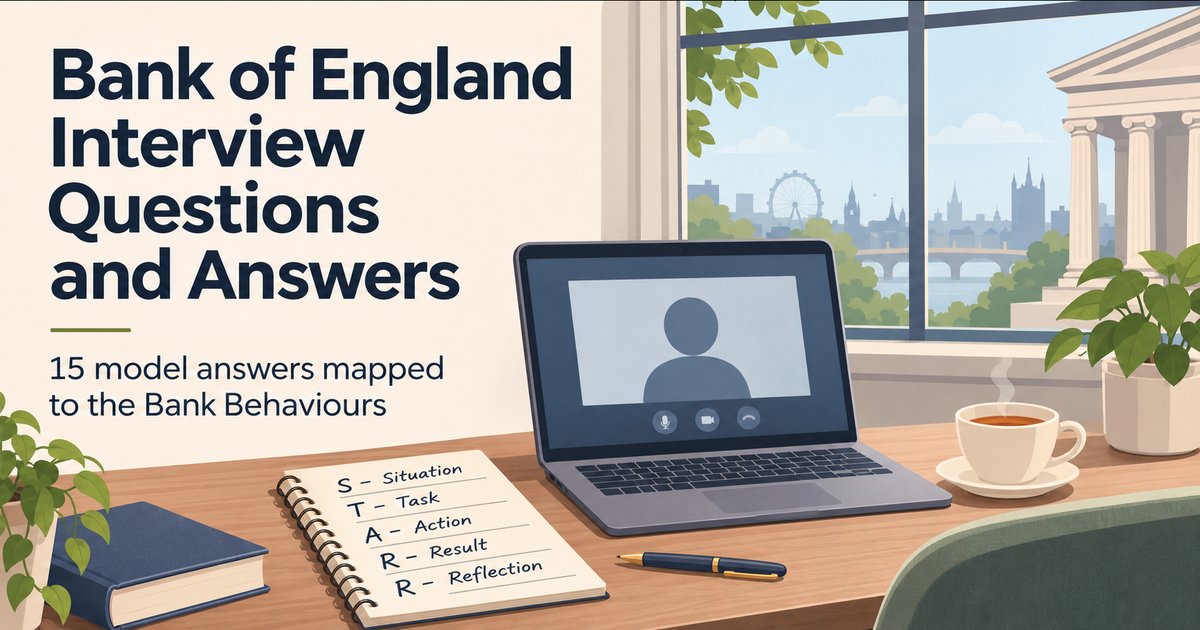
You will meet questions twice: in the recorded video interview and in the interview at the virtual assessment centre. The Bank recommends the STARR method (situation, task, action, result, reflection). The Bank asks for real-life experiences and your own personal and academic journey, so as a school leaver you can draw on examples from school, a part-time job, a club, volunteering or caring for someone at home.
- Learn the three Bank Behaviours and have two examples ready for each.
- Keep answers short and structured: the video recording stops at the time limit and you cannot re-record.
- Use your own words. The Bank says you can use AI to research and proofread, but not during the video interview, live interview or group exercise, and that scripted answers get you less far than genuine examples.
- Know why you want an apprenticeship rather than university full time, and why you chose your stream. For the 2026 start the streams were Data Science and Digital and Technology Solutions; check the 2027 list when it is published.
- Read what the Bank does: its own pages are the best source.
Our Bank of England interview questions and answers guide has model answers mapped to each Behaviour, the video interview guide shows how to fit a STARR answer into the time limit, and the assessment centre guide explains the group exercise with a free sample brief.
Security vetting and checks
All Bank staff need National Security Vetting. The Bank says it usually takes three to four weeks after an offer but can take much longer, and that you should not hand in your notice to an employer before clearance is granted. If you have lived outside the UK in the last five years, give full details: for some countries the Bank cannot complete the checks.
Apprenticeship, internship or graduate scheme?
Which Bank of England programme fits you
- Finishing A levels (or equivalent) and want to earn while you get a degree: the Degree Apprenticeship.
- At university already: the Bank's 10-week Summer Internship for university students (its page says 2027 internship applications open in November 2026).
- Finishing a degree: the graduate programmes. See our Bank of England graduate scheme guide for salaries, streams and dates.
- The Bank accepts only your first application across all its Future Talent programmes, so choose the one that fits your stage before you start the form.
Programme descriptions from the Bank's Future Talent, Summer Internships (updated 30 October 2026) and How to apply pages.
Common mistakes
- Waiting for the closing date. The last round was open by 1 December and closed on 12 January; the 2027 deadline is not published yet.
- Assuming last year's streams will come back. The 2026 start had two streams, the 2025 start had four plus the Level 4 programme.
- Missing the maths requirement. Two degree streams asked for maths at grade 6 in the 2024/25 round (2025 start).
- Applying for two Bank programmes. Only your first application is accepted.
- Treating the online test as a formality. It is normally the first assessed stage (the Bank does not consider the score of applicants who apply through the Disability Confident scheme), and it tests fit with the Bank's culture and Behaviours.
- Handing in notice at a job before security clearance comes through.
Practise the situational judgement test before 7 December
The free questions above are the start of our Bank of England Situational Judgement Test Practice: ten scenario sets mapped to the three published Bank Behaviours, in the most and least likely format the Bank describes, every option explained, and one practice mock.
See the Bank of England SJT Practice. Independent practice; not affiliated with the Bank of England.
Frequently asked questions
When do Bank of England apprenticeship applications open for 2027?
Monday 7 December 2026 at 12pm (midday) GMT, according to the Bank's Apprenticeships page updated 29 October 2026. You can register your interest on that page to get a reminder.
What is the closing date for the Bank of England degree apprenticeship?
The 2027 closing date had not been published on 5 November 2026. In the last round, applications closed at 12pm (midday) on Monday 12 January 2026.
How much does a Bank of England degree apprentice earn?
For the August 2026 start the Bank advertised a salary of £28,080 a year in London and £25,270 in Leeds, plus its benefits package. For the 2025 start it advertised £27,000 in London and £24,250 in Leeds. The 2027 salary has not been published yet.
What grades do I need for the Bank of England degree apprenticeship?
For the 2026 start: at least five GCSEs at grade 4 (C) or above including English and maths, and BBB at A level (achieved or predicted) or equivalent, which the Bank put at 120 UCAS points. In the 2024/25 round (2025 start) the Professional Economist and Financial Services Professional streams also asked for maths at grade 6 (B).
Is the Bank of England degree apprenticeship free?
For the 2026 start the Bank described the degree as fully funded, with a salary and 20% of working hours set aside for study. The 2027 terms have not been published yet, but the live page still describes the programmes as leading to a fully funded qualification.
How long is the Bank of England degree apprenticeship?
In the last two rounds it was a 36-month contract leading to a permanent position. The Bank says degree studies can take up to 48 months.
Is the apprenticeship in London or Leeds?
It depends on the stream. For the 2026 start both the Data Science and the Digital and Technology Solutions streams had opportunities in London and Leeds, with hybrid working.
What tests are in the Bank of England apprenticeship application?
After the application form there is an online situational judgement test, then a recorded video interview, then a virtual assessment centre with one group exercise and one interview. In the test you pick the option you would be most likely and least likely to do in each scenario, with no time limit.
Does the Bank of England still offer a Level 4 apprenticeship?
It did not open applications for the Level 4 Apprenticeship in the 2025/26 round. For the 2025 start it was an 18-month programme in London paying £24,400. Check the 2027 Apprenticeships page when it updates.
Can I apply to the apprenticeship and an internship at the same time?
No. The Bank does not accept more than one application per candidate across its Future Talent programmes and only accepts your first.
More in this series
- Bank of England graduate scheme 2027: salary, deadline and stages
- Bank of England interview questions and answers, mapped to the Bank Behaviours
- Bank of England video interview questions 2027 and how to structure your answers
- Bank of England assessment centre: the group exercise and interview explained
Sources
- official — Bank of England: Apprenticeships (page last updated 29 October 2026): 2027 applications open Monday 7 December at 12pm (midday) GMT
- official — Bank of England: Apprenticeships, 2025/26 round for a 2026 start (page updated 26 January 2026; Wayback Machine copy): two degree streams, London £28,080, Leeds £25,270, funding rules
- official — Bank of England: Apprenticeships (page updated 1 December 2025; Wayback Machine copy): applications open, closing Monday 12 January at 12pm
- official — Bank of England: Apprenticeships, 2024/25 round for a 2025 start (page updated 23 October 2025; Wayback Machine copy): Level 4 £24,400; degree London £27,000, Leeds £24,250, four streams
- official — Bank of England: Apprenticeships (page updated 15 April 2026; Wayback Machine copy): applications closed, register for 2027
- official — Bank of England: Future Talent (page last updated 29 October 2026): programmes for school leavers, students and PhD candidates
- official — Bank of England: How to apply for our Future Talent programmes (page last updated 29 October 2026)
- official — Bank of England: Situational Judgement Test information (PDF guidance for candidates)
- official — Bank of England: What we offer you (page last updated 8 October 2026)
- official — Bank of England: Summer Internships (page last updated 30 October 2026): 10-week programme for university students; 2027 applications open in November 2026
- official — Bank of England: register your interest for 2027 Future Talent opportunities (form linked from the Apprenticeships page)
- official — UCAS: Tariff calculator (linked from the Bank's How to apply page for international qualifications)
official = a document published by the conducting body. reported = a news or coaching site we could not check against an original. Where sources disagree this page says so rather than picking one.