Checked 7 October 2026. Pattern, marking, ratios and eligibility are those of CEN 06/2025 (21 October 2025) and CEN 07/2025 (28 October 2025) with Corrigendum-1 of each, which changed only the application dates. The CENs reserve the right to change terms and conditions at any stage and the RRBs may add or alter a stage. Dates are those of the RRB notices on the common portal on this date.
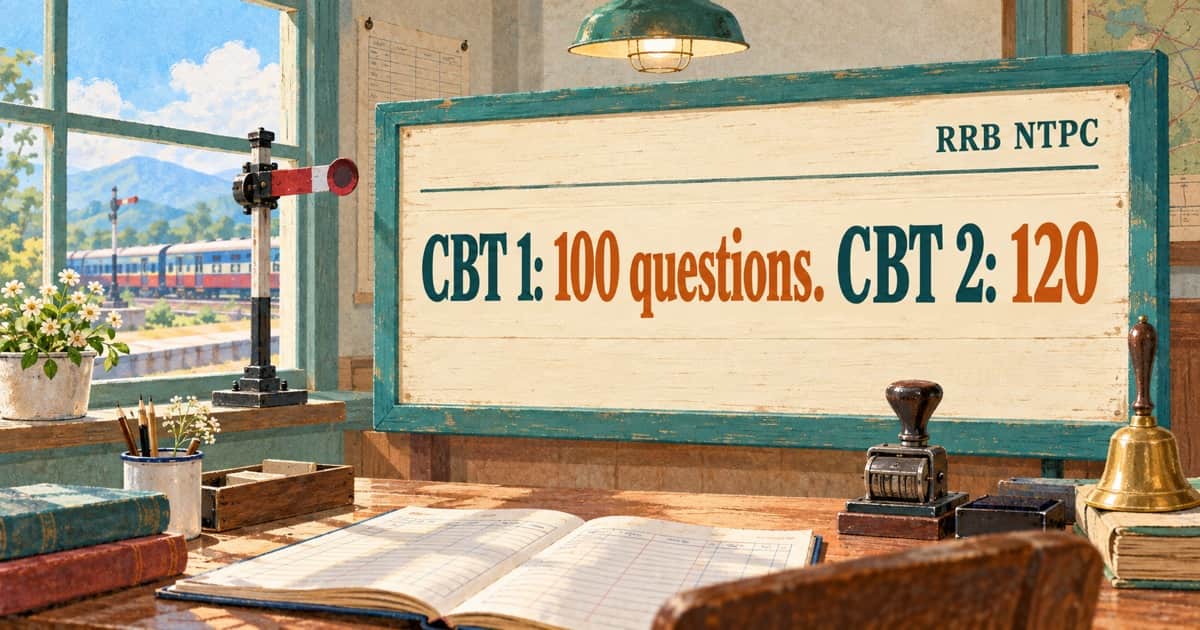
NTPC is a two-computer-test selection, and of the two only the second counts toward merit (Station Master and Traffic Assistant add an aptitude test worth 30 per cent). Both notifications run a 90-minute CBT-1 of 100 questions as a screening test, shortlist 15 times the community-wise posts for a 90-minute CBT-2 of 120 questions, and then add a typing test or an aptitude test only for the posts that need one, before document verification and a medical examination. Every question is worth 1 mark and every wrong answer takes away one third of a mark. This guide sets out each stage as printed, matches it to the ten posts, and gives you the age, fee and medical rules in one place, with tools to check your own numbers.
All from paragraph 13 of CEN 06/2025 and CEN 07/2025. CBT-1 marks are screening marks; CBT-2 marks carry into merit.
ProSyllabus is an independent study site. We are not affiliated with Indian Railways, the Railway Board or any Railway Recruitment Board. Every rule and number below is quoted or summarised from their published notices, and the notices control if anything here differs.
The stages, side by side
The two notifications use the same tests. Candidates who need a scribe get 120 minutes in place of 90 in both CBTs, and the section distribution in the printed tables is described as indicative, so a real paper can vary a little from it.
| Item | Detail |
|---|---|
| CBT-1 (screening) | 90 minutes; 100 questions: General Awareness 40, Mathematics 30, General Intelligence and Reasoning 30; 1 mark each; minus 1/3 per wrong answer; common to all posts of the CEN |
| CBT-2 (merit) | 90 minutes; 120 questions: General Awareness 50, Mathematics 35, General Intelligence and Reasoning 35; 1 mark each; minus 1/3 per wrong answer |
| Scribe candidates | 120 minutes in both CBTs (compensatory time 20 minutes per hour is set out separately in paragraph 11.7.10) |
| Shortlist for CBT-2 | From normalised CBT-1 marks, 15 times the community-wise posts notified against the RRB; the railways may increase or decrease the limit in total or for a category |
| Minimum percentage | UR 40%, EWS 40%, OBC (non-creamy layer) 30%, SC 30%, ST 25%; may be relaxed by 2 marks for PwBD where candidates are short against reserved posts |
| Normalisation | Normalised marks are used wherever a CBT is held in several sessions on the same syllabus; the method is the percentile notice explained in the cut-off guide |
| Final steps | Document verification and medical examination for all posts; empanelment on merit and medical fitness |
CBT-1 only screens: the notification says its normalised score is used for shortlisting candidates for the second stage and the standard of its questions follows the educational standard of the post. A strong CBT-1 does not carry over, and a candidate who is shortlisted starts again from zero in CBT-2. That has a practical effect on how to use the cut-offs published after CBT-1: they say who reached CBT-2, not who will be selected.
Indicative section split printed in paragraphs 13.1 and 13.2 of both notifications. General Awareness is the biggest single section in both tests.
What each of the ten posts goes through
The first two stages are common. The difference is the third stage: Station Master and Traffic Assistant take the Computer Based Aptitude Test (CBAT), the two typist posts take the Computer Based Typing Skill Test (CBTST), and the rest go straight to document verification after CBT-2.
| Post | After CBT-2 | Merit from |
|---|---|---|
| Chief Commercial cum Ticket Supervisor (G) | Document verification, medical | Normalised CBT-2 |
| Goods Train Manager (G) | Document verification, medical | Normalised CBT-2 |
| Station Master (G) | CBAT (8 x posts per community), then DV, medical | 70% CBT-2 + 30% CBAT |
| Traffic Assistant (G) | CBAT (8 x posts per community), then DV, medical | 70% CBT-2 + 30% CBAT |
| Junior Accounts Assistant cum Typist (G) | CBTST, qualifying (8 x posts per community), then DV, medical | Normalised CBT-2; typing marks not added |
| Senior Clerk cum Typist (G) | CBTST, qualifying (8 x posts per community), then DV, medical | Normalised CBT-2; typing marks not added |
| Commercial cum Ticket Clerk (UG) | Document verification, medical | Normalised CBT-2 |
| Trains Clerk (UG) | Document verification, medical | Normalised CBT-2 |
| Accounts Clerk cum Typist (UG) | CBTST, qualifying (8 x posts per community), then DV, medical | Normalised CBT-2; typing marks not added |
| Junior Clerk cum Typist (UG) | CBTST, qualifying (8 x posts per community), then DV, medical | Normalised CBT-2; typing marks not added |
The detail of the typing and aptitude stages, including the typing-speed formula and the CBAT T-score rules, is in the typing test and CBAT guide. Document verification calls candidates in the ratio of one to one against the posts of the category, after the typing or aptitude stage where it applies, and ties in merit are broken by age (the older candidate ranks higher) and then alphabetical order of the name.
How a post becomes a CBT-2 list
The 15-times rule is applied community by community, against the posts the RRB has notified. For the Graduate CEN the maximum list is 15 x 5,810 = 87,150 candidates across the country, which against 25,89,978 applications is about 3.4 per cent by our division; for the Under Graduate CEN the figure is 15 x 3,058 = 45,870. The tool below does the same sum for the board and category you choose. Where the list is larger than the number of applicants in a small category, the printed minimum percentage, not rank, becomes the filter.
Practise it, don't just read it
A section you can fix this week is worth more than another read-through of the notice.
Our RRB NTPC library has two live quizzes today, on number series patterns and on simplification and BODMAS. Those are the two Mathematics and Reasoning areas the printed syllabus lists first; the other sections of CBT-1 and CBT-2 are not covered by a live quiz yet.
The syllabus the notification prints
Both notifications print one syllabus for CBT-1 and CBT-2, grouped under three headings. It is not a chapter list; it is a list of areas "likely to include questions pertaining to" them. The table reproduces the headings in our wording.
| Section | Areas named in the notification |
|---|---|
| Mathematics | Number system, decimals, fractions, LCM and HCF, ratio and proportion, percentage, mensuration, time and work, time and distance, simple and compound interest, profit and loss, elementary algebra, geometry and trigonometry, elementary statistics |
| General Intelligence and Reasoning | Analogies, number and alphabetical series, coding and decoding, mathematical operations, similarities and differences, relationships, analytical reasoning, syllogism, jumbling, Venn diagrams, puzzles, data sufficiency, statement and conclusion, statement and courses of action, decision making, maps, interpretation of graphs |
| General Awareness | Current events of national and international importance, games and sports, art and culture, Indian literature, monuments and places, general science and life science up to Class 10 CBSE, history and freedom struggle, geography, polity and governance, science and technology including space and nuclear programmes, UN and other organisations, environment, basics of computers, common abbreviations, transport systems in India, Indian economy, famous personalities, flagship government programmes, flora and fauna, important government and public sector organisations |
Two readings follow from the printed split. General Awareness is 40 of 100 in CBT-1 and 50 of 120 in CBT-2, so the share barely moves between the tests (40.0 per cent and 41.7 per cent by our division); the "CBT-2 is the harder test" talk is about a larger paper and a smaller, sharper field, not about a different syllabus. Second, because of the one-third deduction, a question you can narrow to two options is worth attempting: with a random pick between two the expected gain is 0.5 - (0.5 x 1/3) = +0.33 marks, while a blind pick among four options is exactly zero.
Eligibility: qualification, age, fee and medical standard
Qualification: a degree from a recognised university for the Graduate posts, and the 12th with at least 50 per cent marks for the Under Graduate posts (not insisted on for SC, ST, PwBD and ex-servicemen, or where the candidate holds a higher qualification). Candidates waiting for the final result of the prescribed qualification are not eligible, and the crucial date is the closing date of the application. Corrigendum-1 moved that closing date to 27 November 2025 for the Graduate CEN and to 4 December 2025 for the Under Graduate one.
Where other pages get this wrong
The crucial date for qualification and caste certificates is the extended closing date, not the one printed in the body of the notification.
Commonly published instead: Paragraph 6 of CEN 06/2025 asks for the qualification "as on 20.11.2025" and the post-extension pages still show that date.
Corrigendum-1 of 19 November 2025 moved the closing date from 20 November to 27 November 2025 and says in terms that the crucial date for the validity of educational qualifications and all other certifications is the revised closing date. The same corrigendum shifted the fee-payment, modification and scribe windows. The Under Graduate CEN went the same way (27 November to 4 December 2025).
| Item | CEN 06/2025 (Graduate) | CEN 07/2025 (Under Graduate) |
|---|---|---|
| Application dates | Opened 21.10.2025; closed 27.11.2025 (originally 20.11.2025); fee 29.11.2025; modification 30.11 to 09.12.2025 | Opened 28.10.2025; closed 04.12.2025 (originally 27.11.2025); fee 06.12.2025; modification 07.12 to 16.12.2025 |
| Age on 01.01.2026 | 18 to 33; born between 02.01.1993 and 01.01.2008 (UR, EWS) | 18 to 30; born between 02.01.1996 and 01.01.2008 (UR, EWS) |
| Earliest birth date, OBC-NCL | 02.01.1990 | 02.01.1993 |
| Earliest birth date, SC and ST | 02.01.1988 | 02.01.1991 |
| Qualification | Degree; typing proficiency in English or Hindi on computer essential for JAA cum Typist and SCT | 12th pass with 50% aggregate (not insisted on for SC, ST, PwBD, ExSM, higher qualification); typing proficiency essential for ACT and JCT |
| Ground | Relaxation (printed) |
|---|---|
| SC and ST | 5 years |
| OBC (non-creamy layer) | 3 years |
| Ex-servicemen, 6 months continuous service after attestation | UR and EWS 3 years, OBC-NCL 6 years, SC and ST 8 years, after deducting the length of service from age |
| Persons with benchmark disabilities | UR and EWS 10 years, OBC-NCL 13 years, SC and ST 15 years |
| Serving Group C and erstwhile Group D railway staff, 3+ years (and substitutes) | Upper age 40 (UR, EWS), 43 (OBC-NCL), 45 (SC, ST) |
| Quasi-administrative railway offices (canteens, co-operative societies, institutes) | Up to the length of service rendered or 5 years, whichever is less |
| Women who are widowed, divorced or judicially separated and not remarried | Upper age 35 (UR, EWS), 38 (OBC-NCL), 40 (SC, ST) |
If you qualify for relaxation on more than one ground you get the largest one, not the sum. Candidates of SC, ST and OBC-NCL who apply against UR vacancies do not get category relaxation. The date of birth in the application must match the Class 10 certificate; a later change is not considered and a mismatch disqualifies.
| Fee item | Amount (printed) |
|---|---|
| Examination fee, general | Rs 500; Rs 400 refunded, less bank charges, on appearing in CBT-1 |
| SC, ST, ex-servicemen, PwBD, women, transgender, minorities and economically backward class (EBC) | Rs 250, refunded in full less bank charges on appearing in CBT-1 |
| Modification of the application | Rs 250 each time, non-refundable |
The EBC concession is an income-based fee waiver (an EBC income certificate, a BPL card or a similar poverty-alleviation document, held on or before the closing date) and is not reservation: the notifications say EBC, EWS and OBC are three different categories. Medical standards are printed per post: A-2 (Station Master, Goods Train Manager, Traffic Assistant) needs distant vision 6/9, 6/9 without glasses with no fogging test, near vision Sn 0.6 without glasses and passes in colour, binocular, night and myopic vision tests; B-2 (Chief Commercial cum Ticket Supervisor, Commercial cum Ticket Clerk) allows 6/9, 6/12 with or without glasses with lenses not above 4D; C-2 (the typist posts) is 6/12, nil with or without glasses. Candidates who have had Lasik or another refractive surgery are not eligible for the A-2 posts, and for Station Master and Traffic Assistant the vision certificate in the notification's Annexure VII is checked at the aptitude test.
What is the exam pattern of RRB NTPC CBT-1?
CBT-1 is a 90-minute computer test of 100 questions of 1 mark each: General Awareness 40, Mathematics 30 and General Intelligence and Reasoning 30. It has negative marking of one third of a mark and is a screening test only.
What is the pattern of CBT-2?
CBT-2 is 90 minutes and 120 questions of 1 mark each: General Awareness 50, Mathematics 35 and General Intelligence and Reasoning 35, again with one-third negative marking. Its normalised marks decide merit.
Is the pattern the same for Graduate and Under Graduate NTPC?
Yes. CEN 06/2025 and CEN 07/2025 print the same CBT-1 and CBT-2 tables, minimum percentages and shortlisting ratio. The posts, pay levels, age limits and qualification differ.
Do CBT-1 marks count in the final merit?
No. The notifications use the normalised CBT-1 score to shortlist for CBT-2 and say merit is drawn from CBT-2 (with the CBAT for Station Master and Traffic Assistant). The typing test is qualifying only.
How many candidates are shortlisted for CBT-2?
15 times the community-wise vacancies notified against the RRB, from normalised CBT-1 marks, although the railways may increase or decrease the limit.
What is the qualifying percentage in NTPC CBT?
UR 40 per cent, EWS 40 per cent, OBC non-creamy layer 30 per cent, SC 30 per cent and ST 25 per cent, with up to 2 marks of relaxation for PwBD where candidates are short against reserved posts.
What is the upper age limit for NTPC Graduate and Under Graduate?
On 1 January 2026 the limits are 33 years (Graduate) and 30 years (Under Graduate) for UR and EWS, with 3 years extra for OBC-NCL and 5 for SC and ST, and the other relaxations in the table above.
Sources
- official — Railway Recruitment Boards: Detailed CEN 06/2025, Non-Technical Popular Categories (Graduate), 21.10.2025 (59 pages; Annexure A post parameters, Annexure B RRB-wise vacancies)
- official — Railway Recruitment Boards: Detailed CEN 07/2025, Non-Technical Popular Categories (Under Graduate), 28.10.2025 (56 pages)
- official — RRBs: Corrigendum-1 to CEN 06/2025 dated 19.11.2025 (closing date 27.11.2025)
- official — RRBs: Corrigendum-1 to CEN 07/2025 dated 27.11.2025 (closing date 04.12.2025)
- official — RRBs: Frequently Asked Questions on CEN 06/2025 (21.10.2025)
- official — RRBs: Notice of 13.02.2026, tentative schedule of CBT-1, CEN 06/2025 (16 to 27 March 2026)
- official — RRBs: Notice of 12.06.2026, tentative schedule of CBT-II, CEN 06/2025 (10 July 2026)
- official — RRBs: Notices of 24.08.2026 (CBT-2 on 17 September 2026) and 27.08.2026 (viewing CBT-1 scores), CEN 07/2025
- official — RRBs: Notice on Normalization Methodology for Computer Based Test (CBT) exams, for all CENs (dated 09.02.2026 on the portal)
- official — RRBs: Notice dated 04.08.2026, CEN 06/2025 RRB-wise and community-wise number of applications received (tentative)
- official — Railway Recruitment Boards: common website of all RRBs (CEN-wise notices, results, cut-offs)
official = a document published by the conducting body. reported = a news or coaching site we could not check against an original. Where sources disagree this page says so rather than picking one.


