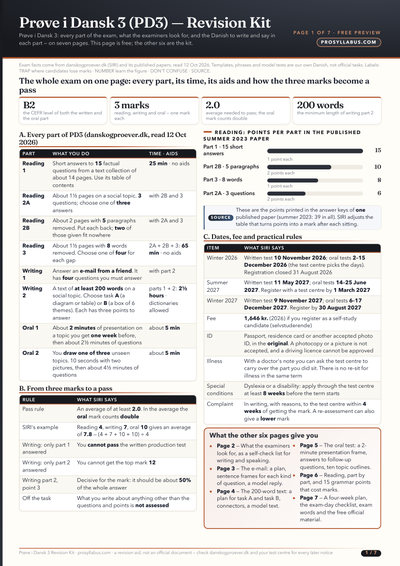


Checked 13 October 2026. The format and timings are from BEK nr 1687 af 16/12/2025 bilag 1 and SIRI’s PD3 pages, read 13 October 2026. The grade descriptions are from SIRI’s assessment guides of May 2025 (written) and December 2024 (oral), read as archived copies because SIRI has moved the guides to a site that needs a login; a newer edition may exist there. Every task and text on this page is ours.
- Cheatsheet + revision sheet: key concepts in 2 lines each
- All 8 parts: time, aids, marking
- 2.0 to pass, oral counts double
- 45 connectors and opinion phrases
- 2 model texts: e-mail and 200 words
- 10 oral topics with questions
Prøve i Dansk 3 eksempler: what this page adds
SIRI publishes one example of each part of Prøve i Dansk 3 (PD3), and you should use them: they are indexed with working links in the past-papers guide. The trouble is that there is exactly one of each. Once you have sat the summer 2023 reading set, you have no second paper to test yourself on [official: SIRI’s PD3 pages list one example per part].
So this page is a second set. Every task below was written for this page in the official task format: none is an official question, and none repeats our quiz or our revision kit. The reading tasks are shorter than the real ones, and we say by how much. After each task you get what the examiner is told to look for, taken from SIRI’s own assessment guides, and at the end a tool that marks your reading answers and places your writing and speaking against the official descriptions.
Format: BEK 1687/2025 bilag 1 pt 3.9–3.39 and SIRI’s PD3 pages [official]. The mini set and its 21 points are ours.
| Part | The real test | On this page | Points per answer (2023 key) |
|---|---|---|---|
| Reading, delprøve 1 | 15 short-answer questions on a text collection of about 10 normal pages, 25 minutes | 5 questions on three short texts | 1 |
| Reading, delprøve 2A | 3 questions with 3 options each on a text of about 1.5 normal pages | 3 questions on a short text | 2 |
| Reading, delprøve 2B | 5 removed paragraphs to put back, printed with 2 that fit nowhere | 3 gaps, 4 pieces (1 extra) | 2 |
| Reading, delprøve 3 | 8 removed words or expressions, 4 options for each | 4 gaps, 4 options each | 1 |
| Writing, delprøve 1 | An informal e-mail answering four questions; no length set | One full task | Not scored in points: one grade for both writing tasks |
| Writing, delprøve 2 | Task A or B, three points, at least 200 words | One task A (task B is in the model-answers guide) | Not scored in points |
| Oral, delprøve 1 | Presentation of about 2 minutes, then about 2½ minutes of questions | One topic, a model presentation, four questions | Not scored in points: one oral grade |
| Oral, delprøve 2 | One of three topics by lot, two pictures, two compulsory questions, about 4½ minutes | One topic with both compulsory questions | Not scored in points |
The real times and what each part tests are laid out in the written exam guide and the oral exam guide; this page does not repeat them. All people, places and figures in the practice texts are invented.
Reading, delprøve 1: find the fact fast (læseforståelse)
In the real delprøve 1 you get a text collection and a booklet with 15 factual questions, and 25 minutes. SIRI’s candidate page says you should not read the whole collection but use its table of contents to find the text that holds each answer, and write a short answer [official: SIRI PD3 page]. The regulation calls the skill scanning: “skanne/søgelæse i en forholdsvis stor tekstmængde” (bilag 1 pt 3.12) [official]. Give yourself eight minutes for the five questions below, which is our scaling of 25 minutes for 15, and less if you can, because these texts are far shorter than the real collection.
Tekstsamling (our text) — Lindeby Bibliotek
1. Åbningstider og selvbetjening
Lindeby Bibliotek har personale mandag til fredag fra kl. 10 til 17 og lørdag fra kl. 10 til 14. Uden for disse tider er biblioteket åbent med selvbetjening alle dage fra kl. 7 til 22. For at komme ind i den selvbetjente åbningstid skal man scanne sit sundhedskort ved hoveddøren og taste sin pinkode. Børn under 15 år skal være sammen med en voksen i den selvbetjente åbningstid. Studiecellerne på første sal kan reserveres på bibliotekets hjemmeside for højst tre timer ad gangen.
2. Lån, fornyelse og gebyrer
Bøger og lydbøger kan lånes i 30 dage, mens film og spil kan lånes i 14 dage. Et lån kan fornyes to gange, hvis ingen andre har reserveret materialet. Afleverer man for sent, koster det et gebyr på 20 kr. for voksne. Børn og unge under 18 år betaler ikke gebyr. Har man mistet en bog, skal man betale det beløb, det koster biblioteket at købe en ny.
3. Arrangementer i foråret
Hver tirsdag kl. 16 er der lektiecafé, hvor frivillige hjælper skoleelever med lektierne. Den første torsdag i måneden mødes sprogcaféen kl. 19, og her kan alle øve sig i at tale dansk over en kop kaffe. Det er gratis at deltage i både lektiecaféen og sprogcaféen, og man behøver ikke at tilmelde sig. Forfatteraftenen i april koster 50 kr., og billetter købes på bibliotekets hjemmeside.
English: A library’s information pages under three headings: staffed hours and self-service access with the health card and a PIN; loan periods, renewals and late fees (none for under-18s); a homework café, a language café and a ticketed author evening.
Lindeby and its library are invented. A real collection is about 10 normal pages under about five sub-headings.
Spørgsmål (our questions)
1. Hvad skal man scanne ved hoveddøren i den selvbetjente åbningstid?
2. Hvor længe kan man højst reservere en studiecelle ad gangen?
Søg informationer under Lån, fornyelse og gebyrer
3. Hvor mange gange kan et lån fornyes?
4. Skal en 16-årig betale gebyr, hvis en bog bliver afleveret for sent? Svar ’ja’ eller ’nej’.
Søg informationer under Arrangementer i foråret
5. Hvilket arrangement skal man købe billet til?
English: 1. What must you scan at the main door in self-service hours? 2. For how long at most can a study cell be booked at a time? 3. How many times can a loan be renewed? 4. Must a 16-year-old pay a fee for a late book? Answer yes or no. 5. Which event do you have to buy a ticket for?
The real booklet groups its questions under the heading to search, as here, and includes a few yes/no questions [official: SIRI PD3 page and the 2023 booklet].
What the marker looks for. Reading is marked with a key, not judged by eye. The published 2023 key gives 1 point or 0 for each answer, and its note explains the notation: a slash means “and/or”, and words in brackets may be part of the answer but need not be [official: 2023 answer key]. In other words the key asks for the fact, briefly. A full sentence is not required, and copying a long stretch of text costs you time you do not have.
Reading, delprøve 2A: three questions on the whole argument
Delprøve 2A is a text of about 1.5 normal pages on a social topic with three multiple-choice questions that follow the order of the text, three options each [official: SIRI’s two PD3 pages]. What is tested is careful reading for the main points: “læse omhyggeligt globalt” (bilag 1 pt 3.15). Ours is about a third of that length.
Tekst (our text) — Frokost ved skrivebordet
Ifølge Karen Holm handler den fælles frokost ikke kun om hygge. Det er ofte ved frokostbordet, at en medarbejder finder ud af, hvem der kan hjælpe med et problem, og det sparer tid senere. Hun understreger dog, at ingen skal tvinges til at deltage. Nogle har brug for ro midt på dagen, og det skal der også være plads til.
Hendes råd til ledere er derfor enkelt: Lederen skal ikke lave regler om, hvor medarbejderne spiser, men selv sætte sig i kantinen. Når chefen holder pause, tør de ansatte nemlig også gøre det.
English: Lunch breaks are getting shorter and more people eat at their desks. A work-environment consultant calls that a bad trend: no real break, and you do not get to know colleagues. Shared lunch is not only about cosiness; it is where staff find out who can help with a problem. Nobody should be forced. Her advice to managers: make no rules, but sit in the canteen yourself, because staff dare to take a break when the boss does.
Karen Holm is an invented person.
Spørgsmål (our questions) — sæt ét kryds
A. Det er en fornuftig måde at spare tid på i en travl hverdag.
B. Det betyder, at man hverken får en rigtig pause eller lærer kollegerne at kende.
C. Det er kun et problem for nye medarbejdere.
2. Hvad siger teksten om den fælles frokost?
A. Den kan gøre det lettere at finde ud af, hvem man kan få hjælp af.
B. Den bør være obligatorisk for alle medarbejdere.
C. Den er især vigtig, fordi den er hyggelig.
3. Hvad råder Karen Holm ledere til at gøre?
A. At indføre faste regler for, hvor frokosten skal spises.
B. At give medarbejderne en længere frokostpause.
C. At vise et godt eksempel ved selv at holde pause i kantinen.
English: 1. What does she think about eating at the desk? 2. What does the text say about shared lunch? 3. What does she advise managers to do?
What the marker looks for. One cross per question; the 2023 key gives 2 points or 0 [official]. Notice how the wrong options are built here, as in the official sample: each reuses words from the text (spare tid, hygge, regler) but says something the text does not. The option to choose is the one that says what the text says in other words.
Reading, delprøve 2B: put the paragraphs back
In delprøve 2B five passages of about the same length have been taken out of a text of about 2.5 normal pages. The booklet prints them in random order together with two that fit nowhere, and each letter may be used once [official: SIRI centre page; 2023 booklet]. Ours has three gaps and four pieces.
Tekst (our text) — Tilbage på skolebænken som 45-årig
Det er dog ikke let at begynde forfra. Mange voksne elever har børn og huslån, og en elevløn er ofte meget lavere end den løn, de er vant til. (2) Uden den støtte ville mange slet ikke have råd til at skifte fag.
Til gengæld oplever skolerne, at de voksne elever er meget motiverede. De ved, hvorfor de er der, og de møder til tiden. (3) På den måde får begge grupper noget ud af at gå i klasse sammen.
Tekstdele:
A. Flere lærere fortæller desuden, at de ældre elever hjælper de unge med at holde fokus, mens de unge til gengæld er hurtigere til det digitale.
B. Samtidig mangler virksomhederne faglært arbejdskraft, for eksempel elektrikere og social- og sundhedsassistenter.
C. Nogle kan derfor få et særligt tilskud, mens de er under uddannelse.
D. Derfor har flere skoler valgt at lukke deres aftenhold.
English: More adults start a new education in mid-career. (1) So vocational schools offer shorter courses for adults, who get credit for experience. Starting again is hard: children, a mortgage, a low trainee wage. (2) Without that support many could not afford to change trade. Schools find adult students motivated and punctual. (3) In that way both groups gain from sharing a class. Pieces: A older students help the young keep focus, the young are quicker with digital things; B companies lack skilled workers; C some can get a special grant while training; D so several schools have closed their evening classes.
The text is constructed for practice and describes no particular scheme.
What the marker looks for. The right letter in each box, 2 points or 0 [official: 2023 key]. The method is to read the sentence after each gap first. Here “Derfor tilbyder …” needs a cause before it, “Uden den støtte …” needs a kind of support before it, and “begge grupper” needs two groups to have been named.
- Cheatsheet + revision sheet: key concepts in 2 lines each
- All 8 parts: time, aids, marking
- 2.0 to pass, oral counts double
- 45 connectors and opinion phrases
- 2 model texts: e-mail and 200 words
- 10 oral topics with questions
Reading, delprøve 3: the missing words
Delprøve 3 is a text of about 1.5 normal pages with eight words or expressions removed and four options for each gap. It tests close reading at the level of the sentence, and a precise sense of what the candidate words mean [official: SIRI’s PD3 pages; bilag 1 pt 3.18]. In the 2023 sample two of the eight gaps were linking words and six were content words or phrases; ours has two of each.
Tekst (our text) — Delebiler i byerne
English: In the larger cities sharing a car has become common. The main (1) is that you avoid the cost of insurance, repairs and parking. (2), experience shows that one shared car can replace several private ones. The scheme (3) does not suit everyone: if you need the car at the same time every day, you cannot be sure one is free. Several councils will therefore (4) the number of fixed parking spaces for shared cars.
| Gap | A | B | C | D |
|---|---|---|---|---|
| 1 | ulempe | fordel | regel | årsag |
| 2 | Desuden | Derimod | Ellers | Imidlertid |
| 3 | således | derfor | dog | altså |
| 4 | begrænse | undgå | øge | forsinke |
What the marker looks for. One cross per gap, 1 point or 0 [official: 2023 key]. Read to the end of the sentence before you choose: gap 4 is settled only by the last clause, “så de bliver lettere at finde”.
Answers to the reading set, with the reason for each
Mark your answers here, or type them into the tool further down. The points follow the published summer 2023 keys; the set is ours, so the total of 21 is ours too.
| Item | Key | Why (the words in the text) | Points |
|---|---|---|---|
| Part 1, question 1 | (Sit) sundhedskort | “skal man scanne sit sundhedskort ved hoveddøren” — the health card | 1 |
| Part 1, question 2 | Tre timer | “for højst tre timer ad gangen” — three hours at most | 1 |
| Part 1, question 3 | To (gange) | “Et lån kan fornyes to gange” — twice, if nobody has reserved it | 1 |
| Part 1, question 4 | Nej | “Børn og unge under 18 år betaler ikke gebyr” — under-18s pay no fee | 1 |
| Part 1, question 5 | Forfatteraftenen | The two cafés are free; “Forfatteraftenen i april koster 50 kr., og billetter købes …” | 1 |
| Part 2A, question 1 | B | “holder man ikke en rigtig pause, og man lærer ikke sine kolleger at kende”. A turns the point round; C is not in the text | 2 |
| Part 2A, question 2 | A | “finder ud af, hvem der kan hjælpe med et problem”. B contradicts “ingen skal tvinges”; C contradicts “ikke kun om hygge” | 2 |
| Part 2A, question 3 | C | “ikke lave regler …, men selv sætte sig i kantinen”. A is what she advises against; B is not mentioned | 2 |
| Part 2B, gap 1 | B | The lack of skilled workers is the cause that “Derfor tilbyder mange erhvervsskoler …” points back to | 2 |
| Part 2B, gap 2 | C | “et særligt tilskud” is what “Uden den støtte” refers to | 2 |
| Part 2B, gap 3 | A | Older and younger students are the “begge grupper” of the next sentence. D fits nowhere | 2 |
| Part 3, gap 1 | B (fordel) | Avoiding costs is an advantage, not a drawback, a rule or a cause | 1 |
| Part 3, gap 2 | A (Desuden) | A second advantage is added: “moreover”. The other three mark a contrast or an alternative | 1 |
| Part 3, gap 3 | C (dog) | The text turns to a limit: “however, it does not suit everyone” | 1 |
| Part 3, gap 4 | C (øge) | More spaces make the cars “lettere at finde”; limiting, avoiding or delaying would not | 1 |
From the two official answer keys of summer 2023; the total of 39 is our sum. It is one paper: SIRI adjusts the points-to-grade table after each sitting and does not publish it, so no number of points is an official pass mark.
Writing, delprøve 1: the e-mail (skriftlig fremstilling)
The first writing task is an informal e-mail. You get a situation and an extract of a mail from someone you know, with four questions to answer, and a task box with three instructions; no length is set (bilag 1 pt 3.24–3.26; SIRI’s candidate page; the published 2022 and 2023 papers) [official]. Here is one in that format.
Delprøve 1 (our task) — En e-mail
… Tak for sidst! Det var hyggeligt at se dig til Annes fødselsdag. Du fortalte, at du lige er begyndt til svømning om aftenen. Hvordan går det med det?
Som du ved, har jeg fået tilbudt et job i Aalborg. Lønnen er bedre, men jeg kender ingen i byen. Hvad synes du, jeg skal gøre for at lære nye mennesker at kende?
Min kæreste vil helst blive i København, fordi hun er glad for sit arbejde. Tror du, det kan fungere, hvis vi bor i hver sin by i et år?
Jeg skal også finde ud af, om jeg skal leje en lejlighed eller købe en med det samme. Hvad ville du gøre? …
Opgave: Skriv et svar til din ven.
• Sig tak for mailen.
• Svar på de understregede spørgsmål i mailen.
• Foreslå, at I mødes, inden han flytter.
English: Your Danish friend Thomas has been offered a job in Aalborg. He asks how your evening swimming is going; what he should do to get to know new people; whether it can work if he and his girlfriend live in different cities for a year; and whether you would rent or buy a flat at once. Thank him, answer the underlined questions, and suggest meeting before he moves.
What the examiner looks for. The regulation says the e-mail is assessed on whether you can answer questions, “herunder fortælle, foreslå, forklare og kommentere”, in language that fits the situation and with a fairly high degree of correctness (bilag 1 pt 3.27) [official]. SIRI’s assessment guide then describes three levels. For the e-mail they turn on three things: a personal, speech-like tone; whether you refer back to the friend’s mail naturally instead of producing a list of answers; and how many language errors there are [official: assessment guide, May 2025].
| The friend asks | What you must do | A way to open, in Danish | English |
|---|---|---|---|
| Hvordan går det med det? | Tell (fortælle) | Du spørger, hvordan det går med svømningen. Det går faktisk rigtig godt, selvom jeg er træt om aftenen. | You ask how the swimming is going. It is actually going really well, although I am tired in the evening. |
| Hvad synes du, jeg skal gøre …? | Suggest (foreslå) | Hvis jeg var dig, ville jeg melde mig ind i en forening, for der møder man hurtigt nye mennesker. | If I were you, I would join a club, because you meet new people quickly there. |
| Tror du, det kan fungere …? | Comment and explain (kommentere, forklare) | Jeg tror godt, det kan fungere i et år, hvis I aftaler faste weekender sammen. | I do think it can work for a year, if you agree on fixed weekends together. |
| Hvad ville du gøre? | Give your choice and a reason | Jeg ville leje en lejlighed det første år, så du kan nå at lære byen at kende, før du køber. | I would rent a flat for the first year, so that you have time to get to know the town before you buy. |
Two complete answers to an e-mail task, a weaker and a stronger one, are compared line by line in the model-answers guide.
Writing, delprøve 2: task A, with a table
The second task is the one that decides the writing grade (bilag 1 pt 3.23) [official]. You choose A or B. Task A comes with facts, “fx et diagram eller en tabel”, and three points: describe it briefly, explain causes of some of the differences, and discuss advantages and disadvantages “eller lignende” [official: SIRI candidate page]. In the published 2022 and 2023 papers the third point carried the printed instruction that it should make up about 50% of the answer [official]. The answer must be at least 200 words (pt 3.30).
Delprøve 2A (our task) — Unge med fritidsjob
13–14 år: 22 %
15–17 år: 48 %
18–19 år: 61 %
Alle 13–19 år: 44 %
Opgave
• Beskriv kort de vigtigste forskelle i tabellen.
• Forklar, hvilke årsager der kan være til nogle af forskellene.
• Diskutér, hvilke fordele og ulemper der kan være ved, at unge har et fritidsjob, mens de går i skole. Begrund dine synspunkter. (Dette punkt bør fylde ca. halvdelen af din tekst.)
Du skal skrive mindst 200 ord.
English: Share of young people with a part-time job alongside school (fritidsjob), by age (invented figures for practice): 13–14: 22%; 15–17: 48%; 18–19: 61%; all 13–19: 44%. Describe the main differences briefly; explain possible causes of some of them; discuss advantages and disadvantages of young people having a job while at school, giving reasons. This point should fill about half of your text. At least 200 words.
The figures are invented for this exercise and describe no survey.
| Point | What the 12 description asks for | A sentence that does it, in Danish | English |
|---|---|---|---|
| 1. Describe | A short, clear and precise description of what the figures show | Tabellen viser, at andelen af unge med fritidsjob stiger med alderen, fra 22 % blandt de 13–14-årige til 61 % blandt de 18–19-årige. | The table shows that the share of young people with a spare-time job rises with age, from 22% among 13–14-year-olds to 61% among 18–19-year-olds. |
| 2. Explain causes | Possible causes explained clearly, with relevant elaboration | En mulig forklaring er, at de ældste har flere udgifter, fordi mange af dem sparer op til kørekort eller til at flytte hjemmefra. | One possible explanation is that the oldest have more expenses, because many of them are saving for a driving licence or for moving away from home. |
| 3. Discuss | Views and arguments expressed clearly and precisely; about half of the text | På den ene side lærer de unge at møde til tiden og tage ansvar. På den anden side kan et job gå ud over lektierne, hvis de arbejder for mange timer om ugen. | On the one hand the young learn to turn up on time and take responsibility. On the other hand a job can come at the expense of homework if they work too many hours a week. |
What the examiner looks for. The full descriptions for 12, 7 and 02 are below, shortened and translated by us from the assessment guide of May 2025. Read down the last column: what separates the levels in task 2 is how clearly reasons and arguments are unfolded, how the paragraphs are tied together, and how much the errors disturb the reader [official].
| Grade | SIRI’s words for it | E-mail (task 1) | Text of 200 words (task 2) |
|---|---|---|---|
| 12 | Særdeles god opfyldelse af de faglige mål | Answered in a personal, speech-like style that fits the genre; well organised; refers back to the friend’s mail in a natural way; very few language errors; good, precise word choices | Each point clear and precise, with relevant elaboration; suitable paragraphs that are tied together well; precise linking words; only few errors; varied syntax with several subordinate clauses; control of a fair number of less common words and expressions |
| 7 | God opfyldelse af de faglige mål | A good many personal, speech-like phrasings; mostly well organised, but with abrupt transitions or stereotyped references back to the mail; some errors and a few less precise word choices | Points mostly clear and precise; elaborations and reasons can be simplified and stereotyped; paragraphs typically joined by stereotyped openings; some errors that disturb the reading only slightly; mostly in control of a varied syntax and of some less common words |
| 02 | Den netop acceptable grad af opfyldelse | The points are answered, but not in quite speech-like phrasings; typically organised as a list; typically no natural reference back to the mail; a few errors in verb tenses, noun endings and elementary syntax; imprecise choices in common phrases | Description may lack precision; causes or comments not quite clear, with little elaboration; opinions and arguments only to a lesser degree clear, with simplified and unclear reasons; less suitable paragraphs, openings stereotyped or missing, so the text reads as a list; a good many errors that sometimes disturb the reading; fairly elementary syntax |
The same guide gives examiners general rules that are worth knowing before you plan your time [official: assessment guide, May 2025]:
What SIRI tells the examiners about the writing test
- The answer to task 2 decides the grade, point 3 above all, which is about half of the answer and is where candidates are tested at B2 level.
- If the examiners are in doubt between two grades, the e-mail can tip it: a good e-mail speaks for the higher grade.
- If only the e-mail is answered, the grade can only be 00 or -3. If only task 2 is answered, that pulls the grade down by one step from the start.
- An answer that misses the task set (“indholdsmæssigt skævt”) is marked down.
- The minimum number of words is a guide for the candidate. Examiners are told not to count the words; only a substantial shortfall pulls the grade down.
- The tests measure language, not knowledge: not knowing a fact does not in itself lower the grade.
Official: Bedømmelsesvejledning, skriftlig del af Prøve i Dansk 3, May 2025, “Overordnede retningslinjer” and bilag 1 (archived copy; the current edition is on SIRI’s assessor-training site).
- Cheatsheet + revision sheet: key concepts in 2 lines each
- All 8 parts: time, aids, marking
- 2.0 to pass, oral counts double
- 45 connectors and opinion phrases
- 2 model texts: e-mail and 200 words
- 10 oral topics with questions
Oral, delprøve 1: the prepared presentation (mundtlig kommunikation)
For the first oral part you are given a topic in advance and present it for about two minutes; the examiner then asks questions for about 2½ minutes [official: examiner booklet, May–June 2024]. SIRI’s guidance on topics gives examples in a fixed form, a general subject with a focus, such as “Det danske arbejdsmarked med fokus på stress” [official: topic guidance, January 2025]. Our topic uses the same form but is not on SIRI’s list or in our kit: Frivilligt arbejde i Danmark med fokus på idrætsforeninger.
Præsentation (our model, about 200 words)
Frivilligt arbejde betyder, at man arbejder uden at få løn. I en idrætsforening kan man for eksempel være træner for et børnehold, kasserer eller hjælper i caféen, når der er kamp.
Det næste punkt er, hvorfor foreningerne har brug for frivillige. Kontingentet i en forening er ofte lavt, og derfor har klubberne ikke råd til at ansætte trænere til alle hold. Hvis forældre og andre voksne ikke hjalp til, ville mange børn ikke kunne gå til fodbold eller håndbold. De frivillige får også selv noget ud af det, for de møder andre mennesker og bliver en del af et fællesskab.
Til sidst vil jeg sige min egen mening. Jeg synes, at frivilligt arbejde er en god måde at lære sit lokalområde at kende på, især når man er ny i landet. Men jeg mener også, at det kan blive et problem, hvis de samme få personer skal lave det hele. Derfor bør foreningerne efter min mening blive bedre til at fordele opgaverne.
English: I would like to talk about voluntary work in Denmark with a focus on sports clubs. First I will explain what voluntary work is, then why the clubs need volunteers, and finally what I think myself. Voluntary work means working without pay: as a coach of a children’s team, as treasurer, or helping in the café on match days. Membership fees are often low, so clubs cannot afford to employ coaches for every team; without parents and other adults many children could not play football or handball. Volunteers gain too: they meet people and become part of a community. My own view: it is a good way to get to know your local area, especially when you are new in the country, but it becomes a problem if the same few people do everything, so clubs should share the tasks better.
Time it: the presentation should be neither shorter nor longer than about two minutes [official: SIRI candidate page]. The oral guide has a 2-minute timer.
What the examiner looks for. For the grade 12 the guide asks for a presentation that is organised in points, that opens with an outline (“en disposition”) and in which it is clear all the way which sub-point is being spoken about. At 7 and 02 the outline is still there, but the sub-points are marked less clearly and the ending is typically stereotyped: the guide’s own example is “alt i alt mener jeg” followed by a remark that does not really sum up [official: assessment guide, December 2024]. That is why the model above announces three points, signals each one, and ends on a view that follows from what was said.
| Kind of question (official) | Our question on this topic | English |
|---|---|---|
| Opklarende — clarifying | Du sagde, at kontingentet ofte er lavt. Vil du forklare det lidt nærmere? | You said the membership fee is often low. Would you explain that a little more? |
| Uddybende — elaborating | Du nævnte, at de frivillige selv får noget ud af det. Kan du fortælle lidt mere om det? | You mentioned that the volunteers gain something themselves. Can you say a little more about that? |
| Forklaring og begrundelse — explanation and reason | Du sagde, at foreningerne har brug for frivillige, men hvorfor tror du så, at det er svært at finde nye? | You said the clubs need volunteers, so why do you think it is hard to find new ones? |
| Stillingtagen og argumentation — a view and an argument | Mener du, at frivillige trænere burde få løn? Hvorfor eller hvorfor ikke? | Do you think volunteer coaches ought to be paid? Why, or why not? |
Svar på det sidste spørgsmål (our model)
English: That is a hard question. On the one hand it would probably be easier to find coaches if they were paid. On the other hand the fee would go up, and then some families could not afford to let their children do sport. So I think the coaches should be volunteers, but that the club ought to pay for their courses.
The four kinds of question are the ones printed in the official examiner booklet. The examiner must ask questions that call for explanation and for a view, to test how far you can give reasons and argue [official].
Oral, delprøve 2: the unprepared topic
In the second part you draw one of three topics. A sheet with two pictures is put in front of you, you get about ten seconds to look, and the examiner asks about one of the two situations for about 4½ minutes. There is a first compulsory question on a concrete side of the topic and a second on a more general side, each followed by further questions [official: examiner booklet, May–June 2024]. We cannot print pictures in the official style, so the two situations are described in words.
Emne (our task) — Kollektiv trafik
Situation B: en cykelparkering ved en station i en stor by, hvor der ikke er flere ledige pladser.
Indledning til situation A: ”Situation A viser et busstoppested i en lille landsby, hvor der kun kører få busser om dagen.”
Første obligatoriske spørgsmål: ”I nogle mindre byer er der blevet færre busafgange. Hvorfor tror du, det er sådan?”
Opfølgende spørgsmål: ”Hvilke problemer kan det give for dem, der bor der?”
Andet obligatoriske spørgsmål: ”Nogle mener, at kollektiv trafik burde være gratis for alle. Hvilke fordele og ulemper mener du, der kan være ved det for samfundet?”
Opfølgende spørgsmål: ”Mener du, at pengene hellere skulle bruges på bedre cykelstier? Hvorfor eller hvorfor ikke?”
English: Topic: public transport. Situation A: a bus stop in a small village where the timetable shows two departures a day. Situation B: a full bicycle park at a station in a big city. First compulsory question: in some smaller towns there are fewer bus departures; why do you think that is? Follow-up: what problems can that cause for the people who live there? Second compulsory question: some think public transport should be free for everyone; what advantages and disadvantages can there be for society? Follow-up: should the money rather be spent on better cycle paths?
Svar på de to obligatoriske spørgsmål (our models)
Andet: Den største fordel ville være, at flere lod bilen stå, og det ville give mindre trængsel og mindre forurening i byerne. Det ville også hjælpe folk med en lav indkomst. Ulempen er, at det ville koste mange skattekroner, og de penge skulle tages fra noget andet, for eksempel skoler eller sygehuse. Desuden er jeg ikke sikker på, at folk på landet ville få glæde af det, hvis der alligevel ikke kører nogen bus.
English: First: I think it is above all about money. When only a few passengers are on the bus, each trip becomes very expensive, and so departures are cut. But it quickly becomes a vicious circle: when the bus runs less often, more people buy a car, and then there are even fewer passengers. Second: the biggest advantage would be that more people left the car at home, which would mean less congestion and less pollution in the cities, and it would help people on a low income. The drawback is that it would cost a great deal of tax money, which would have to be taken from something else, such as schools or hospitals. And I am not sure people in the country would benefit if no bus runs anyway.
Both answers give a reason without being asked. If you do not, the examiner must keep asking until there is enough to judge [official: examiner booklet].
What the examiner looks for. The three published descriptions for the oral grade, shortened and translated by us, are below. The clearest difference between them is how much help you need: at 12 none; at 7 “a little help” where a reason or a view is asked for; at 02 “a good deal of help” to form an answer to the second compulsory question [official: assessment guide, December 2024].
| Grade | Presentation | Follow-up questions | Unprepared topic | Language |
|---|---|---|---|---|
| 12 | Well organised in points; opens with an outline; always clear which sub-point is being spoken about; coherent, clear and precise; pronunciation and rhythm support it well | Understands and answers every kind of question with ease, clearly and relevantly, with no help from the examiner | Understands and answers both compulsory questions and the follow-ups with ease, with no help | Good, varied syntax and a fair number of less common words and expressions; answers all kinds of question clearly and precisely |
| 7 | Mostly well organised; opens with an outline; mostly clear which sub-point is meant; closes briefly but typically in a stereotyped way | Answers clarifying and elaborating questions mostly with ease, but typically needs a little help to answer fully where a reason, a view or an argument is asked for | First compulsory question mostly with ease; second answered fairly clearly, typically with some help such as a repeated or rephrased question | Fairly good and varied syntax; some less common words, but typically some imprecise or wrong word choices |
| 02 | Fairly well laid out; opens with an outline but marks the sub-points less clearly; typically no ending, or a stereotyped one; content and language not quite clear and precise | Answers clarifying questions fairly easily but only to a lesser degree clearly; typically needs some help with reasons, views and arguments | First compulsory question fairly easily, with some help; second answered briefly and imprecisely, typically with a good deal of help | Less control of varied syntax; in control of common words but only to a lesser degree of less common ones; several wrong word choices |
Mark yourself against the official descriptions
Two warnings about what the tool can and cannot tell you. First, its reading score is a count of points on a short set of ours; SIRI converts points to a grade with a table it sets after each sitting and sends to censors as confidential material, so no practice score converts into a grade. Second, the tool treats a description you pick as if it were a grade, in order to run the official pass formula. Nobody can award themselves a grade, and the descriptions exist only for 12, 7 and 02; the grades between them are for the examiner and the censor. Use the result to decide what to practise first. How the three grades combine, and why the oral is worth half, is in the pass rule and calculator.
The same exam on seven printable pages
If working through one task per part has shown you where the gaps are, the kit gives you the frames to fill them.
The Prøve i Dansk 3 revision kit is a seven-page PDF in English with the Danish you need: the whole exam on one page, what the examiners look for as a self-check list, a plan and sentence frames for the e-mail, a plan and connectors for the 200-word text, a frame for the 2-minute presentation with ten topic outlines, reading part by part with 15 grammar points, and a four-week plan. Its exam facts come from danskogproever.dk; its model texts are our own, never official tasks. Page 1 is free to read in full before you decide.
Where to go from here
Sit the official samples next, under the clock: the past-papers guide lists every file SIRI publishes and tells you which to keep for a full run. For the writing test, read two tasks with a weaker and a stronger answer each. If single sentences are where you lose marks, do the 20 grammar correction drills, and when you want the weeks laid out, use the six-week plan.
Frequently asked questions
Are these official Prøve i Dansk 3 questions?
No. Every task on this page was written for it, in the official task format. SIRI’s own examples are free on danskogproever.dk and are indexed in our past-papers guide.
How close is the mini reading set to the real test?
The task types and the points per answer are the same, but there are fewer gaps and pieces (our 2B has three gaps and four pieces, the real one five gaps and seven pieces). It is much shorter: 15 answers against 31 in the real paper, on short texts instead of about 15 normal pages.
How many points do I need in reading to pass?
No figure is published. SIRI sets the table that turns points into a grade after each sitting and does not publish it. The summer 2023 paper had 39 points in all.
How is a short answer in reading part 1 marked?
With a key: 1 point or 0. In the published key a slash means and/or, and words in brackets may be included but need not be.
How many questions are there in the e-mail?
SIRI’s candidate page says four, and you must answer all of them. The task box also tells you to thank for the mail and to do one more thing, such as suggest a meeting.
Which writing task matters most?
Task 2, the text of at least 200 words. The regulation says it decides the grade, and SIRI’s guide for examiners singles out point 3, about half of the answer.
Do examiners count the words in task 2?
SIRI’s assessment guide of May 2025 tells them not to. The minimum is a guide for the candidate, and only a substantial shortfall pulls the grade down.
What should a PD3 presentation start with?
An outline. All three published grade descriptions mention that the candidate opens with one; the higher grades add that each sub-point is clearly marked along the way.
Do I describe the pictures in oral part 2?
No. You have about ten seconds to look at two pictures, and the examiner then asks questions about one of the two situations.
Can I see the official grade descriptions myself?
SIRI has moved its assessment guides to a training site that needs a login from a language centre. Archived copies of the May 2025 and December 2024 editions are linked in the sources below; on 13 October 2026 the December 2024 copy opened and the May 2025 one did not.
Does it matter if I do not know much about the topic?
SIRI’s guide says the tests measure language, not knowledge. It adds one limit: if you know so little that you cannot show enough language, that affects the grade.
More in this series
- The pass rule: oral counts double, 2.0 with no rounding (calculator)
- The written day: three reading parts (four sections), two writing tasks
- The oral exam: 2-minute presentation and a drawn picture topic
- PD2 or PD3 for permanent residence and citizenship (chooser)
- Self-study: registration, the 1,646 kr fee, pass rates, 10/7/7 for doctors
- Written: two tasks, a weaker and a stronger answer to each, with our grade estimates
- Past papers: where the official PDFs are, what is not published, and a practice planner
- A six-week study plan, dated for your sitting, built on the pass rule
- Six grammar areas, 20 correction drills with an answer checker
- Alinea dansk prøve: the Bliv klar books and the official material, part by part
- PD3 notice board — official updates
Sources
- official — SIRI — Om Prøve i Dansk 3 og krav til at bestå (for candidates)
- official — SIRI — Om Prøve i Dansk 3 (PD3), indhold og niveau (for language centres)
- official — BEK nr 1687 af 16/12/2025 — tests in Danish education for adult foreigners, with bilag 1–3 (retsinformation.dk)
- official — SIRI — Bedømmelsesvejledning, skriftlig del af Prøve i Dansk 3, May 2025 (PDF, 33 pages; Wayback index lists a capture of 12 Sep 2025, but its replay returned 404 on 13 Oct 2026 — SIRI has since moved its assessment guides to its assessor-training site)
- official — SIRI — Bedømmelsesvejledning, mundtlig del af Prøve i Dansk 3, December 2024 (PDF, 34 pages; Wayback capture of 12 Sep 2025)
- official — SIRI — Bedømmelsesvejledninger og lydfiler (says the guides have moved to the assessor-training site)
- official — SIRI sample — PD3 reading, delprøve 1 question booklet, summer 2023 (PDF)
- official — SIRI sample — answer key, PD3 reading delprøve 1, summer 2023 (PDF)
- official — SIRI sample — PD3 reading, delprøve 2A, 2B and 3 question booklet, summer 2023 (PDF)
- official — SIRI sample — answer key, PD3 reading delprøve 2A, 2B and 3, summer 2023 (PDF)
- official — SIRI sample — PD3 written production paper, summer 2022 (PDF)
- official — SIRI — PD3 written production paper, May–June 2023 (PDF, 8 pages; Wayback capture of 20 Apr 2025 — no longer on the live site)
- official — SIRI — PD3 oral censor and examiner booklet, May–June 2024 (PDF)
- official — SIRI — Vejledning om valg af emner og opfølgende interviewspørgsmål, PD2 and PD3 oral delprøve 1, January 2025 (PDF)
- official — SIRI — Klagevejledning til danskprøverne (complaints)
- official — SIRI — Vejledning om den praktiske prøveafholdelse (practical guide for providers), edition of 11 May 2026 (PDF)
official = a document published by the conducting body. reported = a news or coaching site we could not check against an original. Where sources disagree this page says so rather than picking one.


