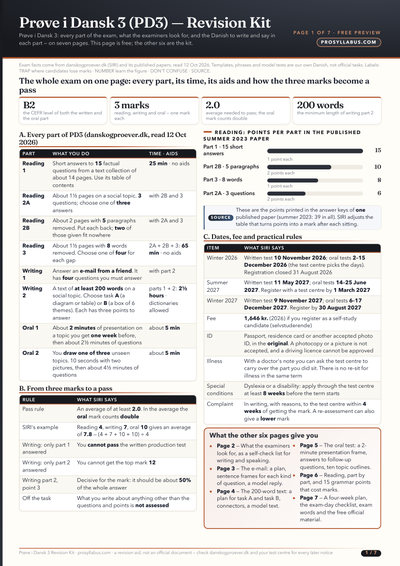


Checked 13 October 2026. Dates are from SIRI’s dates page and its Prøvedatoer 2027 PDF, read 13 October 2026; the 2027 fee is not published yet. The pass rule is BEK nr 1687 af 16/12/2025 §48 and bilag 1. The weekly content and the split of hours are our plan, not an official syllabus, and no authority says six weeks are enough.
- Cheatsheet + revision sheet: key concepts in 2 lines each
- All 8 parts: time, aids, marking
- 2.0 to pass, oral counts double
- 45 connectors and opinion phrases
- 2 model texts: e-mail and 200 words
- 10 oral topics with questions
Dansk 3 prøve: what a six-week plan has to respect
The “Dansk 3 prøve” is Prøve i Dansk 3 (PD3), the final test of Danish Education 3 at B2 level. A plan for it should start from how it is passed, not from a list of grammar chapters. You get three grades, for reading, writing and oral communication. You pass with an average of at least 2.0 in which the oral grade counts twice, and 2.0 cannot be reached by rounding [official: BEK 1687/2025 §48 stk.2; BEK 1759/2024 §12 stk.2]. The arithmetic, including why an oral 7 passes on its own, is worked through in the pass rule and calculator.
Three facts from that rule shape the plan below. The oral is worth half of the result, yet it is held weeks after the written day, so it needs time both before and after. In writing, one grade is given for both tasks and the second task is “afgørende”, decisive, for it (bilag 1 pt 3.23); that task is the text of at least 200 words (pt 3.30) [official]. And reading is marked with a key, so it is the part where method pays fastest.
Rule and times: BEK 1687/2025 bilag 1 pt 3.7, 3.10 and 3.22 [official]; 240 is our sum of 25 + 65 + 150. Deadline: SIRI’s Prøvedatoer 2027 PDF [official].
The dates the plan counts back from
PD3 is held twice a year, in May–June and November–December, and you register directly with a language centre [official: SIRI dates page]. SIRI has published the 2027 dates as a one-page PDF, “Prøvedatoer 2027”, linked from the dates page. The page is not consistent with itself here: on 13 October 2026 its running text for Prøve i Dansk 3 still said the summer 2027 date “offentliggøres senere” (will be published later), while the PDF linked lower on the same page gives the dates. The table uses the PDF [official]; if the two still differ when you read this, ask the language centre you register with. The written test is on one national day per term; the oral is held within a window, and the centre decides your day [official].
| Sitting | Register with a centre by | Written test | Oral window | Days from written day to oral window (ours) |
|---|---|---|---|---|
| Winter 2026 | 31 August 2026 (passed) | Tuesday 10 November 2026 | 2–15 December 2026 | 22 |
| Summer 2027 | 1 March 2027 | Tuesday 11 May 2027 | 14–25 June 2027 | 34 |
| Winter 2027 | 30 August 2027 | Tuesday 9 November 2027 | 6–17 December 2027 | 27 |
Two things follow. First, the registration deadline falls about ten weeks before the written day: 71 days before it for summer 2027 (our count). A six-week plan therefore begins after registration has closed; for summer 2027 week 1 starts on 30 March, four weeks after the deadline of 1 March. Register first, plan second. After the deadline a centre may still let you in “i særlige tilfælde”, and may refuse, for example if there is no room [official: SIRI dates page]. Second, the three to five weeks between the written day and the oral window are part of your preparation, and the plan uses them. Fees, ID and who may register are in the self-study, registration and fee guide.
How the hours are split, and why
The split below is ours. It follows the pass rule rather than habit: many learners spend most of their time on reading and grammar because those are easy to do alone, and leave the half of the result that is spoken until the topic arrives.
| Part | Share before the written day | Share after it | Why (the official fact behind it) |
|---|---|---|---|
| Oral | 35% | 100% | Counts twice in the average (bilag 1 pt 3.7). An oral 7 passes whatever the other two grades are (our arithmetic) |
| Writing | 40% | 0% | One grade for two tasks; the second task is decisive for it (pt 3.23) and must be at least 200 words (pt 3.30). It is slow to improve and needs feedback |
| Reading | 25% | 0% | Marked with a key, 31 answers in 90 minutes. Method and timing give quick gains; only one official practice set exists |
Our plan. The tool further down moves ten percentage points to the part you trust least and recalculates for your own hours.
If one part is clearly your weakest, shift time towards it; the planner does that for you. But be careful with the opposite instinct. A candidate who reads and writes well and dreads speaking is tempted to polish the written parts further. Under this pass rule that is the worst trade available: with reading 7 and writing 7, an oral of -3 still gives exactly 2.0, and nothing better than a bare pass (our arithmetic).
- Cheatsheet + revision sheet: key concepts in 2 lines each
- All 8 parts: time, aids, marking
- 2.0 to pass, oral counts double
- 45 connectors and opinion phrases
- 2 model texts: e-mail and 200 words
- 10 oral topics with questions
The six weeks, one by one
| Week | Weeks before the written day | Focus | What to do |
|---|---|---|---|
| 1 | 6 | Find your level | Sit the summer 2023 reading set on the clock (25 + 65 minutes) and mark it. Write one e-mail and one 200-word text. Record one 2-minute presentation. |
| 2 | 5 | The 200-word text | Three task-2 texts: one A, two B. Three paragraphs, point 3 about half, a reason after every opinion. |
| 3 | 4 | Reading method and grammar | Scan-read for facts against a 25-minute timer; practise paragraph order and gap-fill. Do the 20 correction drills and find the same errors in your own texts. |
| 4 | 3 | The e-mail and oral questions | Three e-mails of 30 minutes each. Answer the four kinds of follow-up question aloud on two topics. |
| 5 | 2 | One full written run | Reading 25 + 65 minutes, a 10-minute break, then 2½ hours of writing by hand with your dictionary. Compare with the official descriptions. |
| 6 | 1 | Repair and rest | Rewrite your weakest text, repeat your five most frequent errors, check your ID and the room time. No new material. |
Week 1: find your level
Begin with a measurement. Sit SIRI’s summer 2023 reading set on the clock, 25 minutes for delprøve 1 and 65 for the rest, with no dictionary, and mark it with the keys. Write one e-mail and one text of 200 words, by hand if your centre does not offer a computer. Record yourself giving a two-minute presentation on any societal topic. You now have three samples of your own Danish, and everything else in the plan refers back to them. The files are indexed, with working links, in the past-papers guide.
Week 2: the 200-word text
Write three task-2 texts this week, one task A and two task B. Keep to the three points of the task, give each its own paragraph and let the third take about half, which is what the published papers ask for. After each text, check it against SIRI’s descriptions of the grades. The model-answers guide shows a weaker and a stronger answer to the same task with every difference marked, and has a word counter with a checklist.
Week 3: reading method and grammar
You have used the official reading set, so this week is method on other texts. For delprøve 1, take any long informative text with headings, write five factual questions before reading, then find the answers against a timer. For 2B, cut a newspaper article into paragraphs and reassemble it. The examples guide has one short task of each type with the reasons for the answers. Then do the 20 correction drills and, more important, look for the same six patterns in the texts you wrote in weeks 1 and 2.
Week 4: the e-mail and the oral questions
Write three e-mails of thirty minutes each: all four questions answered, each tied to what the friend wrote. For the oral, take two topics and answer aloud the four kinds of follow-up question printed in the official censor and examiner booklet: clarifying, elaborating, asking for an explanation and a reason, and asking for your view with arguments (the regulation’s words are “opklaring, uddybning, begrundelse og stillingtagen”, bilag 1 pt 3.37). The 2024 booklet scripts three complete topics you can use.
Week 5: one full written run
Run the written day once from start to finish: reading 25 and 65 minutes, a break of about ten minutes, then 2½ hours of writing with the dictionary you will bring. Use the May–June 2022 writing paper if you have not opened it, and read SIRI’s passed answer afterwards. The point of the run is the clock: most people discover that the e-mail took too long.
Week 6: repair and rest
No new material. Rewrite your weakest text from the run. List your five most frequent errors and write each sentence correctly three times. Check what you must bring: original ID, a dictionary for writing, nothing for reading. The rules of the room and the list of accepted ID are in the written exam guide.
- Cheatsheet + revision sheet: key concepts in 2 lines each
- All 8 parts: time, aids, marking
- 2.0 to pass, oral counts double
- 45 connectors and opinion phrases
- 2 model texts: e-mail and 200 words
- 10 oral topics with questions
After the written day: the oral, with all your hours
Once the written test is behind you, every hour goes to the half of the result that is still open. The oral has two parts of five minutes each, instructions included: a presentation of about two minutes on a topic you are given in advance, followed by about 2½ minutes of questions, and then about 4½ minutes of questions on one of three topics drawn by lot [official: examiner booklet, May–June 2024].
While you wait for your topic, practise the unprepared part, because it cannot be learned by heart: answer a “hvorfor tror du …” question and a “hvilke fordele og ulemper …” question aloud every day, and give a reason without being asked. When the topic arrives, build the presentation in three sub-points, open with an outline and time it at two minutes. You may bring your own notes of one A4 page for the presentation (BEK 1687/2025 §26 stk.2) [official]. When exactly the topic is handed out is stated differently on SIRI’s page and in the regulation; both versions, and the whole oral day, are in the oral exam guide.
The free official material, and the week it belongs to
| Material | Publisher | Use it in |
|---|---|---|
| Reading set, summer 2023: two booklets, two text files, two keys | SIRI (danskogproever.dk) | Week 1 as a baseline, or week 5 for the full run — once only |
| Writing paper, May–June 2022 | SIRI | Week 5, the full run |
| Example of a passed written answer | SIRI | Week 5, after your own answer |
| Censor and examiner booklet, May–June 2024 | SIRI | Week 4 and every week after the written day |
| Video of a passed oral performance, with its picture sheet | SIRI | Week 1 to see the format; again after the written day |
| Guidance on topics and follow-up questions, January 2025 | SIRI | Week 4: it lists example topics and question types |
| Assessment guides, written (May 2025) and oral (December 2024) | SIRI — now behind a login; archived copies exist | Week 2 and week 5, to compare your texts with real graded answers |
| Prøvedatoer 2027 and the dates page | SIRI | Before week 1: register by the deadline |
If you have fewer than six weeks
The planner drops the weeks that have already passed, but the priorities are worth stating. With four weeks, merge weeks 3 and 4 and keep the full run. With two weeks, do the timed reading set, two task-2 texts and one e-mail, and speak every day. With days, read the pass rule again and put your time where the weights are: the 200-word text in writing, and a presentation you can deliver in two minutes. All of this is our advice.
What this plan cannot promise
No authority says that six weeks are enough, and we do not either. PD3 closes module 5 of Danish Education 3, a course that takes most people far longer than six weeks. The plan is for someone whose Danish is already near B2 and who needs to turn it into three grades. The official statistics show how much the route matters: among those who completed all parts, candidates enrolled on a course passed far more often than self-studiers. The figures and their source are in the self-study and pass-rate guide. If your week-1 samples are far from the descriptions of a pass, the useful decision may be the later sitting.
The same exam on seven printable pages
The kit carries a four-week version of this plan on its last page, with the exam-day checklist beside it.
The Prøve i Dansk 3 revision kit is a seven-page PDF in English with the Danish you need: the whole exam on one page, what the examiners look for as a self-check list, a plan and sentence frames for the e-mail, a plan and connectors for the 200-word text, a frame for the 2-minute presentation with ten topic outlines, reading part by part with 15 grammar points, and a four-week plan. Its exam facts come from danskogproever.dk; its model texts are our own, never official tasks. Page 1 is free to read in full before you decide.
Frequently asked questions
What is the Dansk 3 prøve?
Prøve i Dansk 3 (PD3), the final test of Danish Education 3 after module 5, at level B2. It has a written part (reading and writing) and an oral part, and gives three grades.
When is PD3 in 2027?
Written test on Tuesday 11 May 2027 with orals from 14 to 25 June, and on Tuesday 9 November 2027 with orals from 6 to 17 December, according to SIRI’s Prøvedatoer 2027.
When must I register for the May 2027 test?
By 1 March 2027, with a language centre. That is 71 days before the written day by our count.
Is six weeks enough to prepare for PD3?
No authority says so. Six weeks can turn Danish that is already close to B2 into exam performance; it is not a way to reach B2 from a lower level.
Which part should I spend most time on?
Our plan gives writing 40%, the oral 35% and reading 25% before the written day, then all time to the oral. The oral counts twice in the average.
How long is it between the written and the oral test?
The oral window opens 22 days after the written day in winter 2026, 34 days in summer 2027 and 27 days in winter 2027. Your centre picks your day within the window.
What free material does SIRI publish?
A complete reading set with keys, a writing paper with a passed answer, an examiner booklet for the oral, a video of a passed oral and guidance on topics.
Should I practise writing by hand?
Yes, unless your centre has told you that you can use a computer. SIRI says you write by hand and that some centres offer a computer.
Can I prepare the oral topic in advance?
Only the first part. You are given a presentation topic shortly before the oral term. The second topic is drawn by lot in the room.
What if I am strong on paper but weak at speaking?
Then the oral is where your time should go. With 7 in reading and 7 in writing, an oral of -3 gives exactly 2.0; any slip on paper and the test is failed.
Is there a course I must take before PD3?
No. You can register as a self-studier with a language centre and pay the fee. Our self-study guide covers the fee and the rules.
More in this series
- The pass rule: oral counts double, 2.0 with no rounding (calculator)
- The written day: three reading parts (four sections), two writing tasks
- The oral exam: 2-minute presentation and a drawn picture topic
- PD2 or PD3 for permanent residence and citizenship (chooser)
- Self-study: registration, the 1,646 kr fee, pass rates, 10/7/7 for doctors
- Examples: one original task for each part, with what the examiner looks for
- Written: two tasks, a weaker and a stronger answer to each, with our grade estimates
- Past papers: where the official PDFs are, what is not published, and a practice planner
- Six grammar areas, 20 correction drills with an answer checker
- Alinea dansk prøve: the Bliv klar books and the official material, part by part
- PD3 notice board — official updates
Sources
- official — SIRI — Tilmeldingsfrister og prøvedatoer (2026 dates, 2027 notice, 2026 fees)
- official — SIRI — Prøvedatoer 2027 (PDF, 1 page)
- official — BEK nr 1687 af 16/12/2025 — tests in Danish education for adult foreigners, with bilag 1–3 (retsinformation.dk)
- official — BEK nr 1759 af 30/12/2024 — the 7-point grading scale for the Danish tests (retsinformation.dk)
- official — SIRI — Om Prøve i Dansk 3 og krav til at bestå (for candidates)
- official — SIRI — Om Prøve i Dansk 3 (PD3), indhold og niveau (for language centres)
- official — SIRI — PD3 oral censor and examiner booklet, May–June 2024 (PDF)
- official — SIRI — Vejledning om valg af emner og opfølgende interviewspørgsmål, PD2 and PD3 oral delprøve 1, January 2025 (PDF)
- official — SIRI sample — PD3 reading, delprøve 1 question booklet, summer 2023 (PDF)
- official — SIRI sample — PD3 reading, delprøve 2A, 2B and 3 question booklet, summer 2023 (PDF)
- official — SIRI sample — PD3 written production paper, summer 2022 (PDF)
- official — SIRI sample — example of a passed PD3 written answer, at its current address (PDF, 2 pages)
- official — SIRI sample — video of a passed PD3 oral performance (MP4)
- official — SIRI — Bedømmelsesvejledning, skriftlig del af Prøve i Dansk 3, May 2025 (PDF, 33 pages; Wayback index lists a capture of 12 Sep 2025, but its replay returned 404 on 13 Oct 2026 — SIRI has since moved its assessment guides to its assessor-training site)
- official — SIRI — Bedømmelsesvejledning, mundtlig del af Prøve i Dansk 3, December 2024 (PDF, 34 pages; Wayback capture of 12 Sep 2025)
- official — SIRI — Bedømmelsesvejledninger og lydfiler (says the guides have moved to the assessor-training site)
official = a document published by the conducting body. reported = a news or coaching site we could not check against an original. Where sources disagree this page says so rather than picking one.


