
Checked 13 October 2026. From lag (2001:82) om svenskt medborgarskap as amended to SFS 2026:1689, förordning (2026:451) as amended to SFS 2026:1194, and Migrationsverket’s citizenship pages in Swedish and English, read 13 October 2026. Migrationsverket decides each case; where the Act and the agency’s page word something differently, both are printed.
Who must take medborgarskapsprovet: the rule in one paragraph
Three official texts answer this, and this page uses nothing else: the Citizenship Act, the government’s ordinance on the test, and Migrationsverket’s own pages. Put together they say: an applicant for Swedish citizenship who is 16 or older and has not turned 67 must show knowledge of Swedish society; that is done with a pass on the citizenship test in samhällskunskap unless the applicant holds one of the school grades the Act lists; a few groups are outside the requirement altogether; and nobody sits the test without first being referred by Migrationsverket [official: lag (2001:82) 11–13 c §§; förordning (2026:451) 4–5 §§].
Official: lag (2001:82) om svenskt medborgarskap. Migrationsverket states the age range as 16 to 66.
“Migrationsverket medborgarskap test” is how many people search for this, and it is half right. Migrationsverket decides who takes the test and uses the result; UHR builds and runs the test and decides the result (ordinance 3–4 §§) [official]. Questions about whether you must take it go to Migrationsverket. Questions about registration and the test day go to UHR.
The three texts and what each one says
| Text | What it says | In Swedish |
|---|---|---|
| Lag (2001:82) 11 § first paragraph 6 | An adult applicant must have shown sufficient knowledge of Swedish and of Swedish society “enligt 13 §”. | “har visat tillräckliga kunskaper i svenska och om det svenska samhället enligt 13 §” |
| Lag (2001:82) 11 § second paragraph | That requirement does not apply to a person who has turned 67. | “Kravet i första stycket 6 gäller inte den som har fyllt 67 år.” |
| Lag (2001:82) 12 § first paragraph 5 | For a child the knowledge requirement applies if the child has turned 16. | “om barnet har fyllt sexton år” |
| Lag (2001:82) 13 § | Knowledge of Swedish society is shown by a passed citizenship test in samhällskunskap, unless 13 c § gives another way. | “visas genom godkänt medborgarskapsprov i samhällskunskap om inte annat följer av 13 c §” |
| Lag (2001:82) 13 c § | A pass grade in samhällskunskap or basic social-studies subjects from listed school forms also shows the knowledge. | “godkänt betyg i samhällskunskap eller grundläggande samhällsorienterande ämnen” |
| Lag (2001:82) 11 c § and 12 a § | Without shown knowledge, naturalisation is possible only if a disability or other personal circumstances make it unreasonable to ask. | “på grund av en funktionsnedsättning eller andra personliga förhållanden, inte rimligen kan begäras” |
| Förordning (2026:451) 4–5 §§ | Migrationsverket refers applicants to UHR; a person who is to take part must have been referred. | “Den som ska delta i ett medborgarskapsprov ska ha anvisats enligt 4 §.” |
| Migrationsverket, citizenship for adults | The requirement applies to those aged 16 to 66. Stateless persons born in Sweden under 21 and Nordic citizens who have made a notification are exempt. A disability or other reasons can exempt. | “Kravet gäller dig som är mellan 16 och 66 år.” |
Medborgarskapsprov undantag: who is outside the requirement
“Undantag” means exception. The table lists every group that one of the three texts places outside the knowledge requirement, with the text it comes from. If a group is not in this table, we did not find it in the Act, the ordinance or on Migrationsverket’s page.
| Group | Source | What to note |
|---|---|---|
| Children under 16 | Lag (2001:82) 12 § first paragraph 5 | The requirement applies only once the child has turned 16. |
| People who have turned 67 | Lag (2001:82) 11 § second paragraph; Migrationsverket: “16 to 66” | The Act says “har fyllt 67 år”; Migrationsverket gives the range. Both mean the same age line. |
| Nordic citizens who have made a notification (anmälan) | Migrationsverket, Swedish page | Limited to the notification route. See the next section. |
| Stateless persons born in Sweden who are under 21 | Migrationsverket | The notification routes in the Act are 6 § (a child) and 8 § (aged 18 to 20); neither lists knowledge among its conditions. |
| A person for whom, because of a disability or other personal circumstances, it cannot reasonably be asked | Lag (2001:82) 11 c § fourth paragraph; 12 a § for children | Decided case by case by Migrationsverket. No list of conditions is given. |
Nordic citizens: the exemption is for a notification, not for every Nordic applicant
This is the point most often copied wrongly, including in short summaries that say “Nordic citizens are exempt”. Migrationsverket’s Swedish page reads: “nordiska medborgare som har gjort en anmälan om svenskt medborgarskap är undantagna från kunskapskraven” — Nordic citizens who have made a notification of Swedish citizenship are exempt from the knowledge requirements. The English version of the same page says Nordic citizens “who have applied for Swedish citizenship”. The two words are not the same thing in this law, so we print both and follow the Swedish page, which uses the Act’s own term [official: Migrationsverket, Swedish page; English page].
A citizen of Denmark, Finland, Iceland or Norway has two main ways to become Swedish, and they are different procedures with different conditions. (The Act has a third, narrower notification in 19 §: a person who has lost Swedish citizenship and has since continuously been a citizen of one of those countries gets it back by notification on taking up residence in Sweden.)
| Route | Conditions in the text | Knowledge requirement | Fee stated by Migrationsverket |
|---|---|---|---|
| Notification (anmälan), 18 § | Has turned 18; habitual residence in Sweden for five years; not sentenced to a custodial penalty during that time. | Not among the conditions in 18 §. Migrationsverket: exempt. | 475 kr |
| Application (ansökan), 11 § with 11 a § | The ordinary conditions of 11 §, with residence shortened to two years for Danish, Finnish, Icelandic and Norwegian citizens. | 11 a § shortens the residence period only; 11 § first paragraph 6 is not removed. Our reading of the text: it applies. | The ordinary application fee |
Migrationsverket’s page for Nordic citizens puts the choice this way: if you have lived in Sweden for at least five years you can make a notification; if you have not, you can instead make an application, for which you must have lived in Sweden for at least two years [official: Migrationsverket]. The last cell of the second row above is our reading of the Act, not a sentence from the agency. If you are a Nordic citizen with between two and five years in Sweden, ask Migrationsverket before assuming either way.
Inside the requirement, but no test: the grades in 13 c §
The largest group that never sits the test is not “exempt” at all. These applicants have the requirement and meet it with a grade. 13 c § says knowledge of Swedish society can also be shown by a pass grade in samhällskunskap or grundläggande samhällsorienterande ämnen from [official]:
- the final year of compulsory school (grundskolan) or adapted compulsory school, or one of the last two years of special school;
- upper secondary school (gymnasieskolan), adapted upper secondary school, or folk high school studies at upper secondary level;
- municipal adult education (kommunal vuxenutbildning, Komvux).
Source: lag (2001:82) 13 c §. Migrationsverket’s page lists the same three.
Two things that sound close are not in that list: a grade from SFI, which is about the Swedish language, and the certificate from the newcomers’ course called samhällsorientering. The comparison guide explains both. UHR adds a practical note: if you realise you meet the requirement another way after you have registered, send a message through its contact form [official: UHR, Frågor och svar].
Everyone else: referred by Migrationsverket, then the test
If you are 16 to 66, hold none of the grades and are in none of the groups above, the test is how you show the knowledge. You still cannot simply book it. The ordinance gives Migrationsverket the task of referring applicants, and says a participant must have been referred. UHR’s wording: “Det är Migrationsverket som avgör vem som får skriva provet. Du kan bara anmäla dig om du fått ett anvisningsbrev från Migrationsverket” [official: UHR].
Registration is closed today and the next date is not announced; what is and is not fixed about the test itself is in the format guide. If you fail, UHR says you may get the chance to show your knowledge again and that you should contact Migrationsverket about what applies to you.
Checker: must I take the test?
The same logic as a table, for readers without the tool. Read down and stop at the first row that fits you.
| If this is true | Result | Rests on |
|---|---|---|
| Nordic citizen, 18 or older, becoming Swedish by notification (18 §) | Exempt from the knowledge requirements on Migrationsverket’s wording. No test. | Migrationsverket; lag (2001:82) 18 § |
| Born in Sweden, stateless since birth, under 21 | Exempt on Migrationsverket’s wording. No test. | Migrationsverket; lag (2001:82) 6 § and 8 § |
| Applying, and under 16 | The requirement has not started. No test. | 12 § first paragraph 5 |
| Applying, and 67 or older | The requirement does not apply. No test. | 11 § second paragraph |
| Applying, 16 to 66, with a pass grade listed in 13 c § | The requirement applies and the grade meets it. No test. | 13 c § |
| Applying, 16 to 66, no grade, disability or other personal circumstances | An exemption is possible; Migrationsverket decides. Otherwise the test, with an adaptation if UHR grants one. | 11 c § (12 a § for a child); ordinance 7 § |
| Applying, 16 to 66, no grade, none of the above | The test, once Migrationsverket has referred you. | 13 §; ordinance 4–5 §§ |
Three things that look like exemptions and are not
- The fee exception. The ordinance frees a person who is stateless and has refugee status or a travel document from a Swedish authority from the 2,000-kronor fee (6 § second paragraph). That is an exception from paying, not from the test.
- An adaptation. UHR may adapt the test for a participant who needs it because of a disability or other personal circumstances (ordinance 7 §): extended time, enlarged text, changes to the room. You still take the test.
- Having lived in Sweden a long time. Neither the Act nor Migrationsverket’s page lists years of residence as a way to show knowledge. Residence is its own requirement.
Sources: förordning (2026:451) 6–7 §§; UHR’s page on adaptations; lag (2001:82) 11 §.
What the texts do not say
We looked for answers to the questions below in the Act, the ordinance and Migrationsverket’s pages and did not find them. We leave them open rather than guess.
| Question | What we found |
|---|---|
| Which disabilities or circumstances count under 11 c §? | No list. The test is whether it “cannot reasonably be asked”. Migrationsverket decides. |
| Does a foreign school or university qualification in civics count? | 13 c § lists Swedish school forms only. Nothing on foreign qualifications. |
| Does a Swedish university degree replace the test? | Not listed in 13 c §. |
| Does a passed test or a grade expire? | Nothing stated. |
| How many times may the test be retaken? | UHR says only that a person who fails may get the chance to show knowledge again and should contact Migrationsverket. |
Knowledge of Swedish is the other half of the same requirement, with its own list of proofs: see the språkkrav guide. All six requirements for citizenship are in the requirements guide.
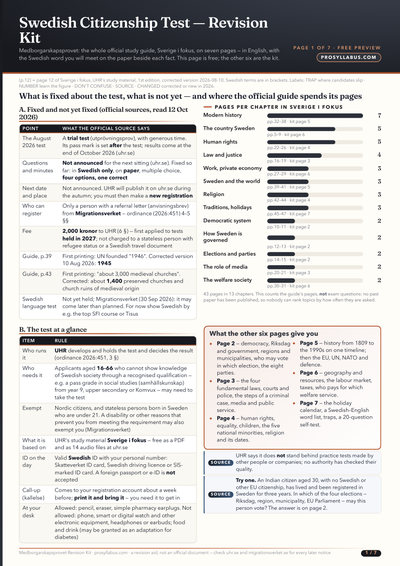
Preview the medborgarskapsprovet revision kit
If the checker says the test applies to you, the next question is what to read. The kit puts the whole official guide, Sverige i fokus, on seven pages in English, with the Swedish word you will meet on the paper beside each fact and the guide’s page number after it. Page 1 is free to read in full on the kit page, where you can also see the contents of the other six pages before deciding.
Frequently asked questions
Who must take medborgarskapsprovet?
An applicant for citizenship who is 16 or older and has not turned 67, who has no pass grade in samhällskunskap from the school forms listed in 13 c § of the Citizenship Act, who is not in an exempt group, and whom Migrationsverket has referred to the test.
At what age does the requirement stop?
The Act says the knowledge requirement does not apply to a person who has turned 67. Migrationsverket states the range as 16 to 66.
Are Nordic citizens exempt from the test?
Migrationsverket’s Swedish page says Nordic citizens who have made a notification (anmälan) of Swedish citizenship are exempt from the knowledge requirements. The notification route in 18 § needs five years of residence. The English page says “applied”; the two wordings are both printed above.
Do children have to take the test?
For a child the knowledge requirement applies once the child has turned 16. Under 16 it does not.
I studied samhällskunskap at Komvux. Do I need the test?
A pass grade in samhällskunskap from municipal adult education is one of the proofs listed in 13 c §, so on the text of the Act you do not. Send the grade to Migrationsverket.
Does an SFI grade exempt me from the civics test?
No. A pass grade in the highest SFI course is a proof of Swedish under 13 a §. It is not in the list of proofs of knowledge of Swedish society in 13 c §.
Can I be exempt because of a disability?
The Act allows naturalisation without shown knowledge if, because of a disability or other personal circumstances, it cannot reasonably be asked (11 c §). Migrationsverket decides each case. UHR can also adapt the test.
Can I take the test before I apply for citizenship?
No. The ordinance says a participant must have been referred by Migrationsverket, and UHR says you can only register with a referral letter.
Who do I ask about the referral letter?
Migrationsverket. UHR says questions about the letter must go there.
Who is exempt from the test fee?
A person who is stateless and has refugee status or a travel document from a Swedish authority (ordinance 6 §). This is an exception from the fee, not from the test. The fee first applies to tests held in 2027.
More in this series
- Medborgarskapsprovet: what is decided, what is not, and a 10-question mini test
- Medborgarskapsprov frågor: 30 practice questions with answers, by chapter
- Språkkravet: the Swedish level required and how to check which proof you hold
- Svenskt medborgarskap krav: the six requirements and what the test covers (checklist)
- Samhällskunskap for the test: all 13 chapters on one page, with a revision tracker
- Swedish citizenship test in English: a guide for expats, with a 10-question mini test
- Svensk medborgarskap test: a 2-week study plan, day by day, with a tracker
- Medborgarskapsprov svåra frågor: rights, democracy, history, 15 worked questions
- Medborgarskapsprov vs SFI and samhällsorientering: what is different, what to study
Sources
- official — Lag (2001:82) om svenskt medborgarskap, amended up to SFS 2026:1689: 11–13 e §§ (riksdagen.se)
- official — Förordning (2026:451) om medborgarskapsprov, amended up to SFS 2026:1194 (riksdagen.se)
- official — Migrationsverket — Medborgarskap för vuxna (the Swedish version of the same page)
- official — Migrationsverket — Citizenship for adults: requirements, knowledge of Swedish and Swedish society, maintenance, orderly life, fee (read 13 October 2026)
- official — Migrationsverket — Anmälan om svenskt medborgarskap för dig som är medborgare i Norden (read 13 October 2026)
- official — UHR — Frågor och svar om medborgarskapsprovet (read 13 October 2026)
- official — UHR — Om medborgarskapsprovet (page last updated 17 August 2026; read 13 October 2026)
- official — UHR — Anpassningar: extended time, enlarged text, physical test environment (updated 8 June 2026)
official = a document published by the conducting body. reported = a news or coaching site we could not check against an original. Where sources disagree this page says so rather than picking one.


