Checked 13 October 2026. From Skolverket’s pages on SFI, förordning (2010:1138) and lag (2013:156) on samhällsorientering, the county administrative boards’ site informationsverige.se, UHR’s pages on the test and lag (2001:82), all read 13 October 2026. SFI rules changed on 1 January 2026; the match between samhällsorientering and the test’s chapters is our own reading and the course differs between municipalities.
Medborgarskapsprov, SFI and samhällsorientering: three different things
Many people who are told about medborgarskapsprovet have already sat in a Swedish classroom: SFI (svenska för invandrare, Swedish for immigrants), or the newcomers’ course samhällsorientering, or both. The natural questions are whether that already counts, and whether the test is just the same content again. The short answers, each taken from an official text:
- SFI is a language education. A pass grade in its highest course is one of the proofs of Swedish the Citizenship Act lists (13 a § 2). It is not a proof of knowledge of Swedish society.
- Samhällsorientering is a course about society, given as far as possible in your own language. It ends with a certificate (intyg), and that certificate is not among the proofs listed in 13 c §.
- Medborgarskapsprovet is a test, in Swedish only, on the content of the study guide Sverige i fokus. Passing it is how knowledge of Swedish society is shown, unless you hold one of the school grades listed in 13 c §: samhällskunskap or basic social-studies subjects.
Sources: lag (2001:82) 13–13 c §§; förordning (2010:1138) 7 and 10 §§; UHR.
Official: Skolverket; förordning (2010:1138) 3 and 5 §§; Sverige i fokus.
Side by side
Every cell is from the official page or legal text named in the last row. Where a text says nothing, the cell says so.
| Point | Medborgarskapsprovet | SFI | Samhällsorientering |
|---|---|---|---|
| What it is | A knowledge test for citizenship applicants. | Municipal adult education in Swedish for people who need basic knowledge of the language. | A course on Swedish society for certain newly arrived immigrants. |
| Who is responsible | UHR builds and runs it; Migrationsverket refers applicants. | The municipality (part of Komvux); Skolverket publishes the syllabus. | Each municipality must offer it; the county administrative boards follow it up. |
| Who it is for | Applicants Migrationsverket has referred. | From 1 July of the year you turn 16, resident in Sweden and lacking the basic Swedish the education gives. No upper age limit. | New arrivals who have turned 18 and are below the target pension age, are registered in a municipality and hold one of the residence permits, or the residence card, that the Act lists. Not citizens of EEA countries or Switzerland, and not pupils in upper secondary school. |
| Language | Swedish only. | Swedish is what is taught. | As far as possible in the mother tongue or another language the participant knows well; an interpreter if needed. |
| Content | The 13 chapters of Sverige i fokus; eleven knowledge areas in the ordinance. | Communicating in speech and writing in everyday life, society, studies and work. Courses A to D on three study paths. | Eight parts; the emphasis is on the practical side of living in Sweden. |
| Length | Test time not announced. | Differs by person. At least 15 hours of teaching a week; three years from admission, at most six with special reasons. | At least 100 hours; normally finished within a year of starting. |
| What you get | A result in your UHR account, reported to Migrationsverket. | A grade after each course: Godkänt or Icke godkänt. | A certificate (intyg) from the municipality. |
| Cost to you | 2,000 kronor in the ordinance, first for tests held in 2027, and not charged to a stateless person with refugee status or a Swedish travel document; UHR says fee information will come. | Free. | Free. |
| What it shows for citizenship | Knowledge of Swedish society (13 §). | Knowledge of Swedish, if it is a pass grade in the highest course (13 a § 2). | Not listed in 13 a § or 13 c §. |
| Source | UHR; lag (2001:82); förordning (2026:451) | Skolverket, Utbildningsguiden and the SFI page | Lag (2013:156); förordning (2010:1138); informationsverige.se |
SFI and the citizenship test
Skolverket describes SFI as an education “för dig som behöver grundläggande kunskaper i svenska”, for those who need basic knowledge of Swedish. The stated aim is that you can communicate orally and in writing in everyday life, in society, in studies and at work [official: Skolverket, Utbildningsguiden]. The goals Skolverket lists on that page are language goals: adapting language to purpose and audience, strategies for learning and reading, digital tools, and relating to information from different sources. Knowledge of how Sweden is governed is not among them.
| SFI fact | What Skolverket says |
|---|---|
| Study paths | Three: 1, 2 and 3. Path 1 is for those with little or no schooling; path 3 for those more used to studying. |
| Courses | Each path consists of courses that build on each other in difficulty, A to D. You may stop after any course, but you must be given the chance to study up to and including course D, whichever course you started on. |
| Grades | Godkänt or Icke godkänt, after each completed course. |
| Testing without the course | A person resident in Sweden may take a “prövning” in a course to get a grade; it is only done by a municipality that offers the course. |
| Time limit | Three years from admission; longer with special reasons, at most six years. Skolverket’s page for teachers dates the new rules, including the three-year limit, from 1 January 2026. |
| Cost | Free; books and learning tools are provided. No student aid from CSN for SFI. |
For citizenship, the Act names one SFI result: “godkänt betyg i den högsta kursen i kommunal vuxenutbildning i svenska för invandrare eller motsvarande utbildning” (13 a § 2). Skolverket’s page shows course D as the last of the four, and Migrationsverket’s English page calls it “the highest level” of SFI. So a pass in course D meets the Swedish requirement; a pass in course B or C is not in the list. The other proofs of Swedish are in the språkkrav guide.
Where other pages get this wrong
Finishing SFI does not replace the citizenship test in samhällskunskap.
Commonly published instead: that “SFI is enough for citizenship”, without saying which requirement it meets.
The Act has two separate lists. 13 a § lists proofs of Swedish and includes the highest SFI course. 13 c § lists proofs of knowledge of Swedish society and names only grades in samhällskunskap or basic social-studies subjects from compulsory school, upper secondary school or folk high school at that level, and Komvux. SFI is in the first list and not the second [official: lag (2001:82)].
Samhällsorientering and the citizenship test
Samhällsorientering has its own Act and ordinance. The ordinance says the course “syftar till att underlätta de nyanländas etablering i arbets- och samhällslivet”: it aims to make it easier for new arrivals to establish themselves in working life and society. It is to give a basic understanding of Swedish society, with the goal that participants develop knowledge of human rights and fundamental democratic values, the individual’s other rights and obligations, how society is organised, and practical everyday life (2 §) [official: förordning (2010:1138)].
The ordinance then lists eight parts (3 §). The county administrative boards’ site describes each in a line. The last column is our reading of which chapters of the test’s study guide come closest; it is a guide to where to start, not an official mapping.
| Part of samhällsorientering (3 §) | In English (ours) | Described on informationsverige.se as | Closest chapters of Sverige i fokus (our reading) |
|---|---|---|---|
| 1. Att komma till Sverige | Coming to Sweden | the basis of Sweden’s democracy; Sweden’s history and development up to today | 2. Sveriges demokratiska system; 10. Sveriges moderna historia |
| 2. Att bo i Sverige | Living in Sweden | looking for a home, contacting authorities, what to do in an accident | No close match |
| 3. Att försörja sig och utvecklas i Sverige | Supporting yourself and developing in Sweden | looking for work, why we pay tax and what the tax money is used for | 8. Arbetsmarknad och privatekonomi; 9. Välfärdssamhället |
| 4. Individens rättigheter och skyldigheter | The individual’s rights and obligations | human rights and how they affect the laws in Sweden | 5. Lag och rätt; 7. Mänskliga rättigheter |
| 5. Att bilda familj och leva med barn i Sverige | Starting a family and living with children in Sweden | being a parent in a new country; the support society can offer families | 7. Mänskliga rättigheter |
| 6. Att påverka i Sverige | Having an influence in Sweden | how Sweden is governed and which parties are in the Riksdag | 3. Så här styrs Sverige; 4. Politiska val och partier |
| 7. Att vårda sin hälsa i Sverige | Looking after your health in Sweden | how health care works and how to find your way in it | 9. Välfärdssamhället |
| 8. Att åldras i Sverige | Growing old in Sweden | the rights and possibilities of older people and the help available | 9. Välfärdssamhället |
On that reading, eight of the 13 chapters (kapitel 2, 3, 4, 5, 7, 8, 9, 10; 27 of the 43 pages) have a part of samhällsorientering described as touching the same subject, and five do not: kapitel 1 (Landet Sverige), 6 (Mediernas roll), 11 (Sverige och omvärlden), 12 (En sekulär stat och ett mångreligiöst land), 13 (Traditioner och högtider), together 16 pages. The page figures are our arithmetic.
Three differences matter more than the overlap.
- Language. The ordinance says samhällsorientering is to be given, as far as possible, in the mother tongue or another language the participant knows well (7 §). The test is in Swedish only. Knowing that the regions run health care is not the same as recognising “regionerna ansvarar för hälso- och sjukvården” in a question.
- Emphasis. The ordinance puts the weight on “den praktiska aspekten av att leva i Sverige”, the practical side of living in Sweden, and lets each municipality adapt content and scope to the participants and local conditions (3 § and 6 §). The test is based on one national text.
- Proof. The course ends with a certificate that states its scope and content (10 §). There is no grade and no test in the ordinance.
Source: förordning (2010:1138) 3, 6, 7 and 10 §§.
“Samhällsorienterande ämnen” in the Act is not the course samhällsorientering
The words are confusingly close. 13 c § accepts a pass grade in “samhällskunskap eller grundläggande samhällsorienterande ämnen” from compulsory school, upper secondary level or Komvux. That is a grade in a school subject, from the school forms the paragraph lists. Samhällsorientering for new arrivals is a different thing under a different Act, lag (2013:156); it is offered by the municipality, gives a certificate and no grade, and is not one of those school forms. We found no sentence in the Act or on Migrationsverket’s page that accepts the certificate. That is our reading of the texts; if you hold only the certificate, ask Migrationsverket rather than assume [official: lag (2001:82) 13 c §; lag (2013:156)].
What do I already know? A checker
The same answers as a table, for readers without the tool.
| What you hold | Swedish requirement | Swedish society requirement | What to study |
|---|---|---|---|
| Pass grade in the highest SFI course (course D) | Shown (13 a § 2) | Not shown: the test, or a school grade listed in 13 c § | All 13 chapters; your reading Swedish is a real head start. |
| Pass grade in an SFI course below the highest | Not in the list in 13 a § | Not shown | Both: finish course D or another listed proof of Swedish, and the 13 chapters. |
| Certificate from samhällsorientering | Not shown | Not listed in 13 c §: the test, or a school grade that is listed there | Start with kapitel 1, 6, 11, 12, 13, then learn the Swedish terms for the rest. |
| Both course D and the certificate | Shown (13 a § 2) | Not shown | Kapitel 1, 6, 11, 12, 13 first; then practice questions in Swedish on everything. |
| Pass grade in samhällskunskap or basic social-studies subjects from Komvux or the Swedish school forms in 13 c § | Separate: needs its own proof | Shown (13 c §): no test | Nothing for the civics test. Check the Swedish requirement. |
| None of these | Not shown | Not shown | Both requirements are open. The test covers only the second. |
What to study, depending on where you start
If you did SFI. You can read. Use that: go straight to the Swedish text of Sverige i fokus instead of a translation, and let the two-week plan set the pace. The vocabulary of the guide is more formal than everyday SFI Swedish: “statsskick”, “rättsväsendet”, “offentlighetsprincipen”. The topic map lists the words to know for each chapter.
If you did samhällsorientering. You have met much of the content, probably not in Swedish. Your job is translation in the literal sense: attach the Swedish term to each thing you already understand. Then read the five chapters with no close match in the course descriptions, which are also where many concrete facts sit: geography, the media, Sweden and the world, religion, and traditions and holidays.
If you did neither. Nothing is assumed. The guide in English explains the test and the steps, and the 30 practice questions show the level of the Swedish.
If you are still choosing a course. One route removes the test altogether: a pass grade in samhällskunskap from Komvux is itself a proof under 13 c §. Whether that is quicker for you than preparing for the test depends on your municipality’s courses and on your Swedish; we have no official figures to compare the two. The exemption guide lists every route.
Practise it, don't just read it
Whichever course you came from, the test is in Swedish. Try one full quiz in Swedish to see where you stand.
One Swedish practice quiz is live on the exam page today: 12 questions on democracy and how Sweden is governed, four options each, with the reason for every answer. None of its questions is repeated on this page.
Preview the medborgarskapsprovet revision kit
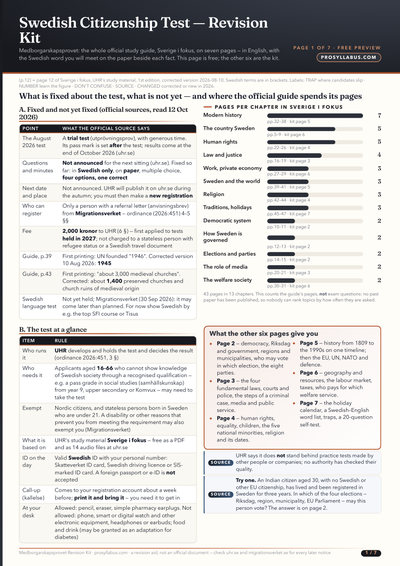
If the content is familiar from a course but the Swedish terms are not, a page that puts the two side by side is the quickest bridge. The kit puts the whole official guide, Sverige i fokus, on seven pages in English, with the Swedish word you will meet on the paper beside each fact and the guide’s page number after it. Page 1 is free to read in full on the kit page, where you can also see the contents of the other six pages before deciding.
Frequently asked questions
Is SFI enough for Swedish citizenship?
For the Swedish-language requirement, a pass grade in the highest SFI course is one of the proofs the Act lists. It does not show knowledge of Swedish society, which needs the citizenship test or one of the school grades listed in 13 c § (samhällskunskap or basic social-studies subjects).
Which SFI course counts for citizenship?
The Act says the highest course. Skolverket describes four courses, A to D, so that is course D.
Does samhällsorientering replace medborgarskapsprovet?
The course certificate is not among the proofs of knowledge of Swedish society listed in 13 c § of the Citizenship Act, and we found nothing on Migrationsverket’s page that accepts it. Ask Migrationsverket about your own case.
Is the test the same content as samhällsorientering?
Partly. By our reading of the official one-line descriptions, eight of the 13 chapters of the test’s study guide have a part of samhällsorientering on the same subject. The course stresses practical everyday life and is adapted locally; the test is based on one national text.
In which language is samhällsorientering given?
As far as possible in the participant’s mother tongue or another language they know well, with an interpreter if needed. The citizenship test is in Swedish only.
How long is samhällsorientering?
At least 100 hours, and it should normally be finished within a year of starting.
Is there a test at the end of SFI or samhällsorientering?
SFI gives a grade, Godkänt or Icke godkänt, after each course. The ordinance on samhällsorientering provides for a certificate and mentions no test or grade.
Does a grade in samhällskunskap from Komvux count?
Yes. A pass grade in samhällskunskap from municipal adult education is listed in 13 c § as a proof of knowledge of Swedish society.
Can EU citizens take samhällsorientering?
The Act on samhällsorientering says it does not apply to citizens of countries in the European Economic Area or Switzerland.
What does SFI cost?
Skolverket says the education is free and that books and learning tools are provided.
More in this series
- Medborgarskapsprovet: what is decided, what is not, and a 10-question mini test
- Medborgarskapsprov frågor: 30 practice questions with answers, by chapter
- Språkkravet: the Swedish level required and how to check which proof you hold
- Svenskt medborgarskap krav: the six requirements and what the test covers (checklist)
- Samhällskunskap for the test: all 13 chapters on one page, with a revision tracker
- Swedish citizenship test in English: a guide for expats, with a 10-question mini test
- Svensk medborgarskap test: a 2-week study plan, day by day, with a tracker
- Medborgarskapsprov undantag: who must take the test, who is exempt, with a checker
- Medborgarskapsprov svåra frågor: rights, democracy, history, 15 worked questions
Sources
- official — Lag (2001:82) om svenskt medborgarskap, amended up to SFS 2026:1689: 11–13 e §§ (riksdagen.se)
- official — Skolverket, Utbildningsguiden — Om komvux i svenska för invandrare (sfi): who may study, courses A–D, study paths 1–3, grades, time limit (read 13 October 2026)
- official — Skolverket — Komvux i svenska för invandrare (sfi): the page for teachers, with the note on rules from 1 January 2026 (read 13 October 2026)
- official — Förordning (2010:1138) om samhällsorientering för vissa nyanlända invandrare, amended up to SFS 2019:1310 (riksdagen.se)
- official — Lag (2013:156) om samhällsorientering för vissa nyanlända invandrare, amended up to SFS 2026:1690 (riksdagen.se)
- official — Informationsverige.se (the county administrative boards) — Samhällsorientering and the eight parts of “Om Sverige” (read 13 October 2026)
- official — UHR — Om medborgarskapsprovet (page last updated 17 August 2026; read 13 October 2026)
- official — UHR — Frågor och svar om medborgarskapsprovet (read 13 October 2026)
- official — Förordning (2026:451) om medborgarskapsprov, amended up to SFS 2026:1194 (riksdagen.se)
- official — UHR and Skolverket — Sverige i fokus. Utbildningsmaterial till medborgarskapsprov, 1st edition 2026, corrected version 2026-08-10 (PDF)
- official — Migrationsverket — Citizenship for adults: requirements, knowledge of Swedish and Swedish society, maintenance, orderly life, fee (read 13 October 2026)
official = a document published by the conducting body. reported = a news or coaching site we could not check against an original. Where sources disagree this page says so rather than picking one.


