
Inspector Posts papers and keys are useful only when you know which pattern and key status you are looking at. The Department of Posts superseded the four-paper pattern by letter No. 7-14/2011-SPN-II dated 22 August 2025. The 2025 and 2026 sittings used the three-paper scheme. A 2022 paper is still a topic-level exercise, but not a full-format mock for the current exam. Check the Circle or Department notice before treating a circulated scan or provisional key as final.
- Marks booster + cheatsheet: most-asked concepts in 2 lines each
- 20 traps IP LDCE has tested
- Post Office Act 2023, section by section
- Three Paper II formats
- CCS (CCA) Rules step by step, with Art. 311
- Pension formulas, with GPF, NPS and UPS
What exists, year by year
| Exam cycle | Pattern | Answer key | Still useful for |
|---|---|---|---|
| LDCE IP 2019 (held 2019) | Four papers | Published; the four papers circulate as series-wise PDFs | Postal manuals, PO Guide, savings-scheme mechanics |
| LDCE IP 2022 (for vacancy years 2019, 2020 and 2021) | Four papers | Provisional keys were uploaded on the departmental website from 08.07.2022; final keys followed | The full postal syllabus and service rules |
| LDCE IP 2023–24 | Four papers | Published | Current-shape questions on the manuals and SB Orders |
| LDCE IP 2025 | Three papers — first sitting under the revised scheme | Final answer keys released with the results in March 2026 | A completed new-pattern practice set, checked against the final key |
| LDCE IP 2026 | Three papers | Provisional keys for Paper-I and Paper-III uploaded from 29.09.2026; feedback to your Circle by 17:30 on 06.10.2026 | The latest format check; verify the paper file, series and final-key status before scoring |
Update, 29 September 2026: the provisional answer keys for Paper-I and Paper-III of LDCE IP 2026 (held on 26 and 27 September 2026) are uploaded on the departmental website from 29.09.2026 (DoP, DE Section, F. No. A-34013/02/2026-DE dated 29.09.2026). Feedback on a key goes in the Annexure-I format to your own Postal Circle's email ID by 17:30 hours on 06.10.2026; circles compile it and send it to the DE Section by 08.10.2026. Paper-II is written, so it has no key. The letter: https://utilities.cept.gov.in/dop/pdfbind.ashx?id=15529
Where to get them — official first
- Your own Circle's website, under Recruitment. Circles publish the question papers and the provisional and final answer keys for exams they conduct; West Bengal Circle is one that keeps a standing recruitment-documents page.
- The India Post Employee Corner and the departmental website, where provisional answer keys are uploaded with a window for representations before the final key.
- The service federations — FNPO and the AIPEU circle sites — which mirror the keys as they are published.
- Union and community sites (SA Post, Potools, Postalstudy, GDS News) compile papers year by year. Useful, but they are mirrors: where a mirror and the official key differ, the official key is the key.
We do not host copies of the question papers here. Our previous-papers tab for this exam links what is published and turns the recurring topics into practice.
Start with a verified new-pattern set
LDCE IP 2025 was the first exam held after the 22 August 2025 pattern letter. The 2026 sitting also used 125 + 150 objective questions and a 50-mark written Paper-II. For a scored practice set, use the 2025 paper with its final key if you can verify the file and series. Use the 2026 paper as the newest format check, but do not score it as final from a provisional key. Papers before 2025 are topic banks, not complete mocks under the current scheme.
The 2025 final key changed the scoreable paper
The 23 March 2026 Department of Posts result letter for LDCE IP 2025 is more useful than an anonymous “solved PDF”. It records what happened after objections to the provisional keys. Two moderation committees reviewed the consolidated comments with the paper setters; a high-level committee considered referred cases. The final decision changed the answer option for one Paper-I question and dropped nine objective questions across Papers I and III. This is an official record of key status and scoring treatment, not our estimate of question difficulty.
| 2025 paper | Original questions | Same as provisional | Answer changed | Dropped / ignored | Final maximum |
|---|---|---|---|---|---|
| Paper I | 125 | 120 | 1 — Q48 in Series A | 4 — Q21, Q49, Q60, Q118 in Series A | 242 marks, down from 250 |
| Paper II | Written paper | Not applicable | Not an objective key | Not applicable | 50 marks, unchanged |
| Paper III | 150 | 145 | None recorded | 5 — Q3, Q49, Q78, Q119, Q124 in Series A | 290 marks, down from 300 |
| All papers | 275 objective plus Paper II | 265 objective answers | 1 objective answer | 9 objective questions | 582 marks, down from 600 |
The question numbers above are Series A numbers in paragraph 4 of the official final-key letter; they are not the same numbers in the other booklet series. The letter says the corresponding questions in Series B, C and D received the same treatment, but it does not let us map them by simply copying Series A's question number. Match the booklet series before marking. Read the first four pages and Annexure E of the DoP 2025 result and final-key PDF (https://utilities.cept.gov.in/dop/pdfbind.ashx?id=14707); later pages include candidate records that are unnecessary for this key audit.
265 unchanged provisional answers · 1 answer changed · 9 questions dropped. The narrow changed-answer segment is drawn with a minimum visible width; the counts in the table above are authoritative. Source: DoP final-key result letter, 23 March 2026.
The chart is a key-resolution chart, not a topic-frequency chart. It cannot tell you how often savings schemes, the Constitution or a particular rule appeared, because the public key table contains question numbers and answer decisions, not a verified topic code for every question. A confident “most repeated topics” graph would require the original booklet for every coded year and a published classification rule. The old four-paper sittings make such a graph even less comparable to the current three-paper exam. Use the current syllabus as the revision map and old papers as question-type examples until that audit is done.
The 2025 revised qualifying gate: keep the denominator with the key
Dropping four two-mark questions from Paper I and five from Paper III reduced the maximum from 600 to 582. The Department recalculated both individual-paper minimums and the overall percentage threshold on a pro-rata basis. This is why a coaching sheet saying “Paper I needs 100 and Paper III needs 120” is wrong for the 2025 final-key result: those are 40% of the original 250 and 300, while the final maximums were 242 and 290. Use the final key and its revised denominator together. The figures below are historical 2025 qualifying marks, not 2026 cutoffs and not selection marks.
| 2025 paper | Final maximum | UR threshold | SC/ST threshold | What changed |
|---|---|---|---|---|
| Paper I · individual | 242 | 96.8 (40%) | 79.86 (33%) | Four two-mark questions dropped |
| Paper II · individual | 50 | 20 (40%) | 16.5 (33%) | Written paper unchanged |
| Paper III · individual | 290 | 116 (40%) | 95.7 (33%) | Five two-mark questions dropped |
| Overall · all papers | 582 | 261.9 (45%) | 221.16 (38%) | Overall minimum recalculated on 582 |
The 2025 result letter prints these two column labels as UR and SC/ST. It discusses PwBD reservation and disability-certificate checks elsewhere, but does not label the revised-percentage column PwBD. The calculator therefore shows only the categories named in this specific table. Candidates who need a different applicable instruction should use the Department’s result communication and recruitment rules.
There are two gates. A candidate must clear the printed minimum for each paper and the printed overall minimum. Passing the overall number alone does not repair a low written-paper mark. Conversely, clearing each paper at its minimum may still leave the sum below the overall floor. The final result also depends on merit, vacancies and applicable service instructions; these percentage floors do not guarantee selection. For a real result, use the Department’s published evaluation and candidate communication, not a tool or an old provisional key.
Try 100, 23 and 120 marks with UR selected. All three paper floors are met: 100 exceeds 96.8, 23 exceeds 20, and 120 exceeds 116. Yet the sum is 243, below the revised overall minimum of 261.9. That is the useful lesson from the calculator: do not stop reviewing once all three individual percentages clear. Try an additional 20 marks in Paper III and the sum becomes 263, above the historical overall floor. The example still says nothing about a 2025 rank or a 2026 outcome.
The 2026 answer keys are provisional as of 2 October
The 29 September 2026 DoP letter says provisional answer keys for Paper I and Paper III of the 26–27 September IP LDCE are uploaded and invites feedback. It does not call those keys final, does not announce dropped questions, and does not publish revised maximum marks for that sitting. The candidate deadline is 17:30 on 6 October 2026, through the relevant Postal Circle in the Annexure-I format; circles then compile comments for the Department. Read the official provisional-key notice and annexures (https://utilities.cept.gov.in/dop/pdfbind.ashx?id=15529) before sending any representation. Paper II is written and has no objective answer key.
| If you have | Use | Do not |
|---|---|---|
| A 2025 Paper I or III booklet | Match its series against the final key and the Series-A-equivalent dropped questions | Score a dropped item or use the old 250/300 denominators |
| A 2025 provisional key only | Keep it to see how the review changed an answer | Treat Q48 Series A or the nine dropped questions as unchanged |
| A 2026 Paper I or III booklet | Match its series, make a provisional error log, and watch for the final key | Call a provisional raw mark your official score or predict dropped items |
| An older four-paper booklet | Code relevant questions by the present syllabus and solve as topic tests | Use the whole sitting as a current 600-mark mock |
What makes an answer-key objection reviewable
The 2026 Annexure-I asks for the paper number, booklet series, question number, the question with all four options, the provisional answer and the candidate’s proposed correction. Its note asks for the rule or instruction and a scanned source. A useful objection therefore identifies the exact edition and clause of a primary rule, explains why the provisional option fails, and states why the alternative follows. “A coaching answer says B” is not a source. This page does not collect or submit objections, and the representation must go through the stated Postal Circle channel. Avoid placing names, roll numbers or personal contact details on a public forum.
For your own revision log, classify every disputed item as one of four states: final and unchanged; final and corrected; final and dropped; or provisional and unresolved. Put the source URL and date beside the state. Do not merge provisional 2026 answers into a practice bank labelled “official final”. When a final notice appears, replace the provisional status and inspect whether the denominator and thresholds changed. This version control is more valuable than adding a large unverified “solved papers” download list. It keeps a candidate’s practice score tied to the exact key that created it.
Keep the current syllabus beside the paper audit
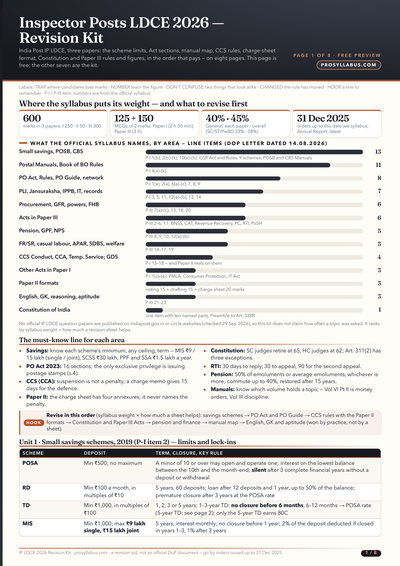
The free tables show which papers and keys can be compared. For a compact revision sheet after you find a weak rule, the separate eight-page IP LDCE kit covers all three papers: schemes, Acts, time limits, pension formulas and Paper II formats. Page one can be previewed before purchase. The kit is separate from the quiz library and membership.
Preview the IP LDCE revision kitPrimary documents behind this audit
- DoP LDCE IP 2025 result letter, 23 March 2026 — paragraphs 3–5, revised marks table and Annexure E final keys. Candidate annexures are not used here.
- DoP LDCE IP 2026 provisional-key notice, 29 September 2026 — status, feedback deadline and Annexure-I format.
Official Department of Posts sources. Checked 2 October 2026; recheck the Employee Corner for a later 2026 final-key notice.
Frequently asked questions
How many questions were dropped from the 2025 IP LDCE final keys?
Nine objective questions: four in Paper I and five in Paper III. The DoP letter dated 23 March 2026 also changed the answer option for one Paper-I question (Q48 in Series A).
Why did the 2025 maximum become 582 instead of 600?
The final key dropped nine two-mark objective questions, reducing Paper I from 250 to 242 and Paper III from 300 to 290. Paper II stayed at 50. The overall final-key maximum was therefore 582.
What were the revised 2025 UR qualifying marks?
The official result letter gives 96.8 in Paper I, 20 in Paper II, 116 in Paper III, and 261.9 overall. They are historical 2025 figures under the final key, not the 2026 result.
Can I use the 2026 provisional key as a final score?
No. As of 2 October 2026 the Department has published provisional keys for Papers I and III and invited feedback by 17:30 on 6 October. Wait for a final-key decision before treating a 2026 raw tally as final.
What the current syllabus still requires
Use this as a source checklist, not a measured question-frequency ranking. These families are named in the current syllabus, but no complete question-by-question topic audit of every booklet is available here:
- Savings-scheme mechanics — who may open an account, minimum and maximum deposit, tenure, premature closure, nomination, transfer, across the nine notified 2019 schemes. Never the interest rate, which is notified quarterly.
- The governing statute — until 2024 the Indian Post Office Act 1898, and since then the Post Office Act 2023 which repealed it.
- CCS (CCA) Rule 11 — which penalties are minor and which are major. It is named in the current syllabus; no individual question is guaranteed.
- CCS (Conduct) Rules — Rule 3 integrity and devotion to duty, Rule 13 gifts, Rule 18 property returns, Rule 15 private trade.
- Constitution — Article 311, and the article ranges the syllabus names: 124–147 and 214–232.
- RTI Act 2005 — time limits, the fee, exemptions under section 8, the appellate structure.
- Mail operations — Speed Post, registered and insured articles, MNOP, and now PNOP and the Dak Ghar Niryat Kendras.
- PLI and RPLI — the rules and the scheme structure, not the current maximum sum assured, on which public sources disagree.
How to solve a four-paper-era paper usefully
- Solve it as a topic test, not a mock. Take the postal-content questions from its Paper-I and Paper-II together — under the new pattern they are all Paper-I ground.
- Do not assume a topic disappeared just because it moved to another paper. Compare each old-paper topic to the current three-paper syllabus before keeping it in your revision queue.
- Mark every question whose answer depends on a document dated before 2024. The Post Office Act 2023, the Post Office Rules and Regulations 2024 and the CCS (Pension) Rules 2021 all replaced what an older key relied on.
- Keep the old key, but check it against the current rule when the answer is a number or an authority. The audit of our own question bank caught a widely-copied error of exactly this kind: it is the Director General, not the Central Government, who fixes charges by regulation under section 3(2)(b) of the Post Office Act 2023.
A Sukanya Samriddhi Account can be opened in the name of a girl child who has not attained the age of:
- A. ten years
- B. eight years
- C. twelve years
- D. eighteen years
Answer: ten years
The scheme permits an account to be opened by a guardian in the name of a girl child until she attains the age of ten years. The account matures on completion of twenty-one years from opening, which is a different limit and not the age bar for opening.
What is the minimum deposit required in a financial year to keep a Sukanya Samriddhi Account from becoming a defaulted account?
- A. 250 rupees
- B. 500 rupees
- C. 1,000 rupees
- D. 100 rupees
Answer: 250 rupees
The scheme requires a minimum of 250 rupees in a financial year, with a maximum of 1.5 lakh rupees. A minimum of 500 rupees in a year is the Public Provident Fund requirement, and 100 rupees is the minimum monthly recurring deposit instalment.
From the ProSyllabus IP LDCE question bank — 15 quizzes, 150 questions, each one passed independently by two auditors.
Frequently asked questions
Are IP LDCE previous year question papers available officially?
Yes. Postal circles publish the question papers and the provisional and final answer keys for the exams they conduct, under the Recruitment section of the circle website, and provisional keys are uploaded on the departmental website with a window for representations before the final key is issued.
Which IP LDCE previous papers match the current pattern?
The 2025 and 2026 sittings used the three-paper, 600-mark format introduced by DoP letter No. 7-14/2011-SPN-II dated 22 August 2025. The 2025 final key was released with its result; the 2026 Paper-I and Paper-III keys released on 29 September 2026 were provisional. Verify each paper file and series before practice.
Are older four-paper IP LDCE papers still worth solving?
Yes, as topic tests rather than mocks. The 2025 revision added ground — the Post Office Act 2023, the Post Office Rules and Regulations 2024, DIGIPIN, PNOP, BNSS 2023, the CCS (Pension) Rules 2021 — rather than removing it. Check any answer that turns on a document dated before 2024 against the current rule.
Where are the provisional answer keys published?
On the departmental website, with a period during which candidates may submit representations against a key. The final answer key is issued afterwards and is what the result is computed on. For LDCE IP 2026 the provisional Paper-I and Paper-III keys went up from 29 September 2026, with feedback due to your own Postal Circle's email in the Annexure-I format by 17:30 hours on 6 October 2026 (DoP letter F. No. A-34013/02/2026-DE dated 29.09.2026).
The rest of the India Post series
- IP LDCE 2026 — new 3-paper pattern, full syllabus and exam dates
- IP LDCE Paper II — noting, drafting and the major-penalty charge sheet
- India Post PA/SA LDCE (LGO) — syllabus, pattern, DEST and the merit rule
- GDS to MTS, Postman and Mail Guard — syllabus and pattern
- The Post Office Act, 2023 — summary and MCQs
- CCS (Conduct) Rules, 1964 — notes and MCQs
- CCS (CCA) Rules, 1965 — penalties, procedure and MCQs
- The POSH Act, 2013 — notes and MCQs
- DIGIPIN explained — India Post’s digital address code
- India Post Payments Bank (IPPB) for departmental exams
Practice: IP LDCE quizzes · syllabus · previous papers · PA/SA/MTS


