
Checked 11 November 2026. Unit marks from CBSE’s 2026-27 subject curricula; board dates from CBSE’s 2027 date sheet (06.11.2026); the practical and internal assessment window from CBSE’s circular of 05.11.2026; internal assessment and competency rules from the Secondary Curriculum 2026-27. Read on 11 November 2026.
Short answer: good marks in Class 10 come from knowing where the marks are and practising for them. In Mathematics, Science, Social Science and the languages, each subject is out of 100: 80 marks in the CBSE board paper and 20 internal marks from your school. Inside the 80, CBSE fixes how many marks each unit carries: Algebra alone is 20 of the 80 in Mathematics, and Literature is 40 of the 80 in English. CBSE also says that about half of the questions are competency-focused (case-based, source-based, application). So the plan is: secure the 20 internal marks, find the subject where you are furthest from your target, revise its heaviest units first, and practise CBSE’s own sample papers with their marking schemes. The main board exams run from 16 February to 9 March 2027 (Painting opens on 16 February); Mathematics, on 17 February, is the first of the main papers.
Secondary Curriculum 2026-27; CBSE date sheet 06.11.2026; CBSE circular 05.11.2026.
Where the marks come from
In Mathematics, Science, Social Science and the languages, each subject is out of 100, split 80 + 20; Computer Applications is 50 theory + 50 practical. The 20 internal marks are four parts of 5: periodic assessment (the average of the best two of three assessments), multiple assessment, portfolio and subject enrichment. Those 20 marks are given by your school before the board exam and cannot be improved in the second exam. The full split for every subject, and how grades work, are in our Class 10 marking scheme guide; the pass rule (33% in each subject, theory and internal marks together) is in the passing marks guide.
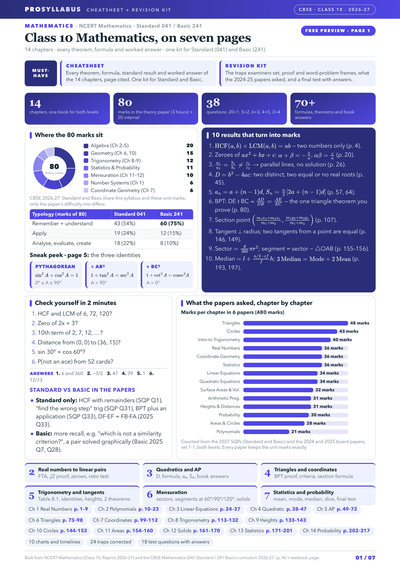
- Marks booster + cheatsheet: key concepts in 2 lines each
- 24 exam traps, listed
- 20 marks: Algebra
- Board-paper counts, chapter by chapter
- 12 marks: Trigonometry
- 11 marks: statistics and probability
The marks map: where the 80 marks sit, subject by subject
These are the marks CBSE gives each unit or section of the board paper in its 2026-27 curricula. Use them as one input when you order revision, together with where your own marked papers lose marks and how much time is left. Unit marks are fixed for the unit as a whole, not for each chapter in it, and every unit is examined, so weightage is never a reason to skip a chapter.
CBSE Mathematics curriculum, Class X 2026-27.
CBSE Science curriculum, Class X 2026-27.
| Subject | Where the board-paper marks sit (2026-27) | Split | Marks Booster Kit |
|---|---|---|---|
| Social Science | History (map work included) 20 · Geography (map work included) 20 · Political Science 20 · Economics 20 | Board paper 80 + internal 20 | <a href="/kits/cbse-class-10-history-revision-kit" style="color:#255a45;font-weight:600">History</a>, <a href="/kits/cbse-class-10-geography-revision-kit" style="color:#255a45;font-weight:600">Geography</a>, <a href="/kits/cbse-class-10-political-science-revision-kit" style="color:#255a45;font-weight:600">Political Science</a>, <a href="/kits/cbse-class-10-economics-revision-kit" style="color:#255a45;font-weight:600">Economics</a> |
| English (Language and Literature) | Literature (First Flight and Footprints without Feet) 40 · Reading (unseen passages) 20 · Grammar 10 · Writing 10 | Board paper 80 + internal 20 | <a href="/kits/cbse-class-10-first-flight-revision-kit" style="color:#255a45;font-weight:600">First Flight</a>, <a href="/kits/cbse-class-10-footprints-revision-kit" style="color:#255a45;font-weight:600">Footprints without Feet</a> |
| Hindi Course A | Textbook and supplementary reader 30 · Creative writing 20 · Grammar 16 · Unseen passages 14 | Board paper 80 + internal 20 | <a href="/kits/cbse-class-10-hindi-a-revision-kit" style="color:#255a45;font-weight:600">Hindi A</a> |
| Hindi Course B | Textbook and supplementary reader 28 · Creative writing 22 · Grammar 16 · Unseen passages 14 | Board paper 80 + internal 20 | <a href="/kits/cbse-class-10-hindi-b-revision-kit" style="color:#255a45;font-weight:600">Hindi B</a> |
| Sanskrit | Textbook comprehension 30 · Applied grammar 25 · Composition (letter, picture or paragraph, translation) 15 · Unseen passage 10 | Board paper 80 + internal 20 | <a href="/kits/cbse-class-10-sanskrit-revision-kit" style="color:#255a45;font-weight:600">Sanskrit</a> |
| Computer Applications | HTML 25 · Networking 15 · Cyber ethics 10 (plus practical 50) | Theory 50 + practical 50 (school) | <a href="/kits/cbse-class-10-computer-applications-revision-kit" style="color:#255a45;font-weight:600">Computer Applications</a> |
Three things stand out. In English, Literature is 40 of the 80 marks, so the two textbooks deserve steady time alongside reading, grammar and writing practice. In Hindi A and B, the textbook section and creative writing together are 50 marks, more than grammar and unseen passages combined. In Social Science, the four parts are equal at 20 marks each, so your own marked work decides which part comes first; map work (5 marks across History and Geography) is part of those 40 marks. In Computer Applications, the 50 practical marks are assessed in school, and the 50-mark written paper is HTML 25, Networking 15 and Cyber ethics 10.
- Marks booster + cheatsheet: key concepts in 2 lines each
- 24 exam traps, listed
- 20 marks: Algebra
- Board-paper counts, chapter by chapter
- 12 marks: Trigonometry
- 11 marks: statistics and probability
Find your marks gap: a planner
If the planner does not run on your device, do it on paper. For each subject, estimate = paper percentage × 0.8 + internal marks out of 20 (Computer Applications: × 0.5 + practical out of 50). Shortfall = target − estimate, or 0 if the estimate is already higher. Consider only papers that have not yet started (10:30 am IST on the exam date). The subject with the biggest shortfall gets the daily revision slot first; if two are equal, start with the one whose board paper comes first. If every shortfall is 0, keep revising all subjects and check with timed sample papers.
Two worked examples
Example 1: an 85% target
- A student wants 85 in each subject and estimates (paper and internal marks together): Mathematics 68, Science 74, Social Science 82, English 86, Hindi A 88.
- Shortfalls to 85: Mathematics 17, Science 11, Social Science 3, English 0, Hindi 0. The positive shortfalls add up to 31, and 28 of them are in Mathematics and Science. (For an overall average of 85 the student needs 425 of 500; the estimates total 398, so 27 more marks in total, because English and Hindi are already above 85.)
- Mathematics comes first: its shortfall is biggest and its paper, on 17 February, comes first. On the marks map Algebra (20) and Geometry (15) are 35 of the 80 board marks, so if the student’s marked papers show losses there too, those chapters go to the top of the list.
Our arithmetic, using CBSE’s 2026-27 unit marks.
Example 2: what the board paper must give
- A student has 18 of 20 internal marks in Science and wants 85 in the subject.
- 85 − 18 = 67, so the board paper must give 67 of 80, or about 84% of the paper.
- With the internal marks known, the target for the paper is concrete: at most 13 of the 80 marks can be dropped. Chemical Substances and World of Living are 50 of the 80 marks, so they are a large share of what is being tested; where the 13 dropped marks come from depends on the paper and the student.
Our arithmetic; split from CBSE’s Science curriculum 2026-27.
Seven habits that protect marks
What CBSE’s own documents point to
- Treat internal marks as real marks. 20 of 100 per main subject; for periodic assessment the school holds three assessments and averages the best two. Submit portfolio and project work on time.
- Order revision by weight and by your own mistakes. Use the marks map with your marked papers, then cover every remaining chapter.
- Practise application, not only recall. CBSE says about half the questions are competency-focused: case-based, source-based, data and application questions.
- Use CBSE’s 2026-27 sample papers and marking schemes. Check the question-specific marking scheme for what earns credit. Our sample papers guide has every subject’s link.
- Show working where the question needs it. Compare your long answers with the marking scheme for that question to see what earns credit.
- Write in the right section. CBSE told Class 10 students that in Science and Social Science, answers written in the wrong section of the answer book are not evaluated.
- Time full papers. One full paper a week from January, timed to the real duration (3 hours for the main subjects, 2 hours for Computer Applications), shows whether the last section is getting rushed.
Secondary Curriculum 2026-27; CBSE guidance 09.12.2025; CBSE sample paper notification 21.09.2026; CBSE date sheet 06.11.2026.
A plan from now to the board exams
This is our plan for a student starting in mid-November. Dates for papers and the internal assessment window are CBSE’s; everything else is a suggestion to adapt.
| When | What to do |
|---|---|
| Now to mid-December | Run the planner. Give the biggest-gap subject a daily 45 to 60 minute slot; keep the rest on normal revision. Close weak chapters in the heaviest units first. |
| 9 Nov to 19 Dec 2026 | Winter-bound schools hold practicals and internal assessment in this window. Finish projects and portfolio work. |
| When your school holds them | School pre-boards (each school sets its own dates). Read the marked paper chapter by chapter; our <a href="/hub/cbse-class-10-pre-board-marks-low-score-plan" style="color:#255a45;font-weight:600">pre-board guide</a> has a low-score plan. |
| 1 Jan to 13 Feb 2027 | Regular schools hold practicals and internal assessment. One full CBSE 2026-27 sample paper per subject under time, marked with its marking scheme. Re-run the planner. |
| From 16 Feb 2027 | Board papers: Mathematics 17 Feb, Science 22 Feb, Computer Applications 24 Feb, English 26 Feb, Sanskrit 1 Mar, Hindi 3 Mar, Social Science 8 Mar. In the gap before each paper, mostly recall summaries and past papers; if a topic is still uncovered, decide with your teacher whether there is time for it. |
The full date sheet and result timeline are in our Class 10 date sheet guide. If you miss your target in the main exam, CBSE’s second board exam lets you try to improve up to three subjects.
- Marks booster + cheatsheet: key concepts in 2 lines each
- 24 exam traps, listed
- 20 marks: Algebra
- Board-paper counts, chapter by chapter
- 12 marks: Trigonometry
- 11 marks: statistics and probability
If you are a parent
You do not need to know the syllabus to help with this. What helps most is a calm routine and one clear priority at a time.
- Agree on a realistic target together. Start from your child’s latest school marks, not from a cousin’s result. A target a few marks above today’s estimate is easier to work towards than one that feels out of reach.
- Run the planner side by side. It takes a few minutes and turns “study more” into one named subject and its heaviest units.
- Do the free two-minute self-check together. Page 1 of each Marks Booster Kit is free to read and ends with a two-minute self-check. Open the kit for the biggest-gap subject and see how your child does. Missed questions point to topics to revise from the textbook; a short self-check is a quick signal, not a full test. The other six pages of the kit are there if you want a revision sheet for that subject.
- Protect one daily slot. Same time each day, phone in another room. A short slot kept every day beats a long one that keeps slipping.
- Ask the school two questions. How are the internal marks made up this year, and when are the periodic tests and pre-boards?
CBSE’s Parenting Calendar for 2026-27 asks parents of Class 9 and 10 students to watch for warning signs such as withdrawal, changes in sleep and a loss of interest in things their child used to enjoy. If you see them, talk to the school counsellor. Tele-MANAS (14416) is the Government of India’s toll-free 24x7 mental health line.
Marks Booster Kits by subject
Each Marks Booster Kit is a 7-page revision PDF for one NCERT book or subject, for the 2026-27 session and the 2027 boards, meant to be used beside the NCERT textbook, not instead of it. English has one kit per textbook (First Flight, Footprints without Feet) and Social Science one per part (History, Geography, Political Science, Economics). Page 1 of each is free to read on the kit page. Start with the subject the planner shows first; Mathematics and Science are listed first because theirs are the first two main papers (17 and 22 February); the other cards show each paper’s date.
Board paper Wed 17 Feb 2027
Mathematics
Largest block: Algebra (20)
Board paper Mon 22 Feb 2027
Science
Largest blocks: Chemical Substances: Nature and Behaviour, World of Living (25 each)
Board paper Mon 8 Mar 2027
Social Science
Largest blocks: History (map work included), Geography (map work included), Political Science, Economics (20 each)
History kit →Geography kit →Political Science kit →Economics kit →
Board paper Fri 26 Feb 2027
English (Language and Literature)
Largest block: Literature (First Flight and Footprints without Feet) (40)
Board paper Wed 3 Mar 2027
Hindi Course A
Largest block: Textbook and supplementary reader (30)
Board paper Wed 3 Mar 2027
Hindi Course B
Largest block: Textbook and supplementary reader (28)
Board paper Wed 24 Feb 2027
Computer Applications
Largest block: HTML (25) · practical 50 in school
Practise it, don't just read it
Once a chapter is revised, test it. Our Class 10 chapter quizzes are short, a quick check on the topics they cover; written practice and your teacher’s feedback show broader progress.
The ProSyllabus CBSE Class 10 library has chapter quizzes for Mathematics, Science, Social Science (History, Geography, Political Science and Economics), English (First Flight and Footprints without Feet), Hindi and Health and Physical Education. You can start free, and a ProSyllabus school plan opens more of them each month.
Frequently asked questions
How can I score good marks in Class 10 CBSE?
Secure the 20 internal marks in each main subject, find the subject furthest from your target, revise its heaviest units first using CBSE’s unit marks, and practise CBSE’s 2026-27 sample papers with their marking schemes under time.
Which chapters carry the most marks in Class 10 Maths?
By unit, Algebra carries 20 of the 80 board marks, Geometry 15, Trigonometry 12, Statistics and Probability 11, Mensuration 10, and Number Systems and Coordinate Geometry 6 each (CBSE 2026-27).
Which units carry the most marks in Class 10 Science?
Chemical Substances: Nature and Behaviour and World of Living carry 25 marks each, Effects of Current 13, Natural Phenomena 12 and Natural Resources 5, out of 80.
Is it possible to score 90% in Class 10?
It is possible, but no plan can promise it. Use the planner to see how far each subject is from 90 today and where those marks sit on the paper, then work on the biggest gap first.
Does CBSE give an overall percentage in Class 10?
No. CBSE does not print an aggregate or overall percentage on the Class 10 marksheet.
When are the CBSE Class 10 board exams in 2027?
The main board exams run from 16 February to 9 March 2027. Mathematics is on 17 February, Science on 22 February, English on 26 February, Hindi on 3 March and Social Science on 8 March.
Is a Marks Booster Kit enough on its own?
No. It is a 7-page revision PDF for one book, subject or Social Science part, used with the NCERT textbook, CBSE sample papers and your teacher’s feedback. Page 1 maps the marks and ends with a two-minute self-check; the other pages are revision notes for that book or subject.
More in this series
- Two board exams: who sits which, which score counts
- Official sample papers and marking schemes, by subject
- Marking scheme: 80+20, internal marks, competency share
- Passing marks, compartment and Essential Repeat
- Date sheet and result dates, year by year
- Pre-board marks: do they count, and a low-score plan
- CBSE Class 10 notice board — updates
- Class 10 Mathematics previous year question papers
- Class 10 Science previous year question papers
- Class 10 Social Science previous year question papers
- Class 10 English previous year question papers
- Class 10 Hindi Course A previous year question papers
- Class 10 Hindi Course B previous year question papers
- Class 10 Maths board paper analysis, 2026
Sources
- official — CBSE Academic — Secondary Curriculum 2026-27, Part 1 (scheme of studies and assessment)
- official — CBSE — Examination Bye-laws: scheme of examinations and pass criteria
- official — CBSE Academic — Notification: Sample Question Papers for Classes X and XII, 2026-27 (21.09.2026)
- official — CBSE Academic — Mathematics syllabus and question paper design, Class X 2026-27
- official — CBSE Academic — Science syllabus and question paper design, Class X 2026-27
- official — CBSE Academic — Social Science syllabus and question paper design, Class X 2026-27
- official — CBSE Academic — English Language and Literature syllabus, Class X 2026-27
- official — CBSE Academic — Hindi Course A syllabus and question paper design, Class X 2026-27
- official — CBSE Academic — Hindi Course B syllabus and question paper design, Class X 2026-27
- official — CBSE Academic — Sanskrit syllabus and question paper design, Class X 2026-27
- official — CBSE Academic — Computer Applications (165) syllabus, Class X 2026-27
- official — CBSE — Date Sheet for Class X and Class XII Board Examinations 2027 (CBSE/Date Sheet/X-XII/2026-27, 06.11.2026)
- official — CBSE — Circular: Practical Examinations / Internal Assessment for Classes X and XII, 2027, with subject-wise marks (05.11.2026)
- official — CBSE Academic — Class X sample question papers and marking schemes 2026-27
- official — CBSE — Guidance to Class X students: answer book in sections for Science and Social Science (09.12.2025)
- official — CBSE — Parenting Calendar 2026-27 (29.04.2026)
- official — Ministry of Health and Family Welfare — Tele-MANAS, 24x7 mental health helpline 14416
official = a document published by the conducting body. reported = a news or coaching site we could not check against an original. Where sources disagree this page says so rather than picking one.


