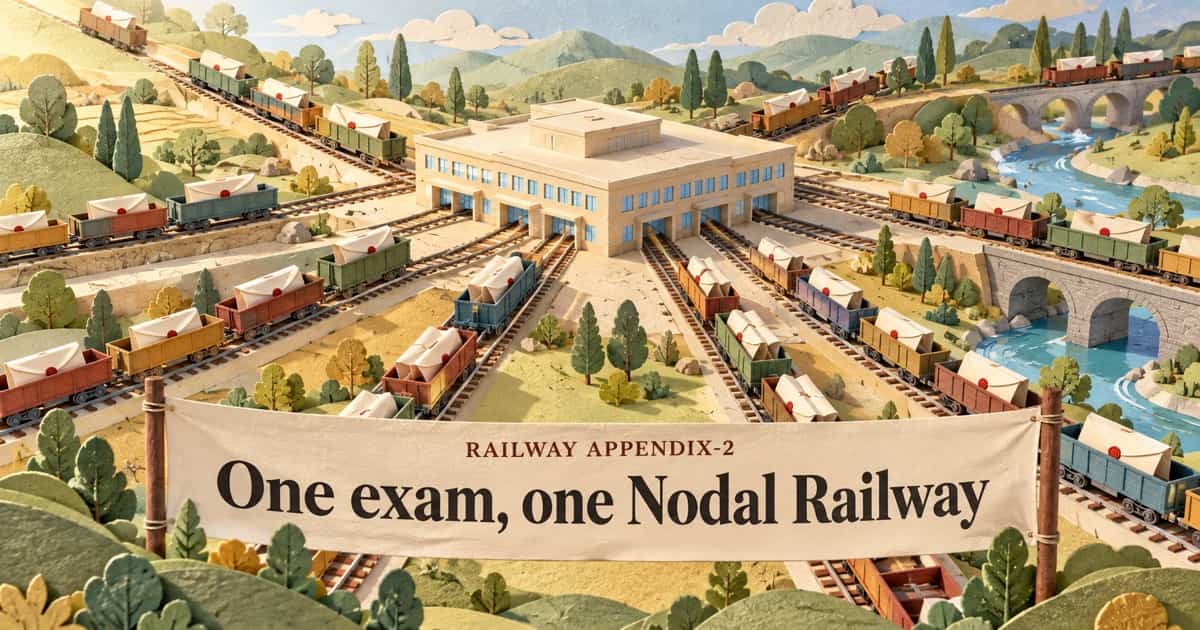
Checked 29 September 2026. Conduct rules are IREM Appendix 2 para 3 (ACS 292), RBA 19/2025 and RBA 28/2025. The nomination steps and timetable are from the 2025 sitting only (Northern Railway notifications of 11.11.2025 and corrigendum of 28.11.2025). No 2026 notification or Nodal Railway had been published on 29 September 2026.
Until 2025 there was no single Appendix-2 examination. Each accounts office held its own, at intervals its head decided. Since July 2025 there is one: a computer-based test through one Nodal Railway, with the computer side run by an agency that the Railway Recruitment Board engaged. For 2025 the Nodal Railway was Northern Railway, and the exam was held on 21 December 2025 in two shifts. This guide explains who does what under the new system and how nomination worked in 2025, gives the exam-day timetable, and looks at what is and is not known about results and the next sitting. Where the documents disagree, on frequency and on dates, we print both sides.
 Great Indian Festival dealsSale prices live on laptops, tablets, phonesSee on Amazon
 Laptop dealsStudent laptops — see today's pricesSee on Amazon
 Tablet dealsFor notes, PDFs and online classesSee on Amazon
 Bluetooth speakersPocket-size to party-sizeSee on Amazon
 Books for Railway Appendix-2 IREM ExaminationGuides and reference booksSee on AmazonRailway Appendix-2 IREM Examination solved papersPrevious years, with answersSee on Amazon🛍Office laptop bagsFor the commute and the exam daySee on Amazon
 Study lampsEye-friendly light for late nightsSee on Amazon
As an Amazon Associate, ProSyllabus earns from qualifying purchases. Prices and availability are set by the seller.
ProSyllabus is an independent study site. We are not affiliated with Indian Railways, the Railway Board, Northern Railway or any zonal railway or production unit. Every rule below is quoted or summarised from published Board letters and the IREM, and your Accounts office decides every nomination.
Who does what
Para 3 of Appendix 2, as rewritten by ACS 292, has two sentences. The exam "shall be conducted in CBT mode in coordination with the Examination Conducting Agency (ECA) engaged through RRB", and it "shall be conducted through a single Nodal Railway for a calendar cycle", with the Board deciding the Nodal Railway for each calendar year. RBA 19/2025 of 17.06.2025 fills in the roles, and RBA 28/2025 of 29.09.2025 names the railways and brings in the RRB's standard operating procedure of 21.08.2025.
| Role | Who | What it does |
|---|---|---|
| Railway Board | Accounts Directorate | Sets the pattern; picks the Nodal Railway each calendar year; issues the calendar "separately" (RBA 19/2025 para 7) |
| Nodal Railway | Northern Railway for 2025 (RBA 28/2025) | Invites names from all zones and PUs, fixes the programme, liaises with the agency |
| Nodal officer | Dy. CAO/G of the Nodal Railway | Coordinates between the agency and the administration (RBA 19/2025 para 3.e) |
| Examination Conducting Agency | Engaged by RRB (E(RRB) directorate) | Runs the CBT on computer or tablet; arranges the question objection tracker and the result (para 3.d) |
| Question paper setter | Authority authorised by the Board or PFA | Sets the paper and submits it to the agency (para 3.c) |
| Your zone or PU | FA&CAO or Dy. CAO/G (administration) | Checks eligibility, sends the list of candidates, arranges scribes for PwBD candidates |
Two points stand out for candidates. First, the result and the objection tracker belong to the agency under RBA 19/2025, so a challenge to an answer is raised the way that agency's notice says, if one is issued. Second, Appendix-2 and Appendix-4 go through a Nodal Railway, while Appendix-3 is run at Board level with the DF/CCA of the Railway Board as nodal officer. Appendix-3 results have been published; we found none for Appendix-2, and no document says why. See the Appendix-3 results guide.
How nomination worked in 2025
Candidates do not apply to the Nodal Railway. Your own office nominates you. The Northern Railway letter of 11.11.2025, addressed to the Dy. CAO/Gs of all zonal railways and the controlling officers of all production units and RDSO, set out the steps. It is on Northern Railway's own page for the 2025 examination, beside a second letter of the same date to Northern Railway's own accounts offices, a corrigendum of 28.11.2025 and a notice of limited training. Each zone then issued its own call for names, with its own internal dates, so the dates below are the Nodal Railway's.
| Step | What the 2025 letter said | Who acts |
|---|---|---|
| Eligibility date | The cut-off date for eligibility is the date of issue of the notification | Your office |
| Medium | Hindi or English, marked clearly for each candidate; no change once sent | You tell your office |
| List of candidates | By 17.11.2025, in Excel (Times New Roman, size 12) and hard copy, both mandatory; each page signed by a Gazetted officer. Northern Railway's own offices had to send theirs by 14.11.2025 | Your office |
| Covering letter | Signed by the FA&CAO or the Dy. CAO/G, certifying each candidate's particulars; later changes need the PFA's personal approval | Your office |
| Previous chances | Previous attempts and chances used must be stated; incomplete applications not considered | You and your office |
| Debarred candidates | Must not be forwarded; the zone is held responsible if they are | Your office |
| Nil statement | Required from any zone or PU with no candidate | Your office |
| PwBD candidates | Names forwarded with disability details, citing E(NG)I/2022/PM4/9 of 09.12.2022; the zone to "arrange for the scribe facility, if required ... at your end at the examination center". The corrigendum of 28.11.2025 added 40 minutes of compensatory time | Your office |
| Withdrawal | Last date 18.11.2025 (Nodal Railway); your office may set an earlier one | You, through your office |
| Late information | "No cognizance" after the target dates | Nodal Railway |
Annexure B, the proforma, asks for each candidate's HRMS ID, date of birth, category, date of appointment, department, designation, the accounts office where they work, medium, number of the chance, disability details and a preferred centre. The letter's own dates allowed six days between issue and the list deadline, which is our count.
What to do the day a notification appears
- Tell your office in writing that you want to be nominated, and which medium you choose. The medium cannot be changed later.
- Check the chance number your office writes for you. It must include any permission you did not use, unless the GM accepted a withdrawal.
- If you have a disability and may need a scribe or extra time, tell your office at once. The 2025 proforma asked for the type and percentage of disability, whether a scribe was needed at 40% or more, and, below 40%, whether the candidate was eligible for a scribe under the extant rule. The scribe was arranged by the candidate's own railway; follow your zone's notification on how one is proposed.
- If you are not ready, withdraw before the withdrawal date. After it, the permission counts as a chance.
- Keep a copy of the list entry or an acknowledgement. The Nodal Railway takes no cognizance of late information.
Exam day: the 2025 timetable
Annexure A set the timetable for 21.12.2025 (a Sunday). There were two shifts on the same day: paper (a) in the morning and GRP in the afternoon. Each had a reporting time, a gate closure half an hour later and a biometric window. A corrigendum of 28.11.2025 then amended the table: Shift 2 moved half an hour later up to the biometric, the amended table lists no Shift 2 practice test, and PwBD candidates got 40 minutes more in each paper. Many copies in circulation show only the first table. Use the practice test, where there is one, to read the instructions screen, including how many of the 110 questions are marked.
| Stage | Shift 1: Paper (a) | Shift 2: GRP, as amended 28.11.2025 | Shift 2 in the 11.11.2025 table |
|---|---|---|---|
| Reporting time | 8:00 am | 1:30 pm | 1:00 pm |
| Gate closes | 8:30 am | 2:00 pm | 1:30 pm |
| Biometric | 8:30 to 9:00 am | 2:00 to 2:30 pm | 1:30 to 2:00 pm |
| Practice test | 9:15 to 9:30 am | Not listed | 2:15 to 2:30 pm |
| Exam | 10:00 am to 12:00 noon (PwBD to 12:40 pm) | 3:00 to 5:00 pm (PwBD to 5:40 pm) | 3:00 to 5:00 pm |
From Annexure A of the Northern Railway notification of 11.11.2025 as amended on 28.11.2025 (official). Morning times am, afternoon pm. PwBD candidates finished 40 minutes later.
How often: "twice a year" against one sitting
Where other pages get this wrong
The Board has instructed two Appendix-2 sittings a year, but the IREM does not say it, no calendar has been published, and one sitting has been found.
Commonly published instead: "Appendix-2 is held twice a year now", or the opposite, "it is annual".
RBA 19/2025 para 6 says Appendix II and IV "shall be conducted through a single Nodal Railway twice in a year for a calendar cycle". That is an instruction, and the PFA Conference of 26.06.2025 repeated it: "Appendix II and IV to be conducted twice in a year" (RBA 24/2025). ACS 292, which rewrote the IREM two weeks after RBA 19/2025, says only "through a single Nodal Railway for a calendar cycle", with no frequency. In practice we found one CBT sitting, on 21.12.2025. The Board's 2026 compendium, checked to its entries of 09.09.2026, carries no 2026 Appendix-II notice, and we found no Northern Railway notice for 2026. Plan for the next notification, not for a date.
The dates of the letters behind the change also disagree, and it helps to know which is which. RBA 19/2025 is dated 17.06.2025. RBA 21/2025, which carries ACS 292, is dated 02.07.2025 under the same file number, 2025/ACII/20/12/e-3493745. The IREM page prints the authority as "2025/ACII/2012e3493745 dated 02.07.25", a misprint of that file number. The Northern Railway notification says the Board decided to hold the exam in CBT mode by a letter dated 15.07.2025, and its reference line lists 02.07.2025 and 15.07.2025 together. We did not find a letter of 15.07.2025. Northern Railway had already been named earlier: the Board's PFA Conference of 26.06.2025 listed "Nodal railway for Appendix II – Northern Railway for 2025" (RBA 24/2025), and RBA 28/2025 of 29.09.2025 says the nomination had "already" been issued. Which letter first named it formally, we cannot say.
| Date | Document | Status | What it says |
|---|---|---|---|
| 17.06.2025 | RBA 19/2025 | Official, read | Two 100% objective papers; CBT via RRB agency; Nodal Railway "twice in a year" |
| 26.06.2025 | PFA Conference, minutes issued as RBA 24/2025 (17.07.2025) | Official, read | Northern Railway nodal for Appendix II for 2025; Appendix II and IV "to be conducted twice in a year" |
| 02.07.2025 | RBA 21/2025 (ACS 292) | Official, read | IREM paras 1 and 3 rewritten; single Nodal Railway "for a calendar cycle" |
| 15.07.2025 | Board letter cited by Northern Railway | Cited in an official letter; the letter itself not found | Per NR: the decision to hold the exam in CBT mode; NR nominated as Nodal Railway |
| 29.09.2025 | RBA 28/2025 | Official, read | NR nodal for Appendix II and NWR for Appendix IV "already" issued; RRB SOP of 21.08.2025 applies |
| 23.10.2025 | Board letter reported by a candidate site | Reported, not found | 2-hour papers, no negative marking, old exemptions void, pass marks unchanged |
| 11.11.2025 | Northern Railway notification | Official, read on Northern Railway's site | Programme, nomination rules and timetable for 21.12.2025 |
| 28.11.2025 | Northern Railway corrigendum | Official, read on Northern Railway's site | Shift 2 times moved; 40 minutes' compensatory time for PwBD candidates |
Results: what exists and what does not
We found no Appendix-2 result document for 21.12.2025 or any earlier sitting on the Board's site or on Northern Railway's page for the examination. Under RBA 19/2025 the agency arranges the result; the empanelment then follows "extant rules" in each railway. So results are likely to exist as letters inside each zone. A zonal result letter was reported to us but we could not verify it, so we do not cite it.
One line in an official document mentions a count. In the minutes of the PFA Conference of 26.02.2026 (issued as RBA 06/2026), North Eastern Railway's slide on system improvements says: "Appendix IIA: 83 candidate qualified out of 85 result declared on within time." Northern Railway's file number for this exam is "Appendix-IIA Exam", so the line probably refers to NER's candidates in the 21.12.2025 CBT. The minutes do not say so. They also do not say whether 85 is the number who sat or the number on NER's list. It is one zone's line on a slide about its own work. It is not a pass rate for Appendix-2, and nothing about other zones can be read from it.
The papers themselves circulated. Both 21.12.2025 papers, with official answer keys, were posted on appendix3exam.com on 30.12.2025 (reported by that site), which is how we read them. What they covered is in the pattern and syllabus guide, and what marks you need is in the pass marks guide.
Who conducts the Appendix-2 IREM exam now?
A single Nodal Railway chosen by the Railway Board for each calendar year, with the computer-based test run by an agency engaged through RRB. Northern Railway was the Nodal Railway for 2025 (RBA 28/2025).
When was the last Appendix-2 exam?
On 21.12.2025, in two shifts: paper (a) from 10 am to 12 noon and GRP from 3 pm to 5 pm, according to the Northern Railway notification of 11.11.2025. PwBD candidates had 40 minutes more under its corrigendum of 28.11.2025.
When is the next Appendix-2 exam?
Not announced. No 2026 notification or Nodal Railway had been published on 29 September 2026.
Is Appendix-2 held twice a year?
RBA 19/2025 instructs that it be conducted twice in a year, and the PFA Conference of 26.06.2025 repeated it. The IREM text, amended two weeks after RBA 19/2025, does not mention frequency, no calendar has been published, and only one CBT sitting has been found so far.
How do I apply for Appendix-2?
Through your own office, not directly. In 2025 zones and production units sent lists of candidates to the Dy. CAO/G of Northern Railway, with eligibility reckoned on the date of the notification.
Where is the Appendix-2 result?
We found no published result. Under RBA 19/2025 the agency arranges it and railways empanel passed candidates under their own rules, so ask your Accounts office.
What does "Appendix IIA" mean?
Northern Railway used it in the file number for this exam, and NER used it at the PFA conference. The IREM has no separate Appendix 2A in the text we read, so it is probably the same exam.
Sources
- official — Railway Board — IREM Vol I, Appendix 2 (current text incorporating ACS 166 of 2004 and ACS 292 of 2025)
- official — Railway Board — RBA 21/2025, 2025/ACII/20/12/e-3493745 dated 02.07.2025, enclosing ACS 292 (Appendix 2 paras 1 and 3)
- official — Railway Board — RBA 19/2025 dated 17.06.2025: accounts departmental exams in CBT mode through an agency engaged by RRB; Appendix II as two 100% objective papers
- official — Railway Board — RBA 24/2025 dated 17.07.2025: minutes of the PFA Conference of 26.06.2025 (exams slide: Northern Railway nodal for Appendix II for 2025; Appendix II and IV "to be conducted twice in a year")
- official — Railway Board — RBA 28/2025 dated 29.09.2025: Northern Railway nodal for Appendix II, North Western Railway for Appendix IV
- official — Northern Railway (Nodal Railway) — No. 2025/Adm-I/Appendix-IIA Exam (Nodal Rly) dated 11.11.2025 to all zonal railways and PUs: CBT of Appendix-II (IREM) Examination 2025, Annexures A and B (on Northern Railway's "Appendix II(IREM) Examination 2025" page)
- official — Northern Railway (Nodal Railway) — Corrigendum dated 28.11.2025 to the notification of 11.11.2025: amended Annexure A (Shift 2 times; 40 minutes' compensatory time for PwBD candidates)
- official — Northern Railway — No. 2025/Adm-I/Appendix-IIA Exam dated 11.11.2025 to NR's own accounts offices: eligibility conditions by group, dates, Annexures A to C
- official — Appendix II (IREM) Examination 2025 question papers of 21.12.2025 with answer keys (official in form (Railway papers with answer keys), read via a secondary host: Google Drive links on appendix3exam.com; the Railway's own copy was not found online; the links are on this post)
- official — Railway Board — RBA 06/2026 dated 18.03.2026: minutes of the PFA Conference of 26.02.2026 (NER slide)
- official — Railway Board — Accounts Directorate compendium pages 2025 and 2026 (2026 page checked to entries of 09.09.2026)
- official — Railway Board — IREM Vol I, Appendix 2 as archived on 28.03.2013 (the old three-paper text, via web.archive.org)
- reported — appendix3exam.com — FAQ on Appendix-2, including a summary of a Board letter "2025/ACII/25/12/e3493745 dated 23-10-2025" (reported; the letter itself was not found)
official = a document published by the conducting body. reported = a news or coaching site we could not check against an original. Where sources disagree this page says so rather than picking one.


