Exam resources

Oxford Interview (University of Oxford undergraduate admissions interviews)

Oxford interviews are academic conversations about the subject you applied for, similar to a short tutorial, in which tutors see how you think and engage with new ideas. Shortlisted applicants are invited to online interviews in December 2026, held on Microsoft Teams; Oxford typically shortlists around 10,000 from more than 23,000 applications. Invitations usually arrive between the middle of November and early December, sometimes with only a week's notice, and Oxford publishes an interview timetable with each course's dates. Applicants are quite likely to have more than one interview, typically with two tutors, and may be interviewed by more than one college. Some courses add a shared online whiteboard; tier 3 courses, including mathematics, physics and chemistry, also need a touchscreen device and stylus to write on it. Oxford advises working through a question aloud when you do not know the answer at once: the final answer is only part of what tutors find out. Shortlisted candidates for 2027 entry are told the outcome of their application on 12 January 2027 via UCAS.

Mock test

Interview pack

25 maths interview questions, each talked through the way a tutorial works

  • 25 original questions: number, proof, sequences, graphs, calculus, geometry, probability, logic
  • For each: what to say first, the approach step by step, and the trap
  • Where a tutor may take the conversation next, for every question
  • What to say when you are stuck, and how to use a hint
  • Writing maths on the shared whiteboard
  • A 25-minute mock-interview script a parent or friend can run
Mock test

Interview pack

25 physics interview problems, each talked through the way a tutorial works

  • 25 original problems: mechanics, orbits, waves, light, electricity, heat, nuclear, scaling
  • For each: what to say first, the approach step by step, and the trap
  • Numbers worth knowing for quick estimates
  • Where a tutor may take the conversation next, for every question
  • Checking units and limiting cases, and what to say when stuck
  • A 25-minute mock-interview script a parent or friend can run
Mock test

Interview pack

25 chemistry interview questions, each talked through the way a tutorial works

  • 25 original questions: bonding, shapes, trends, energetics, rates, equilibrium, acids, organic, everyday chemistry
  • For each: what to say first, the approach step by step, and the trap
  • The forces to reason with, and energy versus rate
  • Where a tutor may take the conversation next, for every question
  • What to say when you are stuck, and how to use a hint
  • A 25-minute mock-interview script a parent or friend can run
Mock test

Interview pack

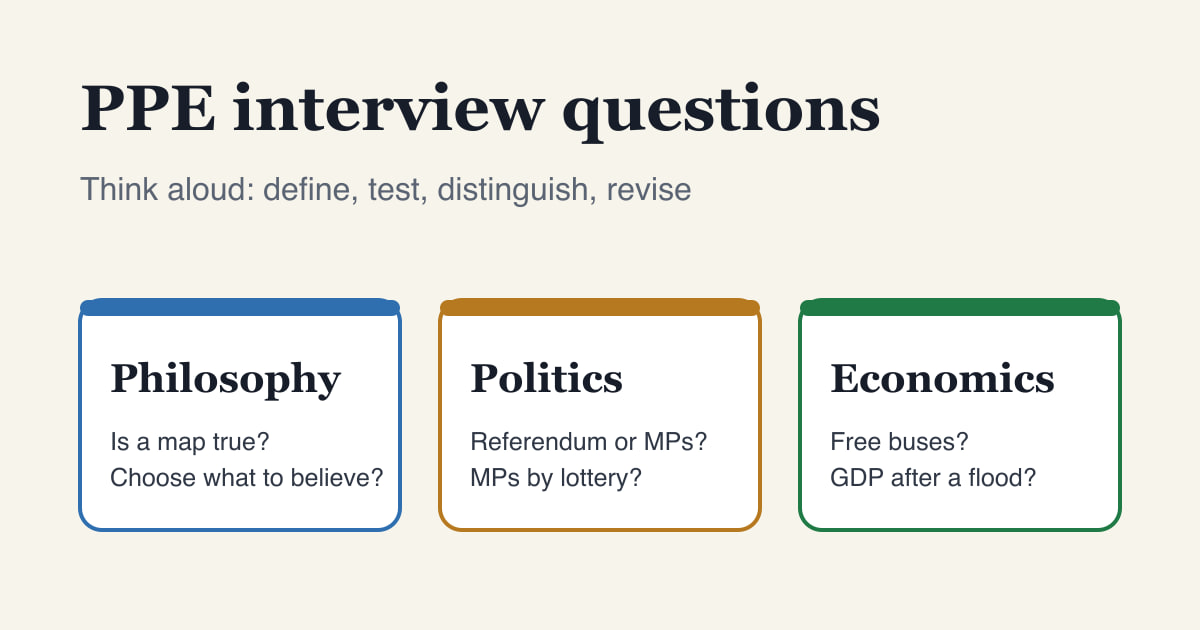
25 PPE questions worked as thinking aloud, plus a mock interview to run at home

  • 9 Philosophy (one worked in full on page 1), 8 Politics and 8 Economics questions
  • Each question: how to think it through aloud and follow-ups to practise; most also give one line of argument (not the only one)
  • Eight thinking moves to practise, and eight traps
  • Economics with worked numbers: a price rise taken to its break-even, comparative advantage, expected value
  • Two data questions on invented charts: turnout and a minimum wage
  • A 30-minute mock interview script with follow-up cards, so a parent or friend can push you without knowing PPE
Mock test

Interview pack

25 History questions worked as thinking aloud, with source passages and a mock interview to run at home

  • 25 original questions, one worked in full on page 1
  • Four questions to prepare about your own submitted essay and personal statement
  • Two invented source passages, each with three questions; a reading method and a sample discussion for the first, four comparison checks for the second
  • An invented population table and an object to read like a historian
  • Eight thinking moves for History, and eight traps
  • A 30-minute mock interview script with follow-up cards, so a parent or friend can push you without knowing History
Guides
Preparing with colleagues?Send this page to your Oxford Interview group — the papers and guides are free to read.
Community
YOUR NEXT STUDY SESSION

Leave with a plan for today.

  1. 21 min

    Study: Mathematics

  2. 6 min

    Review what you missed. Write down the reason behind each correction.

  3. 3 min

    Close your notes and recall the main ideas in your own words.

Open study material

A personal study plan, saved only in this browser.

Disclaimer

Independent practice, not affiliated with the University of Oxford.