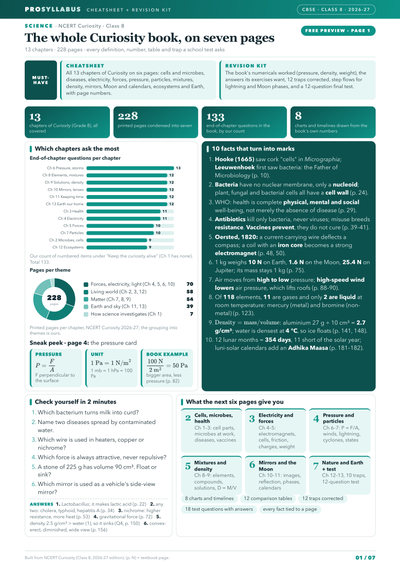
This chapter connects the idea of pressure to powerful weather events. Pressure is defined as force per unit area, with the SI unit pascal (Pa), equal to one newton per square metre. Spreading the same force over a larger area lowers the pressure, which is why broad straps and broad handles feel more comfortable, while a sharp knife or pointed nail concentrates force into a high pressure. Liquids exert pressure not only at the bottom of a container but in all directions, and the pressure increases with the height of the liquid column, which is why overhead tanks are placed high. Air, too, exerts atmospheric pressure in all directions; a rubber sucker sticks because outside air pressure is higher than inside. Winds form because air moves from regions of high pressure to regions of low pressure, as shown with balloons and explained for land and sea breezes. High-speed winds are accompanied by reduced pressure, which can lift weak roofs. Storms, thunderstorms, and lightning are explained through rising warm moist air, condensation, charge separation in clouds, and the eventual flow of charge that produces lightning and thunder. Cyclones are large spinning low-pressure systems that form over warm oceans, with a calm eye at the centre, and the chapter stresses safety measures and the role of the India Meteorological Department.
Pressure and its unitPressure in liquids and airFormation of windsThunderstorms and lightningCyclones and safety
Key terms
Pressure
Force acting per unit area, calculated as force divided by area; its SI unit is the pascal (Pa).
Atmospheric pressure
The pressure exerted by the air of the atmosphere on all objects around us.
Wind
Moving air that flows from a region of high air pressure to a region of low air pressure.
Thunderstorm
A storm accompanied by lightning and thunder, formed from rising warm moist air and charge separation in clouds.
Lightning
A bright flash produced when built-up electric charges flow suddenly within or between clouds or to the ground.
Cyclone
A large spinning system of clouds, winds, and rain around a low-pressure centre called the eye, formed over warm oceans.
Extra questions & answers
Keep the curiosity alive
Discover, design, and debate
Try one from this chapter
How is pressure defined?
Flashcards & interactive practice
Practice quiz · Pressure, Winds, Storms, and Cyclones
Score on this chapter, climb the leaderboard, and get an AI diagnosis of your mistakes.
Dual AI-verified questions Real exam pattern 1 free quiz every month, then ₹9 per quiz — or a monthly plan
#1
Pressure, Winds, Storms, and Cyclones
Start here
Science 10 Qs · ~10 min
Instant score, answer review and weak-topic diagnosis
 6
6 2
2